


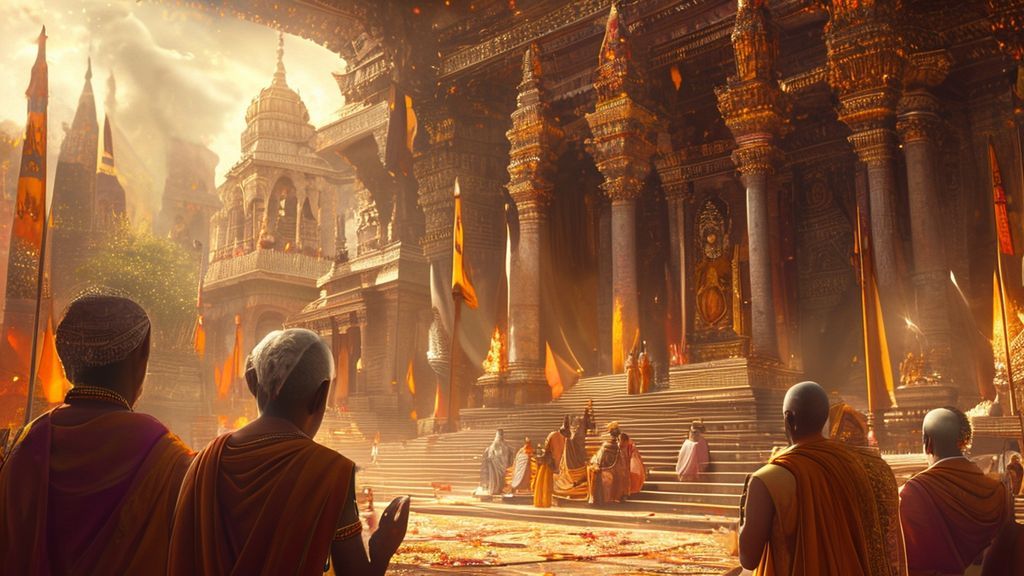
Adi Shankaracharya, the preeminent 8th-century philosopher-saint, revitalized Sanatan Dharma by consolidating the doctrine of Advaita Vedanta. His teachings posit the ultimate non-duality (advaita) of the individual soul (Atman) and the Supreme Universal Spirit (Brahman), offering a direct path to spiritual liberation (moksha) through transcendental knowledge (Jnana).
| Attribute | Details |
|---|---|
| Key Figure | Adi Shankaracharya (Śrī Ādi Śaṅkarācārya) |
| Era | 8th Century CE (c. 788 – 820 CE) |
| Birthplace | Kalady, Kerala, Bharata (India) |
| Key Philosophy | Advaita Vedanta (Non-dualism) |
| Major Works | Commentaries (Bhashyas) on Prasthana Trayi (Upanishads, Brahma Sutras, Bhagavad Gita), Vivekachudamani, Bhaja Govindam |
| Key Contribution | Systematized Advaita, established Chaturamnaya Peethams (monasteries), revitalized Vedic Dharma |
| Scripture Reference | Upanishads, Brahma Sutras, Bhagavad Gita (as interpreted by Shankaracharya) |
The Guiding Light of Advaita: Adi Shankaracharya’s Enduring Legacy
In the vast tapestry of Sanatan Dharma, few figures shine as brightly as Adi Shankaracharya. His advent in the 8th century CE marked a pivotal moment, re-establishing the pristine truths of the Vedas and Upanishads amidst a landscape fragmented by diverse, often nihilistic, philosophical schools. Shankaracharya’s profound intellect, unwavering spiritual conviction, and tireless pilgrimage across Bharata revitalized the very core of Hindu thought. He presented a coherent, rational, and deeply spiritual understanding of reality that continues to inspire millions. His philosophy of Advaita Vedanta is not merely an academic pursuit but a direct call to experience the ultimate unity of existence, liberating the seeker from the illusion of separation and suffering. It is a philosophy that anchors the spiritual aspirations of every sincere seeker on Hindutva.online.
The Puranic Account of a Divine Incarnation
The life of Adi Shankaracharya, though historical, is steeped in divine legend, as chronicled in texts like the Madhaviya Shankara Digvijaya. Born in Kalady, Kerala, to a Nambudiri Brahmin couple, Shivaguru and Aryamba, Shankaracharya was believed to be an incarnation of Lord Shiva Himself, descended to restore Dharma. His birth, after his parents prayed fervently to Shiva, was foretold to be that of a child with extraordinary knowledge but a short lifespan. From a tender age, Shankara displayed unparalleled intellectual prowess and a deep spiritual yearning, mastering the Vedas and Vedangas by the age of eight.
A poignant moment in his early life, as narrated in the Digvijaya, was his encounter with a crocodile in the Periyar River. Trapped, Shankara cried out to his mother, who had initially resisted his desire for Sannyasa, stating that only if he was allowed to take monastic vows could the crocodile release him. In her desperation, Aryamba consented, and Shankara was freed. This event dramatically paved his path to renunciation. He took initiation from Govinda Bhagavatpada, a disciple of Gaudapada, who was the first systematic expositor of Advaita Vedanta in writing, particularly through his Mandukya Karika. Under Govinda Bhagavatpada, Shankaracharya assimilated the profound truths of Advaita, preparing him for his monumental mission to revive Sanatan Dharma across the subcontinent.
The Architectural and Organizational Marvels of the Chaturamnaya Peethams
While Shankaracharya’s architectural contributions are not in the construction of grand temples in the traditional sense, his genius lies in the establishment of the Chaturamnaya Peethams (four monastic centers). These institutions are organizational and intellectual marvels, strategically located at the four cardinal directions of Bharata to preserve and propagate Advaita Vedanta. These are:
- Sringeri Sharada Peetham (South, Karnataka): Associated with the Yajur Veda.
- Govardhan Math, Puri (East, Odisha): Associated with the Rig Veda.
- Dwaraka Sharada Peetham (West, Gujarat): Associated with the Sama Veda.
- Jyotir Math, Badrinath (North, Uttarakhand): Associated with the Atharva Veda.
Each Math was entrusted to one of his four chief disciples – Sureshwaracharya, Hastamalaka, Padmapada, and Totakacharya – ensuring the continuous lineage (Guru-Shishya Parampara) of Advaita. These monastic centers served as vibrant hubs for scriptural study, philosophical debate, and spiritual practice, effectively counteracting the decline of Vedic traditions and unifying disparate Hindu sects under the banner of Sanatan Dharma. They continue to be living monuments to Shankaracharya’s foresight and organizational prowess, embodying the structure of his intellectual empire.
Embodying Advaita: Practices and Puja Vidhi for the Seeker
For the follower of Advaita, the path is primarily one of self-inquiry and transcendental knowledge (Jnana Yoga), rather than elaborate external rituals, though reverence for the Guru and Ishwara is essential. The worship of Adi Shankaracharya himself often involves meditating upon his teachings and recognizing him as the Jagadguru (world teacher).
Here’s a guide to embodying the spirit of Advaita and honoring the legacy of the Acharya:
- Sravana (Listening): Devote time to studying and listening to the core texts of Advaita – the Upanishads, Brahma Sutras, and Bhagavad Gita (the Prasthana Trayi), along with Shankaracharya’s commentaries (Bhashyas) and independent works like the Vivekachudamani. Seek guidance from an authentic Guru.
- Manana (Reflection): Deeply reflect on the concepts presented. Ponder “Aham Brahmasmi” (I am Brahman) and “Tat Tvam Asi” (That Thou Art). Engage in philosophical contemplation to dismantle misconceptions about identity.
- Nididhyasana (Contemplation/Meditation): Engage in regular meditation where the mind is systematically withdrawn from external distractions and internal agitations, allowing for the direct experience of the non-dual truth. Focus on the ultimate reality of Brahman and the non-difference of Atman from Brahman.
- Guru Puja: Offer reverence to the unbroken lineage of Gurus (Guru Parampara) stemming from Shankaracharya. This can be done by chanting Guru Mantras, offering flowers, or simply contemplating their teachings with gratitude.
- Atmabodha (Self-Knowledge): The ultimate “ritual” is the realization of the Self. This involves living a life aligned with Dharmic values, purifying the mind, and constantly discerning the real from the unreal (Viveka).
Mantras and Chants: Echoes of Non-Duality
Shankaracharya’s profound spiritual poetry offers direct entry into the Advaitic experience. One of his most celebrated compositions, Bhaja Govindam, is a poignant call to spiritual awakening. Another powerful hymn is the Dakshinamurti Stotram, which eulogizes Lord Shiva as the universal Guru, silently teaching the ultimate truth of oneness.
A central tenet often chanted is:
ब्रह्म सत्यं जगन्मिथ्या जीवो ब्रह्मैव नापरः।
(Brahma satyam jaganmithya jīvo brahmaiva nāparaḥ.)
Meaning: “Brahman is the only Truth, the world is illusory (Mithya), and the individual soul (Jiva) is verily Brahman, and no other.”
Another powerful invocation to the Guru:
गुरुर्ब्रह्मा गुरुर्विष्णुः गुरुर्देवो महेश्वरः ।
गुरु साक्षात् परब्रह्मा तस्मै श्री गुरवे नमः ॥
(Gurur Brahma Gurur Vishnu Gurudevo Maheshvarah |
Guru Sakshat Parabrahma Tasmai Shri Gurave Namah ||)
Meaning: “The Guru is Brahma, the Guru is Vishnu, the Guru is verily the great Lord Maheswara. The Guru is directly the Supreme Brahman. To that glorious Guru, I offer my salutations.”
Dos and Don’ts for the Advaita Seeker
- Do: Engage in regular self-inquiry (vichara).
- Do: Study scriptural texts and their commentaries diligently.
- Do: Seek the guidance of a qualified Guru.
- Do: Cultivate inner virtues like peace (shama), self-control (dama), endurance (titiksha), and faith (shraddha).
- Don’t: Mistake intellectual understanding for direct experience.
- Don’t: Neglect one’s duties (Dharma) in the world, even while aspiring for liberation.
- Don’t: Engage in excessive ritualism without understanding its underlying philosophy.
- Don’t: Harbor sectarian biases; Advaita emphasizes ultimate unity.
Frequently Asked Questions About Advaita and Shankaracharya
What is Maya in Advaita Vedanta?
Maya is the inexplicable power (Shakti) of Brahman that projects the universe of names and forms, making the non-dual reality appear as multiple. It is not unreal in the sense of non-existent, but it is not ultimately real either, as it vanishes upon the dawn of Brahma-Jnana (knowledge of Brahman). It is described as neither real nor unreal (anirvachanīya).
How does Advaita reconcile with polytheism in Hinduism?
Advaita Vedanta holds that all deities (Ishvara) are manifestations of the one ultimate Brahman, conceived differently by devotees according to their understanding and devotion. These forms serve as aids for concentration and devotion (Upasana) to lead the mind towards the formless, attributeless (Nirguna) Brahman. Thus, Advaita does not contradict the worship of multiple deities but sees them as expressions of the singular Divine.
What is the meaning of “Aham Brahmasmi”?
“Aham Brahmasmi” (अहं ब्रह्मास्मि) is one of the four Mahavakyas (great sayings) from the Brihadaranyaka Upanishad. It means “I am Brahman.” This profound statement reveals the identity of the individual self (Atman) with the Supreme Universal Self (Brahman), indicating that the true nature of the ‘I’ is not the body, mind, or ego, but the eternal, infinite, and conscious reality that is Brahman.
Why is Advaita Vedanta considered difficult to understand?
Advaita Vedanta challenges conventional perceptions of reality, requiring a fundamental shift in perspective. It demands rigorous intellectual inquiry, sustained contemplation, and the shedding of deep-seated dualistic conditioning. The subtlety of concepts like Maya, Brahman, and the ultimate non-duality necessitates a purified mind, sharp intellect, and unwavering dedication, making it demanding but ultimately profoundly rewarding.
Preserving Sanatan Dharma Through the Light of Advaita
Adi Shankaracharya’s life and philosophy are a testament to the eternal dynamism of Sanatan Dharma. His monumental efforts not only revived Vedic wisdom but also provided a robust philosophical framework that countered prevalent nihilism and confusion. By emphasizing the ultimate unity of existence, he offered a path to liberation that transcends sectarian differences and ritualistic complexities, grounding spirituality in direct experience and understanding. The Advaita tradition he solidified continues to be a cornerstone of Hindu thought, reminding every generation of the intrinsic divinity within themselves and the underlying oneness of all creation. Shankaracharya’s legacy is not just a historical chapter; it is a living, breathing tradition that guides sincere seekers towards the ultimate truth, ensuring the perennial relevance and profound depth of Sanatan Dharma.