


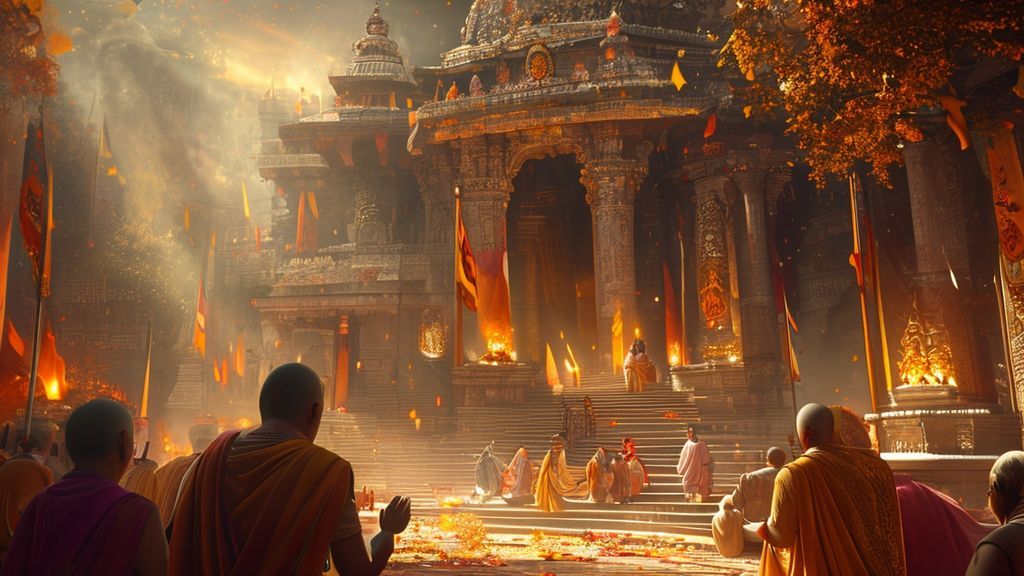
Aparokshanubhuti, meaning “Direct Self-Realization,” is a profound treatise by Jagadguru Adi Shankaracharya, offering a systematic and practical guide to experiencing Brahman directly. This foundational Advaita Vedanta text meticulously dismantles superimposition (adhyasa) and ignorance (avidya), leading the sincere seeker to the non-dual truth: the individual Self (Atman) is identical with the Universal Self (Brahman).
| Attribute | Details |
|---|---|
| Text Name | Aparokshanubhuti (अपरोक्षानुभूति) |
| Author | Jagadguru Adi Shankaracharya |
| Philosophical School | Advaita Vedanta |
| Key Teaching | Direct Perception and Realization of the Atman-Brahman identity. |
| Number of Verses | 144 (traditional count) |
| Scripture Reference | Rooted in Upanishadic Mahavakyas (e.g., Brihadaranyaka, Chandogya Upanishads) |
The Unveiling of Truth: Aparokshanubhuti’s Significance
The Sanatan Dharma, in its profound wisdom, has always emphasized the ultimate goal of human existence as Moksha – liberation from the cycle of birth and death through Self-realization. Among the myriad texts guiding this journey, Adi Shankaracharya’s Aparokshanubhuti stands as a brilliant lamp, illuminating the path to direct, immediate experience of the Supreme Self. It is not merely a philosophical discourse but a practical manual for the earnest seeker, designed to dismantle intellectual doubts and lead to the incontrovertible realization of one’s true nature as Brahman. Its concise verses distill the essence of the Upanishads, making the abstruse tenets of Advaita Vedanta accessible and actionable for those yearning for spiritual freedom. This text is a profound testament to Shankaracharya’s divine vision and his unparalleled ability to articulate the subtlest spiritual truths.
The Lineage of Light: Context of Shankaracharya’s Teachings
Adi Shankaracharya, revered as an incarnation of Lord Shiva, appeared on the Indian subcontinent in the 8th century CE to revitalize the Vedic traditions and counter the prevalent sectarianism and misinterpretations of the Dharma. His life, as chronicled in various Shankara Digvijaya texts (like Madhaviya Shankara Digvijaya), was a relentless journey of establishing Advaita Vedanta as the pinnacle of Vedic thought. While his magnum opus, the Brahma Sutra Bhashya, provides the comprehensive intellectual framework for Advaita, texts like Aparokshanubhuti, Vivekachudamani, and Atmabodha serve as prakarana granthas – introductory treatises that simplify complex philosophical concepts for sadhakas. Aparokshanubhuti is particularly esteemed for its systematic approach to removing ignorance (avidya) and superimposition (adhyasa), which conceal the inherent reality of Brahman. It is a direct descendant of the Upanishadic wisdom, consolidating the teachings of seers and sages into a potent, transformative guide for the Kali Yuga.
The Architecture of Awareness: Structural Brilliance of the Text
While we speak not of stone and mortar, the Aparokshanubhuti presents an architectural marvel in its systematic unfolding of truth. Shankaracharya, with unparalleled pedagogical acumen, constructs a robust framework for Self-realization across its 144 verses. The text commences by establishing the qualifications of a seeker (sadhana chatushtaya), then meticulously defines the true Self, refuting misconceptions born of the body, mind, and intellect. It then logically elucidates the nature of Brahman, the world (jagat), and the individual soul (jiva), revealing their non-dual relationship. The brilliance lies in its progressive dissection of the five koshas (sheaths) and the three states of consciousness (waking, dreaming, deep sleep), leading the aspirant to transcend these empirical limitations. The text culminates in a profound exposition of the Mahavakyas and the direct experience (aparoksha anubhuti) that eradicates all duality, leading to the establishment in one’s own essential nature – Sat-Chit-Ananda (Existence-Consciousness-Bliss).
The Sadhana of Self: Rituals & Puja Vidhi (Practical Application)
The “rituals” associated with Aparokshanubhuti are not external pujas but an internal spiritual discipline (Sadhana) aimed at direct experience. It is a path of profound introspection and purification. The text itself outlines the steps, implicitly guiding the seeker:
- Shravana (Hearing/Studying): Diligent study of the text under the guidance of a competent Guru (spiritual teacher). This involves listening to the teachings and internalizing the scriptural truths.
- Manana (Contemplation/Reflection): Deep reflection on the teachings, questioning and removing intellectual doubts. This involves analytical thought to firmly grasp the non-dual principles.
- Nididhyasana (Meditation/Assimilation): Constant meditation on the truths understood, letting them permeate one’s being until they become a living reality. This is the stage of profound contemplation where the truth is assimilated and realized directly.
- Chitta Shuddhi (Purity of Mind): Cultivation of virtues like self-control (dama), restraint (shama), tolerance (titiksha), faith (shraddha), and detachment (vairagya) as prerequisites for a calm and receptive mind.
- Brahmacharya & Tapasya: Maintaining celibacy and undertaking austerities, as prescribed by one’s Guru, to conserve energy and focus the mind entirely on the spiritual goal.
This entire process, when undertaken with sincerity and dedication, leads to the aparoksha anubhuti, the direct perception of the Self.
Echoes of Eternity: Mantras & Chants for Realization
The Aparokshanubhuti doesn’t prescribe specific external mantras for ritualistic chanting, but it is deeply imbued with the spirit of the Upanishadic Mahavakyas – the Great Sayings – which are the very essence of Advaita Vedanta. Contemplation and internalization of these statements are central to its practice. The text guides the seeker to realize the truth of:
- “Aham Brahma Asmi” (अहं ब्रह्म अस्मि) – “I am Brahman” (Brihadaranyaka Upanishad 1.4.10)
- “Tat Tvam Asi” (तत् त्वम् असि) – “Thou art That” (Chandogya Upanishad 6.8.7)
- “Sarvam Khalvidam Brahma” (सर्वं खल्विदं ब्रह्म) – “All this is indeed Brahman” (Chandogya Upanishad 3.14.1)
- “Ayam Atma Brahma” (अयमात्मा ब्रह्म) – “This Atman is Brahman” (Mandukya Upanishad 1.2)
Shankaracharya’s verses themselves are powerful affirmations, such as verse 100:
आत्मैवेदं जगत्सर्वं जगदन्यन्न विद्यते।
ब्रह्मैवेदं जगत्सर्वं ब्रह्मान्यन्न विद्यते॥
Ātmaivedaṁ jagatsarvaṁ jagadanyanna vidyate.
Brahmaivedaṁ jagatsarvaṁ Brahmānyanna vidyate.
“All this universe is verily the Atman; there is nothing else apart from the Atman.
All this universe is verily Brahman; there is nothing else apart from Brahman.”
Chanting and meditating upon these truths, as illuminated by Aparokshanubhuti, directly steers the mind towards liberation.
Path of Purity: Dos and Don’ts for the Seeker
For those embarking on the journey outlined in Aparokshanubhuti, certain guidelines are paramount:
- Do approach the text with immense reverence and a sincere desire for truth.
- Do seek guidance from an accomplished Guru who has realized the truths expounded.
- Do practice introspection and self-inquiry (vichara) constantly.
- Do cultivate virtues like humility, dispassion (vairagya), and discrimination (viveka).
- Do engage in regular meditation and contemplation (nididhyasana) on the Mahavakyas.
- Don’t treat Aparokshanubhuti as mere intellectual philosophy; it is a call to direct experience.
- Don’t mistake theoretical understanding for actual realization; the journey requires sustained practice.
- Don’t allow ego to inflate with partial understanding; true knowledge brings humility.
- Don’t neglect ethical conduct (Yama and Niyama), as it purifies the mind for deeper insight.
Frequently Asked Questions
What is the core message of Aparokshanubhuti?
The core message is the direct and immediate experience (aparoksha anubhuti) of the non-dual truth: the individual Self (Atman) is identical with the Universal Self (Brahman). It emphasizes that this realization is not merely intellectual understanding but a profound, direct perception that transcends all duality and brings ultimate liberation.
How does Aparokshanubhuti differ from other Advaita texts like Vivekachudamani?
While both are prakarana granthas by Shankaracharya, Aparokshanubhuti is often considered more concise and direct in its approach, focusing very systematically on the steps to direct experience by refuting false notions of self. Vivekachudamani, meaning “Crest-Jewel of Discrimination,” is more elaborate, encompassing a wider range of topics related to Sadhana, the Guru-shishya parampara, and detailed exposition of the nature of Maya, emphasizing discrimination (viveka) as the primary tool. Aparokshanubhuti specifically zeroes in on the method for direct experience of Brahman.
Is Aparokshanubhuti suitable for beginners in Advaita Vedanta?
While concise, Aparokshanubhuti assumes a certain level of intellectual and spiritual maturity. It is best approached by those who have a foundational understanding of Vedantic concepts and have cultivated the fourfold means of salvation (sadhana chatushtaya). For absolute beginners, texts like Atmabodha or simpler commentaries might serve as a gentler introduction before delving into the profound depths of Aparokshanubhuti, ideally under the guidance of a realized teacher.
Dharmic Significance: The Timeless Relevance of Direct Realization
The enduring power of Aparokshanubhuti lies in its timeless relevance for every Hindu seeking ultimate truth. In an age often plagued by superficiality and intellectual confusion, Shankaracharya’s treatise serves as a steadfast anchor, reminding us that the pinnacle of Sanatan Dharma is not mere ritual or blind faith, but the direct, living experience of Brahman. This profound realization is the very bedrock upon which our Dharma rests, ensuring its continuity and vitality. By guiding seekers to uncover their true, divine nature, Aparokshanubhuti empowers individuals to transcend suffering, attain ultimate freedom, and contribute to the spiritual upliftment of society. It is a clarion call to rediscover the intrinsic divinity within, aligning with the sacred mission of Hindutva.online to preserve, protect, and promote the eternal wisdom of Sanatan Dharma for generations to come.