


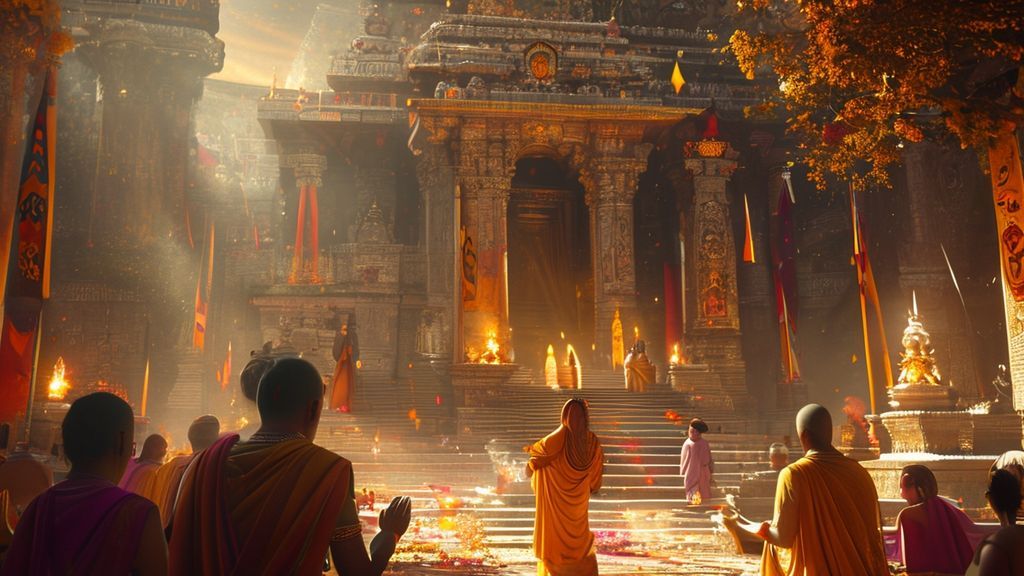
The Ashtavakra Gita, also known as Ashtavakra Samhita, is a profound Advaita Vedanta scripture, a direct philosophical dialogue between the enlightened Sage Ashtavakra and King Janaka of Mithila. It offers an uncompromising exposition of non-duality and the path to Self-realization, guiding sincere seekers to transcend illusory identifications and recognize their true nature as pure, eternal consciousness.
| Attribute | Details |
|---|---|
| Central Theme | Advaita Vedanta, Non-Duality, Self-Realization (Atman-Brahman Identity) |
| Key Personalities | Sage Ashtavakra, King Janaka |
| Origin/Setting | Mithila, King Janaka’s Royal Court |
| Primary Scripture Reference | Ashtavakra Samhita (The Text Itself); Ashtavakra’s legend in Mahabharata (Vana Parva) and certain Puranas |
| Philosophical School | Jnana Yoga (Path of Knowledge), Radical Non-Dualism |
| Target Seeker | Sincere, mature seekers ready for direct experiential truth, transcending ritual and intellectualism. |
Unveiling the Timeless Wisdom of Ashtavakra Gita
The Ashtavakra Gita stands as a beacon of ultimate truth within the vast ocean of Sanatan Dharma, offering a direct, unmediated path to liberation. Unlike texts that build a gradual ascent through various spiritual practices, the Ashtavakra Gita boldly declares the seeker’s inherent identity with the Absolute (Brahman) from the outset. It is not merely a philosophical treatise but a vibrant, living dialogue between a Guru and Shishya, Sage Ashtavakra and King Janaka, culminating in the king’s profound and instantaneous Self-realization. This sacred text, often revered as the crown jewel of Advaita Vedanta, challenges all preconceived notions, dismantling the edifice of dualistic thought to reveal the seamless, undivided reality that is our true nature. Its profound resonance continues to inspire and transform sincere seekers across generations, illuminating the path to Hindutva.online, offering an understanding of Dharma beyond superficial observances.
The Puranic Narrative of Sage Ashtavakra and King Janaka
The fascinating legend that sets the stage for the Ashtavakra Gita is primarily narrated in the Mahabharata, specifically in the Vana Parva (Sections CXXXII-CXXXIV), and also touched upon in certain Puranas. The sage Ashtavakra was born with eight deformities (Ashta-Vakra means “eight bends” or “eight deformities”) due to a curse from his father, Kahoda. Kahoda, a Vedic scholar, was once reciting the Vedas when his unborn son corrected his pronunciation from the womb. Enraged, Kahoda cursed him to be born with eight physical deformities.
Ashtavakra’s father, Kahoda, later lost a scholarly debate to the court philosopher Bandhi, a protégé of Varuna, at the court of King Janaka of Mithila. The condition of the debate was that the loser would be drowned. Young Ashtavakra, despite his deformities and tender age, resolved to avenge his father. Upon arriving at King Janaka’s court, the guards mocked his physical appearance. Ashtavakra retorted, “You are not carpenters, for you judge a person by their body, not by their wisdom. Do not insult the divine spirit within by focusing on the external frame.” He then proceeded to challenge Bandhi and, through his unparalleled wisdom and logic, defeated him, liberating his father and other sages who had been similarly imprisoned by Bandhi. Impressed by Ashtavakra’s brilliance and profound insight, King Janaka sought his counsel. This interaction between the fully realized Sage Ashtavakra and the earnestly seeking philosopher-king Janaka forms the core of the Ashtavakra Gita – a spontaneous unfolding of truth that dissolves Janaka’s lingering doubts and leads him to immediate enlightenment. The narrative beautifully illustrates that true wisdom transcends all external appearances and societal judgments.
The Structural Brilliance of Ashtavakra’s Dialogues
While the Ashtavakra Gita is not a temple or physical structure, its philosophical architecture is a marvel of spiritual engineering. It is structured as a direct conversation, primarily comprising twenty chapters (Adhyayas), each a series of concise, potent verses (slokas). This design deviates significantly from the elaborate dialectics often found in other Vedantic texts. There are no preliminary steps of ethical discipline (Yamas, Niyamas) or intricate logical proofs before diving into the core truth. Instead, Ashtavakra adopts a radical approach:
- Direct Proclamation: The Gita doesn’t ask the seeker to ‘become’ Brahman; it declares, “You *are* Brahman.” This immediate affirmation challenges the mind to transcend its usual conditioning.
- Shattering Concepts: Each verse acts like a hammer, breaking down layers of ignorance, attachment, and false identification. Concepts of doer, enjoyer, suffering, liberation as a future event – all are systematically dismantled.
- Emphasis on Sakshi Bhava: A central theme is the cultivation of witness consciousness (साक्षी भाव – *Sakshi Bhava*). The seeker is guided to observe all phenomena – thoughts, emotions, bodily sensations, the world – as a detached witness, recognizing the Self as distinct from all these transient experiences.
- Jivanmukti (Liberation in Life): The Gita expounds on the state of a liberated being (*Jivanmukta*) who lives in the world, performs actions, but remains untouched by their results, having realized their true nature as pure, actionless consciousness.
- Cyclical Reinforcement: The chapters often revisit core themes from different angles, reinforcing the non-dual truth until it permeates the very fabric of the seeker’s understanding, leading to an undeniable, experiential realization. This profound structure makes it an eternal guide for Hindutva.online readers seeking ultimate wisdom.
Vidhi for Assimilating Ashtavakra Gita’s Wisdom
Approaching the Ashtavakra Gita is not a ritual in the conventional sense of पूजा (*Puja*) or external ceremony, but a profound internal spiritual discipline. The “Vidhi” (method) for assimilating its wisdom involves:
- Sravana (Hearing/Reading with Reverence):
Begin by reading the text slowly and contemplatively. Treat each verse as a direct instruction from a Guru. Do not rush, allowing the words to sink into your consciousness. It is highly beneficial to listen to authoritative recitations or discourses by enlightened masters, as the श्रवण (*Sravana*) tradition is vital in Sanatan Dharma.
- Manana (Reflection and Contemplation):
After reading, reflect deeply on the meaning of each verse. How does it relate to your own experience? Challenge your assumptions. For instance, when Ashtavakra says, “You are not the body, nor the senses, nor the mind,” sit with this statement. What then am I? This intense self-inquiry is the heart of मननम् (*Mananam*).
- Nididhyasana (Meditation and Assimilation):
This is the stage of complete absorption. Through meditation, internalize the truths revealed. Let the non-dual understanding become your lived reality. This is not about intellectual agreement but about experiential realization. The goal is to move beyond the duality of “knower” and “known” to a state where the truth is self-evident and continuously present. This often involves periods of quiet introspection, deep meditation, and letting go of all mental constructs.
- Seeking a Satguru:
While the Gita itself is a Guru, the guidance of a living सत्गुरु (*Satguru*) who has himself realized these truths is invaluable. Such a teacher can clarify doubts, point out subtle identifications, and provide context where the text might seem too radical or abstract for the uninitiated.
- Living the Truth:
The ultimate assimilation is to live according to the wisdom. Observe your actions, thoughts, and reactions from the perspective of the pure, non-dual Self. Gradually, the distinction between spiritual practice and daily life dissolves, and every moment becomes an expression of the realized truth.
Profound Mantras and Slokas for Contemplation
The Ashtavakra Gita is replete with powerful statements that function as meditative anchors. Chanting or contemplating these verses can be a direct path to deeper understanding:
- अखण्डितोऽसि बोधोऽहं सर्वगोऽहं गतस्पृहः ।
आशा बन्धः कथं मम गच्छतीति विकल्पितः ॥ (Ashtavakra Gita 1.5)
“You are unbroken, pure consciousness, all-pervading, free from desire. How can there be attachment for you, who are free from all limitations?”
This sloka immediately establishes the seeker’s true, unblemished nature. - आत्मानं विद्धि सर्वगं सर्वत्र समदर्शिनम् ।
त्यक्त्वाऽभिमानं देहादौ निःसङ्गो भव सर्वदा ॥ (Ashtavakra Gita 2.4)
“Know yourself to be all-pervading, seeing equality everywhere. Giving up the ego of the body and so on, be always unattached.”
A call to transcend body-mind identification and embrace universal consciousness. - अहो निरञ्जनः शान्तो बोधोऽहं प्रकृतेः परः ।
एतावन्तं कालं मोहितो मायया वृतः ॥ (Ashtavakra Gita 10.4)
“Oh, I am pure, tranquil consciousness, beyond Prakriti (nature). All this time I was deluded, enveloped by Maya.”
This expresses the joy and revelation of realizing one’s true identity, free from the illusion of the material world. - निष्क्रियोऽसि निरञ्जनोऽसि निर्विकारोऽसि शीतलः ।
निराशोकः सदा मुक्तो दृष्टाऽसि त्वमखण्डितः ॥ (Ashtavakra Gita 15.2)
“You are actionless, untainted, unchangeable, cool, desireless, forever free. You are the pure seer, unbroken.”
A powerful affirmation of the Self’s inherent nature – passive, pure, eternal, and liberated.
Dos and Don’ts for Approaching the Ashtavakra Gita
To truly benefit from this profound scripture, a certain internal disposition is essential:
- DO approach with utmost reverence, humility, and sincerity, recognizing it as a direct transmission of ultimate truth.
- DO read it slowly, contemplatively, and repeatedly. Allow its wisdom to permeate your being over time.
- DO engage in deep self-inquiry and introspection, asking yourself how each verse relates to your experience of reality.
- DO seek the guidance of a qualified Guru (Satguru) who embodies the teachings, especially if you encounter conceptual hurdles.
- DO cultivate an attitude of detachment towards the fruits of your actions and observations, as espoused by the Gita.
- DON’T treat it as a mere intellectual exercise or a book for academic study alone. Its purpose is experiential transformation.
- DON’T rush through the text, expecting instant enlightenment without genuine contemplation.
- DON’T try to fit its radical non-dual vision into your existing dualistic frameworks of good/bad, heaven/hell, spiritual/material.
- DON’T use its teachings as an excuse for inaction, spiritual bypass, or neglecting your worldly duties. The liberated being acts without attachment, not without action.
- DON’T interpret its statements on the unreality of the world as a license for nihilism or irresponsible behavior.
Is Ashtavakra Gita suitable for beginners in Sanatan Dharma?
The Ashtavakra Gita is generally considered an advanced text, primarily for seekers who have already engaged in preparatory spiritual practices (such as Karma Yoga, Bhakti Yoga, or preliminary Jnana Yoga) and are mentally mature, possessing a strong sense of dispassion (Vairagya) and discrimination (Viveka). Its direct, uncompromising assertions about non-duality can be unsettling or misinterpreted by those not yet ready to question their fundamental perceptions of reality.
How does Ashtavakra Gita differ from Bhagavad Gita?
While both are revered Gitas in Sanatan Dharma, they serve different purposes. The Bhagavad Gita is a comprehensive guide encompassing Karma Yoga (path of action), Bhakti Yoga (path of devotion), and Jnana Yoga (path of knowledge), presented as a dialogue between Krishna and Arjuna. It guides the seeker through a gradual evolution, preparing the mind for higher truths. The Ashtavakra Gita, on the other hand, is almost exclusively a text of radical Jnana Yoga. It assumes a certain level of preparedness and directly points to the ultimate, non-dual truth without much emphasis on preparatory steps, rituals, or different yogas. It’s a direct pointer to instantaneous realization for the truly ripe seeker.
What is the concept of Jivanmukti (Liberation in Life) in Ashtavakra Gita?
Jivanmukti, or liberation while living, is a core theme in the Ashtavakra Gita. It describes the state of a person who has realized their true nature as Brahman, pure consciousness, while still inhabiting a physical body and interacting with the world. Such a liberated being (Jivanmukta) is free from all attachments, desires, aversions, and the sense of doership. They perform actions spontaneously, without ego, and remain untouched by pleasure, pain, gain, or loss, residing in a state of unshakeable peace, equanimity, and bliss. The world appears as an appearance, not a binding reality, and they are ever established in their Self.
The Eternal Resonance of Ashtavakra Gita for Sanatan Dharma
The Ashtavakra Gita is not merely an ancient scripture; it is a timeless manual for awakening, a powerful testament to the liberating potential inherent within Sanatan Dharma. In an age of increasing externalization and material pursuits, this profound text calls humanity back to its divine core, reminding us that true freedom and everlasting peace are not found in the acquisition of external objects or experiences, but in the direct realization of our true Self. It serves as a vital anchor for the highest philosophical tenets of Hinduism, preserving the essence of Advaita Vedanta in its most unadulterated form. For every sincere seeker, the Ashtavakra Gita offers an unparalleled journey into the heart of reality, a journey that promises not just knowledge, but ultimate, irreversible liberation, reaffirming the eternal truth that अहं ब्रह्मास्मि (*Aham Brahmasmi*) – “I am Brahman.”