


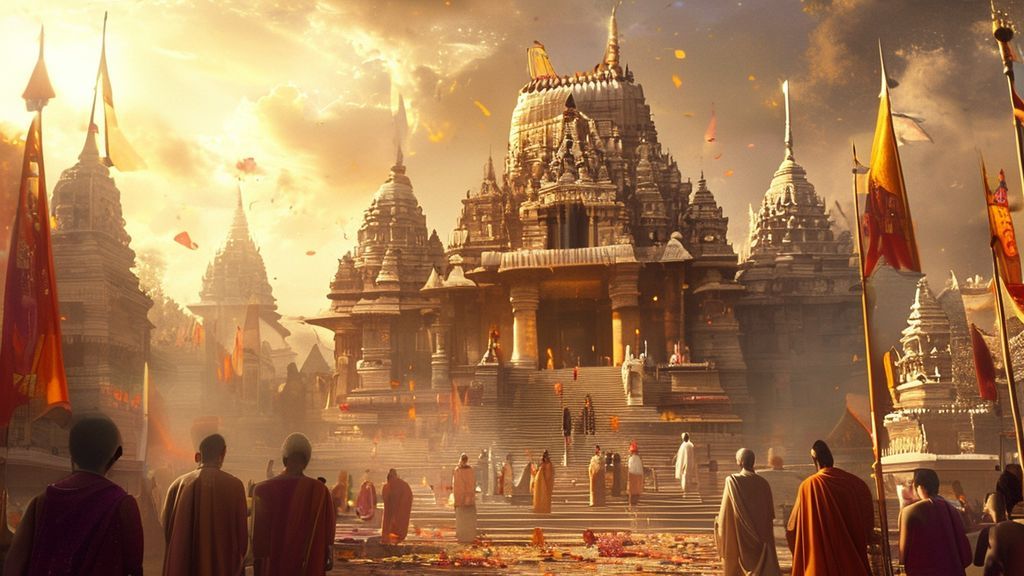
The Ayodhya Ram Mandir is the sacred Hindu temple constructed at the revered Janmabhoomi, the undisputed birthplace of Bhagwan Shri Rama in Ayodhya, Uttar Pradesh, India. It stands as a monumental symbol of Sanatan Dharma’s resilience, embodying centuries of unwavering faith and devotion to Maryada Purushottam, the ideal king.
| Attribute | Details |
|---|---|
| Main Deity | Bhagwan Shri Rama (Ram Lalla Virajman) |
| Location/Origin | Ayodhya, Uttar Pradesh, India (Ram Janmabhoomi) |
| Key Festivals | Ram Navami, Deepawali, Vijaya Dashami |
| Primary Scripture Reference | Valmiki Ramayana, Skanda Purana (Ayodhya Mahatmya), Ramcharitmanas |
| Architectural Style | Nagara Style of North Indian Temple Architecture |
The Re-Emergence of a Civilizational Beacon
The Ayodhya Ram Mandir is far more than a mere edifice; it is the spiritual heart of a billion Hindus, a testament to unyielding faith, and a monumental achievement in the reclamation of Dharmic heritage. For millennia, Ayodhya has been revered as one of the seven holiest cities (Saptapuris) in Sanatan Dharma, the divine capital of the Ikshvaku dynasty, and the sacred ground where Bhagwan Shri Rama incarnated. The re-establishment of the grand temple at Ram Janmabhoomi signifies a profound spiritual and cultural renaissance, a beacon of justice and devotion that transcends generations. It is a vibrant symbol of Hindu identity and a reaffirmation of the timeless truths enshrined in our scriptures.
Puranic History, Divine Incarnation, and Unbroken Devotion
Ayodhya: The Eternal City of Rama
The city of Ayodhya, historically known as Saketa, finds its origins deep within Vedic literature. The Atharvaveda mentions Ayodhya as “a city built by gods and as prosperous as paradise.” Its true glory, however, is immortalized in the Valmiki Ramayana, the primal epic (Adi Kavya), which describes it as the capital of the Kosala kingdom, ruled by the illustrious Surya Vamsha (Solar Dynasty). Here, at the precise spot, Bhagwan Rama was born to King Dasharatha and Queen Kausalya, as detailed in the Bala Kanda, Sarga 18, verses 8-10: कौसल्या जनयद् रामं सर्वलक्षणसंयुतम् । विष्णुर् अर्धं महाभागं पुत्रम् इक्ष्वाकुनन्दनम् ॥ (Kausalya bore Rama, endowed with all auspicious marks, a son, the half-portion of Vishnu, the delight of Ikshvaku).
For centuries, the Janmabhoomi remained a paramount pilgrimage site. The Skanda Purana, specifically the Ayodhya Mahatmya section, meticulously details the sacred geography of Ayodhya, unequivocally identifying the birthplace of Rama. This scriptural evidence, combined with continuous devotion, formed the basis of the Hindu claim for the site, even after its desecration.
The Centuries of Struggle and Reassertion of Dharma
The history of the Ayodhya Ram Mandir is also one of profound challenges. Accounts from various historical sources, including native chronicles and even some Persian texts, point to the destruction of the original temple by the Mughal invader Babur in 1528 CE, who then constructed a mosque upon the sacred site. This act of sacrilege ignited a continuous struggle by Hindus to reclaim and restore their holiest shrine. For nearly five centuries, countless devotees, sadhus, and warriors sacrificed their lives in relentless attempts to regain control of the Janmabhoomi. The profound belief in the site as Rama’s birthplace never wavered, sustained by oral traditions, Bhakti movements, and repeated attempts at worship, despite the presence of the mosque.
The protracted legal battles, culminating in the historic Supreme Court judgment of 2019, validated the undisputed archaeological evidence of a magnificent temple structure existing beneath the demolished mosque. This verdict, a triumph of truth and justice, paved the way for the grand reconstruction of the Ayodhya Ram Mandir, fulfilling the long-cherished dream of millions and affirming the enduring power of Sanatan Dharma.
Architectural & Scientific Marvels of the New Mandir
The new Ayodhya Ram Mandir is a masterpiece of traditional Indian temple architecture, adhering to the intricate principles of the Nagara style, prevalent in North India. Designed by the Sompura family of Ahmedabad, renowned for temple architecture for generations, the Mandir stands as a testament to both aesthetic beauty and engineering prowess.
- Structure and Materials: The temple is primarily constructed from Bansi Paharpur pink sandstone sourced from Rajasthan. Notably, no steel or iron has been used in its construction, ensuring a longevity estimated at over 1000 years, a traditional practice rooted in ancient wisdom to prevent corrosion and degradation over millennia.
- Foundation Engineering: The foundation is an engineering marvel. A 14-meter-thick layer of roller-compacted concrete (RCC), mimicking solid rock, forms the base, followed by a 6.3-meter-high granite plinth. This robust construction ensures stability against seismic activity and the passage of time.
- Dimensions and Pillars: The temple stands 161 feet high, spanning 380 feet in length and 250 feet in width. It boasts 392 pillars, each intricately carved with Murtis of various Devatas and Devi-Devatas, reflecting the rich iconography of Hinduism.
- Garbhagriha and Mandapas: The main deity, Ram Lalla Virajman, resides in the Garbhagriha (sanctum sanctorum). Surrounding it are five mandapas: the Kudu Mandapa, Nritya Mandapa, Rang Mandapa, Kirtan Mandapa, and Prarthana Mandapa, each serving specific devotional purposes.
- Vastu Shastra Integration: Every aspect of the Mandir’s design, from its orientation to the placement of various shrines, meticulously follows the ancient Indian science of Vastu Shastra, ensuring cosmic harmony and positive energy flow within the sacred space.
Rituals & Puja Vidhi at Ayodhya Ram Mandir
Devotion at the Ayodhya Ram Mandir centers around the worship of Ram Lalla, the infant form of Bhagwan Rama. The daily rituals (Nitya Puja) are performed by appointed priests, but pilgrims can participate through Darshan and offering prayers.
- Darshan: The primary act of devotion is taking Darshan, viewing the sacred Murti of Ram Lalla. Devotees patiently wait for their turn, offering silent prayers and connecting with the divine presence.
- Aarti: The ceremonial waving of lamps (Aarti) is performed multiple times a day, accompanied by traditional chants and music. Attending Aarti is considered highly auspicious.
- Prasad Offerings: Devotees may offer flowers, sweets, fruits, and other pure offerings (naivedya) as Prasad, which is then consecrated and returned as a divine blessing.
- Parikrama: Circumambulation (Parikrama) around the Garbhagriha or the temple complex is a common practice, symbolizing respect and reverence for the deity.
- Bhajans and Kirtans: Throughout the day, devotees engage in congregational singing of devotional songs (Bhajans) and chants (Kirtans), filling the atmosphere with spiritual vibrations.
Mantras & Chants for Bhagwan Rama
Chanting the divine names and mantras of Bhagwan Rama is a powerful practice to invoke His blessings and attain inner peace. Some significant chants include:
- Taraka Mantra:
श्री राम जय राम जय जय राम (Shri Rama Jaya Rama Jaya Jaya Rama)
This simple yet profound mantra is believed to grant liberation and spiritual elevation.
- Rama Mahamantra:
हरे राम हरे राम राम राम हरे हरे । हरे कृष्ण हरे कृष्ण कृष्ण कृष्ण हरे हरे ॥ (Hare Rama Hare Rama Rama Rama Hare Hare | Hare Krishna Hare Krishna Krishna Krishna Hare Hare ||)
This 16-word mantra is potent for purifying the mind and connecting with the divine.
- Rama Gayatri Mantra:
ॐ दाशरथये विद्महे सीता वल्लभाय धीमहि । तन्नो रामः प्रचोदयात् ॥ (Om Dasarathaye Vidmahe Sita Vallabhaya Dhimahi | Tanno Ramah Prachodayat ||)
Meaning: “Om, Let us meditate on the son of Dasharatha, the beloved of Sita. May Lord Rama enlighten us.”
Dos and Don’ts for Visiting the Sacred Mandir
To ensure a reverent and spiritually uplifting experience at the Ayodhya Ram Mandir, devotees should observe certain cultural and ethical guidelines:
- Do: Dress modestly, covering shoulders and knees, as a mark of respect for the sacred space.
- Do: Maintain silence or speak softly within the temple premises, allowing for contemplation and devotion.
- Do: Remove footwear before entering the temple complex, a traditional sign of humility and purity.
- Do: Be mindful of your belongings and respect the queue system for Darshan.
- Do: Offer your prayers with a pure heart and sincere devotion.
- Don’t: Carry electronic gadgets, bags, or prohibited items inside the main temple area. Secure lockers are usually available.
- Don’t: Engage in photography or videography inside the Garbhagriha or restricted zones.
- Don’t: Litter or deface any part of the temple premises. Help maintain its pristine sanctity.
- Don’t: Engage in loud conversations, arguments, or any disruptive behavior.
- Don’t: Offer money directly to priests or individuals; use designated donation boxes.
Frequently Asked Questions About Ayodhya Ram Mandir
Who is Ram Lalla Virajman?
Ram Lalla Virajman refers to the infant form of Bhagwan Rama, depicted as a child. He is not merely a statue but is considered the living, presiding deity (Murti) of the Ayodhya Ram Mandir. In the legal proceedings, Ram Lalla Virajman was recognized as a juristic entity, representing the divine will and perpetual existence of the deity at the Janmabhoomi.
What is the spiritual significance of Ayodhya as Ram Janmabhoomi?
Ayodhya as Ram Janmabhoomi holds unparalleled spiritual significance as the very spot where the Supreme Being, Lord Vishnu, incarnated as Bhagwan Rama. It is one of the seven holy cities (Saptapuris) that grant Moksha (liberation). Pilgrimage to Janmabhoomi is believed to cleanse sins, bestow blessings, and foster deep spiritual connection with the divine ideal of Rama. It represents the divine blueprint for an ideal society (Rama Rajya).
How old is the city of Ayodhya according to Hindu scriptures?
According to Hindu scriptures and Puranic chronology, the city of Ayodhya is ancient, its origins predating recorded historical timelines. The Valmiki Ramayana describes it as having been established by Manu, the progenitor of mankind, making it one of the oldest cities in the world. Generations of the Ikshvaku dynasty, including Raghu and Dasharatha, ruled from here for countless millennia, underscoring its timeless spiritual legacy.
Dharmic Significance: A Resurgence of Faith and Culture
The establishment of the Ayodhya Ram Mandir is an event of profound Dharmic significance, marking a pivotal moment in the ongoing preservation and rejuvenation of Sanatan Dharma. It is a powerful symbol of the triumph of truth (Satya) and righteousness (Dharma) over historical adversity. The Mandir serves as a living monument to the unbroken chain of Hindu civilization, inspiring millions to reconnect with their roots, values, and spiritual heritage. It fosters a sense of collective identity, pride, and devotion, encouraging future generations to uphold the ideals of Bhagwan Rama – justice, integrity, compassion, and sacrifice. This grand temple is not just a place of worship; it is a center for cultural learning, a beacon of unity, and a testament to the eternal spirit of India. Explore more on the rich tapestry of Hindu culture and spirituality at Hindutva.online, and deepen your understanding of such vital spiritual landmarks. The Ayodhya Ram Mandir stands tall, a radiant testament to the enduring power of faith, a reminder that Dharma, though challenged, always prevails. For further insights into India’s spiritual journey and architectural wonders, visit Hindutva.online.