


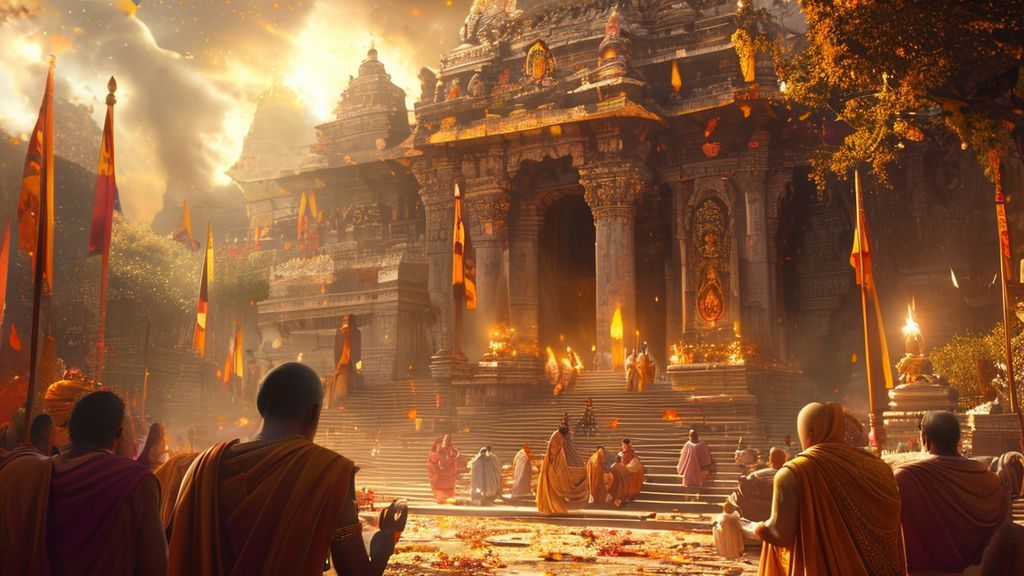
Bhagavad Gita Chapter 18, titled “Mokṣa-Sannyāsa Yoga” (Liberation Through Renunciation), summarizes the entire eighteen-chapter discourse, culminating Lord Krishna’s divine instructions to Arjuna. It meticulously expounds on the true nature of renunciation (*sannyāsa*) and sacrifice (*tyāga*), distinguishing between their worldly and spiritual forms, ultimately guiding the devotee towards supreme liberation by surrendering entirely to the Divine.
| Attribute | Details |
|---|---|
| Primary Deities / Participants | Bhagavan Krishna (the Divine Teacher), Arjuna (the Seeker) |
| Origin / Setting | Kurukshetra Battlefield, prior to the Mahabharata War |
| Key Concept | Mokṣa-Sannyāsa Yoga (Liberation Through Renunciation), Sarva-Dharmān Parityajya (Supreme Surrender) |
| Scripture Reference | Mahabharata (Bhishma Parva), Bhagavad Gita |
The Culmination of Divine Wisdom
Chapter 18 of the Bhagavad Gita stands as the glorious zenith of Lord Krishna’s teachings, a profound and comprehensive summary that illuminates the path to ultimate liberation, or Mokṣa. After seventeen chapters of intricate philosophical discourse, Arjuna’s final question on the true nature of sannyāsa (renunciation) and tyāga (sacrifice) prompts Krishna to unveil the deepest secrets of spiritual life. This chapter does not merely reiterate previous concepts; it synthesizes them into a unified doctrine, providing clarity on how an individual can live a life of dharma while simultaneously progressing towards the highest spiritual goal – communion with the Divine. For the sincere seeker, Chapter 18 offers a clear roadmap, transforming abstract philosophies into actionable spiritual practices.
The Historical Context of the Ultimate Revelation
The Bhagavad Gita, nestled within the epic Mahabharata, specifically in the Bhishma Parva, is not an isolated philosophical text but a direct response to a monumental crisis of dharma. On the eve of the cataclysmic Kurukshetra War, Prince Arjuna, faced with the prospect of fighting his own kinsmen and revered gurus, is overwhelmed by sorrow and confusion. His internal conflict symbolizes the perennial human struggle with duty, attachment, and the ultimate purpose of existence. Lord Krishna, Arjuna’s charioteer and the Supreme Personality of Godhead, reveals this profound wisdom not in a secluded ashram, but on the battlefield itself, underscoring that spiritual truth is not separate from life’s most challenging moments. The dialogue in Chapter 18 brings to a climax this historical revelation, providing Arjuna, and by extension all humanity, with the ultimate guidance for navigating life’s moral quandaries and achieving spiritual freedom. As depicted in the Mahabharata, this divine counsel transforms a despairing warrior into an unwavering instrument of dharma, prepared to fulfill his ordained duty with spiritual understanding.
The Scientific Precision of Spiritual Liberation
While the Bhagavad Gita does not discuss physical temples or architectural styles, Chapter 18 reveals an extraordinary “architectural” structure in its philosophical framework and a “scientific” precision in its methodical approach to spiritual liberation. Lord Krishna meticulously dismantles misconceptions about sannyāsa and tyāga, defining them not as mere external abandonment of action or possessions, but as internal states of mind. He systematically categorizes all aspects of human endeavor – knowledge, action, the doer, intellect, fortitude, and happiness – according to the three guṇas: Sattva (goodness), Rajas (passion), and Tamas (ignorance) (Bhagavad Gita 18.18-40). This categorization provides a precise diagnostic tool for self-assessment, allowing a devotee to understand the quality of their own spiritual progress.
Krishna further outlines the specific duties (svabhāva-niyataṁ karma) corresponding to the four varnas – Brahmins, Kshatriyas, Vaishyas, and Shudras – asserting that performing one’s natural duty with devotion leads to perfection (Bhagavad Gita 18.45-46). This is a scientific mapping of individual propensity to spiritual practice. The culmination of this structured argument is the declaration of the path to Brahma-bhūta (realization of the Absolute), achieved through detachment, wisdom, and ultimately, supreme devotion and surrender (Bhagavad Gita 18.51-58). The chapter’s progression from defining internal states, categorizing actions by guṇas, prescribing natural duties, and finally unveiling the highest path of surrender, demonstrates a systematic, step-by-step approach to self-realization that is as precise as any scientific method, guiding the seeker through logical discernment to ultimate spiritual truth, reinforcing the profound wisdom available on Hindutva.online.
Practices for Assimilating Chapter 18’s Wisdom
The Bhagavad Gita, particularly Chapter 18, is not just theoretical; it calls for practical application. Assimilating its wisdom requires dedicated effort and transformation of one’s daily life. Here are key practices:
- Śravaṇa (Listening) and Adhyayana (Study): Regularly listen to or read Chapter 18 with reverence and attention. Seek guidance from qualified spiritual teachers (*ācāryas*) who can illuminate the deeper meanings of the verses. This constant engagement reinforces the teachings.
- Manana (Contemplation): After studying, deeply reflect on the teachings. Meditate on the concepts of true sannyāsa and tyāga. Ask yourself: “Am I truly renouncing the fruits of my actions, or just the actions themselves?” “Am I acting out of attachment or as an offering?”
- Nididhyāsana (Meditation and Realization): Strive to internalize the teachings through focused meditation. Visualize surrendering your actions, their results, and ultimately your ego to the Divine. Practice being a detached witness to your actions while fully engaged in them.
- Karma Yoga (Action in Renunciation): Apply the principle of performing your svadharma (one’s natural duty) without attachment to the results. Whether in professional life, family duties, or community service, act with dedication, offering the outcome to the Divine.
- Bhakti Yoga (Devotion and Surrender): Cultivate unalloyed devotion to Lord Krishna. The ultimate teaching of Chapter 18 is sarva-dharmān parityajya mām ekaṁ śaraṇaṁ vraja (Bhagavad Gita 18.66) – complete surrender. Practice remembering the Lord throughout the day, chanting His names, and seeing Him in all beings.
- Austerity and Self-Control: Practice tapasya (austerity) in its sattvic form – control over speech, mind, and body, performed without expectation of reward, for the purification of consciousness (Bhagavad Gita 17.14-16).
Mantras and Key Slokas for the Devotee
Chapter 18 is replete with profound verses that encapsulate the entire essence of the Bhagavad Gita. Chanting and meditating upon these slokas can bring immense spiritual benefit and clarity:
-
Bhagavad Gita 18.61:
ईश्वरः सर्वभूतानां हृद्देशेऽर्जुन तिष्ठति ।
भ्रामयन्सर्वभूतानि यन्त्रारूढानि मायया ॥Īśvaraḥ sarva-bhūtānāṁ hṛd-deśe ’rjuna tiṣṭhati,
bhrāmayan sarva-bhūtāni yantrārūḍhāni māyayā.Meaning: The Supreme Lord resides in the heart of all beings, O Arjuna, causing them to wander by His mystic power (maya) as if mounted on a machine.
Significance: This verse reminds us of the omnipresence of the Divine within every living entity, establishing the foundation for surrender.
-
Bhagavad Gita 18.62:
तमेव शरणं गच्छ सर्वभावेन भारत ।
तत्प्रसादात्परां शान्तिं स्थानं प्राप्स्यसि शाश्वतम् ॥Tam eva śaraṇaṁ gaccha sarva-bhāvena Bhārata,
tat-prasādāt parāṁ śāntiṁ sthānaṁ prāpsyasi śāśvatam.Meaning: Surrender unto Him completely, O descendant of Bharata. By His grace, you will attain supreme peace and the eternal abode.
Significance: A direct call to complete surrender to the Supreme Lord, promising eternal peace and dwelling in the Divine abode as a result of His grace (prasāda).
-
Bhagavad Gita 18.65:
मन्मना भव मद्भक्तो मद्याजी मां नमस्कुरु ।
मामेवैष्यसि सत्यं ते प्रतिजाने प्रियोऽसि मे ॥Man-manā bhava mad-bhakto mad-yājī māṁ namaskuru,
mām evaiṣyasi satyaṁ te pratijāne priyo ’si me.Meaning: Always think of Me, become My devotee, worship Me, and offer your homage to Me. Thus, you will come to Me without fail. I promise you this, for you are My very dear friend.
Significance: This is a powerful Catur-śloki (four-verse essence) verse, summarizing the path of Bhakti Yoga as a direct means to attain the Divine.
-
Bhagavad Gita 18.66 (The Charama Shloka – The Ultimate Verse):
सर्वधर्मान्परित्यज्य मामेकं शरणं व्रज ।
अहं त्वा सर्वपापेभ्यो मोक्षयिष्यामि मा शुचः ॥Sarva-dharmān parityajya mām ekaṁ śaraṇaṁ vraja,
ahaṁ tvā sarva-pāpebhyo mokṣayiṣyāmi mā śucaḥ.Meaning: Abandon all varieties of religion (dharma) and simply surrender unto Me. I shall deliver you from all sinful reactions; do not fear.
Significance: This is the climax of Krishna’s teachings, the ultimate instruction for liberation through unconditional surrender to the Supreme Lord, promising complete freedom from all karmic reactions and spiritual distress. It is the essence of Prapatti.
Dos and Don’ts for Applying Gita’s Wisdom
- DO: Engage in regular, diligent study and contemplation of the Bhagavad Gita, especially Chapter 18.
- DO: Endeavor to perform all your duties (svadharma) with utmost sincerity, but offer the results to the Divine without attachment.
- DO: Cultivate an attitude of devotion (bhakti) and surrender (śaraṇāgati) to the Supreme Lord in all aspects of life.
- DO: Strive to understand the true nature of renunciation as an internal detachment, not merely an external abandonment.
- DO: Seek guidance from genuine spiritual preceptors (guru) for clarification and deeper understanding.
- DON’T: Misinterpret sarva-dharmān parityajya as abandoning moral duties or ethical conduct; it means abandoning egoistic adherence to ritualistic or personal dharmas for the sake of the Supreme Dharma.
- DON’T: Become complacent, thinking that mere intellectual understanding is sufficient; practical application is crucial.
- DON’T: Engage in actions driven purely by material desire or ego, expecting personal gratification.
- DON’T: Doubt the promises of Lord Krishna; approach His words with profound śraddhā (faith).
Frequently Asked Questions on Chapter 18
What is the core distinction between sannyāsa and tyāga according to Chapter 18?
In Bhagavad Gita 18.2-3, Lord Krishna clarifies that sannyāsa (renunciation) traditionally means giving up all activities based on material desire. However, true tyāga (sacrifice or abandonment) is defined as giving up the fruits of all activities. The ultimate teaching is that one should not renounce prescribed duties, but rather perform them without attachment to their outcomes, making tyāga of results the more encompassing and practical path for most householders and spiritual aspirants.
How does one achieve liberation through surrender as taught in this chapter?
Liberation through surrender, or śaraṇāgati, is primarily taught in the Charama Shloka (18.66): “Sarva-dharmān parityajya mām ekaṁ śaraṇaṁ vraja.” This means giving up all ego-driven religious, social, and personal duties, and completely taking refuge in the Supreme Lord. It implies recognizing Krishna as the ultimate doer, the ultimate enjoyer, and the ultimate controller, and aligning one’s will with His. This surrender brings freedom from all karmic reactions and leads to eternal peace and spiritual abode.
What is the role of the three guṇas (Sattva, Rajas, Tamas) in Chapter 18’s teachings?
Chapter 18 extensively explains how the three guṇas — Sattva (goodness), Rajas (passion), and Tamas (ignorance) — influence knowledge, action, the doer, intellect, fortitude, and happiness (Bhagavad Gita 18.18-40). Understanding these influences helps the devotee identify and transcend lower guṇas, moving towards sattva, and ultimately going beyond all guṇas (guṇātīta) to attain pure spiritual realization. This categorization provides a framework for self-analysis and purifying one’s consciousness.
Is this path of surrender exclusive to a particular yoga or applicable to all?
The path of surrender as taught in Chapter 18 is the culmination of all yogas. While it explicitly emphasizes Bhakti Yoga (devotion), it integrates elements of Karma Yoga (action without attachment), Jñāna Yoga (wisdom), and Dhyāna Yoga (meditation). Krishna’s final instruction to surrender encompasses the essence of all spiritual practices, making it universally applicable. It suggests that regardless of one’s chosen path, the ultimate goal involves recognizing and submitting to the Supreme Divine will.
Why This Matters for Every Hindu
Bhagavad Gita Chapter 18 is not merely an ancient scripture; it is a living, breathing guide for every Hindu striving for a meaningful existence. Its teachings on true renunciation and absolute surrender are the bedrock of Sanatan Dharma, offering clarity in a world often clouded by confusion and materialism. By understanding that liberation comes not from abandoning the world, but from transforming one’s internal relationship with it and with the Divine, devotees can engage fully in life while simultaneously advancing spiritually. This chapter empowers us to perform our duties with dedication, untainted by ego or attachment, fostering peace within ourselves and harmony in society. It reiterates the timeless truth that our ultimate purpose is to realize our spiritual identity and reunite with the Supreme. Embracing the wisdom of Chapter 18 ensures that the profound philosophical and practical insights of our tradition remain vibrant and relevant, guiding humanity towards mokṣa and upholding the eternal principles championed by Hindutva.online for generations to come.