


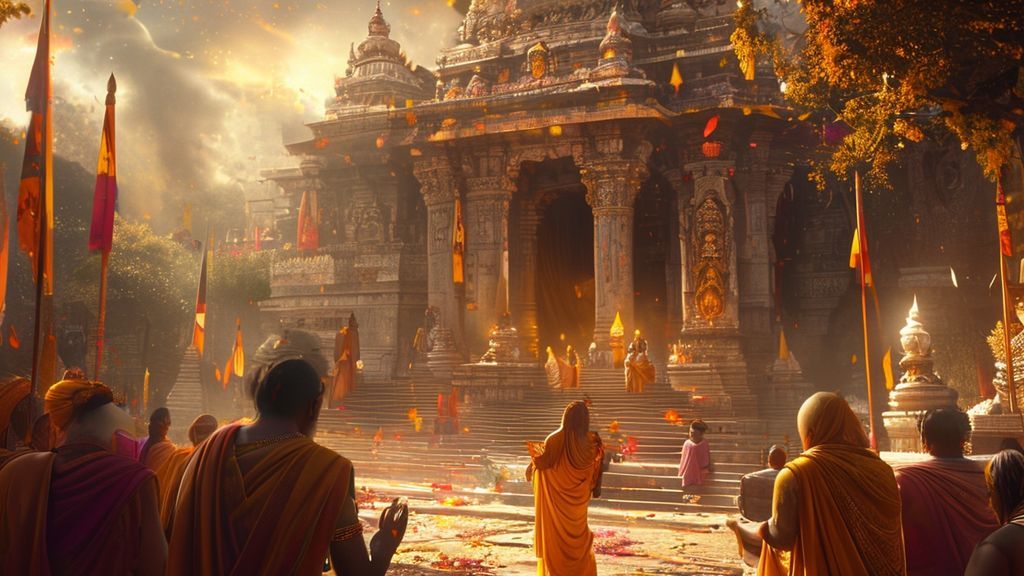
Bhagavad Gita Chapter 3, known as Karma Yoga, meticulously articulates the path of selfless action, guiding individuals to perform their duties without attachment to results. Lord Krishna teaches Arjuna that inaction is impossible and inferior to dedicated work offered as a sacrifice, emphasizing the importance of performing prescribed duties for societal welfare and spiritual liberation, thereby maintaining cosmic order and individual spiritual progress.
| Attribute | Details |
|---|---|
| Chapter Name | Karma Yoga (The Yoga of Action) |
| Location in Gita | Third Chapter |
| Key Speaker | Bhagavan Sri Krishna |
| Recipient | Arjuna |
| Central Theme | Performing duties without attachment to the fruits of action; righteous action for dharma. |
| Core Concepts | Niyatam Karma (Prescribed Duties), Anasakti Yoga (Detachment), Lokasangraha (Welfare of the World), Yajna (Sacrifice). |
| Key Verses | BG 3.9, BG 3.19, BG 3.27, BG 3.35 |
| Scripture Reference | Mahabharata, Bhishma Parva, Bhagavad Gita |
Introduction to Karma Yoga: The Divine Path of Action
In the profound spiritual discourse of the Bhagavad Gita, Chapter 3, titled Karma Yoga, unfolds as a foundational pillar of Sanatan Dharma. After Lord Krishna’s illuminating exposition on Jnana Yoga (the path of knowledge) and Buddhi Yoga (the yoga of intellect) in Chapter 2, Arjuna, bewildered, questions the necessity of action if knowledge is supreme. He asks, “If You consider intelligence to be better than fruitive work, O Janardana, then why are You engaging me in this ghastly war?” (BG 3.1). This chapter stands as the divine response, meticulously detailing why action, performed with the right understanding and attitude, is not merely inevitable but essential for spiritual progress and the maintenance of cosmic order. It is a guide for every devotee seeking to reconcile their worldly duties with their spiritual aspirations, demonstrating that genuine renunciation lies not in the abandonment of action, but in the renunciation of attachment to its results.
Puranic History & The Divine Context: Arjuna’s Dilemma
The narrative of the Bhagavad Gita is deeply embedded within the epic Mahabharata, specifically within the Bhishma Parva. On the battlefield of Kurukshetra, Arjuna, the mighty Pandava warrior, faces his kinsmen, gurus, and elders. Overwhelmed by grief and moral dilemma, he expresses his desire to abandon the war, believing that fighting would lead only to sin and sorrow. In the second chapter, Krishna patiently explains the immortality of the soul and the transient nature of the body, instructing Arjuna on the path of knowledge and the equanimity of the intellect. However, Arjuna, hearing of the superiority of intellect over fruitive action, misinterprets Krishna’s words, assuming that complete inaction or sannyasa (renunciation) is the prescribed path, even for a kshatriya like himself, whose duty is to fight for dharma. It is this profound misunderstanding that Krishna addresses in Chapter 3. He clarifies that mere cessation of action does not lead to freedom from karma, for even without external action, the mind continues to act and conceive. Thus, Krishna unequivocally establishes the supremacy of Karma Yoga – the performance of prescribed duties (Niyatam Karma) without attachment to the results, offering them as a sacrifice (Yajna). As stated in Bhagavad Gita 3.9: “यज्ञार्थात्कर्मणोऽन्यत्र लोकोऽयं कर्मबन्धनः। तदर्थं कर्म कौन्तेय मुक्तसङ्गः समाचर॥” (yajñārthāt karmaṇo ‘nyatra loko ‘yaṁ karma-bandhanaḥ | tad-arthaṁ karma kaunteya mukta-saṅgaḥ samācara ||) — “Work done as a sacrifice for Vishnu has to be performed; otherwise, work causes bondage in this material world. Therefore, O son of Kunti, perform your prescribed duties for His satisfaction, and in that way you will always remain free from bondage.” This forms the bedrock of Karma Yoga, ensuring that action becomes a means of liberation, not entanglement.
The Science of Action: Philosophical & Ethical Foundations
Karma Yoga is not merely a set of instructions; it is a profound scientific and ethical system for living. Lord Krishna meticulously explains the intricacies of action (karma), inaction (akarma), and forbidden action (vikarma). He elucidates that the three modes of material nature (gunas – sattva, rajas, tamas) compel every living entity to act, making inaction impossible (BG 3.5). The true essence of Karma Yoga lies in understanding that actions are performed by the material energy (Prakriti) and its gunas, and the deluded soul, identifying with the body, wrongly considers itself the doer. As described in Bhagavad Gita 3.27: “प्रकृतेः क्रियमाणानि गुणैः कर्माणि सर्वशः। अहङ्कारविमूढात्मा कर्ताहमिति मन्यते॥” (prakṛteḥ kriyamāṇāni guṇaiḥ karmāṇi sarvaśaḥ | ahaṅkāra-vimūḍhātmā kartāham iti manyate ||) — “The bewildered spirit soul, under the influence of the three modes of material nature, thinks himself to be the doer of activities, which are in actuality carried out by nature.” This understanding cultivates detachment from the ego-sense and the desire for results. Furthermore, Karma Yoga emphasizes Lokasangraha – working for the welfare and cohesion of society. Krishna Himself, as the perfect example, performs actions to set an ideal for humanity, even though He has no personal need to act. The chapter also stresses the importance of Svadharma, one’s own prescribed duties, stating that it is better to perform one’s own duty imperfectly than to perfectly perform another’s (BG 3.35).
Living Karma Yoga: A Practical Guide for Devotees
Embodying Karma Yoga is a transformative journey that refines the individual and purifies the consciousness. It is a dynamic spiritual practice applicable to every sphere of life. Here’s how one can integrate Karma Yoga into daily existence:
- Identify Your Svadharma: Understand your natural duties and responsibilities based on your station in life, family, profession, and societal role.
- Perform with Dedication: Execute your tasks with utmost sincerity, skill, and attention, striving for excellence as an offering to the Divine.
- Renounce Attachment to Results: Consciously detach from the outcome of your actions. Understand that you have control over your effort, but not over the fruits. Practice equanimity in success and failure.
- Cultivate a Sacrificial Spirit (Yajna Bhava): See all your actions as a form of sacrifice or service to the Divine, to humanity, or to the cosmic order. This transforms mundane work into a sacred offering.
- Purify Intentions: Regularly examine your motivations. Ensure your actions are driven by duty and dharma, rather than by selfish desires, greed, or ego.
- Maintain Equanimity: Practice mental balance and steadfastness (Sthita-prajna) amidst the dualities of life – pleasure and pain, honor and dishonor, success and failure.
- Reflect and Meditate: Regularly reflect on your actions and their impact. Combine action with periods of introspection and meditation to deepen your understanding of the self and the divine.
Mantras & Chants for the Karma Yogi
Reciting the sacred verses of the Bhagavad Gita helps engrain its wisdom into the heart. For the practitioner of Karma Yoga, the following slokas from Chapter 3 are particularly potent:
-
BG 3.9: यज्ञार्थात्कर्मणोऽन्यत्र लोकोऽयं कर्मबन्धनः। तदर्थं कर्म कौन्तेय मुक्तसङ्गः समाचर॥
Yajñārthāt karmaṇo ‘nyatra loko ‘yaṁ karma-bandhanaḥ | Tad-arthaṁ karma kaunteya mukta-saṅgaḥ samācara ||
Meaning: Work done as a sacrifice for Vishnu has to be performed; otherwise, work causes bondage in this material world. Therefore, O son of Kunti, perform your prescribed duties for His satisfaction, and in that way you will always remain free from bondage.
-
BG 3.19: तस्मादसक्तः सततं कार्यं कर्म समाचर। असक्तो ह्याचरन्कर्म परमाप्नोति पूरुषः॥
Tasmād asaktaḥ satataṁ kāryaṁ karma samācara | Asakto hyācaran karma param āpnoti pūruṣaḥ ||
Meaning: Therefore, without being attached to the fruits of activities, one should act as a matter of duty; for by working without attachment, one attains the Supreme.
-
BG 3.27: प्रकृतेः क्रियमाणानि गुणैः कर्माणि सर्वशः। अहङ्कारविमूढात्मा कर्ताहमिति मन्यते॥
Prakṛteḥ kriyamāṇāni guṇaiḥ karmāṇi sarvaśaḥ | Ahaṅkāra-vimūḍhātmā kartāham iti manyate ||
Meaning: The bewildered spirit soul, under the influence of the three modes of material nature, thinks himself to be the doer of activities, which are in actuality carried out by nature.
-
BG 3.35: श्रेयान्स्वधर्मो विगुणः परधर्मात्स्वनुष्ठितात्। स्वधर्मे निधनं श्रेयः परधर्मो भयावहः॥
Śreyān sva-dharmo viguṇaḥ para-dharmāt sv-anuṣṭhitāt | Sva-dharme nidhanaṁ śreyaḥ para-dharmo bhayāvahaḥ ||
Meaning: It is far better to discharge one’s prescribed duties, even imperfectly, than to perform another’s duties perfectly. Destruction in the course of performing one’s own duty is better than engaging in another’s duties, for to follow another’s path is dangerous.
Dos and Don’ts for the Aspiring Karma Yogi
- Do: Perform your duties with full attention and skill, seeing it as an offering.
- Don’t: Be driven solely by the desire for personal gain or fear of failure.
- Do: Cultivate detachment from the outcomes of your actions, accepting whatever comes with equanimity.
- Don’t: Abandon your responsibilities or neglect your prescribed duties.
- Do: Act for the welfare of others (Lokasangraha) and for the greater good of society.
- Don’t: Allow your actions to be motivated by ego, pride, or self-aggrandizement.
- Do: Remain steadfast in your Svadharma, even if it seems difficult or unglamorous.
- Don’t: Compare your duties or results with others, leading to envy or despair.
Frequently Asked Questions on Karma Yoga
What is the difference between Karma Yoga and Sannyasa (Renunciation)?
Karma Yoga emphasizes performing action without attachment to results, living in the world but not being of it. Sannyasa, in its traditional form, involves the complete cessation of all worldly duties and pursuits, focusing solely on spiritual realization. Krishna clarifies in Chapter 3 that true sannyasa is not merely giving up action, but giving up the desire for the fruits of action. A true Karma Yogi is a Sannyasi at heart, even while engaged in the world.
Can a person truly live without performing any action?
No, Lord Krishna unequivocally states in Bhagavad Gita 3.5 that “Not even for a moment can one remain without performing action.” Even breathing, thinking, and digesting are actions. The body, mind, and senses are always engaged. True inaction is impossible in the material realm, making the path of Karma Yoga the only practical and liberating choice for an embodied soul.
How does Karma Yoga lead to liberation (Moksha)?
By performing actions without attachment to their fruits, the Karma Yogi gradually purifies the mind. This purification leads to the eradication of desires, ego, and the accumulation of new karma. When actions are performed as an offering to the Divine, they cease to bind the soul, leading to freedom from the cycle of birth and death, and ultimately, to self-realization and liberation.
What is “Lokasangraha” in the context of Karma Yoga?
Lokasangraha (लोकसंग्रह) refers to the maintenance of universal order, the welfare of the world, and holding society together. Krishna emphasizes that leaders and wise persons must engage in action not for their own benefit, but to set an example for others and to maintain social harmony and righteousness. Their actions serve as a guide for the masses, ensuring that society functions according to dharma. You can explore more about this crucial concept and its practical application for modern Hindus on Hindutva.online.
Karma Yoga: The Eternal Preservation of Sanatan Dharma
Bhagavad Gita Chapter 3, Karma Yoga, provides an eternal blueprint for righteous living, making it indispensable for the preservation and understanding of Sanatan Dharma. It teaches that spiritual life is not an escape from worldly duties but a transformation of them. By aligning our actions with dharma, performing them selflessly, and offering them to the Divine, we contribute not only to our individual liberation but also to the stability and progress of the entire cosmos. This profound teaching empowers every Hindu to find sanctity in their daily work, transforming mundane tasks into sacred offerings, and thus upholding the eternal principles of truth, righteousness, and cosmic harmony.