

The Brihadeeswara Temple towers 216 feet (66 meters) above Thanjavur, crowned by an 80-ton monolithic granite capstone that has baffled engineers for over a millennium regarding how it was lifted to such heights without modern machinery. Built between 1003-1010 CE by the illustrious Chola emperor Raja Raja Chola I, this UNESCO World Heritage Site represents the pinnacle of Dravidian architectural achievement and stands as testimony to 11th-century Tamil engineering genius that rivals—and in some aspects surpasses—contemporary medieval European construction techniques.

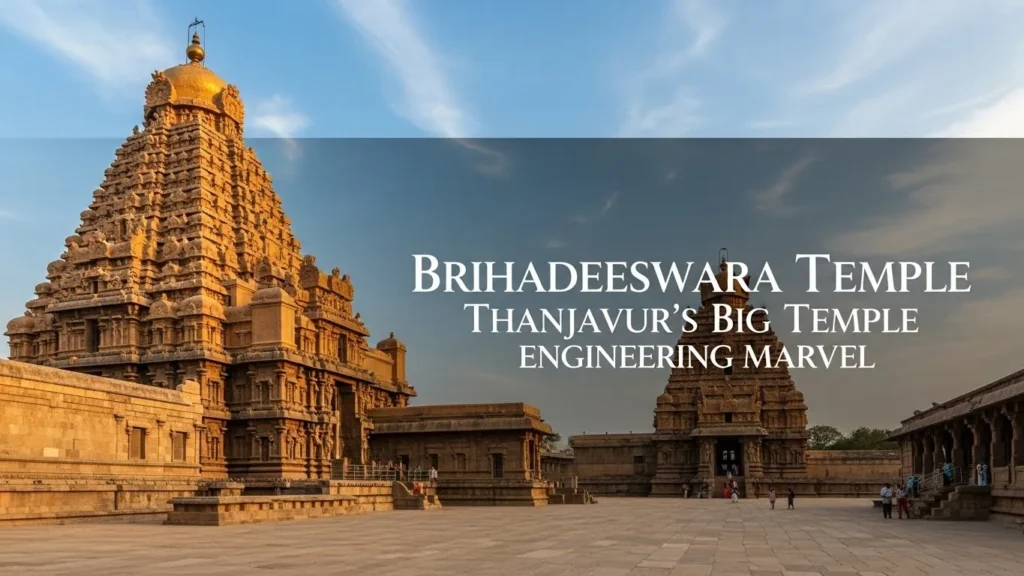
The temple’s most astounding feature is its complete construction using interlocking granite blocks without any mortar, cement, or binding material, relying purely on precise stone-cutting, advanced corbelling techniques, and sophisticated weight distribution that has enabled the structure to survive over 1,000 years including at least six major earthquakes.
Spread across 47 acres (some sources cite 40 acres), the temple complex showcases the Chola dynasty’s imperial ambitions, administrative sophistication, and unparalleled artistic capabilities. The massive 20-foot-high monolithic Nandi (sacred bull) carved from a single stone, towering sculptures, elaborate murals depicting Shaivite legends, and over 1,300 inscriptions documenting temple administration transform Brihadeeswara into a comprehensive archive of 11th-century Tamil civilization. This comprehensive guide explores the temple’s construction mysteries, architectural innovations, historical significance, daily rituals, and practical visiting information for 2026.
Historical Context: Raja Raja Chola I’s Vision
Raja Raja Chola I (985-1014 CE) ascended to power when the Chola Empire dominated South India, controlling territories from Sri Lanka to coastal Andhra Pradesh and establishing naval supremacy across the Bay of Bengal. The emperor’s military conquests and administrative reforms generated unprecedented wealth, enabling ambitious cultural patronage that included extensive temple construction, literary achievements, and artistic renaissance. The Brihadeeswara Temple, originally named “Rajarajeswaram” after its founder, served multiple functions beyond religious worship—it symbolized imperial power, functioned as administrative hub managing vast temple lands and wealth, and demonstrated Tamil civilization’s architectural superiority.
The temple’s construction timeline reveals remarkable efficiency—commenced around 1003 CE and completed by 1010 CE, a mere seven years for a structure of such monumental scale and complexity. This rapid construction required extraordinary organization, resource mobilization, and coordination of thousands of skilled artisans, laborers, and administrative personnel. According to temple inscriptions, the architect Kunjara Mallan Raja Raja Perunthachchan designed and executed the project, though undoubtedly coordinating massive teams of specialists including stone-cutters, sculptors, masons, engineers, and laborers.
The temple was consecrated in the 25th regnal year of Raja Raja Chola I (1010 CE) with elaborate ceremonies befitting an imperial foundation. The event marked not merely a religious milestone but a political statement affirming Chola supremacy and cultural sophistication. The temple’s scale—deliberately designed to inspire awe comparable to devotion owed to Lord Shiva himself—communicated that the Chola emperor commanded resources and capabilities rivaling divine powers.
Stone procurement presented formidable logistical challenges—the granite used throughout the temple came from quarries located 60-100 kilometers away, requiring transport of massive blocks weighing many tons each across considerable distances using only human and animal power. The temple complex utilized thousands of precisely cut granite pieces, with the heaviest—the 80-ton capstone—representing the construction’s most spectacular achievement. The successful completion within seven years despite these challenges testifies to the Chola administration’s organizational excellence and the Tamil people’s collective commitment to this monumental undertaking.
Engineering Marvels: The 80-Ton Capstone Mystery
The temple’s most enigmatic feature is the massive monolithic granite capstone (kumbam/kalasha) weighing approximately 80 tons that crowns the 216-foot-tall vimana (temple tower). How 11th-century engineers lifted this enormous single piece of granite to such heights—equivalent to a modern 20-story building—without cranes, pulleys, or modern machinery continues to puzzle scholars and inspire awe in visitors. The capstone has remained perfectly positioned for over 1,000 years, demonstrating the precision of its placement and the engineering calculations ensuring its stability.
Three principal theories attempt to explain the capstone’s installation:
Theory 1: The 6-Kilometer Ramp
The most widely accepted explanation proposes construction of a massive inclined ramp extending approximately 6 kilometers from ground level to the vimana’s summit. Engineers would have gradually built an earthen or stone ramp at a gentle incline (approximately 1:20 ratio) running from the quarry site or staging area to the temple’s apex. The 80-ton capstone would be rolled, dragged, or transported on log rollers up this massive ramp using elephants, oxen, and hundreds of laborers pulling ropes in coordinated effort.
This theory aligns with construction techniques documented in ancient Indian texts and archaeological evidence from other large-scale projects. Once the capstone reached the summit and was positioned, the ramp would be dismantled and removed, leaving no physical trace. The efficiency of completing this within the seven-year construction timeline suggests sophisticated project management and massive labor deployment.
Theory 2: Circular/Spiral Ramp Around the Vimana
An alternative hypothesis suggests builders constructed a spiral ramp wrapping around the vimana itself, gradually ascending as each story was completed. This approach would require less total ramp volume than a linear 6-kilometer structure and could be integrated into the construction process, with the ramp serving to transport materials for each successive level. Elephants and human teams would pull the capstone up the gradually ascending circular path.
This method’s advantage lies in its efficiency and reduced material requirements. However, skeptics question whether the ramp’s support structure could bear the 80-ton load while maintaining sufficient width for elephant teams and hundreds of workers. The precision required to align the ascending path with the vimana’s narrowing profile at each level adds complexity to this theory.
Theory 3: Lever and Counterweight Systems
Some researchers propose sophisticated lever mechanisms and counterweight systems that progressively lifted the capstone in stages, similar to techniques used in Egyptian pyramid construction. This would involve creating a series of platforms at increasing heights, using massive wooden levers fulcrumed on precisely positioned stones, with counterweights (possibly water-filled containers or additional stone masses) facilitating controlled lifting.
While this theory demonstrates ancient engineering sophistication, it faces challenges explaining how such systems could function at extreme heights with the margin for error decreasing as elevation increased. The precision required to avoid catastrophic failure during the final placement stages would demand extraordinary mathematical calculations and structural engineering knowledge.
Architectural Innovations and Sacred Geometry
The Brihadeeswara Temple exemplifies advanced dry masonry construction where granite blocks interlock with remarkable precision, eliminating any need for mortar or binding agents. This technique, requiring meticulous stone-cutting accuracy measured in millimeters, creates structural stability through perfectly fitted joints using tenons and mortises—projecting stone elements fitting into corresponding recesses in adjacent blocks. The interlocking system distributes weight evenly across the structure while providing flexibility that enables earthquake resistance by allowing slight movement without catastrophic failure.
Key architectural and engineering features:
The Towering Vimana (Main Shrine Tower)
The vimana rises 216 feet (66 meters) in a stepped pyramidal form consisting of 13 stories that gradually taper as they ascend. Unlike typical Dravidian temples where gateway gopurams tower over the main shrine, Brihadeeswara’s vimana dominates the entire complex—a conscious design choice emphasizing the deity’s supremacy and the structure’s singular grandeur. Each of the 13 tiers features diminishing dimensions following precise geometric ratios that create visual harmony while ensuring structural stability.
The vimana’s construction demonstrates sophisticated corbelling techniques—successive horizontal layers of granite extending slightly beyond the layer below, gradually reducing the tower’s cross-section while maintaining structural integrity. This architectural method, perfected by Chola engineers, creates the characteristic stepped profile while distributing the massive weight downward through each successive level.
No-Shadow Phenomenon
One of the temple’s most remarkable features is the architectural design ensuring the vimana casts no shadow at noon during certain times of the year. This phenomenon, achieved through precise alignment with solar paths and careful calculation of the structure’s geometry, demonstrates advanced astronomical knowledge integrated into architectural planning. The temple’s orientation follows cardinal directions with exactitude, aligning the main sanctum eastward to capture sunrise rays that illuminate the Shiva lingam during equinoxes.
Foundation-Free Construction
Astonishingly, no deep foundation was excavated for the temple—the entire structure rests on the ground with only minimal leveling. Despite this, the temple has survived over 1,000 years including at least six major earthquakes that devastated surrounding areas. This counterintuitive stability derives from the interlocking masonry system’s flexibility and the structure’s massive weight (estimated at hundreds of thousands of tons) that anchors it firmly. The absence of rigid foundations allows the building to move slightly during seismic events without structural failure, functioning as a primitive but effective seismic isolation system.
Vastu Shastra and Sacred Geometry
The temple’s layout strictly follows Vastu Shastra principles—the ancient Indian science of architecture aligning buildings with cosmic order and natural energies. Every dimension, proportion, and spatial relationship was precisely calculated and positioned according to sacred geometric principles that transform the structure into a three-dimensional yantra (mystical diagram). The sanctum sanctorum’s positioning at the cosmic center (Brahma Pada), the alignment with cardinal directions, and the proportional relationships between different architectural elements create harmonious energy flows believed to enhance spiritual experience.
Sculptural and Artistic Treasures
The Monolithic Nandi
The massive Nandi (sacred bull, Lord Shiva’s mount) housed in a later-period mandapa near the entrance ranks among India’s largest monolithic sculptures. Carved from a single granite block, the Nandi measures approximately 16-20 feet in length, 12-13 feet in height, and 8 feet in width, weighing multiple tons. The sculpture’s impeccable proportions, muscle definition, and serene expression demonstrate the sculptors’ sophisticated anatomical knowledge and artistic mastery.
The Nandi faces the main sanctum, creating visual and spiritual alignment that guides devotees’ focus toward the Shiva lingam within the inner shrine. This positioning reflects Hindu philosophy principles regarding the relationship between devotee (symbolized by Nandi) and deity—the eternal servant-master dynamic where the faithful always orient toward divine presence.
Chola-Period Murals and Frescoes
The temple’s inner walls preserve magnificent Chola-period murals depicting scenes from Shaivite mythology, particularly narratives about the 63 Nayanars (Tamil Shaivite saints) and various manifestations of Lord Shiva. These paintings, executed using natural mineral pigments on lime-plastered surfaces, demonstrate sophisticated artistic techniques including perspective, narrative composition, and color theory. Later Nayaka-period murals overlay some Chola works, creating palimpsest layers documenting evolving artistic styles.
The frescoes include rare depictions of Shiva as Nataraja (cosmic dancer), Ardhanarishvara (half-male, half-female form representing the unity of Shiva and Shakti), and various legends including his marriage to Parvati and conquest of demons. The paintings’ survival for over 1,000 years testifies to the Chola artists’ technical skill in creating durable works and the temple’s protective environment preserving these fragile treasures.
Sculptural Programs
The outer walls feature elaborate sculptures in niches at each level, depicting various deities, celestial beings, and mythological narratives. Notable sculptures include:
- Nataraja in various dancing poses
- Dvarapalas (door guardians) at entrances
- Ashta-Dikpalas (eight directional guardians) protecting cardinal and ordinal directions
- Divine couples in graceful postures
- Narrative reliefs showing Shiva’s miracles and legends
One mysterious carving depicts what appears to be a European figure, sparking speculation about medieval trade connections between the Chola Empire and European/Mediterranean civilizations. This enigmatic sculpture remains unexplained, though it may represent foreign traders, ambassadors, or travelers who visited Thanjavur during the Chola period’s extensive maritime commerce.
Inscriptions: A Thousand-Year Archive
The temple contains over 1,300 inscriptions in Tamil and Sanskrit documenting temple administration, land grants, ritual prescriptions, donor records, and historical events. These epigraphic records provide invaluable information about:
- Temple economy: Lands owned, revenues collected, employee salaries
- Administrative structure: Hierarchies of priests, dancers, musicians, and servants
- Ritual schedule: Daily and annual ceremonial calendars
- Royal patronage: Gifts from Raja Raja Chola I and successive rulers
- Social structure: Caste organization, gender roles, and community participation
The inscriptions transform Brihadeeswara into a living historical archive, preserving documentation that illuminates 11th-century Tamil society with unparalleled detail. Scholars continue studying these inscriptions, revealing new insights about Chola civilization’s political, economic, and cultural dimensions.
Daily Rituals and Temple Life
The Brihadeeswara Temple maintains active worship following ancient ritual prescriptions established during Raja Raja Chola I’s reign. The temple operates on a daily schedule treating Lord Shiva with royal reverence befitting the deity’s cosmic status and the emperor’s divine association. Hereditary priests from traditional Brahmin families perform six major pujas daily, maintaining unbroken continuity with 1,000-year-old practices.
Daily Ritual Schedule (2026):
Major festivals observed:
- Maha Shivaratri: Most significant annual celebration honoring Lord Shiva
- Thai Poosam: Celebration in Tamil month of Thai (January-February)
- Arudra Darshan: Commemorates Shiva as cosmic dancer Nataraja
- Annual Brahmotsavam: Multi-day festival with processions and special rituals
During festivals, the temple extends hours and conducts additional ceremonies accommodating increased devotee participation. The Hindu temple practices maintained at Brihadeeswara preserve authentic Chola-period ritual traditions, offering contemporary visitors genuine connections to medieval Tamil spirituality.
UNESCO World Heritage Designation
Brihadeeswara Temple received UNESCO World Heritage status in 1987 as part of the “Great Living Chola Temples” serial property, later expanded in 2004 to include the Airavatesvara Temple at Darasuram and Gangaikonda Cholapuram Temple. UNESCO recognizes the temples as exceptional examples of Chola architectural achievement and testimony to the dynasty’s cultural sophistication, technological capabilities, and artistic excellence during the 11th-13th centuries.
The designation criteria emphasize:
- Masterpiece of human creative genius in architectural design and engineering innovation
- Outstanding example of architectural ensemble illustrating Dravidian style at its zenith
- Exceptional testimony to cultural tradition of Chola civilization
- Living heritage maintaining unbroken ritual and devotional traditions for over 1,000 years
UNESCO monitoring ensures conservation follows international standards, balancing preservation of historical authenticity with accommodation of ongoing worship. The Archaeological Survey of India (ASI) manages the temple, implementing regular maintenance, structural monitoring, and controlled tourism to protect this irreplaceable cultural treasure for future generations.
Visiting Information: Timings and Practical Details
Temple Hours (2026):
Entry and Photography:
- Entry Fee: Free for all visitors (Indian and foreign nationals)
- Photography: Allowed in exterior areas; restrictions may apply inside sanctum
- Footwear: Must be removed before entering temple premises; shoe storage available
- Dress Code: Modest clothing covering shoulders and legs recommended; traditional attire appreciated
Best Times to Visit:
- Early Morning (6:00-8:00 AM): Fewer crowds; excellent natural lighting for photography; peaceful atmosphere for contemplation
- Late Afternoon (4:00-6:00 PM): Golden hour photography opportunities; pleasant temperatures
- Avoid Midday: Temple closed 12:30-4:00 PM and intense heat makes exterior exploration uncomfortable
Guided Tours:
- Archaeological Survey of India-approved guides available at entrance (₹300-500)
- Provide historical context, architectural explanations, and point out easily missed details
- Audio guides may be available; check current offerings at ticket counter
Recommended Visit Duration:
- Minimum: 1.5-2 hours for basic temple circuit
- Comprehensive: 3-4 hours including museum, murals, inscriptions, and detailed architectural study
- Dedicated study: Full day for photography, research, or in-depth exploration
How to Reach Thanjavur
By Air: Tiruchirappalli International Airport (Trichy) is the nearest airport, located approximately 60 kilometers from Thanjavur. The airport offers domestic connections to Chennai, Bangalore, Mumbai, Delhi, and international flights to Sri Lanka, Singapore, Dubai, and other destinations. From Trichy airport, hire taxis (₹1,200-1,800) or board buses (₹50-100) for the 1.5-2 hour journey to Thanjavur.
By Train: Thanjavur Junction railway station enjoys excellent connectivity across South India and major Indian cities. Direct trains operate from:
- Chennai (5-6 hours)
- Bangalore (7-8 hours)
- Madurai (3-4 hours)
- Trichy (1-1.5 hours)
- Rameswaram (5-6 hours)
The temple is located approximately 0.5-1 kilometer from Thanjavur Junction, accessible by auto-rickshaws (₹30-50), cycle-rickshaws, or walking.
By Road: Thanjavur connects to all Tamil Nadu cities via well-maintained highways:
- Chennai to Thanjavur: 340 km (6-7 hours)
- Trichy to Thanjavur: 55 km (1-1.5 hours)
- Madurai to Thanjavur: 190 km (3.5-4 hours)
- Kumbakonam to Thanjavur: 40 km (1 hour)
Tamil Nadu State Transport Corporation (TNSTC) operates extensive bus services including ordinary, express, and luxury coaches. Private operators offer AC sleeper and seater buses on major routes.
Local Transportation in Thanjavur:
- Auto-rickshaws: Most common; negotiate fare or use meter
- Cycle-rickshaws: Slower but economical for short distances
- Local buses: Frequent services from Old Bus Stand to temple area
- Walking: If staying centrally near the temple, most attractions are accessible on foot
The Thanjavur Old Bus Stand (Town Bus Stand) is located very close to the temple (walkable distance), while the New Bus Stand is about 5 kilometers away. Mini buses and city buses connect the New Bus Stand to the temple area frequently.
Accommodation: Thanjavur offers diverse options from budget lodges (₹500-1,000/night) near the temple to mid-range hotels (₹1,500-3,500) and heritage properties. Staying near the temple enables easy early morning visits and multiple darshan opportunities.
Frequently Asked Questions
What are the Brihadeeswara Temple timings?
The temple opens 6:00 AM to 12:30 PM for morning darshan and 4:00 PM to 8:30 PM for evening darshan. The temple is open all days with no weekly closure, though hours may extend during major festivals. Arrive early morning (6:00-8:00 AM) for fewer crowds and excellent photography light.
How was the 80-ton capstone placed on top?
The 80-ton monolithic granite capstone was likely lifted using a massive 6-kilometer earthen/stone ramp from ground level to the 216-foot summit, with elephants and hundreds of workers pulling the stone. Alternative theories suggest spiral ramps around the vimana or sophisticated lever-counterweight systems. The precise method remains debated, though the achievement demonstrates extraordinary 11th-century engineering capabilities.
Is there an entry fee?
Entry is free for all visitors—both Indian nationals and foreign tourists. Photography is generally allowed in exterior areas, though restrictions may apply inside the sanctum. Approved guides are available for hire (₹300-500) for enhanced understanding of the temple’s history and architecture.
Why is it called the Big Temple?
The temple earned the name “Big Temple” (Periya Kovil in Tamil) due to its massive scale—the 216-foot-tall vimana, 47-acre complex, enormous monolithic Nandi, and gigantic Shiva lingam all justify this colloquial designation. The temple remains one of India’s tallest and largest temple structures built entirely of stone without modern construction techniques.
How long did construction take?
The temple was built in just 7 years (1003-1010 CE) under Raja Raja Chola I’s patronage. This remarkably rapid timeline for such a monumental structure demonstrates the Chola Empire’s organizational capabilities, resource mobilization, and coordination of thousands of skilled artisans and laborers working simultaneously.
How did the temple survive 1,000 years without foundations?
The temple’s survival despite no deep foundations and six major earthquakes is attributed to its interlocking granite block construction without mortar. The precision-fitted stones using tenons and mortises create flexible structural integrity that allows slight movement during seismic events without catastrophic failure. The massive weight also anchors the structure firmly to the ground.
What is the no-shadow phenomenon?
The temple is architecturally designed so the vimana casts no shadow at noon during certain times of the year. This phenomenon results from precise alignment with solar paths and calculated geometry, demonstrating advanced astronomical knowledge integrated into architectural planning. The eastward orientation also ensures sunrise rays illuminate the Shiva lingam during equinoxes.
How do I reach the temple from Thanjavur Railway Station?
The temple is located 0.5-1 kilometer from Thanjavur Junction, easily accessible by auto-rickshaw (₹30-50), cycle-rickshaw, or walking. From Thanjavur Old Bus Stand (Town Bus Stand), the temple is at walkable distance. From the New Bus Stand (5 km away), take mini buses or city buses to the Old Bus Stand, then walk to the temple.
Conclusion
The Brihadeeswara Temple stands as an enduring monument to Raja Raja Chola I’s vision and Tamil civilization’s architectural genius—a structure that continues defying modern engineering understanding while maintaining active worship for over 1,000 years. The 80-ton capstone crowning the 216-foot vimana, the foundation-free construction surviving multiple earthquakes, the shadowless phenomenon at noon, and the precision interlocking of granite blocks without mortar collectively demonstrate that ancient Tamil engineers possessed sophisticated technical knowledge rivaling contemporary civilizations anywhere in the medieval world.
Beyond its engineering marvels, the temple embodies comprehensive cultural achievement—the magnificent Chola murals, the massive monolithic Nandi, the 1,300+ inscriptions documenting temple administration, and the unbroken ritual traditions maintained by hereditary priests connect contemporary visitors to the living heritage of 11th-century South India. The temple functioned not merely as worship space but as administrative center, economic institution, artistic patron, and imperial symbol demonstrating Chola supremacy across South and Southeast Asia.
The UNESCO World Heritage designation ensures international commitment to preserving this irreplaceable cultural treasure while enabling millions of devotees and admirers to experience its sublime grandeur. Visiting Brihadeeswara in 2026 requires minimal planning—free entry, convenient location in Thanjavur, excellent connectivity, and comprehensive facilities make this architectural wonder accessible to all. Whether approached as spiritual pilgrimage, architectural study, historical exploration, or cultural appreciation, the Big Temple rewards genuine engagement with experiences transcending ordinary tourism.
As we navigate the complexities of modern existence, temples like Brihadeeswara remind us that Hindu philosophy and Tamil civilization created enduring masterpieces through devotion, knowledge, collective effort, and unwavering commitment to excellence—principles that remain timelessly relevant for contemporary challenges requiring vision, coordination, and sustained dedication to worthy goals.
About the Author
Anjali Deshmukh – Historian & Vedic Scholar
Anjali Deshmukh is a distinguished historian specializing in ancient Indian history and Vedic philosophy. With a Ph.D. in Indology from Banaras Hindu University, he has authored several acclaimed works on Hindu temples, decolonizing historical narratives, and the contributions of Hindu civilization to global knowledge systems. Anjali Deshmukh is a passionate advocate for accurate historical representation and cultural preservation.