


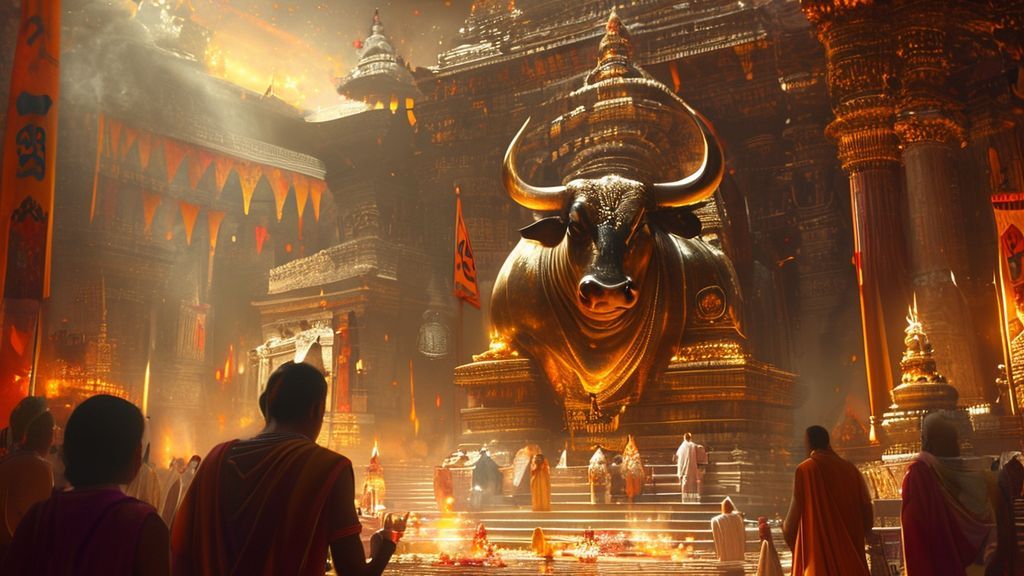
Bull Dream: Nandi and Shiva Connection represents the profound spiritual bond between the supreme ascetic Lord Shiva and his foremost devotee, Nandi (नन्दी), the divine bull. Dreaming of a bull, particularly Nandi, is a potent spiritual sign in Sanatan Dharma, often symbolizing unwavering devotion, strength, purity, and the protective grace of Lord Shiva, inviting the seeker towards deeper spiritual contemplation and adherence to Dharma.
| Attribute | Details |
|---|---|
| Deity | Nandi (नन्दी), also known as Nandikeshwara |
| Connection to Shiva | Chief of Shiva’s Ganas (attendants), primary Vahana (mount), Guardian of Kailasa, epitome of devotion. |
| Key Qualities Symbolized | Dharma, Bhakti (devotion), Tapasya (austerity), Strength, Protection, Purity, Patience, Knowledge. |
| Scripture References | Shiva Purana, Linga Purana, Skanda Purana, Vayu Purana, Mahabharata, Ramayana. |
Introduction: Nandi – The Embodiment of Devotion
In the vast tapestry of Sanatan Dharma, few figures command as much reverence and spiritual significance as Nandi, the divine bull. More than merely a mount for Lord Shiva, Nandi is the very embodiment of Dharma, unwavering devotion, and rigorous penance. His presence at the entrance of every Shiva temple is not coincidental; it is a profound philosophical statement, instructing every devotee on the path to Shiva consciousness. Nandi represents the controlled mind, focused completely on the Divine, a prerequisite for any sincere seeker wishing to approach the Supreme Yogi, Mahadeva. He symbolizes the animalistic tendencies (like desire and ego) that, when surrendered to the divine, transform into instruments of spiritual ascent.
The sacred bull has been revered since Vedic times, long before the Puranic narratives solidified Nandi’s specific identity. The bulls mentioned in the Vedas, often associated with powerful deities like Indra (as a symbol of strength and virility), later converged into the iconic figure of Nandi in the Shaiva tradition. This deep historical and spiritual resonance underscores Nandi’s critical role in understanding the very essence of Shiva Bhakti. For those seeking deeper insights into such foundational aspects of Hinduism, Hindutva.online offers extensive resources.
Puranic History & Legend: The Origins of Nandikeshwara
The scriptures narrate several captivating accounts of Nandi’s genesis, each highlighting different facets of his divine personality and profound connection to Lord Shiva.
The Birth from Sage Shilada’s Penance
The most widely recognized origin story, prominently featured in the Shiva Purana (Rudra Samhita, Sati Khanda, Chapter 15-16) and the Linga Purana, describes Nandi as the son of the revered sage Shilada. Shilada performed intense austerities (tapasya) for a child who would be immortal and free from disease. Lord Indra initially appeared, offering boons, but Shilada desired a divine child. Eventually, Lord Shiva himself appeared and granted Shilada a boon: a child would be born to him without being conceived, emanating directly from a yagna performed by the sage. Thus, Nandi was born from the sacrificial fire, radiating divine effulgence.
Upon Nandi’s birth, celestial beings prophesied his short lifespan. Distraught, Shilada imparted all knowledge to his son. Nandi, however, was undeterred. Guided by his inner wisdom and devotion, he went to the Nivritti Sangam and performed severe penance for Shiva. Pleased by Nandi’s unwavering devotion, Lord Shiva appeared and blessed him with immortality, transforming him into Nandikeshwara (Lord of Nandi), the chief of His Ganas, His closest attendant, and His divine vahana. Shiva also performed Nandi’s marriage to Suyasha, daughter of the Maruts.
Nandi as the Embodiment of Dharma
The Vayu Purana presents Nandi as a manifestation of Dharma (righteousness) itself, often depicted as a bull with four legs, symbolizing the four pillars of Dharma: Tapas (austerity), Shaucha (purity), Daya (compassion), and Satya (truth). In the Kali Yuga, Dharma is said to stand on one leg, indicating its diminished state. Nandi, in this context, constantly upholds and represents the complete, unwavering Dharma, reminding devotees of its eternal principles.
Nandi’s Role in Cosmic Events
While not always explicitly stated as Nandi himself, Shiva’s Ganas, led by Nandi, play crucial roles in many Puranic events. During the Samudra Manthan (churning of the cosmic ocean), when the deadly poison Halahala emerged, it was Shiva who consumed it to save the universe. Nandi, as Shiva’s chief Gana, is often depicted as having a close presence during such cosmic endeavors, ready to assist his Lord. Furthermore, in the Ramayana (Uttara Khanda), Nandi famously cursed Ravana, who had mocked Nandi’s appearance, proclaiming that monkeys would be the cause of his downfall and the destruction of Lanka. This prophecy indeed came true with Lord Rama’s vanara sena.
Architectural & Scientific Marvels: Nandi in Temple Design
The placement and posture of Nandi statues in Shiva temples are not mere decorative elements; they are imbued with profound spiritual and architectural significance, reflecting deep knowledge of sacred geometry and devotee psychology.
The Unwavering Gaze towards Shiva
In virtually every Shiva temple, a majestic statue of Nandi is positioned directly facing the main shrine (garbhagriha), where the Shiva Lingam resides. This placement symbolizes Nandi’s eternal, unwavering gaze and complete focus on Lord Shiva. It teaches devotees the ideal state of meditation and devotion – a mind fixed solely on the Divine. His ears are often tilted forward, suggesting an attentive listener, absorbing every prayer and plea directed towards Shiva.
Symbolism of Posture and Material
Nandi is almost always depicted in a seated, alert posture, often with one ear slightly cocked. This signifies deep contemplation, readiness, and constant vigilance. The statues, often carved from granite, black stone, or polished basalt, represent strength, steadfastness, and immutability. The size of Nandi sculptures varies dramatically, from small effigies to colossal monolithic structures like the one at Lepakshi in Andhra Pradesh or the impressive Nandi at the Brihadeeswarar Temple in Thanjavur (Dravidian style architecture), reflecting the devotion and resources of the patrons and the architectural prowess of the builders. These structures are often integrated into the temple’s central axis, reinforcing the spiritual alignment.
Rituals & Puja Vidhi: Approaching Nandikeshwara
Worshipping Nandi is an integral part of Shiva puja, as he is the primary gateway to Lord Shiva’s grace. Devotees often begin their darshan by offering reverence to Nandi.
- Pradakshina (Circumambulation): Upon entering a Shiva temple, devotees first perform pradakshina around the outer precincts. Before approaching the main shrine, it is customary to circumambulate Nandi, showing respect.
- Whispering Wishes: A common practice is to whisper one’s wishes or prayers into Nandi’s left ear. It is believed that Nandi, being Shiva’s closest attendant, relays these prayers directly to the Lord. This should be done respectfully, covering the mouth, and with pure intent.
- Offerings: Devotees offer fresh flowers, Bilva leaves (especially sacred to Shiva), water, milk, and sometimes fruits or sweets to Nandi. Applying vermillion (sindoor) and turmeric (haldi) paste to his hump is also a traditional practice.
- Meditation and Focus: Before entering the sanctum, devotees often sit for a few moments, fixing their gaze on Nandi, and through him, on Shiva. This helps to quiet the mind and prepare for the divine darshan.
The act of worshipping Nandi teaches humility and the importance of devotion as a means to reach the Supreme.
Mantras & Chants: Invoking Nandi’s Blessings
Chanting mantras dedicated to Nandi helps to connect with his divine energy and seek his blessings, particularly for strength, devotion, and removal of obstacles.
- Basic Nandi Mantra:
ॐ नंदीश्वराय नमः ॥ (Om Nandishwaraya Namaha)
Meaning: Salutations to Nandishwara, the Lord of Nandi.
- Nandi Gayatri Mantra (for deeper connection):
ॐ तत्पुरुषाय विद्महे, महादेवाय धीमहि । तन्नो वृषभ प्रचोदयात् ॥
(Om Tatpurushaya Vidmahe, Mahadevaya Dheemahi। Tanno Vrishabha Prachodayat॥)
Meaning: May we know that Supreme Being, the Great God. May Lord Vrishabha (Nandi) enlighten and inspire us.
- The Mahamrityunjaya Mantra: While not exclusively for Nandi, chanting the Mahamrityunjaya Mantra is also considered beneficial, as Nandi is intrinsically linked to Shiva’s protective energy.
ॐ त्र्यम्बकं यजामहे सुगन्धिं पुष्टिवर्धनम् । उर्वारुकमिव बन्धनान् मृत्योर्मुक्षीय मामृतात् ॥
(Om Tryambakam Yajamahe Sugandhim Pushtivardhanam। Urvarukamiva Bandhanan Mrityor Mukshiya Maamritat॥)
These chants purify the mind and align the devotee’s consciousness with the attributes of Nandi: unwavering focus, strength, and pure devotion.
Dos and Don’ts When Interacting with Nandi
Adhering to proper etiquette ensures reverence and respect for the divine presence of Nandi.
- DO approach Nandi with humility and folded hands.
- DO offer fresh flowers, Bilva leaves, water, or milk.
- DO whisper your prayers gently into Nandi’s left ear, covering your mouth with your hand.
- DO perform Pradakshina around Nandi before entering the main shrine.
- DO maintain cleanliness and purity in thought and deed.
- DON’T speak loudly or disrespectfully near Nandi.
- DON’T lean or sit on Nandi’s statue.
- DON’T block the view of Nandi facing the Shiva Lingam.
- DON’T offer stale or impure items.
- DON’T use Nandi’s image for any trivial or disrespectful purpose.
What does seeing a bull in a dream signify in Hinduism?
In Hinduism, a bull in a dream, especially a white or divine bull, is considered highly auspicious. It often symbolizes Dharma, strength, fertility, prosperity, and spiritual advancement. Dreaming of Nandi specifically indicates divine protection, the fulfillment of wishes through devotion, or a call to strengthen one’s spiritual practices and connection with Lord Shiva. It can signify that Shiva’s grace is upon you, guiding you or offering protection against adversities.
Why is Nandi always placed facing Lord Shiva?
Nandi is always placed facing Lord Shiva to symbolize his eternal and unwavering devotion, attention, and readiness to serve his Lord. This posture signifies complete surrender (Sharanagati) and singular focus (Ekagrata) on the Divine. It serves as a constant reminder to devotees that the path to Shiva consciousness requires an undistracted, devoted mind, just like Nandi’s steadfast gaze.
Is Nandi considered a separate deity or an aspect of Shiva?
Nandi is considered a distinct divine being, revered as a deity in his own right, often worshipped as Nandikeshwara. However, his existence is inextricably linked to Lord Shiva. He is not an aspect or an avatar of Shiva, but rather Shiva’s chief attendant, a devoted bhakta, and the embodiment of Shiva’s principles like Dharma and Bhakti. His worship is integral to Shiva worship, as one must first honor the chief devotee to access the Lord.
What is the origin of Nandi?
According to the Shiva Purana, Nandi originated from the severe penance of the sage Shilada. Shilada desired an immortal child and was blessed by Lord Shiva, who granted him a son born from a yagna. This child, Nandi, later performed intense tapasya for Shiva, who then granted him immortality and appointed him as the chief of His Ganas, His divine vahana, and the guardian of Kailasa. Other Puranas like the Vayu Purana also associate Nandi with the embodiment of Dharma.
Dharmic Significance: Why This Matters for Every Hindu
The profound connection between Nandi and Lord Shiva is more than just a mythological narrative; it is a fundamental pillar of Sanatan Dharma, offering timeless lessons for every seeker. Nandi embodies the ideal devotee – one whose devotion is so absolute that he becomes an inseparable part of the Divine, a conduit for grace. His presence teaches us the value of Tapasya (austerity), Bhakti (devotion), and unwavering Dharma (righteous conduct). He reminds us that true strength lies not in aggression, but in controlled power and focused spiritual energy. Through Nandi, we learn the importance of surrendering our animalistic instincts (our egos and desires) to the higher Self, transforming them into vehicles for spiritual progress.
Understanding Nandi’s role is crucial for appreciating the holistic philosophy of Shaivism and indeed, of Hinduism. He is the guardian, the listener, the messenger, and the exemplar of devotion. For every Hindu, Nandi stands as a symbol of the ultimate spiritual goal: to become so attuned to the Divine that one reflects its purity, strength, and compassion. This eternal bond serves as an inspiration, guiding generations of devotees on their spiritual journey and preserving the profound truths of our ancient tradition. Explore more such insightful articles on the rich heritage of Sanatan Dharma at Hindutva.online.