


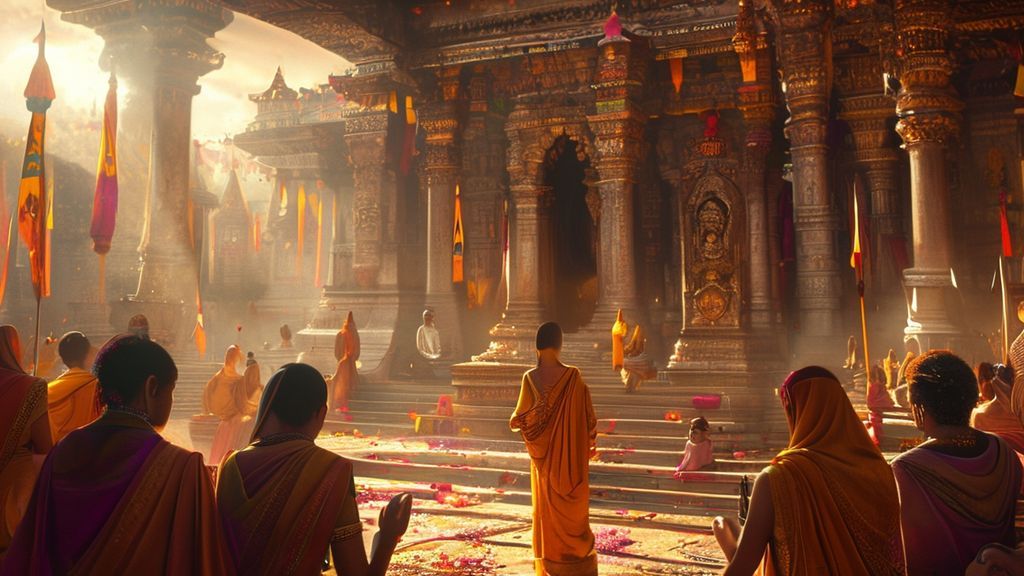
Yes, women can absolutely chant Vedas, a practice deeply rooted in ancient Sanatan Dharma. Scriptural evidence from various Puranas and Smritis affirms that women, just like men, are fully entitled to Vedic studies and recitation, embodying the universal spiritual access inherent in Hindu traditions. This entitlement is not a modern concession but a revival of an age-old tradition.
| Attribute | Details |
|---|---|
| Topic | Women’s Eligibility for Vedic Chanting |
| Core Principle | Universal spiritual access and equality in Sanatan Dharma. |
| Key Scriptural Basis | Rig Veda, Brihadaranyaka Upanishad, Yajnavalkya Smriti, Harita Dharma Sutra. |
| Historical Context | Presence of Brahmavadinis (female Vedic scholars) in ancient India. |
| Significance | Empowerment, spiritual liberation, upholding the true inclusive spirit of Dharma. |
The Timeless Call: Reclaiming Women’s Vedic Heritage
In Sanatan Dharma, the Vedas are not mere texts but the very breath of the Divine, revelations (Śruti) heard by ancient Rishis and Rishikas. The question of whether women can chant Vedas often arises in contemporary discourse, fueled by centuries of socio-cultural shifts that sometimes obscured the original, inclusive spirit of our tradition. This guide aims to dispel misconceptions and firmly establish, based on direct scriptural evidence and historical accounts, that women have always been and continue to be fully entitled to the study, recitation, and living of the Vedic wisdom. The divine knowledge is not confined by gender but is accessible to all sincere seekers who approach it with devotion and discipline. Reclaiming this heritage is vital for the spiritual resurgence of our global Hindu community, affirming the inherent equality enshrined within our ancient scriptures.
Puranic History and Vedic Legends: Women as Seers and Scholars
The Vedic era was one of profound spiritual intellectualism where gender was no barrier to profound spiritual attainment or scholarship. The Rig Veda itself, the oldest and most revered of the four Vedas, bears testimony to several Brahmavadinis – women who were not only scholars but also Rishikas (seers) who composed hymns and engaged in deep philosophical discourse. These revered figures stood shoulder-to-shoulder with their male counterparts, contributing significantly to the Vedic corpus.
- Ghosha: Daughter of Rishi Kakshivan, she composed two hymns in the tenth Mandala of the Rig Veda (X.39 and X.40), hymns dedicated to the Ashwins. Her story, found in the Rig Veda, highlights her erudition and the high esteem in which she was held.
- Lopamudra: Wife of Rishi Agastya, she is credited with a hymn in Rig Veda (I.179.4). Her wisdom and spiritual depth are celebrated in the Mahabharata, where her devotion and intellectual prowess are lauded.
- Apala: A profound devotee, her hymns in the Rig Veda (VIII.91) express her intense devotion and prayers for spiritual purification.
- Vishwavara: This Rig Vedic seeress composed hymns (V.28) focusing on Agni, demonstrating a deep understanding of sacrificial rites and divine invocation.
- Maitreyi: Mentioned in the Brihadaranyaka Upanishad, Maitreyi was one of the two wives of the great sage Yajnavalkya. Her philosophical dialogue with Yajnavalkya on the nature of Brahman and immortality is a cornerstone of advaitic thought. Her profound questions and Yajnavalkya’s responses form a significant portion of this Upanishad, proving her intellectual and spiritual caliber.
- Gargi Vachaknavi: Also featured prominently in the Brihadaranyaka Upanishad, Gargi was an extraordinary woman philosopher who challenged Yajnavalkya in a famous debate at the court of King Janaka. Her incisive questions on the nature of reality and the cosmos demonstrated unparalleled intellectual rigor and courage.
The Yajnavalkya Smriti (1.13) explicitly states, “पुरा कल्पे कुमार्याणां मौञ्जीबन्धनमिष्यते । अध्यापनं च वेदानां सावित्रीवचनं तथा ॥” which translates to: “In ancient times, maidens were entitled to the investiture of the sacred thread (Upanayana), the study of the Vedas, and the chanting of the Savitri Mantra (Gayatri).” This unequivocal statement from a foundational Dharma Shastra leaves no room for doubt regarding women’s Vedic rights.
Furthermore, the Harita Dharma Sutra also affirms that there were two types of women: Brahmavadinī, who engaged in Vedic studies, maintained the sacred fire, and lived as ascetics; and Sadyovadhū, who married immediately. This classification itself acknowledges and validates the path of Vedic scholarship for women.
The Ancient Gurukula System and Transmission of Knowledge
While temples often form the physical anchors of our Dharma, the transmission of Vedic knowledge primarily occurred within the sacred precincts of the Gurukula. In these ancient schools, learning was holistic, encompassing all aspects of life, and spiritual merit was the primary criterion for education, not gender. The anecdotes of Maitreyi and Gargi clearly illustrate that women were not only students but active participants and leaders in philosophical debates and Vedic discussions, a direct outcome of their rigorous training.
The emphasis was on *śruti* (listening), *dharma* (understanding the meaning), and *anusmriti* (recollection and assimilation). Girls, like boys, would undergo Upanayana (sacred thread ceremony), symbolizing their spiritual rebirth and eligibility to study the Vedas. This initiation was not merely ceremonial but conferred the spiritual authority to embark on the demanding path of Vedic learning, including the precise articulation and chanting of the sacred hymns. This ancient system fostered an environment where the spiritual growth of an individual, irrespective of gender, was paramount.
Rituals and Puja Vidhi: Approaching Vedic Chanting
Vedic chanting is not a casual recitation but a profound spiritual practice, a form of *tapasya* (austerity) that purifies the mind and connects the chanter to the cosmic vibrations. For women (and men) desiring to chant Vedas, the approach is steeped in reverence and discipline:
- Seek a Guru: The foremost step is to find a qualified Guru who can impart the correct pronunciation (śuddha uccāraṇa), intonation (svara), and rhythm (tāla) of the Vedic mantras. The Vedas are śruti, meant to be learned by listening.
- Purity (Śuddhi): Maintain physical and mental purity. This involves bathing, wearing clean clothes, and cultivating a serene mind before chanting.
- Right Posture (Āsana): Sit comfortably in a meditative posture like Padmasana or Sukhasana, with a straight spine, ensuring proper breath flow.
- Breath Control (Pranayama): Practice basic pranayama to steady the breath, which is crucial for maintaining the correct length and pitch of Vedic sounds.
- Focus on Sound (Śabda) and Meaning (Artha): Pay meticulous attention to the precise sound of each syllable. Simultaneously, strive to understand the meaning and significance of the mantra, allowing the inner spiritual meaning to resonate.
- Regularity (Niyama): Consistency is key. Daily practice, even for short durations, builds spiritual momentum and deepens understanding.
- Devotion (Bhakti): Chant with utmost devotion, humility, and surrender, recognizing the mantra as a direct invocation of the Divine.
For more insights on spiritual practices, visit Hindutva.online.
Mantras and Chants: The Power of Vedic Vibrations
The Vedas are repositories of potent mantras, each carrying unique cosmic vibrations and spiritual benefits. While ideally learned under a Guru, some universal Vedic mantras can be chanted by all with devotion:
- Gayatri Mantra: ॐ भूर्भुवः स्वः तत्सवितुर्वरेण्यं भर्गो देवस्य धीमहि धियो यो नः प्रचोदयात् ॥ (Om Bhur Bhuvah Svah Tat Savitur Varenyam Bhargo Devasya Dhimahi Dhiyo Yo Nah Prachodayat)
This universal mantra from the Rig Veda (3.62.10) invokes the solar deity Savitr for spiritual wisdom and enlightenment. It is considered the essence of the Vedas and is chanted for intellectual clarity and spiritual awakening, universally accessible to all.
- Maha Mrityunjaya Mantra: ॐ त्र्यम्बकं यजामहे सुगन्धिं पुष्टिवर्धनम् । उर्वारुकमिव बन्धनान् मृत्योर्मुक्षीय मामृतात् ॥ (Om Tryambakam Yajamahe Sugandhim Pushtivardhanam Urvarukamiva Bandhanan Mrityor Mukshiya Maamritat)
From the Rig Veda (7.59.12), this mantra is dedicated to Lord Shiva in his aspect as Tryambaka. It is chanted for protection, healing, longevity, and liberation from the cycle of birth and death.
- Asato Ma Sadgamaya: असतो मा सद्गमय। तमसो मा ज्योतिर्गमय। मृत्योर्मा अमृतं गमय। (Asato Ma Sadgamaya. Tamaso Ma Jyotirgamaya. Mrityorma Amritam Gamaya.)
This powerful prayer from the Brihadaranyaka Upanishad (1.3.28) seeks guidance from unreality to reality, from darkness to light, and from death to immortality. It is a profound invocation for spiritual truth.
Dos and Don’ts for Vedic Chanting
Approaching Vedic chanting requires reverence and adherence to certain principles:
- Dos:
- Seek guidance from an authentic Guru or institution.
- Maintain absolute purity (physical, mental, and verbal).
- Chant with humility, devotion, and a sincere desire for spiritual growth.
- Practice regularly and consistently to internalize the vibrations.
- Understand the basic meaning and significance of the mantras.
- Don’ts:
- Do not chant Vedic mantras without proper learning and guidance, especially complex Suktas.
- Avoid treating Vedic chanting as a mere performance or a casual act.
- Do not alter the pronunciation, intonation (svara), or rhythm (tāla) of the mantras, as this can change their efficacy.
- Refrain from chanting if your mind is agitated, distracted, or impure, as the benefits will be diminished.
- Traditionally, during certain periods of physical impurity (like menstrual cycles), devotees might observe a temporary cessation from specific ritualistic chanting, out of respect for the sanctity, but this is not a prohibition on learning or personal remembrance of mantras.
Frequently Asked Questions
Is there any specific Veda or portion women *cannot* chant?
No, there is no scriptural injunction or prohibition against women chanting any specific Veda or portion thereof. The misconceptions arose from later social interpretations, particularly around the performance of certain elaborate fire rituals (yagnas) that required specific male priesthood roles. The core act of Vedic study and chanting for spiritual development has always been open to women, as evidenced by the Brahmavadinī tradition.
Do women need initiation (Upanayana) to chant Vedas?
Traditionally, Upanayana (the sacred thread ceremony) marks the spiritual birth and formal eligibility for Vedic study for both boys and girls who chose the path of Brahmacharya (celibate studentship). While universal Upanayana for all women declined over time, the spiritual entitlement remains. Many modern Hindu organizations and Gurukulas are now reviving the Upanayana ceremony for girls, affirming their right to Vedic knowledge. However, for personal chanting of universal mantras like Gayatri, a formal Upanayana, though highly beneficial, is not an absolute prerequisite; sincere devotion and proper learning are paramount.
How can modern women learn Vedic chanting today?
Modern women can learn Vedic chanting through various avenues. Reputable Vedic schools (Pathashalas), spiritual organizations, and qualified Gurus now offer classes, both in-person and online, dedicated to teaching Vedic recitation with traditional precision. Institutions like the Chinmaya Mission, Art of Living, and numerous independent Vedic scholars offer structured courses. It is crucial to seek out authentic teachers who emphasize correct pronunciation and understanding of the *swaras* (intonations) to gain the full benefit of Vedic chanting. Exploring Hindutva.online can also lead to resources and guidance on this sacred journey.
Dharmic Significance: Why This Matters for Every Hindu
The reclaiming of women’s rightful place in Vedic chanting is more than just a matter of gender equality; it is a profound affirmation of the timeless, inclusive, and universal nature of Sanatan Dharma itself. When women, as the custodians of cultural transmission and spiritual nurturing within families, embrace Vedic wisdom, the entire fabric of society benefits. It revitalizes our spiritual heritage, ensures the accurate preservation of Vedic knowledge, and empowers individuals to seek direct connection with the Divine. By understanding and promoting the historical truth of women’s Vedic scholarship, we strengthen the foundations of Hindutva, dispelling modern myths and restoring the radiant, all-encompassing light of our ancient tradition for generations to come. This empowerment is a vital step towards a more spiritually conscious and harmonious world, embodying the true spirit of Dharma.