


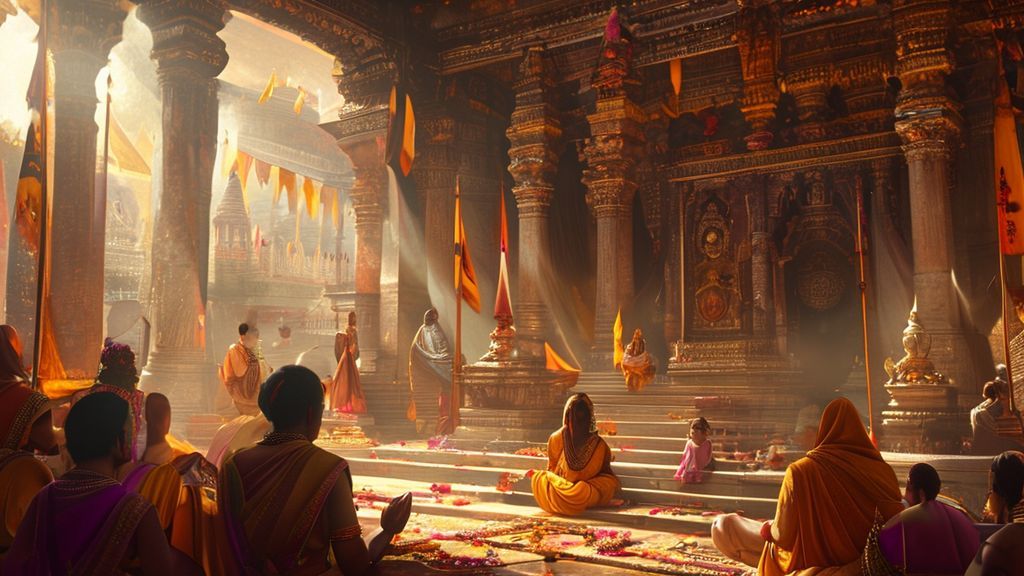
Carnatic Music, or Karnāṭaka Saṅgītam, is the sacred classical music tradition originating from South India, deeply rooted in Sanatana Dharma. It embodies devotion, spiritual expression, and intricate melodic and rhythmic structures designed to elevate the listener and performer towards divine communion, echoing ancient Vedic chant traditions and fostering an inner experience of Brahmananda.
| Attribute | Details |
|---|---|
| Origin | South India (primarily Tamil Nadu, Andhra Pradesh, Kerala, Karnataka), with roots in Vedic chanting and divine revelation. |
| Key Composers (Trinity) | Tyagaraja, Muthuswami Dikshitar, Shyama Shastri. These three 18th-century saints systematized and enriched the tradition. |
| Core Elements | Raga (melodic framework), Tala (rhythmic cycle), Shruti (pitch precision), Laya (tempo), Bhava (emotion/devotion). |
| Scripture Reference | Sāma Veda (source of music), Nārada Purana (details on musical theory), Bharata’s Natya Shastra (treatise on performing arts). |
Introduction: The Resonance of Devotion
Carnatic Music is not merely an art form; it is a profound spiritual discipline, a path to the divine, and a living testament to Sanatana Dharma’s rich cultural tapestry. For millennia, sound, or Nada Brahma, has been revered as the primordial manifestation of the Absolute. This tradition, rooted deeply in the ancient soil of Bharatavarsha, offers a unique confluence of rigorous intellectual discipline, mathematical precision, and an outpouring of heartfelt devotion. Through its intricate ragas and complex talas, Carnatic music transcends mere entertainment, becoming a vehicle for meditation, prayer, and ultimately, self-realization. Its practice and appreciation are considered a form of Upasana, a direct worship of the Supreme Being.
Puranic History & Divine Origin of Nada
The genesis of music, particularly the classical traditions of India, is firmly enshrined in our sacred texts. The Sāma Veda, one of the four principal Vedas, is often hailed as the fountainhead of all musical systems. Its mantras, intended for chanting during Soma sacrifices, were set to specific melodic patterns, known as Samaganas, which bear striking resemblances to the foundational principles of raga and tala. The very word “Sāma” itself denotes a song or melody, signifying the musicalization of Vedic hymns.
The divine origin of music is further elaborated in the Puranas and Itihasas. Lord Shiva, as Nataraja, the cosmic dancer, embodies the rhythm and harmony of the universe, and from his damaru (drum) emanated the very first sounds that formed the Sanskrit alphabet and thus, indirectly, all sound and music. Goddess Saraswati, the deity of knowledge, arts, and wisdom, is invariably depicted holding the Veena, symbolizing the divine patronage of music. Nārada Muni, the celestial sage, is revered as the Adi Guru of music (संगीत का आदि गुरु), having received musical knowledge directly from Lord Brahma. The Nārada Purana, among other scriptures, delineates intricate details of musical theory, classifying ragas, outlining the importance of shruti, and emphasizing the spiritual efficacy of Nada Yoga.
The celestial musicians, the Gandharvas and Kinnaras, are frequently mentioned in the Valmiki Ramayana and the Mahabharata, highlighting music’s integral role in divine realms. Their prowess in playing various instruments and singing captivating melodies serves as a reminder of music’s inherent connection to higher planes of existence. The concept of Saptaswaras (seven notes – Sa, Ri, Ga, Ma, Pa, Dha, Ni) is often linked to natural sounds, the cries of birds and animals, and in esoteric traditions, to the seven chakras of the human body, suggesting a deep yogic and scientific understanding embedded within this artistic structure.
Architectural & Scientific Marvels: The Raga & Tala Systems
While Carnatic music isn’t about physical architecture, its structure exhibits a profound “architectural” and “scientific” marvel akin to the grand temples of South India. The edifice of Carnatic music is built upon two pillars: Raga (राग) and Tala (ताल).
- Raga: The Melodic Blueprint: A raga is far more than a mere scale; it is a specific melodic framework with distinct ascending (आरोहण – arohana) and descending (अवरोहण – avarohana) patterns, characteristic phrases (पकड़ – pakad), and specific emotional colors (भाव – bhava) or moods. The Carnatic system boasts a highly systematic classification of ragas under the Melakarta system, established by Venkatamakhin in the 17th century, comprising 72 parent scales. Each Melakarta raga is a unique combination of the seven notes, derived mathematically, offering a complete universe of melodic possibilities. This system is a monumental achievement in musical theory, unparalleled in its logical precision, allowing for immense creativity within defined boundaries. Certain ragas are associated with specific deities, times of day, or seasons, believed to evoke particular spiritual states or even therapeutic effects. For example, Raga Bhairavi is associated with devotion and solemnity, while Shankarabharanam embodies majesty and peace.
- Tala: The Rhythmic Foundation: Tala provides the rhythmic structure, a cyclic time-measure that guides the improvisation and composition. Unlike Western time signatures, Carnatic talas are complex cycles of beats, accents, and divisions. The seven primary talas (Suladi Sapta Talas) – Dhruva, Matya, Rupaka, Jhampa, Triputa, Ata, Eka – combined with five jatis (variations in the count of beats in a basic unit) yield 35 fundamental talas, and numerous secondary talas. This intricate mathematical framework allows for astounding rhythmic permutations and improvisations (Kalpana Swaram, Neraval, Tani Avartanam), demonstrating a deep understanding of cyclical time and its interplay with melody. The synchronization of intricate rhythmic patterns with sublime melodic expressions is a profound intellectual and spiritual exercise.
The interplay of Shruti (precise microtonal pitch intervals) further adds to the scientific depth, where subtle nuances in pitch differentiate emotional expressions within a raga, a concept almost absent in most Western classical forms. This meticulous attention to microtones gives Carnatic music its characteristic richness and depth, resonating with the subtle frequencies of the universe.
Rituals & Puja Vidhi: The Art of Performance and Learning
The performance of Carnatic music, known as a Kutcheri, is a ritualistic offering, a spiritual communion between the performer, the music, and the audience. It is not merely a concert but a Yajna (यज्ञ) in sound.
- Guru-Shishya Parampara: The learning process itself is a sacred ritual. It begins with surrendering to a Guru, symbolizing the transmission of knowledge from generation to generation. The student learns through rigorous practice (साधना – sadhana), memorization, and emulation, imbibing not just technique but also the spiritual essence from the teacher. This traditional system, preserved through dedicated individuals, ensures the purity and authenticity of the tradition. Hindutva.online recognizes the invaluable contribution of Gurus in preserving our heritage.
- Invocation: A Kutcheri typically begins with an invocation to a deity, often Lord Ganesha, for obstacle removal, or to a family deity. This sets a devotional tone for the entire performance.
- Alapana: The performer elaborates the chosen raga without rhythmic accompaniment, exploring its contours, mood, and essential phrases. This is a meditative and improvisational segment, allowing the artist to immerse themselves in the raga’s essence and transport the audience.
- Kriti Presentation: The core of the performance, a kriti (composition) is rendered. These kritis are devotional poems set to specific ragas and talas, often praising various deities. The rendition includes pallavi, anupallavi, and charanam sections, with opportunities for improvisation (neraval) and rhythmic embellishments (kalpana swaram).
- Tani Avartanam: A solo rhythmic interlude by percussionists (Mridangam, Ghatam, Kanjira), showcasing their virtuosity and intricate mathematical calculations.
- Mangalam: The concert concludes with a benedictory piece, usually a prayer for the welfare of all, reinforcing the spiritual purpose of the music.
Every aspect of a Kutcheri, from the careful selection of ragas to the precise execution of talas and the emotive rendering of lyrics, is an act of devotion, a sonic offering to the Divine.
Mantras & Chants: Kritis as Sonic Prayers
In Carnatic music, many kritis (compositions) are essentially elaborate mantras, embodying the power of sound and devotion. The lyrics, often in Sanskrit, Telugu, Tamil, or Kannada, are direct prayers, philosophical treatises, or devotional expressions. Composers like the Trinity – Tyagaraja, Muthuswami Dikshitar, and Shyama Shastri – were saint-composers whose lives were dedicated to spiritual pursuit, and their compositions reflect profound spiritual realization.
For instance, Tyagaraja’s kritis are replete with devotion to Lord Rama, often exploring philosophical truths through simple yet profound Telugu verse. Muthuswami Dikshitar’s compositions, predominantly in Sanskrit, are known for their intricate raga bhava, lyrical beauty, and often contain Mudras (signatures) that reveal his yogic and tantric insights, dedicating compositions to specific forms of Devi or Shiva. Shyama Shastri’s kritis, mainly in Telugu, are fervent prayers to Goddess Kamakshi. These kritis, when sung with precision (श्रुति शुद्धम् – shruti shuddham) and devotion (भाव – bhava), are transformative:
- “Nagumomu Ganaleni” by Tyagaraja (Raga Abheri): A poignant prayer to Lord Rama, expressing intense longing for His divine vision.
- “Vatapi Ganapatim Bhajeham” by Muthuswami Dikshitar (Raga Hamsadhwani): A powerful invocation to Lord Ganesha, rich in Sanskrit mantra-like phrases, believed to bestow blessings.
- “Marivere Gati” by Shyama Shastri (Raga Anandabhairavi): A heartfelt plea to Goddess Kamakshi, seeking refuge and protection.
The practice of chanting “Om Namah Shivaya” or “Om Namo Narayanaya” with musicality, or rendering the Vishnu Sahasranama or Lalita Sahasranama in specific melodic patterns, connects directly to the Carnatic ethos. The mere vibratory power of these sacred sounds, when imbued with musicality, elevates them to a higher state of spiritual efficacy, fostering inner peace and spiritual awakening.
Dos and Don’ts for the Devotee and Learner
- Do arrive punctually for a Kutcheri as a mark of respect for the artists and the art form.
- Do maintain silence and minimize movement during the performance to allow for complete immersion in the sound.
- Do offer a silent prayer or connect with the devotional lyrics, even if the language is unfamiliar.
- Do appreciate the subtle nuances of raga and tala; a gentle nod or “Shabash” (excellent) is a respectful acknowledgment.
- Do seek guidance from a qualified Guru if you wish to learn, respecting the Guru-Shishya parampara.
- Don’t engage in casual conversation or use mobile phones during a performance; it disrupts the sacred atmosphere.
- Don’t interrupt the artists or sing along loudly unless specifically invited to.
- Don’t treat the concert as mere entertainment; approach it as a spiritual experience and an opportunity for reflection.
- Don’t disrespect the Guru or the tradition; reverence is paramount in Sanatana Dharma.
Frequently Asked Questions
What are the fundamental differences between Carnatic and Hindustani music?
While both are classical Indian traditions, Carnatic music (South Indian) is more devotional, emphasizes compositions (kritis), and has a highly systematized raga classification (Melakarta system). Hindustani music (North Indian) is more improvisational, often focuses on abstract raga exploration (alap, jor, jhala), and has a different raga classification (Thaat system). Instrumentations also differ, with Veena, Mridangam, and Violin prominent in Carnatic, while Sitar, Sarod, Tabla, and Harmonium are common in Hindustani.
Is Carnatic music exclusively devotional?
While a vast majority of Carnatic compositions are devotional, addressing various deities and expressing spiritual philosophy, the art form itself provides a framework for secular expression as well. However, the underlying ethos of Carnatic music remains deeply spiritual, with even instrumental pieces evoking a meditative or contemplative mood. It is a powerful tool for connecting with the divine, regardless of the explicit lyrical content.
Who are the “Trinity” of Carnatic Music, and why are they important?
The “Trinity” refers to three revered saint-composers of the 18th century: Tyagaraja, Muthuswami Dikshitar, and Shyama Shastri. They are crucial because they systematized, enriched, and revitalized Carnatic music, creating thousands of kritis that form the bedrock of the current repertoire. Their compositions beautifully blend melodic complexity, rhythmic sophistication, and profound spiritual lyrics, providing a comprehensive and accessible pathway to the heart of Carnatic tradition.
Can anyone learn Carnatic music, regardless of background?
Absolutely. Carnatic music is a universal art form that welcomes all sincere seekers. While it demands dedication, discipline, and a good ear, its spiritual benefits and aesthetic beauty are accessible to everyone. Many institutions and Gurus worldwide teach Carnatic music, making this profound tradition available to a global audience. For more insights into Indian spiritual traditions, visit Hindutva.online.
Dharmic Significance: Preserving Nada Brahma for Sanatana Dharma
Carnatic music is an invaluable living heritage that safeguards and propagates the eternal values of Sanatana Dharma. It teaches us discipline, devotion, patience, and the profound power of sound as a medium for spiritual transformation. In a world increasingly fragmented, Carnatic music offers a harmonious anchor, connecting us to ancient wisdom and inner peace. It is a powerful cultural force that unites communities, celebrates our deities, and provides a direct path to experiencing Nada Brahma – the Supreme Being as sound. By fostering this sacred art, we not only preserve a beautiful tradition but also ensure that the spiritual resonance of our ancestors continues to uplift future generations, guiding them towards a life imbued with dharma and devotion.