


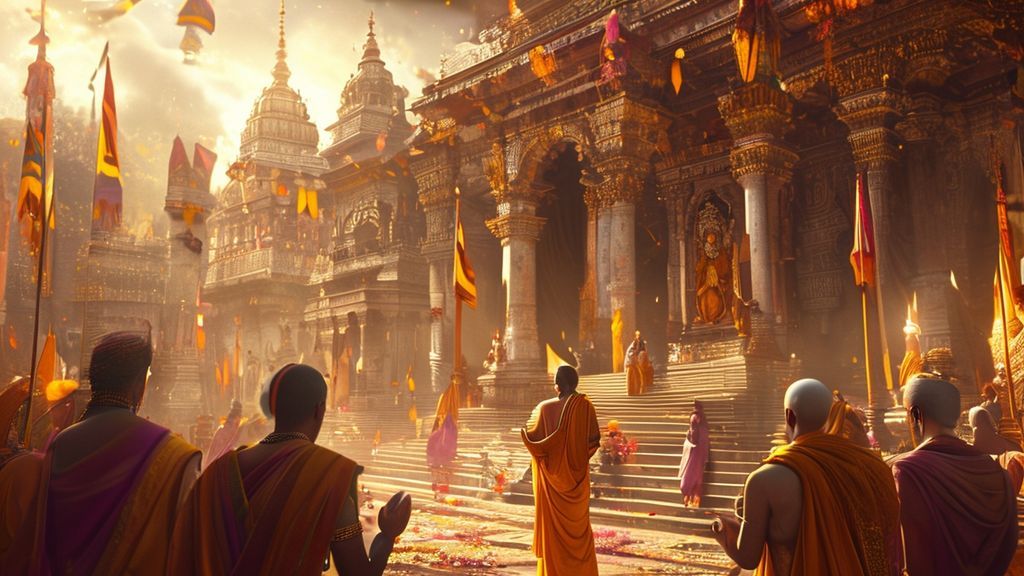
Chaitanya Mahaprabhu (1486-1534 CE) was the pre-eminent founder and spiritual leader of the modern Krishna Bhakti movement, particularly the Gaudiya Vaishnava tradition. He propagated the congregational chanting (Sankirtan) of the Hare Krishna Maha-mantra as the supreme devotional practice for the current age, emphasizing ecstatic love for Radha and Krishna through simple yet profound devotion.
| Attribute | Details |
|---|---|
| Deity | Shri Krishna Chaitanya (considered the combined incarnation of Radha and Krishna) |
| Location/Origin | Nabadwip, West Bengal (then Nadiya) |
| Key Festival | Gaura Purnima (Appearance Day, usually in February/March) |
| Scripture Reference | Chaitanya Charitamrita, Chaitanya Bhagavata, Chaitanya Mangala, Bhagavata Purana (indirectly) |
Introduction: The Dawn of Ecstatic Bhakti
In the tumultuous landscape of late medieval India, when various philosophical schools debated the nature of the Divine, and devotion often seemed mired in complex rituals, a celestial manifestation descended upon the sacred land of Nabadwip. Chaitanya Mahaprabhu emerged as the radiant sun, dispelling the clouds of spiritual confusion and ushering in an unprecedented era of ecstatic devotion to Shri Krishna. His advent revitalized Sanatan Dharma, offering a direct, accessible, and deeply personal path to the Divine through the chanting of the Holy Names. He taught that love for God, prema-bhakti, is the ultimate goal of human life, accessible to all, irrespective of caste, creed, or social standing. This profound message transformed countless lives and continues to inspire millions globally, establishing a spiritual legacy that resonates deeply within the heart of every sincere seeker.
Puranic History & Legend: The Advent of Mahaprabhu
The life of Chaitanya Mahaprabhu is not merely a historical account but a divine saga, meticulously documented in sacred biographies like the Chaitanya Charitamrita by Krishnadasa Kaviraja Goswami and the Chaitanya Bhagavata by Vrindavana Dasa Thakura. Born in Nabadwip, West Bengal, on the full moon night of Phalguna in 1486 CE, he was named Vishvambhara by his parents, Jagannath Mishra and Sachi Devi. He was affectionately called Nimai due to his birth under a Nim tree, and Gauranga for his brilliant golden complexion.
From a young age, Nimai exhibited extraordinary intellectual prowess, mastering Sanskrit grammar, logic, and rhetoric, eventually becoming a renowned scholar and teacher. However, his life took a transformative turn during a pilgrimage to Gaya, where he received initiation from the Vaishnava sannyasi Ishvara Puri. This encounter ignited the dormant spiritual fire within him, transforming the brilliant logician into an ecstatic devotee, constantly immersed in the contemplation of Krishna.
Upon his return to Nabadwip, Nimai began to openly express his intense love for Krishna, often falling into spiritual ecstasies, weeping, laughing, and chanting the Holy Names with abandon. He soon took sannyasa (the renunciant order) at the age of 24, receiving the name Shri Krishna Chaitanya. From this point, his mission became clear: to spread the congregational chanting of the Hare Krishna Maha-mantra (Hari Nama Sankirtan) throughout India.
Chaitanya Mahaprabhu taught that he was Krishna Himself, in the mood of Shrimati Radharani, experiencing the ultimate pangs of separation from the Lord (vipralambha-bhava). This esoteric understanding, elaborated upon in the Chaitanya Charitamrita (Adi-lila, Chapter 1), posits him as the combined form of Radha and Krishna – Rasa-rāja-mahābhāva. His twelve-year journey across India, particularly his prolonged residence in Puri, Odisha, was marked by incredible spiritual displays, converting atheists and scholars alike through the sheer force of his love and devotion. His primary teaching was the universal efficacy of chanting the Holy Names in Kali Yuga, as prescribed in scriptures like the Kali-santarana Upanishad.
The Architecture of Devotion: Building a Bhakti Parampara
While Chaitanya Mahaprabhu did not design physical temples in the traditional sense, his life’s work was the construction of an unparalleled spiritual architecture: the Gaudiya Vaishnava parampara (disciplic succession). He laid the foundational principles for a universal spiritual movement centered on heartfelt devotion rather than elaborate stone structures. His emphasis was on the inner temple of the heart, purified by chanting and loving service to Krishna.
However, his movement profoundly influenced subsequent temple architecture and devotional centers. He personally rediscovered many lost holy places in Vrindavan, which were later developed into magnificent temples by his direct disciples, the Six Goswamis of Vrindavan. Temples like Radha Raman, Radha Gokulananda, and Radha Damodar, while perhaps having earlier roots, were systematically established or revitalized under the inspiration and guidance of his followers. These temples often adopted the Nagara style, characteristic of North Indian temple architecture, and were built not just as places of worship, but as centers for theological study, devotional practice, and the distribution of Prasadam.
The “architecture” Chaitanya Mahaprabhu built was a robust system of devotional principles, scriptural commentary, and a network of dedicated devotees. He structured a spiritual edifice that could withstand the vicissitudes of time, ensuring that the essence of Krishna consciousness, as taught by him, would remain accessible. This monumental task of preserving and propagating Vaishnava philosophy and practice is detailed extensively on portals like Hindutva.online, which strives to make such profound knowledge available to all.
Rituals & Puja Vidhi: The Path of Sankirtan
Chaitanya Mahaprabhu’s greatest contribution to Sanatan Dharma is the emphasis on Hari Nama Sankirtan, the congregational chanting of the Holy Names of God, as the principal devotional practice for the current age, Kali Yuga. The simplicity and potency of this method make it universally accessible.
The primary ritual established by Chaitanya Mahaprabhu is:
- Sankirtan: Gather with fellow devotees. Sing the Hare Krishna Maha-mantra and other Vaishnava bhajans (devotional songs). Musical instruments like harmonium, kartals (hand cymbals), and mridanga (drum) often accompany the chanting. The atmosphere is one of collective joy, spiritual ecstasy, and surrender.
- Japa (Individual Chanting): Devotees also chant the Hare Krishna Maha-mantra individually, typically on a string of 108 Tulasi beads (mala), meditating on the sound vibration and the divine names.
- Arcana (Deity Worship): While Sankirtan is primary, Chaitanya Mahaprabhu’s followers also engage in elaborate Deity worship (Arcana) of Radha-Krishna forms, offering flowers, incense, lamps, and food (Prasadam).
- Bhagavata-shravanam (Hearing Scriptures): Regular hearing and study of sacred texts like the Bhagavata Purana (Srimad Bhagavatam) and Bhagavad-gita are integral parts of the devotional path.
- Vaishnava Seva (Service to Devotees): Serving Vaishnavas and humanity at large is considered a vital aspect of devotional service.
Mantras & Chants: The Sound of Liberation
The central mantra propagated by Chaitanya Mahaprabhu, considered the Maha-mantra (Great Mantra), is the Hare Krishna Maha-mantra. Its chanting is glorified in the Kali-santarana Upanishad as the only means of deliverance in Kali Yuga.
-
Hare Krishna Maha-mantra:
हरे कृष्ण हरे कृष्ण कृष्ण कृष्ण हरे हरे
हरे राम हरे राम राम राम हरे हरे
Hare Krishna Hare Krishna Krishna Krishna Hare Hare
Hare Rama Hare Rama Rama Rama Hare Hare
Meaning: O Energy of the Lord (Hare), O All-Attractive Lord (Krishna), O Supreme Enjoyer (Rama), please engage me in Your devotional service.
-
Panca Tattva Maha-mantra:
जय श्री कृष्ण चैतन्य प्रभु नित्यानन्द
श्री अद्वैत गदाधर श्रीवासादि गौर भक्त वृन्द
Jaya Shri Krishna Chaitanya Prabhu Nityananda
Shri Advaita Gadadhara Shri Vasadi Gaura Bhakta Vrinda
Meaning: All glories to Shri Krishna Chaitanya, Prabhu Nityananda, Shri Advaita, Gadadhara, Shrivasa, and all the devotees of the Lord.
Dos and Don’ts for Sincere Devotees
Chaitanya Mahaprabhu’s teachings, elucidated by his followers, emphasize a life of purity, humility, and unwavering devotion. Adhering to certain principles fosters spiritual growth:
- Do: Chant the Hare Krishna Maha-mantra daily, either individually (Japa) or congregationally (Sankirtan).
- Do: Associate with sincere devotees (Sadhu-sanga) to deepen your understanding and devotion.
- Do: Honor Krishna Prasadam (food offered to the Lord) with reverence, recognizing it as spiritualized sustenance.
- Do: Study the sacred scriptures, especially the Bhagavata Purana and Bhagavad-gita, under the guidance of a bona fide spiritual teacher.
- Do: Practice humility (trnad api sunicena) and tolerance (taror iva sahisnuna), as taught by Mahaprabhu.
- Don’t: Criticize other Vaishnavas or engage in sectarian disputes, understanding that all paths ultimately lead to the Divine.
- Don’t: Neglect one’s prescribed spiritual practices, especially the daily chanting of the Holy Names.
- Don’t: Engage in illicit activities that hinder spiritual progress (e.g., meat-eating, intoxication, gambling, illicit sex), which are traditionally avoided by serious practitioners.
- Don’t: Misinterpret or dilute the profound philosophical teachings of the Gaudiya Vaishnava tradition for mundane gain.
Frequently Asked Questions
Was Chaitanya Mahaprabhu an incarnation of God?
Yes, within the Gaudiya Vaishnava tradition, Chaitanya Mahaprabhu is revered as the Supreme Personality of Godhead, Shri Krishna Himself, who appeared in the mood of Shrimati Radharani. He is understood as the combined form of Radha and Krishna, descending to personally experience the bliss of devotional service and to teach the path of Hari Nama Sankirtan to the world. This is extensively explained in the Chaitanya Charitamrita.
What is the core significance of the Hare Krishna Maha-mantra?
The Hare Krishna Maha-mantra is considered the yuga-dharma, the prescribed spiritual practice for the present age of Kali. Its significance lies in its ability to purify the heart, awaken dormant love for God, and provide spiritual liberation simply through sound vibration. It invokes the Supreme Lord and His internal energy (Hare) to engage one in divine service, making spiritual realization accessible to everyone, regardless of background.
Where did Chaitanya Mahaprabhu spend most of his adult life?
After taking sannyasa, Chaitanya Mahaprabhu made his permanent residence in Jagannath Puri, Odisha, for approximately 18 years until his disappearance. From Puri, he orchestrated the Bhakti movement, sending his chief disciples, like the Six Goswamis, to Vrindavan to uncover and establish the holy places connected with Krishna’s pastimes.
What are the principal teachings of Chaitanya Mahaprabhu?
Chaitanya Mahaprabhu’s principal teachings can be summarized as: 1) The supreme efficacy of chanting the Holy Names (Hari Nama Sankirtan), 2) The attainment of pure love for Krishna (Krishna-prema) as the ultimate goal, 3) The understanding of the soul’s eternal relationship with Krishna, and 4) The practice of humility, tolerance, and respect for all living entities, as embodied in his Siksastakam prayers. His teachings emphasize spontaneous, ecstatic devotion over ritualistic formality.
Chaitanya Mahaprabhu’s Ever-Radiant Legacy in Sanatan Dharma
Chaitanya Mahaprabhu’s advent was a pivotal moment in the history of Sanatan Dharma, akin to a reawakening. He did not merely preach; he lived and embodied the very essence of divine love, transforming the hearts of millions through his personal example and the power of his spiritual ecstasy. His movement democratized spirituality, asserting that sincere devotion, expressed through chanting the Holy Names, is the most direct and potent path to God-realization in Kali Yuga, available to all without distinction.
His legacy is not confined to the Gaudiya Vaishnava tradition but permeates the broader fabric of Hindu spiritual thought, influencing devotional music, art, and philosophy. The universal call for loving God, transcending all material designations, remains his timeless gift to humanity. As we navigate the complexities of the modern world, the simple yet profound message of Chaitanya Mahaprabhu, that true happiness lies in devotion to Krishna, offers solace, direction, and ultimate liberation. Exploring his life and teachings on platforms like Hindutva.online empowers seekers to connect with this profound spiritual heritage and experience the transformative power of Hari Nama Sankirtan for themselves.