


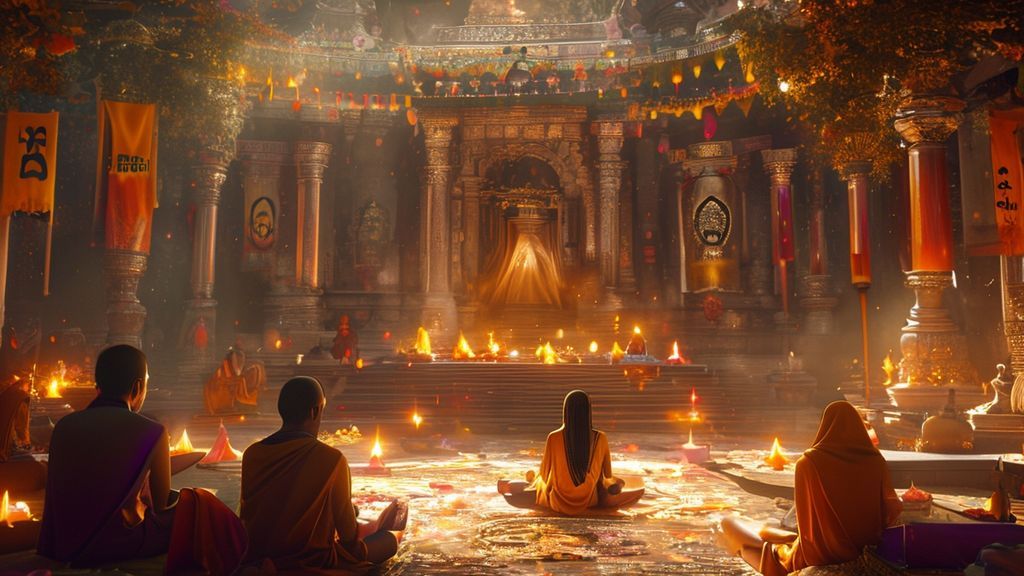
Chakra Healing for Depression: Energy Work, as elucidated in ancient Sanatan Dharma, involves harmonizing the subtle energy centers (*Chakras*) within the *Pranamaya Kosha* (energy body) to alleviate *Vishada* (despondency) and restore mental and emotional balance. This profound practice, rooted in Yogic and Ayurvedic traditions, promotes overall well-being by clearing energetic blockages and fostering inner *Ananda* (bliss).
| Attribute | Details |
|---|---|
| Concept | *Chakra* (Sanskrit: “wheel” or “disk”) – subtle energy vortexes in the human body. |
| Origin | Ancient India, primarily from the Vedic traditions, Upanishads, and Tantric texts. |
| Primary Goal | To balance and activate *Prana* (life force energy) for holistic physical, mental, and spiritual health. |
| Core Principle | Disruptions in *Prana* flow through *Nadis* and *Chakras* lead to imbalance and dis-ease, including *Vishada*. |
| Scripture Reference | Yoga Sutras of Patanjali, Hatha Yoga Pradipika, Shiva Samhita, Gheranda Samhita, Upanishads (e.g., Prashna Upanishad on *Prana*). |
The Ancient Wisdom of Healing the Mind: An Introduction to Chakra Vidya
In the timeless wisdom of Sanatan Dharma, the human being is understood not merely as a physical body, but as a multi-dimensional being composed of several interconnected layers, or *Koshas*. Among these, the
Pranamaya Kosha, the vital energy sheath, plays a pivotal role in our mental and emotional well-being. When this energy body is in discord, it manifests as imbalances in the mind, often leading to conditions such as *Vishada*, or deep despondency, which modern parlance terms depression.
The concept of *Chakras* – luminous wheels of *Prana* – lies at the heart of this energetic understanding. These subtle energy centers are junctions where the *Nadis*, the intricate network of energetic channels, converge and regulate the flow of life force throughout the system. A balanced *Chakra* system ensures a harmonious flow of *Prana*, promoting not only physical health but also mental clarity, emotional stability, and spiritual awakening. When one or more *Chakras* become blocked, underactive, or overactive, the resulting stagnation or erratic flow of *Prana* can deeply impact our psychological state, contributing significantly to feelings of anxiety, apathy, and *Vishada*. This guide from Hindutva.online offers an authoritative exploration of how ancient Yogic science provides a pathway to healing these energetic imbalances.
The Ancient Lineage and Scriptural Basis of Chakra Vidya
While the detailed system of seven primary *Chakras* gained prominence in later Tantric traditions and Hatha Yoga texts, the fundamental understanding of *Prana* and its vital channels (*Nadis*) is deeply embedded in the most ancient Vedic scriptures. The
Prashna Upanishad, for instance, dedicates significant sections to describing the nature of *Prana*, its five vital breaths (*Pancha Prana Vayus*), and its distribution throughout the body, stating, “From the Atman comes *Prana*; as a shadow to a man, so is this to it.”
Later Upanishads, such as the
Katha Upanishad, speak of the “hundred and one channels” of the heart, with one leading upwards to the crown, symbolizing the path to liberation. The
Yoga Sutras of Patanjali, while not explicitly detailing the seven *Chakras*, extensively describes *Pranayama* (breath control) as a crucial limb of Yoga, indicating a profound awareness of subtle energy manipulation for mental mastery and *Samadhi*. The subsequent
Hatha Yoga Pradipika,
Gheranda Samhita, and
Shiva Samhita are definitive texts that systematically elaborate on the *Chakras*, their locations, associated elements, *bija mantras*, and corresponding psychological and spiritual functions. These texts provide the authoritative framework for understanding Chakra healing as a powerful tool in *Sanatana Dharma* for comprehensive well-being, including alleviating *Vishada*.
The Subtle Architecture of the Self: Unveiling the Chakras
Our subtle body is a magnificent temple, with the *Chakras* serving as its sanctum sanctorums, each vibrating at a unique frequency and governing specific aspects of our existence. Understanding their energetic properties is crucial for effective healing of *Vishada*.
- Muladhara Chakra (Root Chakra): Located at the base of the spine, associated with the element Earth. It governs our sense of safety, security, and survival instincts. An imbalance here can lead to deep insecurity, fear, and a feeling of being ungrounded, contributing to *Vishada*. Its *bija mantra* is
LAM.
- Svadhisthana Chakra (Sacral Chakra): Situated in the lower abdomen, associated with the element Water. It relates to emotions, creativity, pleasure, and relationships. Blockages can manifest as emotional numbness, guilt, lack of joy, and suppressed creativity. Its *bija mantra* is
VAM.
- Manipura Chakra (Solar Plexus Chakra): Found in the upper abdomen, associated with the element Fire. This is the center of personal power, willpower, and self-esteem. Imbalances often result in low self-worth, anger, anxiety, and a feeling of powerlessness in managing life, feeding into depression. Its *bija mantra* is
RAM.
- Anahata Chakra (Heart Chakra): Located at the center of the chest, associated with the element Air. It is the seat of love, compassion, forgiveness, and connection. A blocked Anahata can lead to loneliness, grief, inability to give or receive love, and profound sadness. Its *bija mantra* is
YAM.
- Vishuddha Chakra (Throat Chakra): Situated in the throat, associated with the element Ether (Akasha). This chakra governs communication, self-expression, and truth. Suppression of one’s voice, inability to express emotions, or feeling unheard can contribute to *Vishada*. Its *bija mantra* is
HAM.
- Ajna Chakra (Third Eye Chakra): Positioned between the eyebrows, often associated with light. It is the center of intuition, wisdom, clarity, and inner vision. Imbalances can cause confusion, lack of focus, fear of the unknown, and a disconnect from one’s inner guidance. Its *bija mantra* is
OM.
- Sahasrara Chakra (Crown Chakra): Located at the crown of the head, associated with cosmic consciousness. This chakra represents spiritual connection, enlightenment, and transcendence. When blocked, one may feel isolated, purposeless, and profoundly disconnected from the Divine, exacerbating *Vishada*. Its *bija mantra* is
OM or silence.
The flow of *Prana* through the central channel (*Sushumna Nadi*) and the two vital channels (*Ida Nadi* and *Pingala Nadi*) is paramount. *Ida* (lunar, feminine, passive) and *Pingala* (solar, masculine, active) intertwine around the *Sushumna*, activating the *Chakras*. Balancing these three *Nadis* is fundamental to overall energetic harmony and overcoming *Vishada*.
Practices for Chakra Harmonization: A Path to Inner Balance
To address *Vishada* through Chakra healing, a disciplined and devotional approach encompassing various Yogic practices is essential. These techniques aim to cleanse, balance, and activate the *Chakras*, restoring the natural flow of *Prana*.
- Asana (Postures): Specific *asanas* are designed to stimulate particular *Chakras*. For instance, grounding postures like Tadasana (Mountain Pose) and Vrksasana (Tree Pose) strengthen Muladhara. Hip-opening poses like Baddha Konasana (Bound Angle Pose) activate Svadhisthana. Twists and core work stimulate Manipura. Backbends like Ustrasana (Camel Pose) open Anahata. Sarvangasana (Shoulder Stand) and Matsyasana (Fish Pose) benefit Vishuddha. Meditative postures like Padmasana (Lotus Pose) aid Ajna and Sahasrara.
- Pranayama (Breath Control): Regular practice of *Pranayama* is perhaps the most direct way to influence *Prana* flow.
Nadi Shodhana Pranayama (Alternate Nostril Breathing) is particularly effective in balancing Ida and Pingala, thus harmonizing the entire Chakra system. Bhastrika (Bellows Breath) and Kapalabhati (Skull Shining Breath) invigorate Manipura and cleanse blockages.
- Dhyana (Meditation) and Visualization: Focused meditation on each *Chakra*, visualizing its color (red for Muladhara, orange for Svadhisthana, yellow for Manipura, green for Anahata, blue for Vishuddha, indigo for Ajna, violet/white for Sahasrara) and repeating its *bija mantra*, can profoundly impact its energetic state. Imagine a luminous energy flowing into and out of the chakra, clearing any darkness or stagnation.
- Mudra (Hand Gestures): Specific hand gestures channel *Prana*. For example,
Gyan Mudra (thumb and index finger touching) helps focus mind and stimulate Ajna.
Prana Mudra (thumb, ring, and little finger touching) enhances overall *Prana*.
- Mantra Chanting: Beyond *bija mantras*, chanting sacred hymns or the universal sound
Om (AUM) resonates deeply with the subtle body, purifying and activating the *Chakras*.
Mantras and Chants for Energetic Harmony
Mantras are powerful sound vibrations that resonate with the subtle energy centers, helping to purify and activate them. Chanting these with devotion and focus can be a potent tool in overcoming *Vishada*.
- Universal Mantra:
Om (ॐ) – The primordial sound, encompassing all creation, beneficial for all *Chakras* and overall spiritual upliftment.
- Muladhara (Root):
Lam (लं) – Chant for grounding, security, and stability.
- Svadhisthana (Sacral):
Vam (वं) – Chant for emotional flow, creativity, and joy.
- Manipura (Solar Plexus):
Ram (रं) – Chant for self-power, confidence, and courage.
- Anahata (Heart):
Yam (यं) – Chant for love, compassion, and healing grief.
- Vishuddha (Throat):
Ham (हं) – Chant for clear communication and truthful self-expression.
- Ajna (Third Eye):
Om (ॐ) – Chant for intuition, wisdom, and mental clarity.
- Sahasrara (Crown):
Om (ॐ) or silence – Chant for spiritual connection and transcendence.
Consistent chanting, especially focusing on the *bija mantra* of the chakra perceived to be imbalanced, can bring profound shifts in consciousness and energy.
Dos and Don’ts for the Seeker of Chakra Harmony
- Do: Practice consistency and patience. Chakra healing is a gradual process requiring sincere effort over time.
- Do: Maintain a *Sattvic* (pure, wholesome) diet to support energetic purity.
- Do: Seek guidance from a qualified
Guru or experienced Yoga teacher who understands the nuances of Chakra *vidya*.
- Do: Incorporate ethical living (*Yamas* and *Niyamas*) into your daily life, as moral conduct directly impacts energy flow.
- Don’t: Expect instant miraculous cures. Chakra healing complements, but does not necessarily replace, professional medical or psychological treatment for severe *Vishada*.
- Don’t: Over-stimulate a chakra without proper guidance, as it can lead to energetic imbalances.
- Don’t: Approach Chakra healing merely as a commercial trend; approach it with reverence and devotion to its ancient lineage.
- Don’t: Neglect other aspects of your well-being, such as sleep, healthy relationships, and meaningful work.
Can Chakra healing truly alleviate depression (*Vishada*)?
From a Vedic perspective, *Vishada* is often seen as a manifestation of energetic and spiritual misalignment. By systematically balancing the *Chakras* and facilitating the unhindered flow of *Prana*, Chakra healing addresses the root energetic causes of despondency, promoting emotional resilience, mental clarity, and a sense of inner peace, thereby significantly alleviating symptoms of *Vishada*.
How long does it take to experience results from Chakra healing?
The timeline for experiencing results varies greatly among individuals, depending on the severity of the imbalance, consistency of practice, and individual constitution. While subtle shifts may be felt relatively quickly, deeper healing and sustainable changes typically require dedicated, consistent practice over several months or even years, as well as an integrated approach to lifestyle and spiritual discipline.
Is Chakra healing a substitute for modern medical or psychological treatment?
Chakra healing, rooted in the holistic sciences of Sanatan Dharma, is a powerful complementary practice. It is not intended as a substitute for professional medical diagnosis or treatment for clinical depression or other severe mental health conditions. Always consult with qualified healthcare professionals while integrating ancient wisdom practices for overall well-being. The path of Dharma emphasizes a holistic approach to health.
Why This Matters for Every Hindu: Reclaiming Holistic Well-being
The profound wisdom of Chakra healing for *Vishada* is more than just a technique; it is a testament to the holistic vision of Sanatan Dharma. It reminds us that true health encompasses not just the physical, but also the energetic, mental, emotional, and spiritual dimensions of our being. In an age where mental health challenges are prevalent, reclaiming these ancient practices offers a powerful, time-tested pathway to inner harmony and resilience. By understanding and working with our *Chakras*, we not only heal ourselves but also honor the glorious heritage passed down by our Rishis. This self-mastery is a crucial component of Hindutva.online‘s mission to preserve and propagate the eternal truths of Sanatan Dharma, enabling every devotee to experience the fullness of life, free from the shackles of *Vishada* and imbued with radiant *Ananda*.