


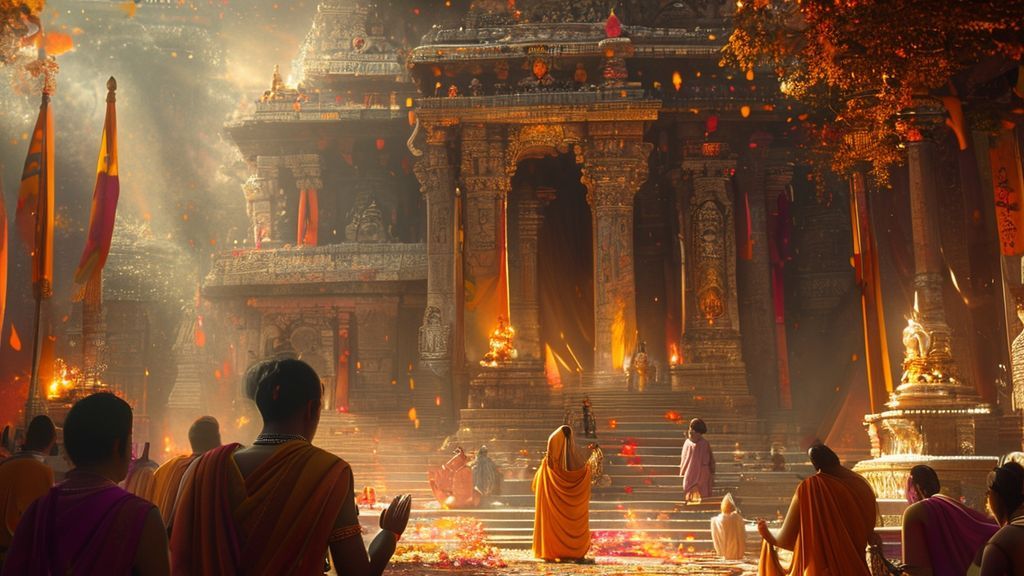
Dakshinamurti Stotra is a profound hymn, primarily attributed to Adi Shankara, eulogizing Lord Shiva in His form as Dakshinamurti – the silent, primordial Guru who imparts ultimate knowledge (Brahma Vidya) through profound silence. This divine discourse transcends spoken words, guiding seekers towards the realization of their true Self (Atman) as non-different from the Absolute (Brahman), illuminating the path of Advaita Vedanta.
| Attribute | Details |
|---|---|
| Deity | Lord Dakshinamurti (a cosmic form of Bhagavan Shiva, the Adi Guru) |
| Primary Composer | Adi Shankaracharya |
| Core Philosophy | Advaita Vedanta (non-dualism) |
| Key Festival for Guru Worship | Guru Purnima (though Dakshinamurti is revered daily by seekers) |
| Scripture Reference | Dakshinamurti Ashtakam (the Stotra itself), various Upanishads for philosophical context. |
The Supreme Guru: Unveiling the Significance of Dakshinamurti
In the vast ocean of Sanatan Dharma, the role of a Guru is paramount. He is the beacon that guides the soul from the darkness of ignorance (Tamas) to the light of knowledge (Prakash), from the unreal (Asat) to the Real (Sat). Among all Gurus, Lord Dakshinamurti stands as the ultimate, the Adi Guru, the primordial teacher of all teachers. His form, seated silently under a banyan tree, surrounded by aged Rishis seeking wisdom, encapsulates the profound truth that the deepest spiritual wisdom often transcends the limitations of words. The Dakshinamurti Stotra, a garland of verses, is not merely a eulogy; it is a profound philosophical treatise encapsulating the essence of Advaita Vedanta, guiding the sincere seeker towards self-realization.
This hymn articulates the cosmic dance of creation, sustenance, and dissolution through the lens of pure consciousness. It reveals how the phenomenal world, with all its diversity and forms, is ultimately an emanation from and identical to the singular, non-dual Brahman. Chanting or even contemplating the meaning of this Stotra is considered a direct pathway to understanding the nature of reality and one’s place within it, purifying the mind, and sharpening the intellect towards spiritual discernment.
Puranic History & The Legend of the Silent Teacher
The concept of Dakshinamurti, though formally articulated by Adi Shankara, has roots deep within Vedic and Puranic traditions, depicting Shiva as the source of all knowledge. The term “Dakshinamurti” itself means “He who is facing south” (Dakshina = south, Murti = idol/form). In many temples, the Dakshinamurti idol is placed facing south, as south is traditionally associated with Yama (death) and therefore represents transcending mortality through wisdom. It is also believed that Dakshinamurti imparts knowledge to the four Kumaras – Sanaka, Sanandana, Sanatana, and Sanatkumara – who were eternally young sages.
The legend, often alluded to in the Shiva Purana and Skanda Purana, describes how these great Rishis approached Lord Shiva, yearning for the highest truth. Instead of delivering elaborate discourses, Lord Shiva simply sat in profound silence, under a Banyan tree (Vata Vriksha). This silence itself became the most eloquent teaching, dispelling all doubts and imparting the highest wisdom of Brahman directly into the hearts of the disciples. This “Chin Mudra” (hand gesture of knowledge), where the thumb and index finger touch, symbolizes the union of the individual soul (Jivatma) with the Universal Soul (Paramatma), while the three outstretched fingers represent the three states of consciousness (waking, dream, deep sleep) being transcended. This silent teaching underscores that ultimate truth is beyond the grasp of the intellect alone; it must be experienced directly.
Philosophical & Symbolic Marvels of the Stotra
While the topic is a Stotra and not a physical temple, its internal structure and philosophical depth represent a magnificent “architectural” marvel of thought. The Dakshinamurti Stotra, consisting of ten verses (usually eight main verses with an introductory and concluding verse), is a concise yet comprehensive exposition of Advaita Vedanta.
- Verse 1 (Pratibimba-vāda): Explains creation as a reflection (pratibimba) of the Self, like a city seen in a mirror, implying the world is not separate from Brahman.
- Verse 2 (Maya-kārya): Describes creation through Maya, the divine power of illusion, comparing the world’s appearance to a magician’s trick or a dream.
- Verse 3 (Puruṣa-prabodha): Illustrates the awakening of consciousness, transitioning from the waking state to deep sleep and then to the Turiya (fourth) state, which is pure awareness.
- Verse 4 (Vyāpti-tattva): Explores the pervasiveness of the Self, residing within all beings, just as light illuminates all objects without being limited by them.
- Verse 5 (Deśakāla-nirupanam): Deconstructs the concepts of space, time, and direction, showing them as manifestations of the inner Self.
- Verse 6 (Sarvātma-bhāva): Emphasizes the identity of the Self with all beings and the universe, declaring “Tat Tvam Asi” (That Thou Art).
- Verse 7 (Ānanda-svarūpa): Proclaims the Self as pure bliss (Ananda), which is experienced in deep sleep and is the ultimate nature of reality.
- Verse 8 (Bandha-mokṣa-viveka): Addresses liberation, stating that the illusion of bondage (samsara) ceases upon realizing the true, non-dual Self.
Each verse is a meticulously crafted doorway to understanding a facet of Brahman, systematically dismantling misconceptions about identity and reality. The Stotra’s structure is a testament to Adi Shankara’s genius, presenting complex metaphysics with poetic elegance and spiritual fervor, making it accessible to profound contemplation.
Rituals & Puja Vidhi for Recitation
Chanting the Dakshinamurti Stotra is primarily a mental and spiritual sadhana, not reliant on elaborate external rituals, though sincerity and devotion enhance its efficacy. Here’s a guide for devotees:
- Purification (Shuddhi): Begin with a bath to cleanse the body. Find a clean, quiet space for recitation.
- Setting the Ambiance: Light a lamp (Deepam) and incense (Dhoopam). You may place an image or idol of Lord Dakshinamurti.
- Intention (Sankalpa): Silently resolve your intention for chanting – whether for knowledge, clarity, spiritual growth, or gratitude towards the Guru principle.
- Guru Vandana: Begin by offering salutations to your lineage of Gurus and to Lord Ganesha, the remover of obstacles.
- Invocation (Dhyana Sloka): Recite the Dhyana Sloka of Dakshinamurti to invoke His presence and focus the mind.
विश्वं दर्पणदृश्यमाननगरीतुल्यं निजान्तर्गतं
पश्यन्नात्मनि मायया बहिरिवोद्भूतं यथा निद्रया ।
यः साक्षात्कुरुते प्रबोधसमये स्वात्मानमेवाद्वयं
तस्मै श्री गुरुमूर्तये नम इदं श्री दक्षिणामूर्तये ॥Vishwam darpana drishyaman nagari tulyam nijantargatam
Pashyannatmani mayaya bahirivodbhutam yatha nidraya |
Yah sakshatkarute prabodha samaye svatmanamevadwayam
Tasmai shri gurumurtaye nama idam shri dakshinamurtaye ||
(Salutations to Sri Dakshinamurti, who is the embodiment of the Guru, who directly realizes his own non-dual Self, just as the world, seen like a city in a mirror, appears externally through Maya.) - Recitation of the Stotra: Recite the Dakshinamurti Ashtakam slowly and clearly, focusing on the meaning of each verse. Repetition (Japa) can be done multiple times.
- Contemplation (Mananam): After recitation, sit in silence and reflect deeply on the profound truths revealed in the Stotra. Allow the wisdom to permeate your being.
- Offering (Samarpanam): Conclude by offering the merits of your chanting to Lord Dakshinamurti and praying for continued guidance and grace.
The best time for recitation is early morning (Brahma Muhurta) or during twilight hours, when the mind is naturally calm and receptive to spiritual insights.
Mantras & Chants for the Seeker
Beyond the Stotra itself, specific mantras dedicated to Lord Dakshinamurti can be chanted for wisdom and spiritual clarity:
- Moola Mantra:
ॐ नमो भगवते दक्षिणामूर्तये मह्यं मेधां प्रज्ञां प्रयच्छ स्वाहा ॥
Om Namo Bhagavate Dakshinamurtaye Mahyam Medham Prajñām Prayachcha Swaha ||
(Salutations to Lord Dakshinamurti, grant me intellect and wisdom.) - Short Mantra for Guru Blessings:
ॐ दक्षिणामूर्तये नमः ॥
Om Dakshinamurtaye Namaha ||
(Salutations to Dakshinamurti.) - Guru Stotram (relevant for the Guru principle):
गुरुर्ब्रह्मा गुरुर्विष्णुर्गुरुर्देवो महेश्वरः ।
गुरुः साक्षात् परब्रह्म तस्मै श्री गुरवे नमः ॥Gurur Brahma Gurur Vishnu Gurur Devo Maheshwara |
Guruh Sakshat Param Brahma Tasmai Shri Gurave Namaha ||
(The Guru is Brahma, the Guru is Vishnu, the Guru is verily Lord Maheshwara. The Guru is directly the Supreme Brahman, salutations to that revered Guru.)
Consistent chanting with devotion and understanding can open channels of intuitive wisdom and dissolve mental obstacles to spiritual progress.
Dos and Don’ts for Devotees
- Do: Approach the Stotra with humility and a sincere desire for knowledge.
- Do: Strive to understand the philosophical meaning of each verse, not just rote recitation. Adi Shankara’s commentary is an excellent resource.
- Do: Practice consistency. Regular recitation, even for a short period, is more beneficial than sporadic, lengthy sessions.
- Do: Maintain physical and mental cleanliness before and during recitation.
- Don’t: Chant with a distracted or agitated mind. If your mind is restless, take a few deep breaths to calm yourself first.
- Don’t: Treat it merely as a ritual for material gain. Its primary purpose is spiritual enlightenment.
- Don’t: Engage in gossip or worldly talk immediately after profound contemplation of the Stotra. Allow the vibrations and insights to settle.
- Don’t: Doubt the efficacy of silent teaching. Sometimes, the deepest truths are absorbed beyond words.
Frequently Asked Questions
Who is Lord Dakshinamurti?
Lord Dakshinamurti is a specific, revered aspect of Bhagavan Shiva, depicted as the Adi Guru, the primordial teacher. He is traditionally shown seated under a banyan tree, imparting the highest spiritual knowledge (Brahma Vidya) to ancient sages through profound silence, epitomizing the ultimate source of wisdom in Sanatan Dharma.
What is the significance of “silent teaching” by Dakshinamurti?
The silent teaching signifies that ultimate truths are often beyond the grasp of ordinary words and intellectual discourse. It implies direct transmission of wisdom from Guru to disciple, a realization that dawns in the heart through intuitive understanding and spiritual maturity, rather than through mere verbal instruction. It emphasizes the transcendental nature of Brahman, which cannot be adequately described by language.
Who composed the Dakshinamurti Stotra?
The Dakshinamurti Stotra, specifically the Ashtakam (eight-verse hymn), is universally attributed to the great 8th-century philosopher-saint, Adi Shankaracharya. It is considered one of his most profound short works, distilling the essence of Advaita Vedanta into a powerful and poetic form.
When is the best time to chant this Stotra?
While the Dakshinamurti Stotra can be chanted at any time with devotion, it is particularly potent during early morning hours (Brahma Muhurta, approximately 96 minutes before sunrise) when the mind is calm and receptive. It is also considered auspicious to chant on Thursdays (Guruvar) or during Guru Purnima, as these times are dedicated to the veneration of Gurus and the principle of knowledge.
The Eternal Echo: Why This Matters for Every Hindu
The Dakshinamurti Stotra is more than just a hymn; it is a foundational pillar of Advaita Vedanta and a timeless testament to the Sanatan Dharma’s emphasis on true knowledge (Jnana) as the path to liberation. In an age saturated with information and superficial learning, the silent teaching of Dakshinamurti reminds us that true wisdom arises from within, guided by the grace of the Guru and deep contemplation.
This Stotra invites every Hindu, every seeker, to look beyond the transient forms and names of the world and to realize the unchanging, eternal Self that underlies all existence. It reiterates the fundamental truth that we are not separate from the Divine, but integral, indivisible parts of the Universal Consciousness. By engaging with this profound text, we not only pay homage to the Adi Guru but also actively participate in the preservation and propagation of the highest spiritual truths, ensuring that the light of Sanatan Dharma continues to illuminate the path for generations to come. For more such insights into our rich spiritual heritage, explore Hindutva.online.