


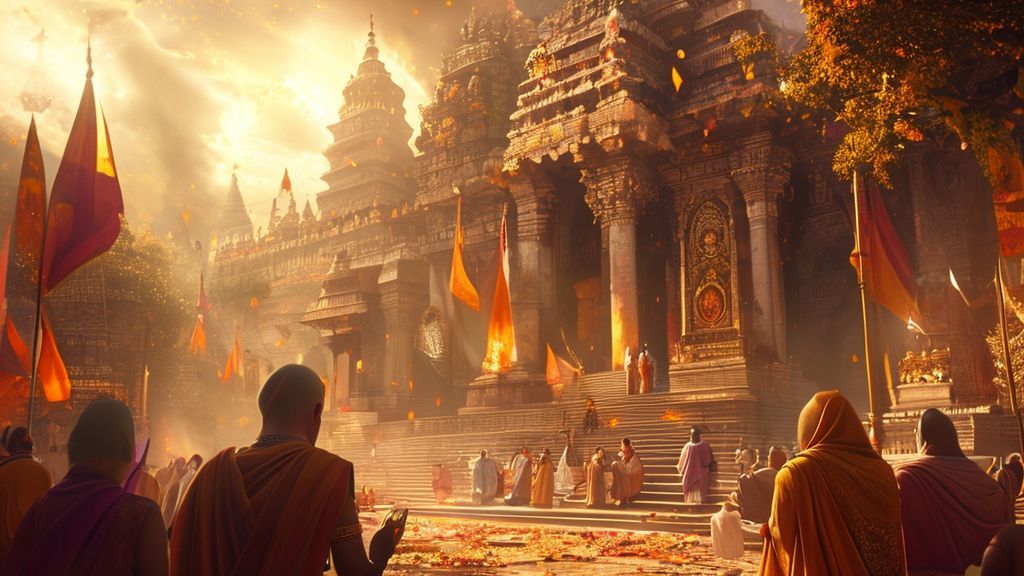
Decolonizing Hinduism is the essential and urgent process of reclaiming the authenticity and sovereignty of Sanatan Dharma by systematically dismantling and rejecting the distorted, reductionist, and often prejudiced interpretations imposed by Western colonial scholarship and modern secular frameworks, thereby restoring its indigenous spiritual integrity and profound Vedic wisdom.
| Attribute | Details |
|---|---|
| Concept | Decolonizing Hinduism |
| Core Purpose | Reclaiming Indigenous Authenticity and Self-Sovereignty of Sanatan Dharma |
| Historical Context | Post-Colonial Era, Critique of Orientalism and Indology |
| Foundational Texts | Vedas, Upanishads, Bhagavad Gita, Puranas, Itihasas (Ramayana, Mahabharata), Darshanas |
| Methodology | Scriptural Study in Sanskrit, Guru-Parampara, Traditional Commentaries, Dharmic Praxis |
| Significance | Preserving and Propagating the Eternal Truths of Sanatan Dharma for Future Generations |
Reclaiming Sanatan Dharma’s Unblemished Light
Sanatan Dharma, the eternal way of life, is a profound spiritual tradition whose wisdom has illuminated humanity for millennia. However, centuries of colonial rule and subsequent Western academic dominance have cast a long shadow, distorting its pristine essence through misinterpretations, reductionism, and deliberate misrepresentation. The crucial endeavor of Decolonizing Hinduism is not merely an academic exercise but a sacred duty – a spiritual reclamation that seeks to restore the authentic understanding of Dharma, freeing it from the lenses of Orientalism, missionary zeal, and secular-materialist frameworks. This process requires a deep dive into our own scriptures, guided by the wisdom of our revered Sages and the unbroken Guru-Parampara, ensuring that the light of the Vedas shines forth in its unblemished glory.
This path demands that sincere seekers and devotees engage directly with the indigenous knowledge systems, understanding that the truths of Dharma are not merely “religious” tenets but a holistic science of consciousness and existence. By shedding the baggage of foreign impositions, we unveil the inherent universality, scientific rigor, and spiritual profundity that truly define our tradition.
The Genesis of Distortion: Colonial Gaze and Academic Hegemony
The journey of decolonization begins with understanding how our sacred traditions became “colonized” in the first place. The British colonial enterprise, coupled with zealous missionary efforts, systematically sought to dismantle indigenous knowledge systems in India. Early European “Indologists” often approached Hindu scriptures with a preconceived Abrahamic framework, searching for parallels, or more often, seeking to highlight perceived “primitivism” or “superstition” to justify colonial rule and conversion. As documented in works analyzing the impact of figures like Max Müller, who, despite his scholarship, was deeply influenced by Christian theological perspectives and a Eurocentric view of history, the very terminology used to describe Hinduism was problematic. Terms like “mythology” for the Puranas, “idolatry” for Murti Puja, and the imposition of a linear, singular “religion” on a diverse Dharma, are all products of this colonial gaze.
The infamous “Aryan Invasion Theory,” though largely discredited by modern genomic and archaeological research, persisted for decades, serving as a tool to divide and conquer, portraying indigenous Indians as invaders themselves, and denying the deep roots of Vedic civilization. This systematic intellectual assault, sustained through the education system, aimed at creating a class of people “Indian in blood and colour, but English in taste, in opinions, in morals, and in intellect,” as Lord Macaulay famously articulated. The task of decolonization, therefore, involves rigorously challenging these inherited narratives and returning to the wellspring of our own authentic knowledge, as preserved in the Shruti (Vedas) and Smriti (Puranas, Itihasas, Dharmashastras).
Architectural Metaphor: Rebuilding the Edifice of Indigenous Knowledge
While we do not speak of temple architecture here, we can metaphorically consider the grand edifice of Hindu knowledge and spiritual systems. Just as a temple, built according to precise Vastu Shastra, resonates with cosmic energies, Sanatan Dharma’s conceptual framework is a meticulously constructed system of thought, practice, and spiritual realization. Colonial interpretations attempted to dismantle this edifice, replacing its coherent structure with fragmented, decontextualized, and often disparaging caricatures. They often failed to grasp the integral unity of philosophical schools (Darshanas), the profound symbolism embedded in Murti Puja (idol worship), or the sophisticated understanding of consciousness found in Yoga and Vedanta. They dismissed sophisticated Ayurvedic medicine as folklore and the precise astronomical calculations of Jyotisha as mere superstition, while promoting their own often less advanced systems.
The scientific marvels of ancient India – from metallurgy (e.g., the Iron Pillar of Delhi, resistant to rust for centuries) to mathematics (the concept of zero, decimal system) and astronomy – were either ignored or attributed to external influences. Decolonizing Hinduism demands we re-assert the indigenous origin and scientific rigor of these contributions, recognizing that Dharma is not antithetical to reason but is, in fact, the very foundation of a holistic scientific inquiry into the nature of reality. It is a system that integrates the inner and outer worlds, the material and the spiritual, in a way that Western thought has only recently begun to explore.
The Praxis of Decolonization: A Devotee’s Guide
To truly decolonize our understanding, devotees must actively engage in practices that root them firmly in authentic Sanatan Dharma. This is not a passive intellectual endeavor but an active spiritual and cultural commitment:
- Immerse in Original Texts: Prioritize the study of the Vedas, Upanishads, Bhagavad Gita, Puranas, and Itihasas in their original Sanskrit or through reliable, traditionally informed translations. Avoid secondary sources heavily influenced by Western academic biases.
- Seek Authentic Guru-Parampara: Connect with traditional Acharyas and Gurus who embody the unbroken lineage of knowledge transmission. The true understanding of Dharma comes through disciplic succession, not merely intellectual analysis.
- Understand Sanskrit Nuances: Recognize that Sanskrit is the language of Dharma, rich in layers of meaning that cannot be fully captured by English or other Western languages. Many misinterpretations stem from inadequate translation. Support efforts to learn basic Sanskrit.
- Engage in Dharmic Praxis: Live the Dharma. Perform your daily Pujas, recite Mantras, observe fasts (Vratas), celebrate festivals, and practice Yoga and Dhyana (meditation) as prescribed by tradition. Experience is the ultimate proof of spiritual truth.
- Critically Analyze Western Narratives: Develop discernment. When encountering discussions about Hinduism from non-traditional sources, question their assumptions, their methodologies, and their underlying biases. Understand the historical context of Orientalism.
By consciously adopting these practices, devotees can build a resilient, informed, and authentic understanding of their heritage, protecting it from external dilutions and internal confusions. For further resources on this critical journey, visit Hindutva.online.
Mantras for Reclaiming Truth
The power of Vak (speech) in Sanskrit mantras is profound. Chanting these sacred vibrations aids in clearing mental fog and aligning with higher truths:
- असतो मा सद्गमय । तमसो मा ज्योतिर्गमय । मृत्योर्मा अमृतं गमय । ॐ शान्तिः शान्तिः शान्तिः ॥ (Asato Ma Sadgamaya | Tamaso Ma Jyotirgamaya | Mrityorma Amritam Gamaya | Om Shantih Shantih Shantih ||)
(Brihadaranyaka Upanishad 1.3.28) “Lead me from untruth to truth, from darkness to light, from death to immortality. Om peace, peace, peace.” This mantra embodies the aspiration to move beyond illusion and ignorance, a core principle in decolonizing the mind.
- ॐ पूर्णमदः पूर्णमिदं पूर्णात् पूर्णमुदच्यते । पूर्णस्य पूर्णमादाय पूर्णमेवावशिष्यते ॥ ॐ शान्तिः शान्तिः शान्तिः ॥ (Om Purnamadah Purnamidam Purnat Purnamudachyate | Purnasya Purnamadaya Purnamevavashishyate || Om Shantih Shantih Shantih ||)
(Ishavasya Upanishad, Invocation) “That is full, this is full. From the full, the full arises. Taking the full from the full, the full itself remains. Om peace, peace, peace.” This mantra articulates the completeness and self-sufficiency of Brahman, reminding us that our tradition is inherently complete and does not require external validation or augmentation.
Dos and Don’ts for the Sincere Seeker
- Do: Engage in diligent self-study of primary Sanskrit texts and traditional commentaries.
- Do: Seek guidance from established Dharmic institutions and enlightened Sages.
- Do: Promote indigenous terms and concepts (e.g., Sanatan Dharma instead of “Hinduism,” Karma instead of “fate,” Murti Puja instead of “idol worship”).
- Do: Cultivate respect for the diversity within Sanatan Dharma and avoid sectarianism.
- Don’t: Blindly accept interpretations from scholars who lack a lived experience or reverence for Dharma.
- Don’t: Conflate Sanatan Dharma with Abrahamic theological frameworks or political ideologies.
- Don’t: Use terms like “mythology” for Puranic narratives; recognize them as symbolic, historical, or philosophical accounts.
- Don’t: Apologize for or dilute the unique tenets of Dharma to fit Western sensibilities.
Frequently Asked Questions on Decolonizing Hinduism
What are some common Western misinterpretations of Sanatan Dharma?
Common misinterpretations include reducing Dharma to a polytheistic or idolatrous religion, portraying Karma as fatalism, misrepresenting the Varna system as a rigid caste hierarchy (ignoring its original Guna-Karma basis), projecting Abrahamic concepts of “sin” or “prophets” onto Hindu thought, and dismissing profound philosophical concepts like Maya or Advaita Vedanta as mere mysticism, without acknowledging their deep logic and experiential basis.
Why is understanding Sanskrit crucial for decolonization?
Sanskrit is the divine language of the Vedas, imbued with spiritual potency and precise philosophical nuance. Many concepts, such as Dharma, Yoga, Atman, Brahman, or Rita, have no direct equivalents in Western languages. Relying solely on translations often leads to loss of meaning, distortion, or incomplete understanding. Learning Sanskrit provides direct access to the source and enables a deeper, authentic comprehension of our scriptures.
How does decolonizing Hinduism differ from Hindu nationalism?
Decolonizing Hinduism is primarily a spiritual and intellectual movement focused on reclaiming the authenticity and indigenous integrity of Sanatan Dharma from external misinterpretations and colonial biases. While it may naturally foster a sense of cultural pride, its core aim is theological and philosophical correctness. Hindu nationalism, on the other hand, is a political ideology that seeks to define India as a Hindu nation and may use religious identity for political ends. While the two can sometimes overlap in their rejection of colonial narratives, their fundamental objectives and methodologies differ significantly. Decolonization prioritizes Dharma itself.
Preserving Sanatan Dharma’s Sovereignty for Eternity
The endeavor of Decolonizing Hinduism is more than just academic; it is a profound act of spiritual self-preservation. It is about safeguarding the timeless wisdom of the Rishis, ensuring that the eternal truths of Sanatan Dharma are transmitted in their pristine form to future generations. By rigorously engaging with our own sources, honoring our Guru-Parampara, and asserting our intellectual and spiritual sovereignty, we empower devotees worldwide to connect with the authentic heart of Dharma. This reclamation ensures that the divine message of the Vedas, Upanishads, and Itihasas continues to guide humanity towards ultimate liberation and truth, unburdened by the misconceptions of a bygone era. Our commitment at Hindutva.online is to be a beacon in this essential journey of rediscovery and reaffirmation, illuminating the true path of Dharma.