

Dev Diwali—the Diwali of the Gods—represents one of the most spectacular and spiritually profound celebrations in Hindu tradition, transforming the ancient city of Varanasi into a celestial realm of light on the night of Kartik Purnima. Celebrated fifteen days after the main Diwali festival, this extraordinary event commemorates Lord Shiva’s cosmic victory over the demon Tripurasura, a triumph so significant that celestial deities themselves descended to earth to celebrate.

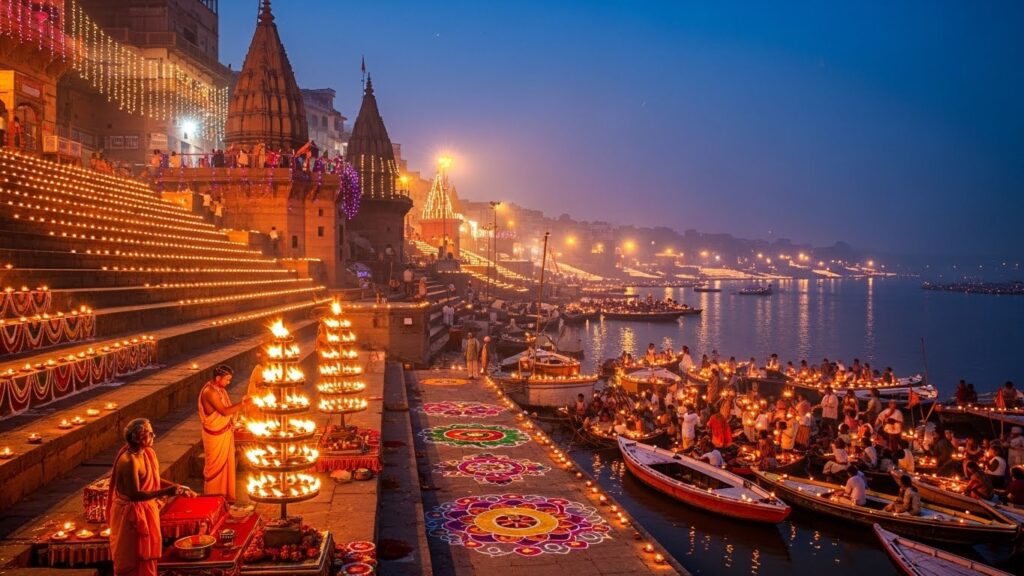
On this sacred night, over a million earthen lamps illuminate the ghats lining the holy Ganges River, creating a breathtaking spectacle that draws pilgrims, tourists, and spiritual seekers from across the globe. In 2025, as Varanasi continues to preserve and enhance this ancient tradition, Dev Diwali offers contemporary practitioners profound lessons about the eternal victory of dharma over adharma, the power of collective devotion, and the sacred relationship between humanity and the divine that has sustained Hindu civilization for millennia.
Understanding Dev Diwali requires exploring the rich mythological narrative of Tripurasura’s defeat, the unique rituals performed in Varanasi, and the theological significance of this divine celebration. The festival embodies the principle that certain sacred spaces—particularly Kashi (Varanasi)—serve as intersections between earthly and celestial realms where gods and humans can meet in mutual reverence and celebration.
The Sacred Narrative: Shiva’s Victory Over Tripurasura
The mythological foundation for Dev Diwali centers on one of the most dramatic episodes in Hindu sacred literature—Lord Shiva’s destruction of Tripurasura, the three demon brothers whose combined power threatened cosmic order itself. This narrative, preserved in the Shiva Purana and other sacred texts, illustrates themes of divine intervention, cosmic balance, and the ultimate futility of ego-driven power confronting transcendent consciousness.
The Rise of Tripurasura
The story begins with Tarakasura, a powerful demon king whose tyranny had terrorized the three worlds. When Tarakasura was finally defeated by Lord Kartikeya (Skanda), son of Shiva, his three sons—Tarakaksha, Kamalaksha, and Vidyunmali—became consumed with grief and vengeance. Determined to surpass their father’s power and avenge his death, the three brothers undertook severe penance to propitiate Lord Brahma, the creator deity.
Pleased by their intense austerities, Brahma appeared before them offering a boon. The brothers, with cunning intelligence, requested what appeared to be an impossible condition for their destruction: they asked that they could be killed only if all three of them were struck simultaneously by a single arrow. Recognizing the near-impossibility of this condition, Brahma granted the boon, making the three brothers essentially invulnerable.
The Three Invincible Cities
Empowered by Brahma’s boon, the demon architect Mayasura constructed three extraordinary cities for the brothers—one made of gold, one of silver, and one of iron. These magnificent cities, known collectively as Tripura (three cities), possessed the remarkable ability to float through the sky, constantly moving and never remaining in one location for extended periods. The cities’ continuous motion made the brothers’ defeat even more challenging, as the condition required all three to be aligned in a single trajectory for that crucial moment when they could be struck simultaneously.
The Reign of Terror
Protected by their invulnerability and residing in their mobile fortresses, the three brothers—now collectively known as Tripurasura—unleashed unprecedented chaos across the three realms. They conquered celestial kingdoms, drove the Devas (gods) from their heavenly abodes, enslaved celestial beings, disrupted sacrificial rites and dharmic practices, and terrorized sages and saints preventing them from performing spiritual austerities. The cosmic balance tilted dangerously toward adharma (unrighteousness), and the universe groaned under Tripurasura’s oppressive rule.
The Gods’ Appeal to Shiva
The defeated and desperate Devas, unable to counter Tripurasura’s power through conventional warfare, approached Lord Shiva seeking divine intervention. Shiva, understanding the cosmic necessity of restoring balance, accepted the responsibility of destroying the demon brothers. However, even for Shiva, the task presented extraordinary challenges due to Brahma’s boon—he would need to strike all three mobile cities simultaneously with a single arrow, a feat requiring perfect cosmic timing and alignment.
The Cosmic Preparation
For this unprecedented task, Lord Shiva assumed the form of Tripurantaka (destroyer of the three cities). The preparation itself involved cosmic elements: the Earth itself became Shiva’s chariot, the Sun and Moon became its wheels, Mount Meru transformed into the bow, the serpent Vasuki served as the bowstring, and Lord Vishnu himself took the form of the arrow. This cosmic assemblage symbolized the unified power of all creation marshaled to restore dharmic balance.
The Decisive Moment
On the sacred day of Kartik Purnima, under the auspicious Abhijit Nakshatra (constellation), the three floating cities aligned in a single trajectory for a brief, crucial moment. Lord Shiva, with perfect concentration and divine power, released the cosmic arrow. In that singular instant, the arrow pierced all three cities simultaneously, destroying them completely and ending Tripurasura’s reign of terror. The demon brothers were killed, cosmic order was restored, and dharma triumphed over adharma.
The Celestial Celebration
The Devas, overwhelmed with relief and gratitude, celebrated this momentous victory by descending to earth and illuminating the ghats of Varanasi—Shiva’s own sacred city—with countless oil lamps. This divine celebration, with gods themselves participating in the earthly realm, established the tradition now observed as Dev Diwali. The lighting of lamps symbolized the illumination of consciousness that dispels the darkness of ignorance and evil, honoring Shiva’s cosmic role as the destroyer of forces opposing dharma.
Varanasi: The Sacred Stage for Divine Celebration
Varanasi, also known as Kashi or Benares, holds unique significance as the location for Dev Diwali celebrations. According to Hindu tradition, Varanasi is not merely an ancient city but Shiva’s eternal abode on earth, making it the most appropriate location for celebrating his greatest triumph. The city’s spiritual geography—particularly its 84 ghats descending to the sacred Ganges—provides the perfect stage for this grand divine celebration.
The Theological Significance of Kashi
Hindu tradition describes Varanasi as the first creation, the city that would survive even universal dissolution (pralaya), and the place where spiritual liberation (moksha) is most accessible. Dying in Kashi is believed to grant automatic liberation, as Shiva himself whispers the Taraka mantra (liberation mantra) into the departing soul’s ear. This sacred status makes Varanasi the natural intersection between human and divine realms, the one place where gods comfortably descend to earth for celebration and where earthly devotees can most readily access divine presence.
The 84 Ghats: Descending to the Divine
The 84 ghats of Varanasi—stone staircases descending to the Ganges—serve practical, social, and profound spiritual functions. Each ghat carries its own history, associated deities, and ritual significance. During Dev Diwali, these ghats transform into a continuous pathway of light, with each step illuminated by earthen lamps creating a visual spectacle that appears to extend from earth to heaven itself. The ghats function as liminal spaces—thresholds between the material and spiritual worlds—making them perfect locations for divine-human interaction.
The Holy Ganges: Purification and Blessing
The Ganges River itself plays a central role in Dev Diwali celebrations. Hindu theology recognizes Ganga not merely as water but as a goddess—Goddess Ganga—whose descent from heaven to earth was mediated by Lord Shiva himself. Bathing in the Ganges during Kartik Purnima is considered supremely meritorious, washing away sins accumulated through lifetimes and purifying the soul. On Dev Diwali night, when the gods themselves descend to bathe in the sacred river, human devotees participate in the same purifying waters, temporarily transcending the ordinary separation between human and divine realms.
Dev Diwali Rituals and Celebrations
The five-day Dev Diwali festival, beginning on Prabodhini Ekadashi and culminating on Kartik Purnima, involves elaborate rituals and celebrations that engage Varanasi’s entire population alongside pilgrims from across India and the world.
Kartik Snan: The Sacred Bath
The most essential ritual begins at dawn when hundreds of thousands of devotees gather at the ghats for Kartik Snan—the sacred bath in the Ganges. This ritual bathing during the Brahma Muhurta (pre-dawn auspicious period) is believed to purify the soul, remove accumulated sins, grant spiritual merit, invoke divine blessings, and prepare the devotee spiritually for the evening celebrations. The morning air fills with Vedic chants, temple bells, and conch shell sounds as devotees immerse themselves in the holy waters with profound reverence.
Deepdan: Offering Light to the River
As evening approaches, the central ritual of Deepdan (offering of lamps) begins. Devotees, families, volunteers, and temple committees work together to place earthen oil lamps along every ghat step, temple, shrine, and building facade facing the river. In 2025, over one million diyas are expected to illuminate Varanasi’s 84 ghats, creating an unbroken chain of light extending for miles along the riverfront. The act of lighting and placing these lamps constitutes an offering to Goddess Ganga, Lord Shiva, and the descending deities, symbolizing the illumination of consciousness and the removal of spiritual darkness.
The Grand Ganga Aarti
The celebration’s magnificent climax occurs at Dashashwamedh Ghat—Varanasi’s most prominent and spiritually significant ghat—where the grand Ganga Aarti ceremony unfolds with extraordinary elaboration. During regular days, seven priests perform the evening Ganga Aarti with synchronized movements, but on Dev Diwali, this ceremony expands dramatically. Twenty-one Brahmins and forty-two young assistants participate in the Dev Diwali Maha Aarti, using massive multi-tiered brass lamps (each weighing several kilograms), conch shells producing resonant calls, incense creating aromatic clouds, flowers scattered in devotional offering, and synchronized movements choreographed with precision.
The priests face the river, waving the enormous lamps in circular patterns while chanting ancient Vedic hymns glorifying Goddess Ganga. The synchronized choreography, amplified chanting, and visual spectacle of giant flaming lamps being raised and lowered creates a hypnotic atmosphere that transports observers beyond ordinary consciousness into sacred time and space.
Witnessing from the River: The Boat Experience
Thousands of devotees observe the Ganga Aarti from boats anchored in the river, providing a unique perspective that encompasses the entire ghats illuminated with countless lamps, the grand aarti ceremony at Dashashwamedh, and the moon reflecting on the sacred waters. This riverine vantage point offers perhaps the most comprehensive view of Dev Diwali’s magnificence, as observers float between earth and sky, witnessing the convergence of human devotion and divine presence in a setting unchanged for millennia.
Cultural Programs and Celebrations
Beyond traditional religious rituals, Dev Diwali 2025 includes extensive cultural programming: classical music concerts featuring renowned artists, traditional dance performances including Kathak and Bharatanatyam, laser light shows projected onto ghats and temples, dramatic enactments of the Tripurasura story, exhibitions showcasing Varanasi’s cultural heritage, and food festivals celebrating traditional Banarasi cuisine. These programs make Dev Diwali accessible to diverse audiences while maintaining spiritual authenticity.
Dev Diwali 2025: Date, Timings, and Planning
For devotees and visitors planning to participate in Dev Diwali 2025, understanding precise dates, timings, and logistical considerations ensures meaningful engagement with this extraordinary celebration.
Dev Diwali 2025 Date
Dev Diwali in 2025 falls on Wednesday, November 5th, coinciding with Kartik Purnima (the full moon day of the Kartik month). This date occurs exactly fifteen days after the main Diwali celebration, marking the conclusion of the extended Diwali festival cycle.
Purnima Tithi Timings
- Purnima Tithi Begins: November 4, 2025 at 9:06 PM IST
- Purnima Tithi Ends: November 5, 2025 at 5:18 PM IST
Key Ritual Timings for November 5, 2025
- Kartik Snan (Holy Bath): Dawn to 8:00 AM (Brahma Muhurta: 4:30 AM – 6:00 AM most auspicious)
- Deepdan Preparation: 3:00 PM onwards (volunteers begin placing and lighting diyas)
- Main Diya Lighting: 5:15 PM – 6:00 PM (ghats illuminated sequentially)
- Ganga Aarti at Dashashwamedh: 6:30 PM – 7:45 PM (peak ceremony)
- Evening Muhurat: 5:15 PM – 7:50 PM (most auspicious for worship and darshan)
Best Viewing Locations
Dashashwamedh Ghat: The primary location for the grand Ganga Aarti; arrive by 5:00 PM to secure viewing position. VIP seating arrangements available with advance booking.
Assi Ghat: Offers a more intimate aarti ceremony with fewer crowds while still providing spectacular diya illumination. Preferred by those seeking a contemplative rather than spectacular experience.
Man Mandir Ghat and Munshi Ghat: Excellent middle positions providing panoramic views of multiple illuminated ghats simultaneously.
Boat Viewing: Book boat rides in advance (prices increase significantly on Dev Diwali). Evening boat rides from 5:30 PM – 8:00 PM offer the best overall visual experience.
Planning Considerations
Given Varanasi’s overwhelming crowds during Dev Diwali—with tourist numbers exceeding normal levels by 500%—careful planning ensures positive experience: book accommodation months in advance, arrange transportation to ghats early, arrive at viewing spots 1-2 hours before scheduled events, wear comfortable shoes for long standing/walking, carry water and minimal belongings, be prepared for intense crowds and limited personal space, and show respect for religious rituals even as a tourist observer.
Theological Significance: Light, Liberation, and Divine Presence
Beyond its visual splendor and mythological narrative, Dev Diwali embodies profound theological principles central to Hindu dharmic philosophy and spiritual practice.
The Symbolism of Light
The million lamps illuminating Varanasi on Dev Diwali represent multiple interconnected meanings: each individual lamp symbolizes a human soul, its flame representing consciousness or the divine spark within; the collective illumination demonstrates how individual spiritual efforts contribute to universal enlightenment; the lamps offered to Ganga represent surrender of ego and personal desire to divine consciousness; and the dispelling of physical darkness mirrors the removal of spiritual ignorance (avidya) through divine grace and self-effort.
The Descent of Deities
The belief that gods descend to earth on Dev Diwali carries deep theological significance. Hindu tradition recognizes that certain times, places, and ritual conditions create openings between ordinary reality and transcendent dimensions—thin places where divine presence becomes more accessible. Dev Diwali in Varanasi represents such a opening, when through proper ritual, devotion, and collective spiritual effort, the boundaries between human and divine realms become permeable. Devotees bathing in the Ganges alongside descending deities experience temporary transcendence of ordinary separation, participating directly in divine reality rather than merely conceptualizing it.
Tripurantaka: Shiva’s Cosmic Function
Shiva’s role as Tripurantaka (destroyer of the three cities) symbolizes his essential cosmic function as the destroyer aspect of the Trimurti (divine trinity). The three cities represent the three types of suffering (physical, mental, spiritual), the three realms of existence (earth, atmosphere, heaven), and the three qualities of nature (sattva, rajas, tamas). Shiva’s single arrow destroying all three simultaneously teaches that ultimate liberation requires transcending all dualistic categories and limited identifications, achieving the unified consciousness that dissolves multiplicity into singularity.
Kartik Purnima: The Auspicious Alignment
The timing of Dev Diwali on Kartik Purnima carries specific astrological and spiritual significance. Kartik month is considered supremely sacred for Vishnu and Shiva worship, while Purnima (full moon) represents consciousness at its fullest illumination. The combination creates maximum spiritual potency, making Dev Diwali an ideal time for spiritual practices including holy bathing, charitable giving, lamp offerings, fasting and prayer, and pilgrimage to sacred sites.
Contemporary Relevance and Global Significance
Dev Diwali’s significance extends far beyond traditional religious observance, offering contemporary relevance in multiple dimensions.
Tourism and Cultural Heritage
Dev Diwali has emerged as one of India’s premier cultural tourism attractions, drawing visitors from over 50 countries. The Uttar Pradesh government invests significantly in infrastructure, security, and promotional activities, recognizing Dev Diwali’s potential to showcase India’s spiritual heritage while generating substantial tourism revenue. In 2024, Dev Diwali attracted over 2 million visitors to Varanasi, with 2025 projections suggesting continued growth.
Environmental Consciousness
Recent years have seen increasing emphasis on environmentally conscious celebrations. Traditional clay diyas replace Chinese electric lights, biodegradable materials are used for decorations, organized cleanup operations follow the festival, and awareness campaigns emphasize river pollution reduction. This evolution demonstrates how ancient traditions can adapt to contemporary environmental challenges while maintaining spiritual authenticity.
Community Cohesion
Dev Diwali’s preparation and execution require massive community cooperation, with thousands of volunteers coordinating to light and maintain over a million lamps. This collective effort strengthens social bonds, transcends caste and class divisions through shared devotional service, engages youth in cultural transmission, and creates shared pride in Varanasi’s unique spiritual heritage.
Digital Documentation and Global Participation
Modern technology enables global participation in Dev Diwali through live streaming of Ganga Aarti ceremonies, virtual reality experiences of the illuminated ghats, social media documentation and sharing, and online devotional programs. These digital extensions allow the worldwide Hindu diaspora to maintain connection with sacred traditions while introducing Dev Diwali to global audiences unfamiliar with Hindu cultural practices.
Frequently Asked Questions About Dev Diwali
What is Dev Diwali and why is it called the Diwali of Gods?
Dev Diwali, celebrated on Kartik Purnima (November 5, 2025), commemorates Lord Shiva’s victory over the demon Tripurasura. Legend holds that celestial deities descended to earth to celebrate this triumph by illuminating Varanasi’s ghats with countless lamps, establishing the tradition of “Dev Deepawali” (Diwali of the Gods). The festival occurs 15 days after main Diwali and exclusively in Varanasi, where over a million earthen lamps create a spectacular display along the Ganges River, symbolizing the gods’ own celebration on earth.
What is the story of Tripurasura and Lord Shiva?
Tripurasura refers to three demon brothers—Tarakaksha, Kamalaksha, and Vidyunmali—who received a boon from Brahma that they could only be killed if struck simultaneously by a single arrow. They built three invincible mobile cities (made of gold, silver, and iron) and terrorized the cosmos. On Kartik Purnima, Lord Shiva assumed the form of Tripurantaka and destroyed all three cities with one cosmic arrow when they aligned momentarily, restoring dharmic balance. The gods celebrated this victory by lighting lamps in Varanasi.
When is Dev Diwali in 2025 and what are the timings?
Dev Diwali 2025 falls on Wednesday, November 5th (Kartik Purnima). Key timings: Kartik Snan (holy bath) at dawn 4:30 AM – 8:00 AM, Diya lighting begins at 5:15 PM, main Ganga Aarti at Dashashwamedh Ghat from 6:30 PM – 7:45 PM, and evening muhurat (most auspicious period) from 5:15 PM – 7:50 PM. The Purnima Tithi begins November 4th at 9:06 PM and ends November 5th at 5:18 PM.
How is Dev Diwali celebrated in Varanasi?
Dev Diwali celebrations involve multiple rituals: devotees take holy baths (Kartik Snan) in the Ganges at dawn, over one million earthen oil lamps are lit along all 84 ghats by evening, the grand Ganga Aarti ceremony with 21 priests is performed at Dashashwamedh Ghat, thousands observe from boats on the river, cultural programs including music and dance are organized throughout the city, and offerings of flowers and prayers are made to Goddess Ganga and Lord Shiva throughout the day.
Why is Varanasi the only place where Dev Diwali is celebrated?
Varanasi (Kashi) is considered Lord Shiva’s eternal earthly abode and the most sacred city in Hinduism. Hindu tradition holds that Varanasi exists beyond ordinary time and space, serving as an intersection between human and divine realms. Since Dev Diwali commemorates Shiva’s cosmic victory over Tripurasura, and the gods descended specifically to Kashi to celebrate, only Varanasi—as Shiva’s own city—is the authentic location for this divine celebration. The city’s 84 ghats along the Ganges provide the sacred geography necessary for this extraordinary festival.
What is the significance of taking a bath in the Ganges on Kartik Purnima?
Bathing in the Ganges during Kartik Purnima (Dev Diwali day) is considered supremely meritorious in Hindu tradition. The ritual bath is believed to wash away sins from multiple lifetimes, purify the soul and prepare it for spiritual advancement, invoke divine blessings and protection, provide merit equal to extensive pilgrimages, and allow participation in the same sacred waters where gods themselves descend. The bath should ideally occur during Brahma Muhurta (pre-dawn) for maximum spiritual benefit.
How many lamps are lit during Dev Diwali in Varanasi?
During Dev Diwali 2025, over 1 million (10 lakh) earthen oil lamps (diyas) will illuminate Varanasi’s 84 ghats and surrounding areas. Volunteers, temple committees, families, and organizations coordinate this massive undertaking, with lamps placed on every ghat step, temple facade, shrine, and building facing the river. The continuous chain of light extends for miles along the Ganges, creating what is considered one of the most spectacular visual displays in India—a literal river of light honoring the divine presence.
What is the difference between Dev Diwali and regular Diwali?
While both festivals celebrate the victory of light over darkness, they differ significantly: Regular Diwali (October 20-21, 2025) commemorates Lord Rama’s return and honors Goddess Lakshmi, celebrated across India and globally with fireworks, sweets, and family gatherings. Dev Diwali (November 5, 2025) specifically honors Lord Shiva’s victory over Tripurasura, is exclusively celebrated in Varanasi, focuses on spiritual rituals including Ganga bathing and lamp offerings, and emphasizes divine presence descending to earth rather than domestic celebrations.
About the Author
Arvind Mehta – PhD in Vedic Studies and Ancient Indian History
Arvind Mehta is a distinguished scholar specializing in ancient Indian history, Vedic traditions, and Hindu cultural practices. With over 15 years of research experience focused on decolonizing historical narratives, he has published extensively on temple architecture, pilgrimage traditions, Hindu philosophy, and the sacred geography of Varanasi. His work bridges academic rigor with accessible presentation, making complex historical, mythological, and philosophical concepts understandable to contemporary audiences seeking authentic knowledge about Hindu civilization and its living sacred traditions.