


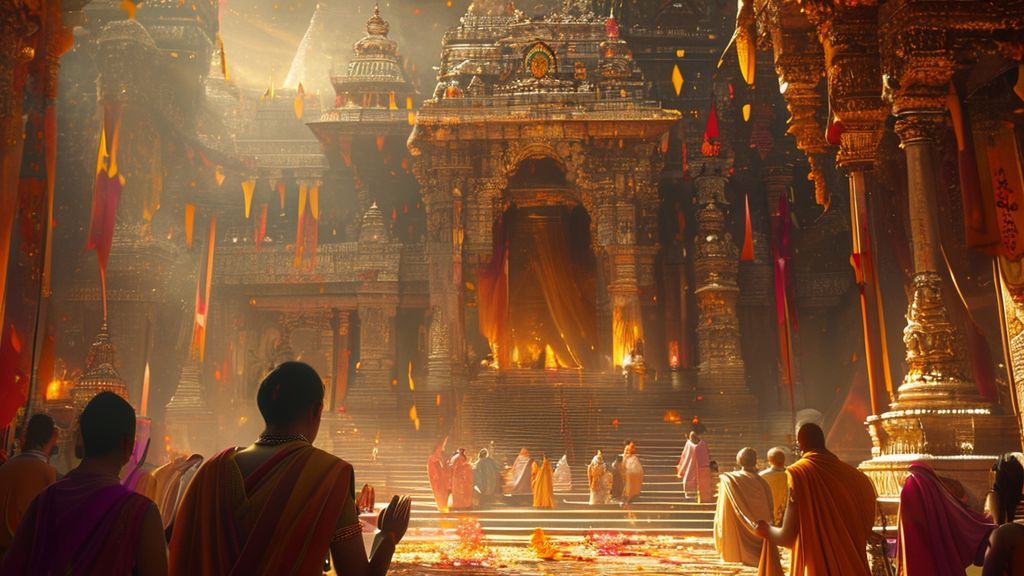
The Devi Suktam (also known as the Vak Suktam), found in Mandala 10, Hymn 125 of the Rig Veda, is a profound Vedic hymn uttered by Vagambhrini, the daughter of Rishi Ambhrina. It is a direct revelation of the Universal Divine Mother (Devi) as the supreme cosmic power (Shakti), the ultimate source and sustainer of all existence, pervading and manifesting as everything.
| Attribute | Details |
|---|---|
| Primary Deity | Devi (Divine Mother) in Her supreme, all-encompassing form, encompassing Saraswati, Lakshmi, Parvati, Durga, Kali. |
| Origin/Source | Rig Veda, Mandala 10, Sukta 125 (Vak Suktam). Attributed to Rishi Vagambhrini. |
| Key Festivals for Recitation | Navaratri, Durga Puja, Saraswati Puja, any Devi worship. |
| Philosophical Basis | Vedanta, Shakti Darshana. Declares the oneness of the individual soul with the cosmic energy. |
| Significance | One of the most foundational texts for understanding the feminine principle in Sanatan Dharma. |
The Ineffable Voice of Shakti: Unveiling the Devi Suktam
The Devi Suktam stands as a monumental hymn within the Rig Veda, not merely as a prayer but as a profound philosophical declaration of the Absolute Truth embodied as the Divine Mother. It is the very voice of Shakti herself, revealing Her omnipotence, omnipresence, and omniscience. For every sincere seeker, this hymn offers a direct pathway to understanding the primordial energy that orchestrates the cosmos, sustains life, and grants liberation. It is the bedrock upon which the vast edifice of Shaktism, a core stream within Sanatan Dharma, is built, guiding devotees to recognize the feminine divine as the supreme Brahman.
Its recitation is not just a ritual act; it is a spiritual practice designed to awaken the inner consciousness to the omnipresent Mother. It inspires a profound sense of devotion (bhakti) and provides clarity on the non-dual (advaitic) nature of reality, where all manifested forms are but expressions of this singular, glorious Divine Feminine. Understanding and chanting the Devi Suktam connects us directly to the source of all power, wisdom, and compassion, helping us navigate the worldly illusion and attain spiritual fulfillment.
The Genesis of Divine Utterance: Puranic Context and Vedic Origin
While the Devi Suktam is a direct emanation from the Rig Veda (X.125), its philosophical underpinnings resonate throughout the Puranic literature, especially in the great Shakti Puranas. The hymn is famously attributed to Vagambhrini, the daughter of Rishi Ambhrina, who, through intense meditation and profound realization, became one with the Divine Word (Vak) and spontaneously expressed this truth. This is not merely a human composition but a divine revelation, a direct experience of the Universal Self manifesting as the primordial sound and energy.
This Vedic hymn serves as the theological precursor to the extensive narratives found in the Devi Bhagavata Purana and the Markandeya Purana’s Devi Mahatmyam (also known as Sri Durga Saptashati or Chandi Path). In the Devi Mahatmyam, the Devi Suktam is often recited as part of the Anga Path, or preliminary prayers, setting the stage for the glorious battles and cosmic manifestations of Durga. It lays the philosophical foundation that the various forms of Durga, Lakshmi, and Saraswati are not separate deities but distinct manifestations of the one supreme Vagambhrini Devi, the universal consciousness and power. She is the source of Brahma, Vishnu, and Shiva, and indeed, all gods and creation, a truth emphatically declared by Vagambhrini in the Suktam itself.
The Architecture of Sound: Philosophical & Linguistic Marvels of the Devi Suktam
The Devi Suktam is not merely a string of verses; it is a meticulously constructed edifice of sound and meaning, a true architectural marvel in the realm of sacred literature. Its eight verses (Riks) systematically unfold the profound truth of the Divine Mother. The structure follows a logical progression of realization:
- Universal Pervasion (Verse 1-2): The Devi declares Her presence with all Devas (Rudras, Vasus, Adityas, Vishwadevas) and Her supporting role for Mitra and Varuna, Indra and Agni. She is the essence that enables all divine functions.
- Cosmic Sustainer (Verse 3-4): She is the One who supports all creation, eating the food that sustains life, hearing, and seeing. She embodies the entire universe, pervading land and sky. She declares, “I hold up the sky, the earth, and the heavens.”
- Source of All Power (Verse 5-6): The Devi reveals Herself as the bestower of wealth, inspiration, and strength. She is the underlying power that makes the gods powerful and helps them conquer. “अहं राष्ट्री संगमनी वसूनां चिकितुषी प्रथमा यज्ञियानाम्।” (I am the Sovereign Queen, the collector of treasures, the knowing, the first among those to whom oblation is due.)
- Ultimate Reality (Verse 7-8): The Suktam culminates in the declaration that She is the one who generated all existence, residing in the innermost self. Her greatness transcends the earth and sky; She is the Self, the supreme reality. “अहमेव स्वयमिदं वदामि जुष्टं देवेभिरुत मानुषेभिः।” (I Myself speak this, which is welcome to Gods and humans.)
This systematic revelation, through precise Sanskrit phonetics, creates a potent mantra shakti. The vibratory frequencies generated by its correct recitation are believed to align the chanter’s consciousness with the universal energy it describes, facilitating direct spiritual experience. It’s a scientific approach to spiritual awakening, where sound is the vehicle for realizing the formless truth.
Sadhana of Shakti: Rituals & Puja Vidhi for Chanting Devi Suktam
Reciting the Devi Suktam is a powerful form of Sadhana (spiritual practice) that enhances devotion, wisdom, and spiritual power. While it can be integrated into any Devi Puja, here’s a common sequence for its dedicated recitation:
- Achamana & Pavitrikaranam: Begin by purifying the body and mind. Sip water three times, uttering “Om Keshavaya Namah,” “Om Narayanaya Namah,” “Om Madhavaya Namah.” Sprinkle water on yourself, chanting “Om Apavitrah Pavitro Va Sarvavastham Gato Pi Va. Yah Smaret Pundarikaksham Sa Bahyabhyantarah Shuchih.”
- Deep Prajvalana: Light a lamp (deepam) as a symbol of knowledge and auspiciousness, invoking the divine light.
- Sankalpa: Declare your intention for chanting the Suktam. This could be for spiritual growth, seeking Devi’s blessings, or universal well-being. “Mamopatta samasta durita kshaya dwara Sri Parameswari prityartham Devi Sukta japa karishye.”
- Guru Vandana & Ganesha Pranam: Offer reverence to your Guru and Lord Ganesha to remove obstacles.
- Dhyanam (Meditation): Before chanting, meditate on the form of the Divine Mother – resplendent, serene, and omnipotent. Visualize Her as the source of all existence.
- Recitation of Devi Suktam: Chant the eight verses of the Devi Suktam with clear pronunciation, devotion (bhava), and understanding of its meaning. Feel the presence of the Divine Mother in every word. You may repeat it multiple times, often in cycles of 3, 9, 11, 21, or 108.
- Phala Shruti & Arpanam: After completion, offer the fruits of your chanting to Devi. Pray for Her blessings and for the welfare of all beings.
- Aarti: Conclude with Aarti, waving a lamp before the deity, symbolizing the dissolution of darkness.
Consistent practice, especially during auspicious times like Navaratri, amplifies the spiritual benefits of this profound hymn. Delve deeper into these practices at Hindutva.online.
Mantras of the Manifest Absolute: Key Verses from Devi Suktam
The Devi Suktam is itself a collection of powerful Vedic mantras. Here are a few seminal verses that encapsulate its essence:
Verse 1: The Pervasive Presence
“अहं रुद्रेभिर्वसुभिश्चराम्यहमादित्यैरुत विश्वदेवैः।
अहं मित्रावरुणोभा बिभर्म्यहमिन्द्राग्नी अहमश्विनोभा ॥”
(Ahaṁ rudrebhirvasubhiścarāmyahamādityairuta viśvadevaiḥ.
Ahaṁ mitrāvaruṇobhā bibharmyahamindrāgnī ahamāśvinobhā.)
I move with the Rudras and the Vasus; I move with the Adityas and all the Vishvadevas. I support both Mitra and Varuna; I support Indra and Agni, and the two Ashvins.
Verse 3: The Sustainer of the Cosmos
“अहं सोममाहनसं बिभर्म्यहं त्वष्टारमुत पूषणं भगम्।
अहं दधामि द्रविणं हविष्मते सुप्राव्ये यजमानाय सुन्वते ॥”
(Ahaṁ somamāhanasaṁ bibharmyahaṁ tvaṣṭāramuta pūṣaṇaṁ bhagam.
Ahaṁ dadhāmi draviṇaṁ haviṣmate suprāvyeye yajamānāya sunvate.)
I uphold Soma, the pressed juice; I uphold Tvashtar, Pushan, and Bhaga. I grant wealth to the devout worshipper who offers oblations and performs the sacrifice.
Verse 6: The Source of Strength and Knowledge
“अहं राष्ट्री संगमनी वसूनां चिकितुषी प्रथमा यज्ञियानाम्।
तां मा देवा व्यदधुः पुरुत्रा भूरिस्थात्रां भूर्यावेशयन्तीम् ॥”
(Ahaṁ rāṣṭrī saṁgamanī vasūnāṁ cikitūṣī prathamā yajñiyānām.
Tāṁ mā devā vyadadhuḥ purutrā bhūristhātrāṁ bhūryāveśayantīm.)
I am the Sovereign Queen, the collector of treasures, the knowing, the first among those to whom oblation is due. The Devas established Me in many places, with many homes, causing Me to enter into many forms.
Chanting these verses with sincere devotion and concentration helps in realizing the oneness with the Divine Mother, dissolving illusions, and experiencing inner peace and power.
Cultural Reverence: Dos and Don’ts for Chanting Devi Suktam
Approaching the sacred Devi Suktam requires not just vocalization but a holistic spiritual mindset. Adhering to these guidelines enhances the efficacy of your practice:
- Dos:
- Purity: Chant with a clean body and mind. Take a bath before recitation.
- Devotion (Shraddha): Cultivate deep faith and reverence for the Divine Mother.
- Focus (Ekagrata): Concentrate on the meaning of the verses and visualize the Devi.
- Pronunciation: Strive for accurate Sanskrit pronunciation to harness the full power of the mantra.
- Consistency: Regular chanting, even for short periods, is more beneficial than sporadic long sessions.
- Sacred Space: Chant in a quiet, clean place, preferably before an altar or image of the Devi.
- Don’ts:
- Impurity: Do not chant when feeling unclean, angry, or distressed without first purifying your mind.
- Distraction: Avoid chanting while multitasking or when your mind is preoccupied with worldly concerns.
- Disrespect: Do not treat the Suktam as a mere poem or chant it without understanding its profound significance.
- Selfishness: While personal boons may be sought, the primary aim should be spiritual growth and universal well-being.
- Excessive Eagerness for Results: Focus on the process, not just the outcome. The benefits unfold naturally.
Frequently Asked Questions About Devi Suktam
What is the spiritual significance of Devi Suktam?
The Devi Suktam is spiritually significant as it unequivocally declares the Divine Mother as the Supreme Reality (Para Brahman) and the sole source of all creation, sustenance, and dissolution. It elevates the feminine principle (Shakti) to the highest philosophical pedestal, teaching non-duality and the inherent divinity of all beings, making it foundational for advaitic realization within Shaktism.
Who is Vagambhrini, and why is she important to the Devi Suktam?
Vagambhrini is the Rishi (seer) to whom the Devi Suktam was revealed. She is important because the hymn is her direct, intuitive experience and utterance of becoming one with Vak, the primordial speech and Divine Mother. She is not merely the composer but the embodiment of the realization that the individual self is identical to the cosmic Shakti, making her the living voice of the Suktam.
What are the benefits of chanting Devi Suktam regularly?
Regular chanting of the Devi Suktam is believed to bestow numerous benefits: enhanced spiritual wisdom, fearlessness, protection from negative influences, fulfillment of righteous desires, improved speech and clarity of thought (as Vak is the goddess of speech), and ultimately, the realization of one’s inner divine potential and liberation (moksha).
Can non-Hindus or those new to Sanatan Dharma chant the Devi Suktam?
Absolutely. The profound truths embedded in the Devi Suktam are universal. While understanding the cultural context and Sanskrit pronunciation enhances the experience, anyone with a sincere heart and respectful intent can chant this hymn. It is a path to connecting with the universal feminine energy, accessible to all who seek spiritual wisdom and devotion. For more resources on ancient Vedic hymns, visit Hindutva.online.
Upholding Sanatan Dharma: Why the Devi Suktam Matters for Every Hindu
The Devi Suktam is more than an ancient hymn; it is a living testament to the eternal truths of Sanatan Dharma. It asserts the paramount importance of the feminine principle, Shakti, as the dynamic force behind all creation, balancing the perception of the static Brahman. In a world often grappling with materialism and imbalance, the Suktam reminds us of the divine feminine’s nurturing, creative, and protective power.
For every Hindu, understanding and revering the Devi Suktam is crucial for several reasons: It deepens our appreciation for the philosophical breadth of the Vedas, clarifies the ultimate unity behind the multitude of deities, and empowers us to see the Divine Mother in every aspect of existence, especially in women. It instills courage, compassion, and wisdom, guiding us to live a life aligned with Dharma. By internalizing its message, we not only preserve a sacred tradition but also awaken the inherent divine potential within ourselves, fostering harmony and spiritual liberation for all.