

Difference Between Kali and Durga Understanding the Fierce Goddesses In the vast pantheon of Hindu deities, few goddesses command as much reverence, fascination, and awe as Kali and Durga—two manifestations of the divine feminine principle known as Shakti. While both embody tremendous power and fierce protection, these two goddesses represent distinct aspects of the cosmic Mother and are often confused by those unfamiliar with Hindu tradition. Understanding the difference between Kali and Durga is essential for appreciating the nuanced and sophisticated theological framework of Hindu goddess worship,

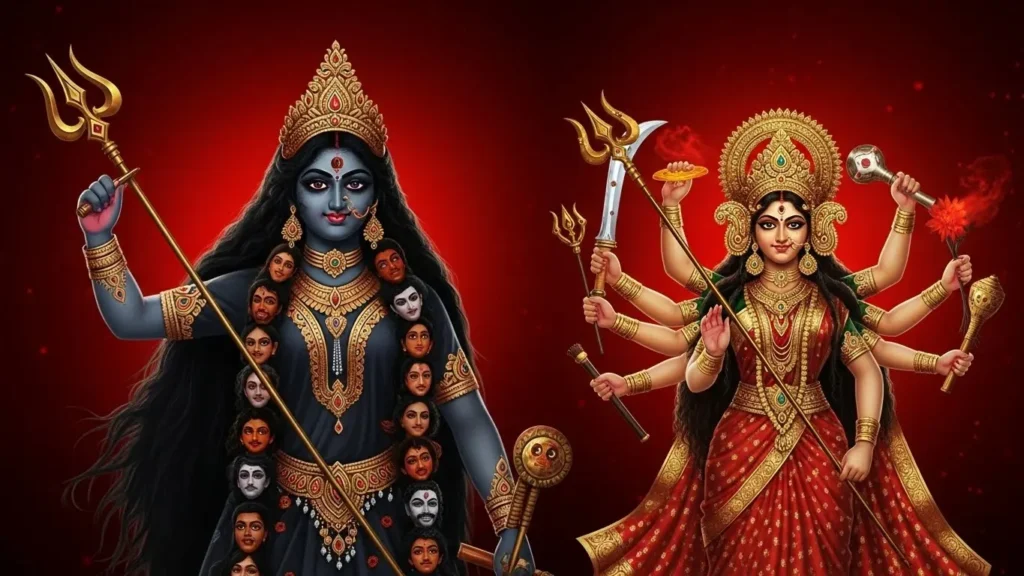
where the divine feminine manifests in multiple forms serving different cosmic functions while ultimately emanating from the same Supreme Consciousness. Durga appears as the majestic warrior goddess riding a lion, balancing fierce determination with maternal grace, celebrated during Navratri as the protector who vanquishes evil while maintaining cosmic order. Kali emerges as the dark, wild, unrestrained force of transformation and time, depicted with skull garland and protruding tongue, embodying destruction’s necessity for renewal and the transcendence of ego required for liberation. Though both goddesses share the common purpose of destroying evil and protecting devotees, their origins, iconography, symbolism, worship traditions, and theological roles reveal profound differences that illuminate Hindu dharma’s comprehensive understanding of Shakti’s manifestation.
In this complete exploration, we examine the mythological origins of both goddesses, their distinct visual representations, the deeper spiritual symbolism each embodies, and how their worship traditions reflect different aspects of the divine feminine accessible to humanity.
Origins: How Durga and Kali Came Into Being
The mythological narratives explaining Durga and Kali’s origins reveal their fundamentally different purposes and cosmic roles within Hindu theology.
Durga: Born from Divine Unity
Goddess Durga’s creation represents the collective power of all gods united to confront a cosmic crisis that individual deities could not resolve alone. According to the Devi Mahatmya (Glory of the Goddess), the most authoritative text on Durga’s mythology, her birth occurred during a time of supreme emergency.
The Demon Mahishasura’s Tyranny
The buffalo demon Mahishasura had performed intense penance to Lord Brahma, obtaining a boon that he could not be killed by any man or god. Protected by this invulnerability, Mahishasura launched a campaign of terror across the three worlds—earth, atmosphere, and heaven. His demonic armies conquered the celestial realms, driving the Devas (gods) from their heavenly abodes and establishing tyrannical rule that disrupted cosmic order (dharma). Sacrifices ceased, righteousness declined as described in Hindu scriptures, and chaos threatened universal balance.
The Divine Assembly and Creation
The defeated and desperate gods—led by Brahma, Vishnu, and Shiva—gathered in cosmic council to address this existential threat. Recognizing that Mahishasura’s boon made him invulnerable to male deities, they understood that only a goddess—neither man nor god—could destroy him. In a unprecedented act of divine cooperation, each god released his distinctive energy (tejas), which converged and fused into a blazing column of light. From this unified divine energy emerged Goddess Durga—a magnificent warrior goddess whose very being contained the combined power of the entire cosmic pantheon.
Arming the Warrior Goddess
Each god gifted Durga with his own weapon or power: Shiva gave his trident, Vishnu his discus, Indra his thunderbolt, Agni his missiles, Vayu his bow, Surya his radiance, Varuna his conch, Yama his staff, Vishwakarma his axe, and Himavan gifted her a lion as her vahana (vehicle). Thus armed with divine weapons and riding her lion, Durga embodied the strategic, disciplined application of cosmic power directed toward a specific righteous purpose—the destruction of Mahishasura and restoration of dharmic order.
Kali: Emerging from Durga’s Fury
While Durga represents the organized, strategic aspect of divine feminine power, Kali’s origin story reveals her as the uncontrolled, primal force of destruction that emerges when even Durga’s tremendous power proves insufficient.
The Battle with Raktabija
According to the Devi Mahatmya, after Durga successfully slayed Mahishasura, new demonic forces arose threatening cosmic balance. Among these was the demon Raktabija, who possessed an extraordinary and dangerous power: every drop of his blood that touched the earth would instantly spawn a duplicate demon identical to the original. In battle, when Durga’s weapons wounded Raktabija, each drop of his blood created countless new demons, multiplying the enemy exponentially faster than even the mighty Durga could destroy them.
Emergence from the Third Eye
Witnessing this impossible situation, Durga’s fury intensified to such extremity that from her forehead—specifically from the ajna chakra (third eye), the seat of divine consciousness and supreme power—emerged the dark, terrible form of Kali. This emergence symbolizes that when measured, controlled power proves insufficient, the universe requires the unleashing of pure, unrestrained destructive energy capable of consuming all that opposes dharma.
Kali, described as emaciated with black skin, wild disheveled hair, blood-red eyes, and a lolling tongue, immediately understood what must be done. She spread her enormous tongue across the battlefield, catching every drop of Raktabija’s blood before it could touch the earth. Then, with terrifying efficiency, she consumed all the duplicate demons that had already manifested while simultaneously draining the original Raktabija of his blood, preventing any further multiplication. This complete, absolute destruction—leaving nothing that could regenerate—accomplished what conventional warfare could not.
The Relationship Between Durga and Kali
This origin story establishes a crucial theological relationship: Kali is not separate from Durga but rather Durga’s most extreme manifestation—the aspect that emerges when circumstances demand absolute, uncompromising destruction without mercy or restraint. Durga represents controlled, purposeful power; Kali embodies that same power unleashed without limitation.
Iconography and Visual Representation: Reading the Symbols
The distinct visual depictions of Durga and Kali immediately communicate their different natures and functions through a sophisticated symbolic language understood by Hindu devotees.
Durga’s Majestic Warrior Form
Physical Appearance
Durga is depicted as radiantly beautiful with golden or fair complexion, representing auspiciousness, prosperity, and the illuminating quality of consciousness. She appears with eight, ten, or sometimes eighteen arms, each holding different weapons gifted by the gods—trident, discus, sword, bow, arrow, conch, mace, and various other implements. This multiplicity symbolizes her ability to address numerous challenges simultaneously while maintaining perfect balance and control.
The Lion Vahana
Durga rides a magnificent lion (sometimes tiger), which itself symbolizes strength, courage, determination, and controlled power. The lion represents the animal instincts and passions of human nature, which Durga masters completely. Her seated position on the lion, calm and composed even in fierce battle, demonstrates the spiritual principle taught in Hindu philosophy that divine consciousness must master rather than suppress natural energies.
Facial Expression and Demeanor
Despite being a warrior goddess engaged in cosmic battle, Durga’s facial expression remains serene and composed, with gentle features that convey both motherly compassion and determined strength. Her expression balances fierceness with grace, demonstrating that power need not be chaotic or uncontrolled. She appears simultaneously as the protective mother (Mata) who nurtures and defends her children and the warrior who destroys threats to cosmic order.
Attire and Adornment
Durga wears elegant, colorful sarees or warrior garments, ornate jewelry befitting a divine queen, and a crown indicating her sovereignty. Her adornments are beautiful and regal, representing the integration of aesthetic beauty with spiritual power—showing that the divine encompasses all positive qualities including grace, elegance, and refinement alongside strength.
Kali’s Terrifying Primal Form
Physical Appearance
Kali appears with black or dark blue skin, symbolizing her association with the void from which all creation emerges and to which all returns, absolute transcendence beyond all qualities, time itself (Kala means “time” in Sanskrit), and the womb of infinite potential. Her form is typically emaciated and gaunt, representing ascetic detachment from material existence and the dissolution of all limited forms.
The Iconic Attributes
Protruding Tongue: Kali’s most recognizable feature—her long red tongue lolling from her mouth—carries multiple symbolic meanings. It represents the rajasic (passionate) quality being consumed and transcended, insatiable hunger for truth and destruction of illusion, and in one famous narrative, her embarrassment when she realized she had stepped on her husband Shiva during her victory dance, making her appear momentarily humanized.
Garland of Skulls: Around her neck, Kali wears a garland of severed heads or skulls, numbering fifty or fifty-two (representing the letters of the Sanskrit alphabet) or 108 (the sacred number). This mala (garland) symbolizes the dissolution of ego across all modes of limited consciousness, liberation from the cycle of birth and death (samsara), the transcendence of time that ultimately claims all physical forms, and her role as destroyer of ignorance represented by the decapitated heads.
Skirt of Severed Arms: Her lower garment consists of severed arms hanging from a belt, representing liberation from karma—the actions (symbolized by arms) that bind souls to material existence, destruction of ego’s grasping nature that tries to control and possess, and the cessation of all action-driven existence in favor of pure being as taught in Vedic philosophy.
Nakedness or Minimal Clothing: Unlike Durga’s elegant attire, Kali appears naked or wearing minimal clothing, symbolizing complete freedom from societal conventions and shame, transcendence of all limited identifications including bodily consciousness, and the primordial state before civilization’s constructs, representing raw, unfiltered reality.
Four Arms: Kali typically has four arms (though sometimes more) holding a severed head dripping blood, a sword or cleaver representing severance of ego, a trident or other weapon, and making gestures (mudras) of blessing and fearlessness. The combination of blessing and destruction demonstrates that what appears terrifying to the ego is actually liberating to the soul.
Three Eyes: Like Shiva, Kali possesses three eyes representing perception of past, present, and future, transcendent vision beyond ordinary sight, and the awakened third eye of spiritual consciousness that sees through all illusions.
Standing on Shiva’s Corpse
Perhaps the most striking iconographic difference from Durga is Kali’s depiction standing on Lord Shiva’s prone body, often portrayed as a corpse (shava). This image carries profound Tantric symbolism: Shiva represents consciousness (Purusha) while Kali represents energy/power (Prakriti/Shakti), without Shakti, consciousness remains inert like a corpse—unable to manifest or act, the image demonstrates that energy and consciousness are interdependent—neither complete without the other, Kali standing on Shiva shows that the active, dynamic principle (Shakti) gives life to passive consciousness, and the moment when Kali realizes she’s stepping on her consort, her tongue protrudes in shock, humanizing the fierce goddess.
Theological and Symbolic Differences
Beyond visual distinctions, Durga and Kali represent fundamentally different aspects of divine feminine power and serve distinct spiritual purposes.
Durga: Protective Mother and Cosmic Order
The Preserving Function
Durga embodies the preserving, protective aspect of Shakti that maintains cosmic balance (dharma) against forces threatening universal order. Her function parallels Vishnu’s role as preserver in the Trimurti (divine trinity), demonstrating that the feminine principle also encompasses preservation alongside creation and destruction.
Accessible Compassion
While fierce toward evil, Durga remains accessible to devotees as the Divine Mother (Mata), whose compassion extends to all who seek her protection. Families worship her during Navratri, offering prayers for health, prosperity, protection, and success. Her maternal aspect makes her approachable, unlike Kali’s more intimidating presence that requires different spiritual preparation.
The Nine Forms: Navadurga
During Navratri, Durga is worshipped in nine different manifestations—Shailaputri, Brahmacharini, Chandraghanta, Kushmanda, Skandamata, Katyayani, Kalaratri, Mahagauri, and Siddhidatri—each representing different qualities: strength, devotion, courage, creativity, motherhood, valor, fierceness, purity, and spiritual perfection. This multiplicity demonstrates Durga’s comprehensive nature encompassing all positive feminine attributes.
Kali: Time, Death, and Ultimate Liberation
The Destroying Function
Kali represents the destroying aspect of Shakti—not destruction for its own sake but dissolution necessary for transformation and renewal. She embodies the principle explained in Hindu cosmology that illusion, ego, and all limited forms must ultimately dissolve for truth to be revealed. Her function parallels Shiva’s role as destroyer in the Trimurti.
Transcendence of Conventional Morality
Kali’s fierce, sometimes shocking imagery deliberately transgresses social norms and conventional religious propriety. This transgression serves a spiritual purpose: forcing devotees to confront and transcend their comfortable assumptions, limited identifications, and ego-bound consciousness. Her worship requires spiritual maturity capable of seeing beyond surface appearances to deeper truths.
Association with Time and Death
The name “Kali” derives from “Kala” (time), establishing her as the personification of time itself—the force that ultimately consumes all that exists. Time cannot be stopped, negotiated with, or escaped; it operates with absolute impartiality. Similarly, Kali’s destruction is impersonal, universal, and inevitable, teaching that attachment to impermanent forms leads only to suffering.
Tantric Worship
Kali holds special significance in Tantric traditions, particularly Bengal Shakta Tantra, where she represents the supreme reality beyond all dualities. Tantric practitioners see Kali as the ultimate teacher who destroys the ego’s illusions through direct, often shocking confrontation with reality’s nature. Her worship sometimes includes practices considered transgressive by orthodox standards—rituals performed at cremation grounds, use of death imagery, and meditation on dissolution—specifically designed to shatter conventional consciousness and awaken practitioners to transcendent reality.
Worship Practices and Cultural Context
The different ways Durga and Kali are worshipped reflect their distinct natures and the different spiritual needs they address.
Durga Puja: Community Celebration
Navratri Festival
Durga’s primary worship occurs during Navratri (nine nights), particularly Sharad Navratri in autumn, which culminates in Durga Puja (especially elaborate in Bengal, Assam, and Odisha). This festival is a joyous community celebration featuring elaborately decorated pandals (temporary structures), magnificent clay images of Durga slaying Mahishasura, continuous music and dance, cultural programs, family gatherings, and communal feasting.
Family-Oriented Worship
Durga worship is inclusive and family-oriented, with children, elders, and entire communities participating together. The atmosphere is festive, celebratory, and accessible—emphasizing joy, gratitude, and celebration of the divine mother’s victory over evil. Offerings include vegetarian food, flowers, fruits, and sweets, with devotional hymns and prayers emphasizing protection, prosperity, and blessing as taught in Hindu traditions.
Mainstream Religious Integration
Durga worship is thoroughly integrated into mainstream Hinduism, with temples dedicated to her throughout India and the diaspora. She is invoked at the beginning of important undertakings, worshipped for protection during difficulties, and honored as the supreme manifestation of Shakti accessible to all devotees regardless of spiritual level.
Kali Puja: Esoteric Intensity
Kali Puja Observance
Kali’s primary festival is Kali Puja (also called Shyama Puja in Bengal), celebrated on the new moon night of Kartik month—the darkest night of the year, symbolically appropriate for the dark goddess. The atmosphere is more intense and esoteric than Durga Puja, with worship often conducted at night, sometimes continuing until dawn.
Offerings and Practices
Unlike Durga’s vegetarian offerings, Kali worship traditionally includes animal sacrifice (bali) in some communities—particularly goats, buffalos, and birds—though many modern practitioners substitute symbolic offerings. The practice reflects Kali’s association with death, blood, and the raw reality of existence where life feeds on life. Offerings also include red hibiscus flowers (symbolizing blood), rice mixed with blood (symbolic), alcohol and meat in some Tantric traditions, and intense devotional practices including all-night vigils.
Tantric Context
Serious Kali worship often occurs within Tantric lineages under a guru’s guidance, involving practices designed to confront fear, transcend ego, and awaken kundalini energy. Practitioners may meditate at cremation grounds—places of death and dissolution—deliberately confronting what most people avoid, seeking the goddess where conventional religion fears to tread.
Less Mainstream, More Esoteric
While Kali is widely recognized and respected throughout Hinduism, her intensive worship remains more specialized than Durga’s, requiring spiritual preparation, guru guidance, and readiness to confront uncomfortable truths about existence, death, and the dissolution of ego that define her teachings.
The Relationship Between Durga and Kali
Understanding the relationship between these goddesses provides crucial insight into Hindu theological sophistication.
Two Aspects of One Reality
Hindu tradition recognizes that Durga and Kali are not separate, competing deities but different manifestations of the same Supreme Shakti—the divine feminine consciousness that creates, preserves, and destroys the universe. Their apparent differences serve pedagogical and spiritual purposes, making different aspects of the infinite accessible to human consciousness at different stages of spiritual development.
Progressive Revelation
Some scholars and practitioners view the progression from Durga to Kali as representing spiritual advancement: beginning practitioners connect with Durga’s accessible, protective motherly form, advanced practitioners penetrate deeper to recognize Kali’s more challenging teachings, and accomplished practitioners realize both as expressions of the singular Supreme Goddess. This progression mirrors the spiritual journey described in Hindu scriptures from seeking protection to confronting death to transcending all dualities.
Complementary Functions
Rather than competing, Durga and Kali complement each other: Durga maintains cosmic order; Kali dissolves illusions, Durga protects life; Kali reminds us of death, Durga nurtures; Kali challenges, and Durga represents disciplined power; Kali embodies wild freedom. Together, they present the complete spectrum of divine feminine energy—from nurturing mother to fierce destroyer, from cosmic protector to ultimate liberator.
Frequently Asked Questions
What is the main difference between Kali and Durga?
The main difference is that Durga represents controlled, protective divine power maintaining cosmic order, while Kali embodies unrestrained destructive energy transcending all limitations. Durga appears majestic with multiple arms holding weapons, riding a lion, and maintaining serene composure. Kali appears with black skin, skull garland, protruding tongue, and stands on Shiva’s corpse. Durga was created by gods’ combined energy to defeat Mahishasura; Kali emerged from Durga’s forehead to destroy Raktabija. Durga is widely worshipped during Navratri as protective mother; Kali receives more esoteric Tantric worship focused on ego destruction and liberation.
Is Kali more powerful than Durga?
Both goddesses are supremely powerful manifestations of the same divine Shakti, making power comparisons meaningless. Theologically, Kali emerged from Durga when even Durga’s tremendous power needed intensification, suggesting Kali represents the most extreme expression of destructive force. However, Durga accomplishes what measured, strategic power can achieve, while Kali represents what only absolute, unrestrained destruction can accomplish. They serve different cosmic functions: Durga preserves order; Kali dissolves illusions. Rather than hierarchical superiority, their relationship represents complementary aspects of complete divine feminine power.
Why does Kali have a skull garland and protruding tongue?
The skull garland (numbering 50-52 or 108) symbolizes destruction of ego across all modes of limited consciousness, liberation from birth-death cycles, triumph over time that claims all physical forms, and the Sanskrit alphabet letters representing sound as ultimate reality. The protruding red tongue represents consumption of rajasic (passionate) qualities, insatiable hunger for truth destroying illusions, and in one story, her embarrassment when realizing she stepped on Shiva during victory dance. These fierce symbols deliberately transgress conventional aesthetics, forcing devotees to transcend comfortable assumptions and confront existence’s raw reality.
Why is Kali standing on Shiva’s corpse?
This iconic image carries profound Tantric symbolism: Shiva represents consciousness (Purusha) while Kali represents energy/power (Prakriti/Shakti). Without Shakti, consciousness remains inert like a corpse unable to manifest or act. The image demonstrates that energy and consciousness are interdependent—neither complete without the other. Kali standing on Shiva shows that active, dynamic power gives life to passive consciousness. When Kali realizes she’s stepping on her consort during her victory dance, her tongue protrudes in shock and embarrassment, humanizing the fierce goddess and demonstrating even supreme power recognizes relationship boundaries.
How is Durga worshipped differently from Kali?
Durga is worshipped during Navratri in joyous community celebrations with elaborate pandals, family gatherings, vegetarian offerings (flowers, fruits, sweets), devotional hymns emphasizing protection and prosperity, and accessible mainstream religious context welcoming all participants. Kali Puja occurs on the darkest new moon night with more intense, esoteric atmosphere, worship often conducted at night sometimes until dawn, offerings traditionally including animal sacrifice (goats, buffalo) or symbolic substitutes, red hibiscus flowers, and in Tantric contexts, practices at cremation grounds designed to confront death and dissolve ego. Durga worship is family-oriented and celebratory; Kali worship requires greater spiritual preparation and maturity.
What do the multiple arms of Durga signify?
Durga’s eight, ten, or eighteen arms each holding different divine weapons symbolize her ability to address numerous challenges simultaneously while maintaining perfect balance and control, the collective power of all gods manifested in her single form, multitasking capability managing protection, destruction, and preservation simultaneously, and comprehensive divine authority encompassing all functions necessary for cosmic order. Each weapon represents specific divine powers: Shiva’s trident, Vishnu’s discus, Indra’s thunderbolt, Agni’s missiles, etc. The multiplicity demonstrates that divine feminine consciousness contains and directs all cosmic forces harmoniously toward righteous purposes.
Can Durga and Kali be worshipped together?
Yes, both goddesses can and often are worshipped together as complementary manifestations of Supreme Shakti. Many temples house both Durga and Kali forms, recognizing their interconnection. Devotees may worship Durga for protection, prosperity, and maintaining life’s balance, while approaching Kali for deeper spiritual transformation, ego dissolution, and liberation from fear and illusion. Advanced practitioners recognize both as aspects of the same divine consciousness, understanding that the nurturing mother and fierce destroyer ultimately serve the single purpose of guiding souls toward spiritual realization. The choice of which form to emphasize depends on individual spiritual needs and developmental stage.
Why is Kali associated with Tantra while Durga is not?
Kali’s fierce, transgressive imagery and association with death, cremation grounds, and ego dissolution align perfectly with Tantric spiritual practices that deliberately challenge conventional consciousness and social norms to achieve breakthrough realization. Tantric traditions emphasize direct confrontation with what most people avoid—death, dissolution, the shadow self—making Kali the ideal deity embodying these teachings. Her naked form, skull garland, and standing on Shiva symbolize transcendence of social conventions, attachment to limited forms, and separation between consciousness and energy—core Tantric principles. Durga, while powerful, maintains more conventional divine aesthetics and is accessible without specialized spiritual preparation, making her worship suitable for mainstream religious practice.
About the Author
Rajiv Anand – PhD in Vedic Studies and Ancient Indian History
Rajiv Anand is a distinguished scholar specializing in ancient Indian history, Vedic traditions, and Hindu cultural practices. With over 15 years of research experience focused on decolonizing historical narratives, he has published extensively on Shakta traditions, goddess theology, Tantric philosophy, and the divine feminine in Hindu civilization. His work bridges academic rigor with accessible presentation, making complex theological, mythological, and philosophical concepts understandable to contemporary audiences seeking authentic knowledge about Hindu wisdom traditions and the profound teachings encoded in goddess worship.