

Divya Desams 108 (Tamil: திவ்ய தேசம், Sanskrit: दिव्य देशम्) are the 108 sacred temples of Lord Vishnu that were glorified in the devotional hymns of the 12 Alwars (Azhvars)—the supreme devotees of Vishnu who composed the Naalayira Divya Prabhandam (4,000 sacred verses) between the 5th and 9th centuries CE. The term “Divya Desam” translates to “Divine Abode” or “Premium Temple”, with “divya” meaning divine/premium and “desam” meaning place/temple, signifying these as the foremost Vishnu shrines where the Lord’s presence is most powerfully manifest.

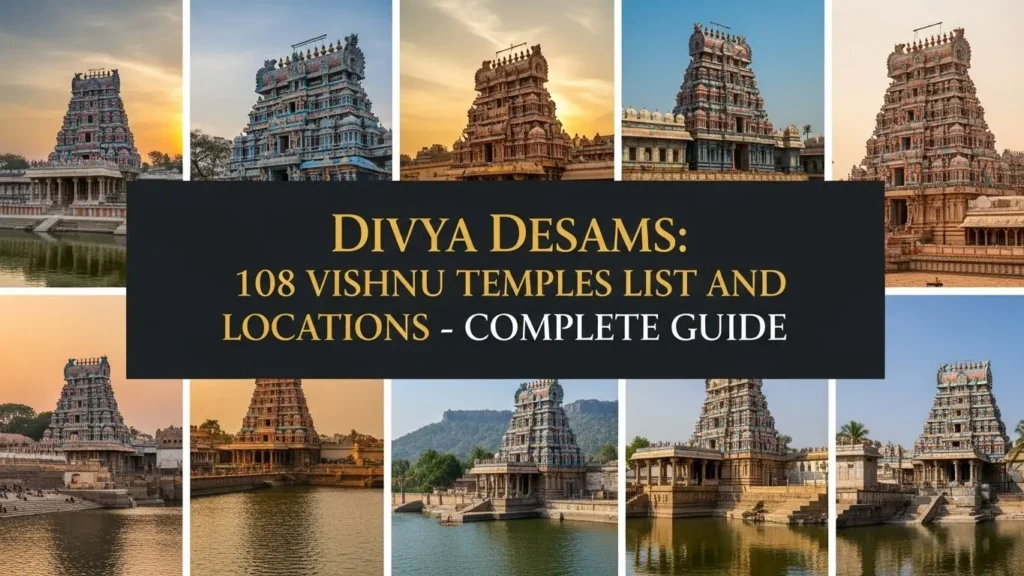
These 108 holy sites represent the earthly manifestations of Lord Vishnu, the preserver and protector of the universe, scattered across the Indian subcontinent from the Himalayas to Kerala, with 106 temples located on earth and 2 in celestial realms (Thiruparkadal/Ksheera Sagara—the ocean of milk, and Paramapadam/Vaikuntha—Vishnu’s heavenly abode).
The geographic distribution spans 84 Divya Desams in Tamil Nadu, 11 in Kerala, 4 in Uttar Pradesh, 3 in Uttarakhand, 2 in Andhra Pradesh, 1 in Gujarat, and 1 in Nepal (Muktinath in Mustang district). The temples are traditionally classified into six regional groups based on ancient Tamil geography: Chola Nadu (40 temples), Thondai Nadu (22 temples), Pandiya Nadu (18 temples), Malai Nadu (13 temples covering Kerala), Nadu Nadu (2 temples), and Vada Nadu (11 temples in northern India), plus the 2 celestial Divya Desams.
The Sri Ranganathaswamy Temple in Srirangam holds the unique distinction of being the foremost among the 108 Divya Desams, mentioned in the ancient Sanskrit epic Ramayana (dated before 3000 BCE), and serving as the spiritual center of Sri Vaishnavism where great acharyas like Ramanuja, Nathamuni, and Yamunacharya developed Vaishnava philosophy.
Vaishnava devotees undertake pilgrimages to these 106 earthly Divya Desams with the ultimate spiritual goal of reaching the two celestial abodes (Thiruparkadal and Paramapadam) through divine grace to acquire pure holiness and attain moksha (liberation). This comprehensive guide explores the complete list of 108 Divya Desams organized by region,
the spiritual significance and historical importance, the 12 Alwars who immortalized these temples through Tamil hymns, major Divya Desam temples and their legends, pilgrimage routes and practical touring information, the Vaishnava philosophy embedded in these sacred sites, and what the Divya Desam tradition reveals about Hindu philosophy‘s devotional path to divine realization through temple worship and sacred geography.
Geographic Distribution of 108 Divya Desams
State-Wise Distribution
The 106 earthly Divya Desams are spread across India and Nepal:
Tamil Nadu: 84 Temples
- The overwhelming majority of Divya Desams
- Concentrated in ancient temple regions
- Represents the heartland of Tamil Vaishnava tradition
Kerala: 11 Temples
Uttar Pradesh: 4 Temples
- Mathura-Vrindavan region (Krishna’s birthplace)
- Ayodhya (Rama’s birthplace)
- Sacred sites from Ramayana and Mahabharata
Uttarakhand: 3 Temples
- Himalayan pilgrimage sites
- Badrinath being the most famous
Andhra Pradesh: 2 Temples
- Tirupati (Sri Venkateswara Temple)
- Ahobilam
Gujarat: 1 Temple
- Dwarka (Krishna’s kingdom)
Nepal: 1 Temple
Celestial Realms: 2 Divya Desams
- Thiruparkadal (Ksheera Sagara): The cosmic ocean of milk where Vishnu reclines on Adisesha
- Paramapadam (Vaikuntha): Vishnu’s eternal heavenly abode
Regional Classification (Traditional Tamil Geography)
The Divya Desams are classified into six traditional regions:
1. Chola Nadu – 40 Temples
The largest cluster, located in the ancient Chola kingdom region
Major concentration areas:
- Kumbakonam region
- Thanjavur district
- Tiruchirapalli (Trichy) area
- Mayiladuthurai (Mayavaram)
- Sirkazhi
Notable temples:
- Srirangam (Ranganathaswamy Temple) – Foremost Divya Desam
- Kumbakonam (Sarangapani Temple)
- Various temples around Kaveri river basin
2. Thondai Nadu – 22 Temples
Ancient region around present-day Chennai and Kanchipuram
Major locations:
- Kanchipuram (multiple Divya Desams)
- Chennai area
- Tiruvallur district
- Sholinghur
Notable temples:
- Kanchipuram’s many Vishnu temples
- Tiruvallikeni (Parthasarathy Temple, Chennai)
3. Pandiya Nadu – 18 Temples
Southern Tamil Nadu region of ancient Pandya kingdom
Major locations:
- Madurai area
- Tirunelveli district
- Srivilliputhur
- Alagar Kovil
Notable temples:
- Madurai Koodal Azhagar Temple
- Alagar Kovil (Kallazhagar Temple)
- Various temples in southern Tamil districts
4. Malai Nadu – 13 Temples
The “Mountain Region” covering Kerala
Distribution:
- 11 temples in Kerala
- Includes Travancore and Malabar regions
- 2 temples technically in border areas
Notable temples:
- Guruvayur (though not officially in 108, highly revered)
- Thiruvananthapuram (Padmanabhaswamy Temple)
- Thrissur area temples
5. Nadu Nadu – 2 Temples
Central region temples
Specific locations:
- Transitional areas between major regions
- Smaller but significant cluster
6. Vada Nadu – 11 Temples
“Northern Region” covering temples outside Tamil country
Includes:
- Uttar Pradesh (4): Mathura, Ayodhya, etc.
- Uttarakhand (3): Badrinath, Naimisharanya, Salagramam
- Andhra Pradesh (2): Tirupati, Ahobilam
- Gujarat (1): Dwarka
- Nepal (1): Muktinath
The Two Celestial Divya Desams
1. Thiruparkadal (Ksheera Sagara):
- The cosmic ocean of milk
- Where Vishnu reclines on the serpent Adisesha
- Described in Puranic cosmology
- Symbolizes primordial consciousness
2. Paramapadam (Vaikuntha):
- Vishnu’s eternal heavenly abode
- The ultimate destination for liberated souls
- Beyond the material universe
- Represents moksha (liberation)
Spiritual Significance:
“Vaishnava Hindus after the completion of visits to the 106 Divya Desams ultimately hope to reach the god’s feet through the remaining two Divya Desams – thiruparkadal and thiruparamapadham to acquire pure holiness”
Complete List of 108 Divya Desams by Region
Divya Desams 108 Chola Nadu (40 Temples)
Major temples in this region:
- Srirangam – Sri Ranganathaswamy Temple (Foremost Divya Desam)
- Thirukkudanthai (Kumbakonam) – Sri Sarangapani Temple
- Thiruvinnagar – Sri Oppiliappan Temple
- Thirukannapuram – Sri Sowriraja Neelamega Perumal Temple
- Thiru Thanjaimaamani Koil – Sri Neelamega Perumal Temple
- Thirukkandiyur – Sri Hara Saabha Vimocchana Perumal Temple
- Thirukkoodaloor – Sri Aaduthurai Perumal Temple
- Thirukkavithalam (Kabisthalam) – Sri Gajendra Varadha Perumal Temple
- Thiruppullam Boothankudi – Sri Valvil Ramar Temple
- Thiru Aadhanoor – Sri Aandu Alakkum Ayan Perumal Temple
And 30 more temples in the Chola Nadu region around Kumbakonam, Thanjavur, Mayiladuthurai, and Trichy areas
Thondai Nadu (22 Temples)
- Kanchipuram temples (multiple Divya Desams):
- Sri Varadaraja Perumal Temple
- Sri Ashtabhuja Perumal Temple
- Sri Deepa Prakasar Temple
- And others
- Chennai area:
- Tiruvallikeni (Parthasarathy Temple)
- Thiruvallur – Sri Veeraraghava Perumal Temple
- Thirukkadigai (Sholingur) – Sri Yoga Narasimha Temple
- Other Thondai Nadu temples:
- Thiru Nindravoor – Sri Bhatavatsala Perumal Temple
- Thiruthanka – Sri Deepa Prakasar Temple
- ThirukKalvanoor – Sri Aadhi Varaha Perumal Temple
Pandiya Nadu (18 Temples)
Major temples in southern Tamil Nadu:
- Madurai:
- Thirukkoodal – Sri Koodal Azhagar Temple
- Alagar Kovil:
- Thirumaalirunsolai – Sri Kallazhagar Temple
- Tirunelveli region:
- Thirukkurugur (Alwar Thirunagiri) – Sri Aadhinatha Swamy Temple
- Thiruvaramangai Vaanamaamalai (Nanguneri) – Sri Thothatrinatha Temple
- Thirukkurungudi – Sri Nindra Nambi Temple
- Other Pandiya Nadu temples:
- Thiruttholai Villimangalam – Sri Aravindha Lochana Temple
- Thirupperai – Sri Magara NedungKuzhai Kaathar Temple
- Thirukkoloor – Sri Vaitha Maanitha Temple
Malai Nadu (13 Temples – Mostly Kerala)
Spread across Kerala’s various regions including:
- Thiruvananthapuram (Padmanabhaswamy Temple area)
- Thrissur region
- Northern Kerala
- Southern Kerala
(Specific temple names and locations vary by source; Kerala temples are highly significant in Vaishnava tradition)
Vada Nadu (11 Temples – Northern India)
Uttar Pradesh (4 temples):
- Mathura – Krishna’s birthplace
- Gokul/Vrindavan – Krishna’s childhood land
- Ayodhya – Sri Rama’s birthplace (Ram Janmabhoomi)
- Naimisharanya – Ancient pilgrimage site
Uttarakhand (3 temples):
- Badrinath – One of Char Dham, dedicated to Badri Narayan
- Salagramam – Sacred site for Shaligram shilas
- One more temple in Uttarakhand region
Andhra Pradesh (2 temples):
- Tirupati – Sri Venkateswara Temple (Most visited temple in world)
- Ahobilam – Narasimha avatara site
Gujarat (1 temple):
- Dwarka – Krishna’s kingdom, one of Char Dham
Nepal (1 temple):
Nadu Nadu (2 Temples)
Located in transitional regions between major areas
The 12 Alwars: Poet-Saints of Tamil Vaishnavism
Who Are the Alwars?
The 12 Alwars (also spelled Azhvars) were Tamil poet-saints who lived between approximately 5th-9th centuries CE:
“Alwar” Meaning:
- Derived from Tamil “Azhvar” meaning “one immersed in God”
- Supreme devotees of Lord Vishnu
- Composers of devotional Tamil hymns
Their Contribution:
- Composed the Naalayira Divya Prabhandam (4,000 sacred verses)
- Sang praises of 108 Vishnu temples
- Established Tamil bhakti (devotional) tradition
- Laid foundation for Sri Vaishnavism philosophy
The 12 Alwars
- Poigai Alwar
- Bhoothathalwar
- Peyalwar
- Thirumazhisai Alwar
- Nammalwar (most celebrated, composed maximum verses)
- Madhurakavi Alwar (devoted to Nammalwar)
- Kulasekhara Alwar (a Chera king)
- Periyalwar (foster father of Andal)
- Andal (only female Alwar, daughter of Periyalwar)
- Thondaradippodi Alwar
- Thiruppaan Alwar
- Thirumangai Alwar (composed maximum hymns after Nammalwar)
Naalayira Divya Prabhandam
- Collection of 4,000 Tamil verses
- Divided into four parts (Prabhandhams)
- Each Divya Desam has hymns (Pasurams) dedicated to it
- Called “Mangalasasanams” – auspicious praise hymns
Spiritual Status:
- Considered equivalent to Vedas in Tamil Vaishnava tradition
- Recited daily in Divya Desam temples
- Forms liturgical foundation of Sri Vaishnavism
- Preserves ancient Tamil and Vaishnava culture
Major Divya Desam Temples
1. Sri Ranganathaswamy Temple, Srirangam
Location: Srirangam, Tiruchirapalli, Tamil Nadu
- “The foremost among the 108 Divya Desams”
- Largest functioning Hindu temple complex in the world
- Dedicated to Ranganatha (reclining form of Vishnu)
- Mentioned in ancient Ramayana (before 3000 BCE)
- Played key role in Vaishnava history
- Associated with great acharyas: Ramanuja, Nathamuni, Yamunacharya
- Witnessed debates between Dvaita and Advaita sub-traditions
- Renowned for stunning gopurams (gateway towers)
- Beautiful vimanas (temple towers over sanctum)
- Seven concentric enclosures
- Magnificent sculptural art
Spiritual Practice:
- Daily elaborate rituals
- Major Vaishnava pilgrimage site
- Center of Sri Vaishnava learning and tradition
2. Sri Venkateswara Temple, Tirupati
Location: Tirumala Hills, Andhra Pradesh
Significance:
- Most visited temple in the world (50,000-100,000 daily)
- One of richest religious institutions
- Vada Nadu Divya Desam
Deity: Lord Venkateswara (Balaji, Srinivasa)
Pilgrimage: Millions visit annually for darshan and blessings
3. Badrinath Temple
Location: Uttarakhand, Himalayas
Significance:
- One of Char Dham pilgrimage sites
- Vada Nadu Divya Desam
- Dedicated to Badri Narayan (Vishnu)
Setting: Spectacular Himalayan mountain temple
4. Dwarka Temple
Location: Gujarat, western coast
Significance:
- Krishna’s legendary kingdom
- One of Char Dham
- Vada Nadu Divya Desam
5. Padmanabhaswamy Temple
Location: Thiruvananthapuram, Kerala
Significance:
- Malai Nadu Divya Desam
- Reclining Vishnu (Padmanabha)
- Recently famous for hidden treasure vaults
6. Sarangapani Temple, Kumbakonam
Location: Kumbakonam, Tamil Nadu
Significance:
- Major Chola Nadu Divya Desam
- One of largest Vishnu temples in Tamil Nadu
- Beautiful Chola architecture
7. Parthasarathy Temple, Chennai
Location: Triplicane (Tiruvallikeni), Chennai
Significance:
- Thondai Nadu Divya Desam
- Krishna as Parthasarathi (Arjuna’s charioteer)
- Important Chennai Vaishnava center
8. Kanchipuram Temples
Location: Kanchipuram, Tamil Nadu
Significance:
- Multiple Divya Desams in single city
- Ancient Vaishnava center
- Varadaraja Perumal Temple most prominent
Pilgrimage to the 108 Divya Desams
The Spiritual Journey
Purpose of Pilgrimage:
- Darshan (sacred viewing) of Vishnu in 108 manifestations
- Earning spiritual merit (punya)
- Purification of consciousness
- Ultimate goal: Attaining moksha (liberation)
- Visiting all 106 earthly Divya Desams purifies the soul
- Prepares devotee for reaching celestial abodes
- Ultimately reaching Paramapadam (Vaikuntha) through divine grace
Practical Pilgrimage Planning
Complete 106-Temple Tour:
- Requires several months to years
- Most devotees visit regionally
- Some undertake lifelong pilgrimage
- Organized yatras cover major temples
Regional Tours:
- Tamil Nadu circuit: Can cover 84 Divya Desams over weeks
- Kerala circuit: 11 temples in 1-2 weeks
- North India circuit: Vada Nadu temples
- Weekend trips: Local Divya Desams
Accessibility
Easy to Access:
- Chennai area Divya Desams
- Kumbakonam region temples
- Kanchipuram temples
- Major cities with Divya Desams
Challenging:
- Himalayan temples (Badrinath, Muktinath)
- Remote village temples
- Temples requiring multiple transport modes
Temple Protocols
Dress Code:
- Men: Dhoti or traditional attire; remove shirts in some temples
- Women: Saree, churidar covering shoulders and knees
- Modest, respectful clothing
Timings:
- Early morning darshan (5-6 AM) usually best
- Afternoon breaks (12-4 PM) common
- Evening darshan and rituals
Offerings:
- Flowers, coconuts, traditional prasadams
- Archana services with devotee names
- Various sevas and poojas available
Spiritual Significance of Divya Desams
Vaishnava Philosophy
Sri Vaishnavism:
- Theological tradition developed by Ramanuja and predecessors
- Emphasizes devotion (bhakti) to Vishnu
- Temple worship as path to liberation
- Guru parampara (teacher lineage) importance
Vishishtadvaita:
- Ramanuja’s philosophy of “qualified non-dualism”
- Brahman (ultimate reality) with attributes
- Souls and universe are Brahman’s body
- Liberation through surrender (prapatti) to Vishnu
Sacred Geography
Divya Desams as Spiritual Technology:
- Temples as divine presence points
- Sacred geography mapping cosmic order on earth
- Pilgrimage transforms consciousness
- Physical journey mirrors spiritual journey
Alwar’s Vision:
- Direct experience of Vishnu at these sites
- Not human designation but divine revelation
- Temples chosen by Lord’s manifestation
- Poetic hymns capture mystical experiences
Moksha Through Temple Worship
The Path:
- Darshan: Seeing and being seen by deity
- Seva: Service to Lord through offerings
- Shravanam: Hearing divine glories (Prabhandam recitation)
- Bhakti: Developing pure devotion
- Prapatti: Complete surrender to Vishnu
- Moksha: Liberation and reaching Vaikuntha
Temple as Vaikuntha on Earth:
- Each Divya Desam is manifestation of heavenly realm
- Visiting temples brings devotees closer to Paramapadam
- The 106 earthly visits prepare soul for celestial journey
Frequently Asked Questions
What are Divya Desams?
Divya Desams are the 108 sacred temples of Lord Vishnu glorified in devotional hymns by the 12 Alwars (Tamil poet-saints) who composed the Naalayira Divya Prabhandam (4,000 sacred verses) between 5th-9th centuries CE. The term “Divya Desam” means “Divine Abode” or “Premium Temple”, representing earthly manifestations of Vishnu as preserver and protector. Of these, 106 temples are located on earth and 2 are in celestial realms (Thiruparkadal/Ocean of Milk and Paramapadam/Vaikuntha).
How many Divya Desams are in Tamil Nadu?
84 of the 108 Divya Desams are located in Tamil Nadu, making it the overwhelming center of the Divya Desam tradition. These are distributed across ancient regional classifications: Chola Nadu (40 temples), Thondai Nadu (22 temples), and Pandiya Nadu (18 temples), plus some in Nadu Nadu category. Major concentrations are found in Kumbakonam, Kanchipuram, Srirangam (Trichy), Chennai, Madurai, and other historically significant Vaishnava centers throughout Tamil Nadu.
Which is the first Divya Desam temple?
Sri Ranganathaswamy Temple in Srirangam holds the unique distinction of being the foremost (first) among the 108 Divya Desams. The temple is dedicated to Ranganatha (reclining form of Vishnu) and is renowned for its stunning gopurams and vimanas. Mentioned in the ancient Sanskrit epic Ramayana (dated before 3000 BCE), the temple played a key role in Vaishnava history with great acharyas like Ramanuja, Nathamuni, and Yamunacharya developing Sri Vaishnavism philosophy there. It is the largest functioning Hindu temple complex in the world.
Who were the 12 Alwars?
The 12 Alwars (Azhvars) were Tamil poet-saints who lived between 5th-9th centuries CE and were supreme devotees of Lord Vishnu. “Alwar” means “one immersed in God” in Tamil. They composed the Naalayira Divya Prabhandam (4,000 sacred verses) praising the 108 Vishnu temples, establishing the Tamil bhakti tradition and laying the foundation for Sri Vaishnavism. The 12 include Nammalwar (most celebrated), Andal (only female Alwar), Thirumangai Alwar, Kulasekhara Alwar (a Chera king), and others. Their hymns are considered equivalent to Vedas in Tamil Vaishnava tradition.
How are Divya Desams distributed across India?
The 106 earthly Divya Desams are spread across: Tamil Nadu (84), Kerala (11), Uttar Pradesh (4), Uttarakhand (3), Andhra Pradesh (2), Gujarat (1), and Nepal (1 – Muktinath). They are classified into six traditional regions: Chola Nadu (40), Thondai Nadu (22), Pandiya Nadu (18), Malai Nadu (13 covering Kerala), Nadu Nadu (2), and Vada Nadu (11 in northern India), plus 2 celestial Divya Desams. This distribution reflects ancient Vaishnava pilgrimage networks and Tamil cultural geography.
What are the two celestial Divya Desams?
The two celestial Divya Desams beyond earthly realms are: 1) Thiruparkadal (Ksheera Sagara)—the cosmic ocean of milk where Vishnu reclines on serpent Adisesha, and 2) Paramapadam (Vaikuntha)—Vishnu’s eternal heavenly abode. Vaishnava devotees believe that after completing visits to the 106 earthly Divya Desams, they ultimately hope to reach these two celestial abodes through divine grace to acquire pure holiness and attain moksha (liberation). These represent the ultimate spiritual destination beyond the material universe.
Can all 108 Divya Desams be visited in one trip?
Visiting all 106 earthly Divya Desams requires extensive time—typically several months to years—as they span from the Himalayas to southern tip of India, Nepal to Gujarat. Most devotees undertake regional pilgrimages: Tamil Nadu circuit covering 84 temples (weeks to months), Kerala circuit with 11 temples (1-2 weeks), or northern circuit covering Vada Nadu temples. Some devotees make it a lifelong pilgrimage, while organized tour operators offer comprehensive packages covering major Divya Desams in specific regions. The two celestial Divya Desams (Thiruparkadal and Paramapadam) are aspirational goals reached through spiritual attainment, not physical travel.
What is the significance of visiting Divya Desams?
Visiting Divya Desams provides darshan (sacred viewing) of Lord Vishnu in 108 manifestations, earns spiritual merit (punya), purifies consciousness, and prepares the soul for ultimate liberation (moksha). Each temple represents a point where Alwars experienced direct divine presence, making them “Vaikuntha on Earth”—earthly manifestations of Vishnu’s heavenly realm. The pilgrimage journey physically and spiritually transforms devotees through temple worship, recitation of Divya Prabhandam hymns, seva (service), and developing pure bhakti (devotion). Completing the 106 earthly visits is believed to prepare devotees for reaching the celestial Divya Desams and attaining Paramapadam through divine grace.
Conclusion
The 108 Divya Desams represent one of Hinduism’s most comprehensive sacred geographies—a divinely revealed network of Vishnu temples spanning the Indian subcontinent from Himalayan Badrinath to southern Kanyakumari, from Gujarat’s Dwarka to Nepal’s Muktinath, creating a pilgrimage circuit that physically maps Vaishnava theology onto India’s landscape while spiritually guiding devotees from earthly worship through 106 temple visits toward the ultimate goal of two celestial abodes representing moksha itself.
The 12 Alwars’ mystical experiences at these sites between 5th-9th centuries CE, immortalized in 4,000 Tamil verses of Naalayira Divya Prabhandam, transformed scattered Vishnu shrines into an integrated sacred system where each temple became a portal to divine presence, each hymn a key unlocking spiritual realization, and each pilgrimage a journey from material existence toward transcendent liberation.
The overwhelming concentration of 84 Divya Desams in Tamil Nadu—particularly in Chola Nadu’s Kumbakonam-Srirangam-Thanjavur triangle, Thondai Nadu’s Kanchipuram-Chennai axis, and Pandiya Nadu’s Madurai-Tirunelveli region—demonstrates how Tamil Vaishnavism created dense networks of sacred architecture where temple-hopping pilgrims could visit multiple Divya Desams within days, experiencing varied manifestations of Vishnu as Ranganatha reclining in Srirangam’s cosmic splendor, Sarangapani blessing Kumbakonam,
Parthasarathi driving Arjuna’s chariot in Chennai, Koodal Azhagar presiding over Madurai, and dozens more forms each revealing different facets of divine personality, each inspiring distinct devotional responses, each providing specific blessings and spiritual experiences documented in Alwar hymns that continue being recited daily in temple liturgy.
Whether one approaches Divya Desams as devoted Vaishnava seeking systematic darshan of all 108 manifestations, spiritual seeker exploring Hindu philosophy‘s bhakti traditions, cultural enthusiast appreciating Tamil devotional poetry and Dravidian temple architecture, or scholar studying how sacred geography constructs religious identity, these temples offer profound insight into how Vaishnavism transformed abstract theological concepts into tangible pilgrimage experiences, how poet-saints’ mystical visions became institutional foundations supporting centuries of religious practice, and how the promise that visiting earthly.
Divya Desams prepares souls for celestial Paramapadam continues motivating millions to undertake journeys long and short, grand and humble, lifelong and weekend, all seeking that transformative darshan where stone images of Vishnu become windows to divine reality, where ancient Tamil hymns sung by temple priests awaken dormant devotion, and where the pilgrim’s physical circumambulation of 106 earthly temples becomes the soul’s spiraling ascent toward Vaikuntha—that ultimate Divya Desam beyond earthly realms where all pilgrimages end, all seeking culminates, and all devotees hope someday to reach through the grace of Lord Vishnu whose 108 sacred abodes across India and beyond remain forever open, forever blessing, forever guiding seekers homeward to divine embrace.
About the Author
Aditya Chauhan – Cultural Heritage & Temple Architecture Specialist
Aditya Chauhan is an accomplished writer and researcher specializing in Hindu festivals, temple architecture, and India’s rich cultural traditions. With a Master’s degree in Indian Art History from Maharaja Sayajirao University, she has extensively documented pilgrimage sites, temple iconography, and folk traditions across India. Her work focuses on making India’s spiritual heritage accessible to contemporary audiences while preserving authentic cultural narratives.