


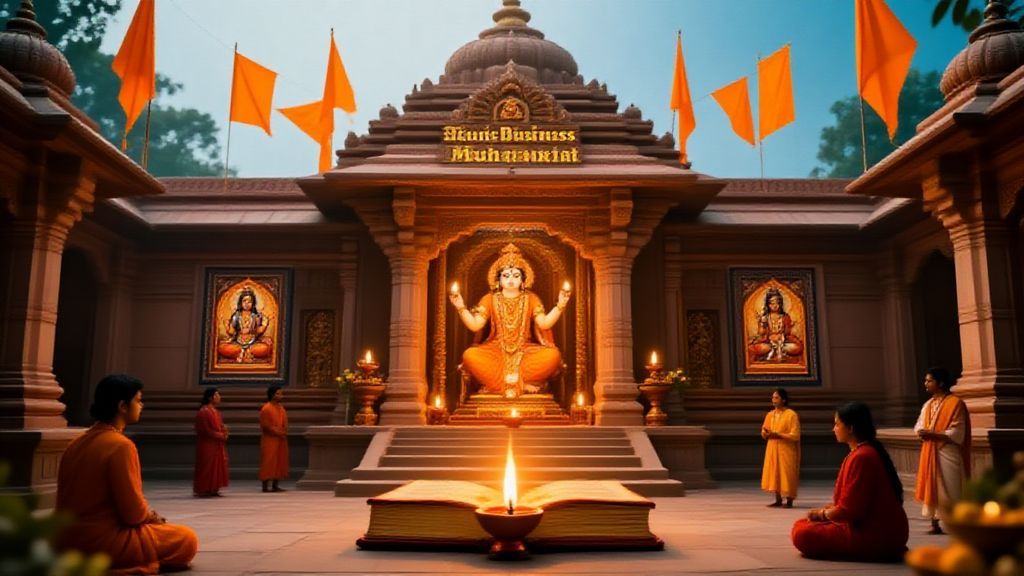
Diwali Business Muhurat, specifically for new account books timing, is the deeply auspicious period during the Lakshmi Puja on Deepavali, revered in Sanatan Dharma for inaugurating financial ventures. This sacred time, known as Chopda Pujan, is when devotees invoke the blessings of Devi Lakshmi, Lord Ganesha, and Bhagwan Kubera for prosperity, wisdom, and ethical wealth accumulation in the coming year.
| Attribute | Details |
|---|---|
| Deities Invoked | Devi Lakshmi (Goddess of Wealth), Lord Ganesha (Remover of Obstacles), Bhagwan Kubera (Treasurer of the Devas), Devi Saraswati (Goddess of Knowledge). |
| Location/Origin | Indian subcontinent, rooted in Vedic traditions and Sanatan Dharma. |
| Key Festival | Diwali (Deepavali), particularly on the Amavasya Tithi of Krishna Paksha in the Kartik month. |
| Associated Ritual | Chopda Pujan (Worship of Account Books), Vahi Pujan. |
| Scripture Reference | Skanda Purana, Padma Purana, Atharva Veda (for Sri Suktam), Muhurat Grantha texts. |
The Auspicious Commencement: Diwali Business Muhurat and Its Significance
In the expansive tapestry of Sanatan Dharma, Diwali, or Deepavali, is not merely a festival of lights but a profound period of spiritual renewal, social harmony, and economic rejuvenation. For the Hindu entrepreneur and business owner, the observance of the Diwali Business Muhurat for inaugurating new account books, known as Chopda Pujan or Vahi Pujan, is paramount. This sacred ritual transcends mere tradition; it is an act of deep reverence, invoking divine blessings for prosperity, ethical conduct, and sustainable growth. It acknowledges that true wealth (`Artha`) must be pursued within the framework of `Dharma` (righteousness), a fundamental principle emphasized in ancient scriptures.
This practice embodies the holistic worldview of Hinduism, where every endeavor, including commerce, is imbued with spiritual significance. By commencing new financial records during an astrologically propitious moment (`Muhurat`), devotees seek to align their worldly efforts with cosmic energies, ensuring that their enterprises flourish under divine grace. It is a heartfelt prayer for liberation from financial obstacles and for the bestowal of bountiful prosperity, guided by the wisdom of Lord Ganesha and the abundance of Devi Lakshmi.
Puranic History and Legends Behind the Ritual
The origins of Diwali itself are steeped in various Puranic narratives, each reinforcing its sanctity. The tradition of worshipping Devi Lakshmi on Diwali Amavasya is deeply entrenched in scriptures. The Skanda Purana and Padma Purana extensively describe Lakshmi’s manifestation from the churning of the cosmic ocean (`Samudra Manthan`), emerging on the very day of Kartik Amavasya. This event signifies the birth of all forms of wealth, fortune, and beauty. Hence, Diwali is her primary festival.
Lord Ganesha, the remover of obstacles (`Vignaharta`) and bestower of intellect (`Buddhi`), is worshipped alongside Lakshmi. The pairing of Lakshmi and Ganesha is unique to business and financial pujas, symbolizing that wealth must be accompanied by wisdom and freedom from impediments. Without Ganesha’s blessings, wealth can be fleeting or lead to misfortune. Bhagwan Kubera, the divine treasurer, is also invoked, particularly for the meticulous management and growth of assets, ensuring that accumulated wealth is preserved and multiplied righteously.
The practice of Chopda Pujan is an extension of this reverence. Historically, business communities, particularly in Western India, meticulously observed this ritual, believing that the blessings bestowed during this Muhurat would safeguard their ledgers from errors, their transactions from deceit, and their ventures from loss. The act of writing “Shubh Labh” (Auspicious Profit) on the new books is not merely symbolic; it’s a spiritual affirmation and a Sankalpa for ethical and prosperous commerce throughout the fiscal year.
Astrological & Dharmic Principles of Muhurat Selection
While Diwali is a fixed festival, the precise Diwali Business Muhurat for Chopda Pujan is determined by intricate Vedic astrological calculations. This isn’t about architectural marvels, but rather the celestial architecture that influences earthly fortunes. The concept of Muhurat, an auspicious time window, is a cornerstone of Vedic astrology, ensuring that significant undertakings are initiated under the most favorable planetary alignments. For Diwali, the primary focus is on the Amavasya Tithi (new moon day) of the Kartik month, specifically during the Pradosh Kaal and sometimes the Mahanishita Kaal.
The Pradosh Kaal, occurring after sunset, is considered supremely potent for Lakshmi Puja, as Devi Lakshmi is believed to be most active and benevolent during this period. Astrologers meticulously analyze the positions of the planets, particularly Jupiter (Guru, representing wealth and wisdom) and Venus (Shukra, representing prosperity and luxury), alongside the lunar constellations (`Nakshatras`) and ascendant (`Lagna`) to pinpoint the most auspicious windows. For example, a stable (`Sthir`) Lagna or Nakshatra like Purva Phalguni or Uttar Bhadrapada, devoid of malefic influences, is preferred for long-term financial stability.
The selection of this precise Muhurat is a scientific application of Dharma, acknowledging the interconnectedness of human actions and cosmic forces. It is believed that energies are heightened during these specific times, making prayers and intentions particularly effective. This scientific approach to timing ensures that the blessings of Ganesha, Lakshmi, and Kubera are not just invoked but are deeply embedded in the very foundation of the business’s financial records.
Rituals and Puja Vidhi for Chopda Pujan
The Chopda Pujan is a structured and devotional process, meticulously followed to invoke maximal divine grace:
- Purification and Preparation: The business premises and the puja area are thoroughly cleaned and purified. A raised platform (`Vedi`) is prepared, covered with a clean cloth. Idols or images of Lord Ganesha, Devi Lakshmi, and Bhagwan Kubera are placed. New account books, ink, pens, and other puja items are arranged.
- Sankalpa (Solemn Vow): The devotee begins by taking a Sankalpa, stating their intention to perform the puja for prosperity, righteousness, and the welfare of their business and family.
- Ganesha Puja: Lord Ganesha is worshipped first to remove all obstacles. This involves offering water (`Jal`), flowers (`Pushpa`), incense (`Dhupa`), lamp (`Deepa`), and sweets (`Naivedya`). The mantra “ॐ गं गणपतये नमः” (Om Gam Ganapataye Namaha) is chanted.
- Lakshmi Puja: Following Ganesha, Devi Lakshmi is invoked. Her idol/image is bathed (symbolically or literally) and adorned. Offerings of lotus flowers, `Bilva` leaves, fruits, sweets, coins, and particularly `Kowdi` (cowrie shells) and `Gomati Chakra` are made. The `Sri Suktam` is chanted.
- Saraswati Puja: For wisdom in business decisions, Devi Saraswati is also invoked. Offering white flowers and sweets.
- Kubera Puja: Bhagwan Kubera is worshipped to ensure the preservation and growth of wealth. Offerings include grains, dry fruits, and specific mantras.
- Chopda Pujan (Worship of Account Books): The new account books are placed near the deities. `Kumkum` (vermilion) and `Haldi` (turmeric) are applied to the books. The sacred symbols of `Om` (ॐ), `Swastik` (卐), and “Shubh Labh” (शुभ लाभ) are drawn on the first page. Prayers are offered for accuracy and prosperity in financial dealings.
- Deep Prajwalana & Aarti: Lamps (`Deepa`) are lit, symbolizing the dispelling of darkness (ignorance and poverty). The Aarti of Lord Ganesha and Devi Lakshmi is performed with utmost devotion, circulating the lamp before the deities.
- Prasad Vitaran: Offerings (`Prasad`) are distributed among family members, staff, and guests, signifying shared prosperity and gratitude.
Mantras and Chants for Prosperity
Chanting specific mantras during the Diwali Business Muhurat amplifies the potency of the rituals:
- Ganesha Mantra: “ॐ गं गणपतये नमः” (Om Gam Ganapataye Namaha) – For obstacle removal and auspicious beginnings.
- Mahalakshmi Mantra: “ॐ ह्रीं श्रीं लक्ष्मीभ्यो नमः” (Om Hreem Shreem Lakshmibhyo Namaha) – A powerful seed mantra for invoking Devi Lakshmi’s blessings for wealth and abundance.
- Sri Suktam: A Vedic hymn from the Atharva Veda, specifically dedicated to Devi Lakshmi, chanted for prosperity, wealth, and spiritual well-being. Its recitation is considered supremely auspicious during Lakshmi Puja.
- Kubera Mantra: “ॐ यक्षाय कुबेराय वैश्रवणाय धनधान्याधिपतये समृद्धिं मे देहि देहि स्वाहा” (Om Yakshaya Kuberaya Vaishravanaya Dhana Dhanyadhipataye Samriddhim Me Dehi Dehi Svaha) – For attracting and managing wealth, and maintaining prosperity.
- Saraswati Mantra: “ॐ ऐं ह्रीं क्लीं महासरस्वती देव्यै नमः” (Om Aim Hreem Kleem Mahasaraswati Devyai Namaha) – For wisdom, clarity, and intelligent decision-making in business.
Dos and Don’ts for Diwali Business Muhurat
Observing certain ethical and spiritual guidelines enhances the efficacy of the Chopda Pujan:
Dos:
- Cleanliness: Ensure your home and business premises are immaculately clean, as Lakshmi resides in pure environments.
- Devotion and Sincerity: Perform the puja with a pure heart and unwavering faith.
- Charity: Offer donations or help the needy on Diwali, as acts of selfless service attract blessings.
- Ethical Intentions: Resolve to conduct business with honesty and integrity.
- Light Lamps: Illuminate your home and workplace with diyas and lights to symbolize the victory of good over evil, and light over darkness.
Don’ts:
- Gambling: While some traditions may involve symbolic games, avoid excessive gambling or speculation, as it goes against the principle of righteous earning.
- Negative Thoughts: Maintain a positive and joyous atmosphere; avoid anger, greed, or despair.
- Untidiness: Do not leave the puja area or your business space cluttered or unclean.
- Non-Vegetarian Food/Alcohol: Abstain from tamasic foods and intoxicating substances on this sacred day to maintain spiritual purity.
Frequently Asked Questions About Chopda Pujan
Why is Diwali considered the best time for business rituals?
Diwali Amavasya is uniquely potent for Lakshmi Puja because it marks Devi Lakshmi’s emergence during Samudra Manthan. Astrologically, the energies are aligned to facilitate wealth attraction, new beginnings, and prosperity, making it the most auspicious period for commencing new financial cycles and account books. It’s a time of renewal and seeking divine blessings for the entire year.
Can old account books be used for Chopda Pujan?
While the tradition primarily emphasizes inaugurating *new* account books (chopdas) as a symbol of a fresh financial year, if new books are not available, existing clean ledgers can be purified and worshipped. However, the spiritual intent is to start anew, so procuring new books is highly recommended to signify the beginning of a prosperous cycle. For more insights on traditional business practices, visit Hindutva.online.
What if I cannot perform the puja exactly at the prescribed Muhurat?
While performing the puja during the precise Muhurat maximizes its efficacy, sincere devotion is paramount. If unforeseen circumstances prevent adherence to the exact timing, one can perform the puja during the general Pradosh Kaal on Diwali evening, or even a suitable time within the Diwali period, ensuring a pure heart and focused intention. Consult a local priest for personalized guidance.
What is the significance of “Shubh Labh” (शुभ लाभ) written on the books?
“Shubh Labh” literally translates to “Auspicious Profit.” Writing these words on the new account books, often accompanied by the Om and Swastik symbols, is a powerful Sankalpa, a sacred vow, to attract not just financial gain but also righteous and ethical profits. It signifies a prayer that all earnings be blessed, come through honest means, and contribute to overall well-being and spiritual growth.
Dharmic Significance: Preserving Sanatan Dharma Through Righteous Commerce
The observance of the Diwali Business Muhurat and Chopda Pujan is far more than a mere custom; it is a profound testament to the enduring principles of Sanatan Dharma. It teaches us that commerce is not separate from spirituality but an integral part of our Dharmic journey. By invoking Lord Ganesha, Devi Lakshmi, and Bhagwan Kubera, we reaffirm our commitment to ethical wealth creation (`Dharma-Artha`), recognizing that true prosperity flourishes when business is conducted with integrity, wisdom, and a spirit of service.
This timeless tradition reinforces the holistic nature of Hindu life, where every action, whether spiritual or material, is intended to lead towards `Dharma`, `Artha`, `Kama`, and ultimately `Moksha`. By honoring these ancient rites, we not only seek personal and corporate prosperity but also contribute to the preservation of our rich cultural heritage and inspire future generations to uphold these sacred values. This continuity ensures that the light of Dharma shines brightly in all aspects of life, including the bustling world of enterprise. Explore more such timeless traditions on Hindutva.online.