


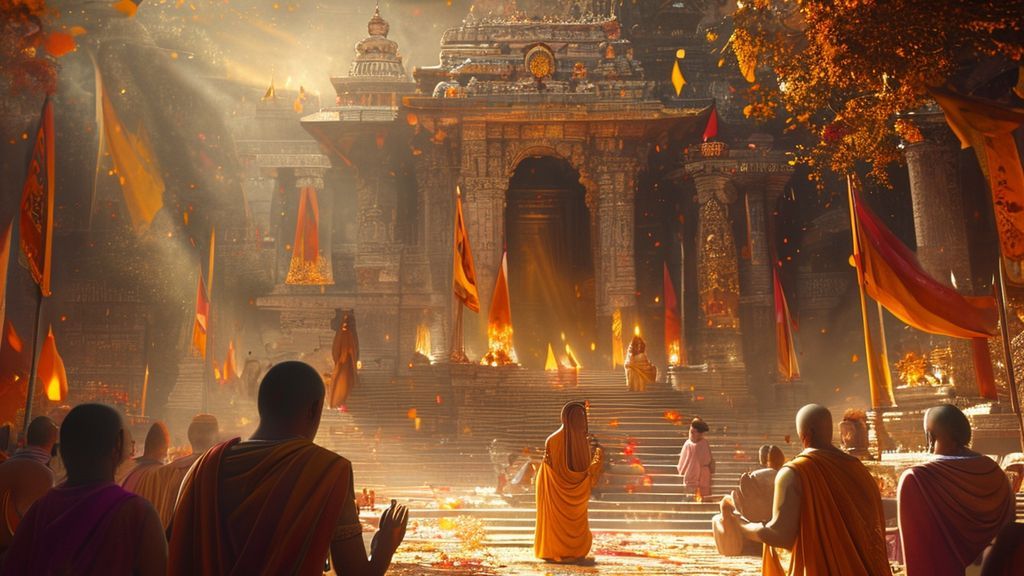
Ego dissolution, known as Ahamkara Nasha in Sanskrit, is the profound Hindu path to transcending the limited individual self, realizing one’s true divine nature, and achieving liberation from suffering. It involves understanding the illusory nature of the ‘I’ thought and surrendering attachment to personal identity, leading to unconditional love and unity, thereby aligning with the universal Brahman.
| Attribute | Details |
|---|---|
| Core Concept | Ahamkara Nasha (Dissolution of the Ego-sense) – realizing the Atman is Brahman. |
| Philosophical Origin | Vedas (specifically Upanishads), Bhagavad Gita, Yoga Darshan, Samkhya Karika. |
| Key Practices | Karma Yoga, Bhakti Yoga, Jnana Yoga, Raja Yoga, Seva (selfless service). |
| Primary Scriptures | Isha Upanishad, Kena Upanishad, Bhagavad Gita, Yoga Sutras of Patanjali, Ashtavakra Gita. |
The Call to Egolessness: A Pillar of Sanatan Dharma
In the vast expanse of Sanatan Dharma, the journey of ego dissolution is not merely a philosophical concept but a deeply practical and transformative path to liberation, or Moksha. The individual ego, termed Ahamkara (अहंकार), is understood as the identification of the true Self (Atman) with the transient body-mind complex. It is the illusory sense of ‘I-ness’ and ‘mine-ness’ that binds us to the cycles of birth and death (samsara) and fuels suffering through attachment, aversion, and desire. The sages of Bharatavarsha, from the Vedic seers to the contemporary spiritual masters, have consistently emphasized that true freedom lies beyond the confines of this limited identity. It is a path of profound self-realization, leading to an experience of unity with the Divine, the ultimate reality, Brahman.
This quest for egolessness is not an annihilation of individuality but a sublimation of the fragmented self into the Cosmic Self, allowing one to live with unparalleled peace, wisdom, and compassion. It is the ultimate antidote to pride, prejudice, and division, fostering a holistic worldview that sees the divine in all creation. The scriptures illuminate this path, offering intricate frameworks and practical methodologies for the sincere seeker.
Puranic Narratives of Ego and Its Dissolution
The Itihasas and Puranas are replete with profound stories illustrating the pitfalls of inflated ego and the glory of its transcendence. These narratives serve as powerful moral compasses, guiding humanity towards righteous living and spiritual awakening.
-
Hiranyakashipu: The Peril of Pride. As recounted in the Bhagavata Purana (Canto 7), the demon king Hiranyakashipu, through intense penance, gained a boona that made him virtually invincible. His ego swelled to immense proportions, leading him to declare himself the sole object of worship and persecute his own son, Prahlada, for his unwavering devotion to Vishnu. Hiranyakashipu’s belief in his own invincibility, born of extreme Ahamkara, ultimately led to his spectacular demise at the hands of Narasimha, Vishnu’s man-lion avatar. This story vividly portrays how unchecked ego can blind one to truth and lead to catastrophic downfall.
-
Daksha Prajapati: The Ego of Authority. The Shiva Purana and Devi Bhagavata Purana narrate the story of Daksha Prajapati, whose immense pride as a creator and a ruler led him to disrespect Lord Shiva, his own son-in-law. His grand Yagna excluded Shiva, born of his conviction that he was superior. This monumental act of ego-driven oversight resulted in Sati’s self-immolation and Shiva’s fierce wrath, leading to the destruction of Daksha’s sacrifice and his eventual humbling. It is a poignant lesson that even great beings are not immune to the corrosive effects of ego and that humility is paramount in spiritual and social conduct.
-
Mahabali: The Surrender of Generosity. The story of King Mahabali, detailed in the Bhagavata Purana (Canto 8), offers a nuanced perspective. Mahabali was a virtuous and generous king, but his very generosity, when tinged with a subtle sense of ‘doer-ship’ or personal ego, required divine intervention. Lord Vamana, Vishnu’s dwarf avatar, appeared and asked for three paces of land. Mahabali, in his pride of giving, readily agreed. Vamana then expanded to cosmic proportions, covering all realms in two steps, leaving Mahabali with no place for the third. In an act of ultimate surrender, Mahabali offered his own head, dissolving his ego and achieving liberation through absolute humility and devotion. He was then blessed by Vishnu to rule the netherworld, Sutala.
-
Arjuna’s Moha and the Teachings of the Gita. At the precipice of the Mahabharata war, Arjuna was gripped by moha (delusion) and an egoistic attachment to his personal identity as a warrior, a kinsman, and a moral agent, leading to despondency. Lord Krishna, in the Bhagavad Gita (Mahabharata, Bhishma Parva), systematically dismantles Arjuna’s ego-driven dilemma, guiding him towards selfless action (Nishkama Karma), devotion, and the realization of his true, immortal Self. The entire Gita is a profound discourse on how to transcend the ego and perform one’s Dharma without attachment, thereby achieving spiritual liberation.
Philosophical Frameworks & Psychological Insights
Hinduism provides sophisticated philosophical frameworks that meticulously analyze Ahamkara and offer profound psychological insights into its nature and transcendence. This is not merely spiritual theory but a deep understanding of the human psyche.
-
Vedanta: The Illusion of Separation. In Advaita Vedanta, Ahamkara is considered a product of Maya, the cosmic illusion that creates the appearance of duality and separateness. The ego superimposes the qualities of the non-Self (body, mind, senses) onto the Self (Atman), causing one to identify with the perishable. The ultimate goal is to realize the Mahavakya, “अहं ब्रह्मास्मि” (Aham Brahmasmi – I am Brahman), thereby dissolving the illusion of the individual ego and realizing the oneness of Atman and Brahman. This realization is not intellectual but an experiential dissolution of the ‘I’ thought.
-
Samkhya Philosophy: The Principle of Individuation. Samkhya, one of the oldest schools, describes Ahamkara as one of the 24 tattvas (principles) of creation. It emerges from Mahat (intellect/buddhi) and is the principle that gives rise to the sense of individual identity, leading to the formation of the mind (manas), senses (indriyas), and elements (bhutas). Understanding Ahamkara within Samkhya involves recognizing it as a mutable principle of nature (Prakriti), distinct from the eternal consciousness (Purusha).
-
Yoga Darshan: Overcoming Asmita. Patanjali’s Yoga Sutras identify Asmita (egoism) as one of the five Kleshas (afflictions) that cause suffering. Asmita is defined as confusing the seer (Purusha) with the instrument of seeing (Buddhi/mind). The entire eightfold path of Raja Yoga (Yama, Niyama, Asana, Pranayama, Pratyahara, Dharana, Dhyana, Samadhi) is a systematic methodology to quiet the mind, purify the consciousness, and ultimately transcend the ego-driven identification, leading to Kaivalya (liberation).
These frameworks offer profound psychological insights: ego is the root of attachment, aversion, fear, anger, and comparison. Its dissolution leads to inner peace, boundless compassion, unbiased perception, and true mental well-being, paving the way for spiritual evolution detailed further on Hindutva.online.
Rituals & Practices for Ego Dissolution
The Hindu path to egolessness is not merely conceptual but intensely practical, offering diverse yogic paths and daily practices tailored to individual temperaments. These are not ‘rituals’ in the conventional sense of external ceremony, but internal disciplines.
-
Selfless Action (Nishkama Karma Yoga): Perform all duties and actions without attachment to their results or concern for personal recognition. Offer the fruits of all labor to the Divine. The Bhagavad Gita emphasizes this as the primary way to transcend ego. When actions are not for personal gain, the ego’s hold loosens.
-
Devotion & Surrender (Bhakti Yoga): Cultivate unconditional love and absolute surrender to one’s chosen deity (Ishta Devata). Through prayer, chanting, and devotion, the devotee dissolves their individual identity into the divine, seeing everything as an expression of the Beloved. This path fosters humility and eradicates pride.
-
Introspection & Discrimination (Jnana Yoga): Engage in rigorous self-inquiry (Atma-vichara), constantly asking “Who am I?” and discerning the eternal Self (Atman) from the ephemeral body, mind, and ego. Study scriptures like the Upanishads and Brahma Sutras to gain wisdom (Jnana) and understand the illusory nature of the ego.
-
Meditation & Mind Control (Raja Yoga): Practice regular meditation (Dhyana) and breath control (Pranayama) to quiet the incessant chatter of the mind. As thoughts subside, the ego-driven thought patterns lose their power, allowing for glimpses of the pure consciousness beyond.
-
Service (Seva): Actively engage in selfless service to humanity and all beings, seeing divinity in everyone. When one serves without expecting anything in return, the ego’s desire for recognition and reward naturally diminishes.
Mantras & Chants for Cultivating Egolessness
Mantras are powerful sound vibrations that can purify the mind and aid in transcending the ego. Chanting with devotion and understanding can realign one’s consciousness.
-
“Om Namah Shivaya” (ॐ नमः शिवाय): A fundamental mantra of surrender to Lord Shiva, representing the cosmic consciousness and destruction of ignorance/ego. It means “I bow to Shiva,” signifying the bowing of the individual ego to the Universal Self.
-
“Soham” (सोऽहम्): Meaning “I am That,” this mantra connects the individual breath (So) with the universal breath (ham), affirming the unity of the individual Self with the Cosmic Self. It’s a powerful tool for self-realization.
-
“Aham Brahmasmi” (अहं ब्रह्मास्मि): One of the four Mahavakyas (Great Sayings) from the Upanishads, affirming “I am Brahman.” Contemplating and chanting this mantra helps dissolve the illusion of separation between the individual ‘I’ and the ultimate reality.
-
Gayatri Mantra (ॐ भूर्भुवः स्वः तत्सवितुर्वरेण्यं भर्गो देवस्य धीमहि धियो यो नः प्रचोदयात्।): This universal Vedic mantra invokes the supreme divine intelligence, stimulating and purifying the intellect. A pure intellect is crucial for discriminating between the real and the unreal, thus enabling ego dissolution.
-
Maha Mrityunjaya Mantra (ॐ त्र्यम्बकं यजामहे सुगन्धिं पुष्टिवर्धनम्। उर्वारुकमिव बन्धनान् मृत्योर्मुक्षीय माऽमृतात्॥): While known for healing, it is also a powerful mantra for liberation from all bondage, including the bondage of the ego and the fear of death, leading to immortality (spiritual liberation).
Dos and Don’ts on the Path of Ego Dissolution
Navigating the spiritual path requires mindful living. Here are essential guidelines for aspiring practitioners:
-
Do: Practice Humility. Actively seek opportunities to serve others without expectation. Recognize that all abilities and achievements are gifts from the Divine.
-
Do: Introspect Regularly. Continuously inquire into the nature of your ‘I-ness’ and question the source of your thoughts and emotions.
-
Do: Cultivate Detachment. Learn to observe successes and failures, praise and criticism, with equanimity, understanding they are transient.
-
Do: Seek Wisdom. Study scriptures, listen to enlightened masters, and engage in spiritual discussions to deepen understanding.
-
Do: Offer Gratitude. Regularly acknowledge and express thanks for everything, seeing the divine hand in all aspects of life.
-
Don’t: Indulge in Self-Praise. Avoid boasting or seeking constant validation for your actions or qualities.
-
Don’t: Criticize or Judge Others. Recognize that judgment often stems from a sense of superiority or comparison, which feeds the ego.
-
Don’t: Compare Yourself to Others. Each soul’s journey is unique. Comparison only fuels envy or pride, both products of ego.
-
Don’t: Cling to Past Identities. Release fixed notions of who you “are” based on achievements, roles, or failures.
-
Don’t: Harbor Resentment or Grievances. These negative emotions are intensely ego-centric and block spiritual progress.
What is the difference between Ahamkara and self-esteem?
Ahamkara is the identification of the true Self with the non-Self (body-mind complex), leading to a deluded sense of individual ‘I-ness’ that is separate and distinct. It is the root of possessiveness, attachment, and illusion. Self-esteem, on the other hand, is a healthy appreciation of one’s inherent worth, capabilities, and value as a divine being. It is distinct from ego in that it does not involve superiority or separation, but a grounded confidence essential for functioning in the world without arrogance or insecurity. True self-esteem arises from a glimpse of the Atman, not from the limited ego.
Is ego dissolution the same as losing individuality?
No, ego dissolution is not about losing individuality in a nihilistic sense, but rather transcending its limitations. The individual personality (Vyaktitva) and unique talents remain; what dissolves is the false identification with that personality as the *entirety* of one’s being. One becomes an instrument of the Divine, acting with clarity and compassion, free from the constraints of personal likes, dislikes, and fear. The individuality becomes purified and aligned with the universal will, rather than being driven by selfish motives.
Can one function in the world without an ego?
Indeed, functioning without a deluded ego allows for more effective, compassionate, and wise engagement with the world. When the ego is dissolved, actions are not driven by personal gain, fear, or insecurity, but by a deeper understanding of Dharma and universal welfare. Such a person acts with purity of intention, unburdened by the desire for recognition or the fear of failure, becoming a true instrument of divine purpose. This is the essence of being a Jivanmukta, one who is liberated while living.
Why This Matters for Every Hindu
The pursuit of ego dissolution is not an esoteric practice for renunciates alone; it is a fundamental pillar for every Hindu seeking to live a life aligned with Dharma. It is the key to unlocking true peace, both within oneself and in the world. By transcending the limited ego, we dismantle the inner walls that create division, hatred, and conflict. It cultivates compassion (Karuna), selfless love (Prema), and a profound sense of interconnectedness (Vasudhaiva Kutumbakam – the world is one family). This spiritual discipline leads to inner purification, enabling one to recognize the divine spark (Atman) within all beings, thus fostering harmony in families, communities, and among nations.
This path ensures that Hinduism remains a dynamic, living tradition, constantly guiding its adherents towards self-transcendence and universal well-being. It is the ultimate preservation of Sanatan Dharma, for a Dharma lived without ego is a Dharma manifest in its purest, most potent form. Embracing this journey transforms individual lives into beacons of light, contributing to a truly spiritual and harmonious global society. Discover more profound insights into living a Dharmic life at Hindutva.online.