


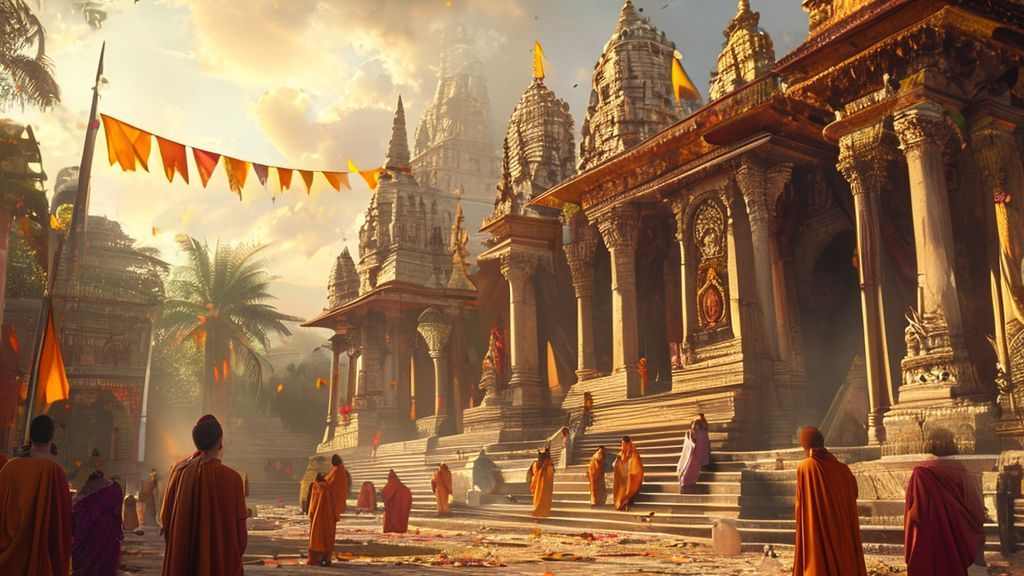
Goan Hindu Temples, a testament to unwavering Sanatan Dharma, represent a unique synthesis of indigenous spiritual resilience and subtle European architectural influences, having remarkably survived centuries of aggressive Portuguese evangelization and destruction through ingenious preservation efforts and cultural adaptation, preserving ancient deities and a vibrant cultural heritage against all odds.
| Attribute | Details |
|---|---|
| Deities (Primary) | Shri Mangesh (Shiva), Shri Shantadurga (Parvati), Shri Nagesh (Shiva), Shri Mahalakshmi |
| Location/Origin | Original sites in Old Goa (Velha Goa) and coastal areas; re-established primarily in Ponda taluka. |
| Key Festival | Mahashivaratri, Navaratri, Shigmo (Holi), Jatra (annual temple festival) |
| Scripture Reference | Portions of Skanda Purana (Sahyadri Khanda) for ancient Goan geography and deities. |
| Architectural Style | Hybrid: Nagara elements with strong influences of European Baroque and Rococo design. |
Introduction: The Unconquerable Spirit of Goan Dharma
Goa, a land blessed by the confluence of the Arabian Sea and the Western Ghats, holds a profound spiritual legacy that predates colonial narratives. For centuries, this sacred land, known in ancient texts as Gomantak, was a vibrant hub of Sanatan Dharma, home to revered temples and a deeply devotional populace. However, with the arrival of the Portuguese in the 16th century, Goa became the crucible of one of the most intense periods of religious persecution in Hindu history. The sustained assault on indigenous faith, marked by forced conversions and the systematic destruction of temples, aimed to erase Hindu identity.
Yet, the spirit of Dharma, like an eternal flame, refused to be extinguished. What emerged from this crucible is a unique tapestry of faith, marked by an extraordinary tale of survival, adaptation, and unwavering devotion. The Hindu temples of Goa today stand as monumental testaments to this resilience. They are not merely structures of brick and mortar but living embodiments of ancestral courage, ingenuity, and the profound commitment to preserving the Sanatan Dharma against overwhelming odds. These temples, often rebuilt in inland sanctuaries, carry the legacy of ancient deities whose idols were secretly carried away from their original consecrated sites, sometimes under the cover of darkness, to be re-enshrined in new abodes.
Puranic History & Legend: Gomantak’s Sacred Roots
The spiritual heritage of Goa is deeply embedded in the Puranas and ancient Itihasas. As detailed in the Sahyadri Khanda of the Skanda Purana, the region of Gomantak was a sacred land, frequented by Rishis and Devas. Lord Parashurama, the sixth Avatar of Vishnu, is said to have reclaimed this land from the sea, making it a pristine space for Dharma. Many of the primary deities worshipped in Goan temples have ancient origins, predating the arrival of the Portuguese by millennia.
For instance, the deity of Shri Manguesh (a form of Shiva), now enshrined in Priol, Ponda, was originally located in Kutthal (present-day Cortalim) in Salcete taluka. The legend, as recounted in local lore and supported by historical texts, speaks of a fierce battle between Lord Shiva and a demon named Shankasur. After a divine intervention, Shiva settled here, and a temple was built. Similarly, Shri Shantadurga, a benevolent form of Devi Parvati, whose main temple now stands in Kavlem, Ponda, was originally worshipped in the ancient Gopakapattanam (Goa Velha). She is revered as the goddess who mediates between Vishnu and Shiva, bringing peace, hence “Shanta.” The systematic destruction during the Portuguese Inquisition saw the original deities rescued by devotees, often Saraswat Brahmins, who carried the sacred Vigrahas across rivers and dense forests to rebuild temples in the relatively safer inland territories of Ponda, then under the lenient rule of the Sonde Kingdom.
These acts of relocation were not mere shifts of location; they were profound expressions of faith, often involving immense risk and sacrifice, ensuring the continuity of the Dharmic tradition. Each relocated deity carries a chronicle of resilience, reminding us of the unwavering devotion of our ancestors.
Architectural & Scientific Marvels: A Fusion of Resilience
The architecture of Goan Hindu temples is a fascinating study in adaptation and cultural syncretism, born out of historical necessity. While retaining core elements of traditional Hindu temple architecture, they exhibit distinct influences from the Baroque and Rococo styles prevalent during the Portuguese era. This unique blend is not accidental but a deliberate choice, perhaps to blend in, or simply reflecting the artistic currents of the time when rebuilding was possible.
Unlike the towering gopurams of Dravidian style or the curvilinear shikharas of pure Nagara style, Goan temples often feature more modest superstructures, sometimes topped with domes that might superficially resemble church architecture. However, these domes are crowned with the traditional Kalasha, maintaining their Hindu identity. A hallmark feature is the Deepastambha, the lamp tower, often exquisitely carved, standing prominently in front of the main shrine. These towers, adorned with intricate stucco work and sometimes painted in vibrant colors, show a clear European decorative influence in their detailing, balustrades, and even the use of plaster.
Inside, the temples typically follow the traditional layout: a Garbhagriha (sanctum sanctorum) housing the main deity, an Antarala (vestibule), a Sabha Mandapa (assembly hall), and sometimes additional shrines for Upadevathas (sub-deities). The use of richly carved wooden ceilings, silver doorways, and intricate frescoes depicting scenes from Puranas, often with a distinctly Goan flavor, are common. The scientific marvel lies in the ingenious engineering of these structures, often built quickly and covertly in new locations, yet designed to last centuries, proving the ingenuity of the local artisans who integrated new aesthetic elements while preserving the sanctity and functionality of Hindu sacred spaces. The planning for water management, natural ventilation, and acoustic properties within these structures also reflects ancient Indian architectural principles.
Rituals & Puja Vidhi: Upholding Ancient Traditions
The daily and periodic rituals performed in Goan Hindu temples adhere strictly to Vedic and Agamic traditions, despite the external architectural adaptations. The core of worship remains steadfast, ensuring the unbroken lineage of devotional practices. A typical Puja Vidhi involves:
- Sankalpa: The devotee (or priest on their behalf) declares the intention of the Puja, stating the time, place, and purpose.
- Avahana: Invocation of the deity into the Vigraha (idol) or Yantra.
- Dhyana: Meditation on the form of the deity.
- Shodashopachara Puja: The sixteen traditional offerings:
- Padya (offering water for feet)
- Arghya (offering water for hands)
- Achamaniya (offering water for sipping)
- Snanam (ritual bath with water, milk, honey, ghee, sugar)
- Vastra (offering clothes)
- Upaveetam (sacred thread)
- Gandha (sandal paste)
- Pushpa (flowers)
- Dhupam (incense)
- Deepam (lamp)
- Naivedyam (food offerings)
- Tambulam (betel leaf and nut)
- Dakshina (monetary offering)
- Pradakshina (circumambulation)
- Namaskaram (prostration)
- Mantrapushpam (offering flowers with Mantras)
- Aarti: Waving of lamps before the deity, followed by distribution of holy flame (Jyoti) to devotees.
- Prasada Vitarana: Distribution of consecrated food (Prasad) to all present.
- Mangala Darshana: Auspicious viewing of the deity.
Specific festivals like Jatra (the annual temple feast), Navaratri, Mahashivaratri, and Shigmo are celebrated with immense fervor, featuring elaborate processions, traditional music (like the Ghumat and Shamel), and folk dances, drawing devotees from across Goa and beyond. These rituals are performed by hereditary priestly families, ensuring the accuracy and sanctity of the traditions passed down through generations.
Mantras & Chants: Echoes of Eternity
The heart of Hindu worship lies in the sacred sound, the Mantra. For devotees visiting Goan temples, chanting these powerful vibrations connects them directly to the divine energy of the enshrined deities. Some common and potent Mantras include:
- For Lord Shiva (Shri Manguesh, Shri Nagesh):
ॐ नमः शिवाय (Om Namah Shivaya) – The Panchakshari Mantra, invoking reverence for Lord Shiva.
महामृत्युंजय मंत्र (Mahamrityunjaya Mantra): “ॐ त्र्यम्बकं यजामहे सुगन्धिं पुष्टिवर्धनम्। उर्वारुकमिव बन्धनान्मृत्योर्मुक्षीय माऽमृतात्॥” (Om Tryambakam Yajamahe Sugandhim Pushtivardhanam | Urvarukamiva Bandhanan Mrityor Mukshiya Maamritat ||) – A powerful prayer for health, longevity, and liberation.
- For Devi Shantadurga, Mahalakshmi, and other Goddesses:
ॐ ऐं ह्रीं क्लीं चामुण्डायै विच्चे (Om Aim Hrim Klim Chamundayai Vichche) – The Navarna Mantra, a core chant for the Goddess Durga.
ॐ जयंती मंगला काली भद्रकाली कपालिनी। दुर्गा क्षमा शिवा धात्री स्वाहा स्वधा नमोऽस्तुते॥ (Om Jayanti Mangala Kali Bhadrakali Kapalini. Durga Kshama Shiva Dhatri Svaha Svadha Namostute ||) – A powerful Stuti from the Devi Mahatmyam, invoking the different forms of the Goddess.
- General Prosperity and Peace:
ॐ सर्वेषां स्वस्ति भवतु। सर्वेषां शान्तिर्भवतु। सर्वेषां पूर्णं भवतु। सर्वेषां मङ्गलं भवतु॥ (Om Sarvesham Svasti Bhavatu. Sarvesham Shantir Bhavatu. Sarvesham Purnam Bhavatu. Sarvesham Mangalam Bhavatu ||) – May auspiciousness be unto all. May peace be unto all. May fullness be unto all. May prosperity be unto all.
These chants, recited with devotion and faith, purify the mind and atmosphere, invoking divine blessings.
Dos and Don’ts: Cultural Etiquette in Goan Temples
To ensure a respectful and spiritually enriching visit to Goan Hindu temples, devotees should observe certain traditional guidelines:
- Do: Dress modestly, covering shoulders and knees.
- Do: Remove footwear before entering the temple premises.
- Do: Maintain silence and reverence inside the temple.
- Do: Offer prayers with a pure heart and sincere devotion.
- Do: Take Prasad (consecrated food) with gratitude.
- Do: Circumambulate the Garbhagriha (sanctum) in a clockwise direction.
- Don’t: Carry leather items (belts, wallets, bags) into the sanctum area if specifically prohibited.
- Don’t: Engage in loud conversations, excessive photography, or disruptive behavior.
- Don’t: Touch idols or temple artifacts without permission from temple authorities.
- Don’t: Enter the temple if under the influence of alcohol or non-vegetarian food, as a mark of respect for the sanctity of the space.
Frequently Asked Questions
How did Goan temples survive Portuguese persecution?
Goan Hindu temples survived through the extraordinary courage and ingenuity of local devotees, primarily Saraswat Brahmins, who secretly relocated the Mool-Vigrahas (main idols) from coastal areas to safer inland territories in Ponda, which were outside direct Portuguese jurisdiction. They rebuilt temples covertly, often adopting architectural elements that blended in with the dominant European styles of the time, yet maintaining core Hindu spiritual traditions.
What makes Goan temple architecture unique?
Goan temple architecture is unique due to its blend of traditional Hindu temple layouts with significant influences from European Baroque and Rococo styles. This can be seen in the use of domes, elaborate stucco work, balustrades, and vibrant colors, particularly on Deepastambhas (lamp towers), which stand in front of the main shrine. This fusion represents an adaptive aesthetic born out of centuries of cultural interaction.
Are the original deities still worshipped in these temples?
Yes, the original Mool-Vigrahas (main idols) and their associated deities, which were painstakingly rescued and transported from their ancient sites during the persecution, are still consecrated and worshipped in the rebuilt temples, primarily in the Ponda region. This continuity of deity worship is central to the spiritual legacy of Goan Hinduism.
Dharmic Significance: Why This Matters for Every Hindu
The story of Goan Hindu temples is more than just a local history; it is a profound narrative of Dharma Vijaya – the triumph of righteousness. It underscores the intrinsic resilience of Sanatan Dharma, demonstrating that faith is not merely a set of dogmas but a living, breathing tradition passed down through generations, capable of enduring the harshest trials. These temples serve as powerful reminders that spiritual heritage is worth fighting for, adapting for, and preserving with every fiber of one’s being.
For every Hindu, these sanctuaries represent an unbroken chain of devotion, a testament to the fact that external pressures can never extinguish the inner flame of spiritual truth. They inspire us to uphold our traditions, cherish our cultural identity, and draw strength from the unwavering faith of our ancestors. The Goan temples are not just historical monuments; they are vibrant centers of spiritual energy, guiding beacons that illuminate the path of Dharma for future generations, reminding us that with unwavering devotion and collective will, Sanatan Dharma shall forever thrive.