


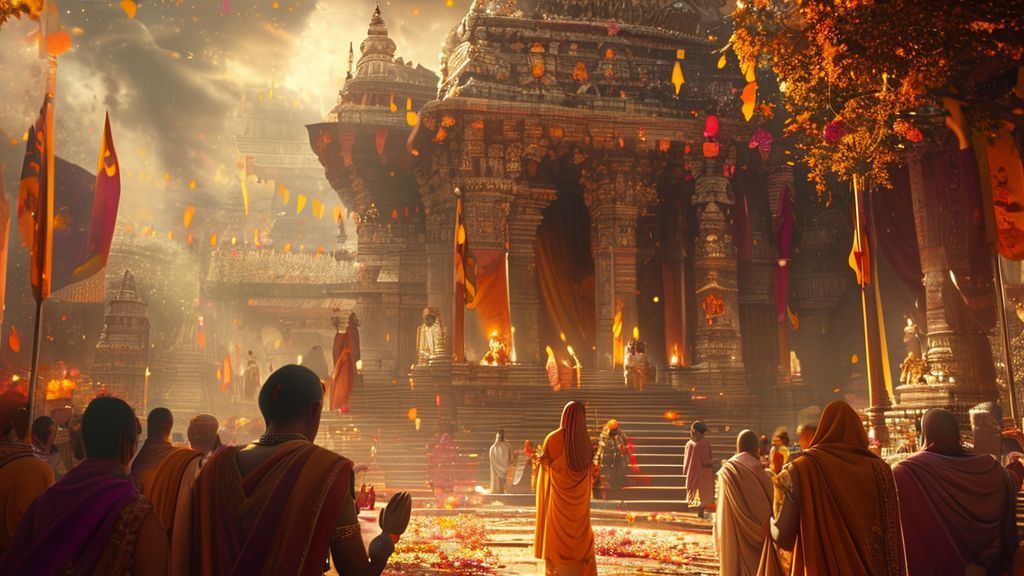
Hindu marriage age, traditionally prescribed by ancient scriptures, centers on the readiness for Grihastha Ashrama, emphasizing spiritual, mental, and physical maturity. While specific ages vary across texts, the ideal suggests males complete their Brahmacharya (around 24-25 years) and females attain puberty and intellectual readiness (typically 16-18 years) for a fulfilling and Dharma-centric conjugal life, ensuring the continuation of lineage and societal harmony.
| Attribute | Details |
|---|---|
| Concept | Vivah Sanskar, entry into Grihastha Ashrama (Householder stage) |
| Traditional Ideal Age (Male) | Post-Brahmacharya, typically 24-25 years (completion of Vedic studies) |
| Traditional Ideal Age (Female) | Post-menarche, possessing intellectual and emotional maturity, often 16-18 years |
| Scriptural Basis | Manusmriti, Dharma Shastras, Grhya Sutras, various Upanishads, Puranas |
| Primary Purpose | Dharma (righteousness), Praja (progeny), Rati (pleasure), and ultimately Moksha (liberation) |
The Sacred Threshold: Understanding Traditional Hindu Marriage Age
In Sanatan Dharma, marriage, or Vivah Sanskar, is not merely a social contract but a profound spiritual union and a crucial Samskara (sacrament) marking the transition into the Grihastha Ashrama, the householder stage. This sacred institution is foundational to society, ensuring the continuation of Dharma, lineage, and the performance of essential Vedic rituals. The traditional Hindu marriage age is not arbitrary; it is meticulously rooted in ancient scriptures, reflecting a deep understanding of human development—spiritual, intellectual, and physical—necessary for fulfilling the duties and responsibilities of married life. It is the wisdom of our Rishis, designed to foster stable families, righteous progeny, and a harmonious society, guiding devotees toward a life aligned with cosmic principles.
Puranic Wisdom and the Ashrama System: A Historical Perspective
The concept of ideal marriage age is intrinsically linked to the Ashrama Dharma, the four stages of life prescribed in Vedic tradition: Brahmacharya (student life), Grihastha (householder), Vanaprastha (forest dweller/retirement), and Sannyasa (renunciation). The Dharma Shastras, particularly the Manusmriti, provide detailed guidelines. For males, marriage traditionally commenced after the successful completion of Brahmacharya, typically around the age of 24 or 25, following 12 years of Vedic studies after their Upanayana Sanskar (initiation ceremony) at around 8 years of age. This ensured intellectual maturity, self-control, and the acquisition of knowledge necessary to guide a family.
As stated in Manusmriti (III.2), “A Brāhmaṇa who has completed his Vedic studies, a Kṣatriya who has finished his martial training, or a Vaiśya who has perfected his trade should marry a wife of his own class, endowed with auspicious signs.” This refers to a state of readiness, not just a numerical age. For females, the scriptures indicate marriage after menarche, when they are physically capable of bearing children and emotionally mature enough to manage a household. Texts like the Smriti Chandrika suggest an ideal age range of 16 to 18 for women, emphasizing that a girl should not be married before puberty. The great epics, Ramayana and Mahabharata, though depicting divine unions, embody these principles of maturity and readiness. For instance, Sita’s marriage to Rama occurred when she was a mature young woman, embodying ideal Dharmic partnership.
Philosophical & Societal Underpinnings: The Science of Grihastha
The ancient seers understood that marriage is not merely for individual happiness but for the sustenance of society and the cosmos. The chosen ages were a ‘scientific’ framework for optimal human development. For males, completing Brahmacharya meant a disciplined mind, mastery over senses, and a firm grounding in Dharma. This intellectual and spiritual preparation allowed them to become responsible householders, capable of supporting their family, performing Yajnas (sacrifices), and contributing to the community. The Atharva Veda (XI.5.3) states, “The Brahmachari, by his tapas, supports the world.” This tapas culminates in the readiness for Grihastha.
For females, the emphasis was on attaining physical maturity (menarche), emotional stability, and intellectual readiness to nurture a family. The Yajnavalkya Smriti underscores the importance of a woman’s virtues and ability to manage a household. These ages ensured that couples were mature enough to understand their mutual duties (Dharma), procreate (Praja), enjoy conjugal pleasure (Rati) within Dharmic bounds, and work towards ultimate liberation (Moksha) together. The synchronized readiness of both partners, as perceived through the lens of Dharma, created a stable unit for raising righteous children (Satputra) and passing on Vedic traditions. Such profound insights are central to understanding the holistic approach of Hindutva.online towards life’s journey.
The Path to Grihastha: Rituals and Preparations
The journey to the Grihastha Ashrama is marked by several significant rituals, emphasizing the sanctity of the traditional marriage age and the preparedness it signifies:
- Brahmacharya Vrata & Samavartana Sanskar: For males, prior to marriage, strict adherence to Brahmacharya is expected. Upon completion of Vedic studies, the Samavartana Sanskar marks the end of student life, where the Guru bestows blessings and advises the student to enter Grihastha, emphasizing the importance of performing one’s duties.
- Varamala & Kanyadaan: The exchange of garlands (Varamala) and the ritual of Kanyadaan, where the bride’s father entrusts his daughter to the groom, are profound acts. Kanyadaan signifies the father’s offering of his daughter as a divine gift, emphasizing the spiritual purity and readiness of the bride.
- Panigrahan: The groom taking the bride’s hand, symbolizing acceptance of responsibility and lifelong partnership. The mantra recited, “I take your hand for good fortune, that you may reach old age with me, your husband,” highlights the long-term commitment.
- Saptapadi (Seven Steps): This is the most crucial part of the wedding, where the couple takes seven steps around the sacred fire (Agni), each step accompanied by a vow for a specific aspect of married life—food, strength, prosperity, happiness, progeny, seasons, and eternal friendship. These vows are taken by individuals who are deemed mature enough to understand and uphold them.
- Astrological Alignment (Kundali Milan): While not a ritual in itself, aligning horoscopes ensures compatibility at various levels—mental, physical, and spiritual—further solidifying the foundation of a lasting union.
Mantras for a Blessed Conjugal Life
The Vivah Sanskar is replete with powerful Vedic mantras that invoke divine blessings for the couple. Chanting these mantras, especially with an understanding of their meaning, strengthens the bond and purifies the atmosphere:
- During Panigrahan, the groom chants: “ओ३म् गृभ्णामि ते सौभगत्वाय हस्तं मया पत्या जरदष्टिर्यथासः। भगो अर्यमा सविता पुरन्धिर्मह्यं त्वादुर्गार्हपत्याय देवाः॥” (Om Grabhṇāmi te saubhagatvāya hastam mayā patyā jaradaṣṭiryathāsaḥ. Bhago aryamā savitā purandhirmāhyaṁ tvā durgārhapatyāya devāḥ.)
“I grasp your hand for good fortune, that with me, your husband, you may attain old age. Bhaga, Aryaman, Savitā, Pūṣan, and the gods have given you to me for the householder’s life.” - During Saptapadi, for each step, a specific vow is made. For example, the first step: “एकामिष एकपदी भव सा मामनुव्रता भव पुत्रान् विन्दावहै बहुस्ते सन्तु जरदष्टयः।” (Ekāmiṣa ekapadī bhava sā māmanuvratā bhava putrān vindāvahai bahuste santu jaradaṣṭayaḥ.)
“May you take one step with me for food. Be devoted to me. May we be blessed with many sons, and may they live to old age.” - A general prayer for marital harmony and prosperity: “अग्निः पत्नीमन्वैति सोमो वधूयुरभवत्। सूर्यस्य यत्पत्नीं सुभगां तां नो देहि तपस्विनीम्॥” (Agniḥ patnīmanvaiti somo vadhūyurabhavat. Sūryasya yatpatnīṁ subhagāṁ tāṁ no dehi tapasvinīm.)
“May Agni follow the wife, may Soma be eager for the bride. That auspicious wife of Surya, give her to us, who is ascetic.”
Dos and Don’ts for a Dharmic Union
- DO prioritize spiritual compatibility and shared Dharmic values over superficial attractions.
- DO seek the blessings and guidance of elders and parents, as their wisdom is invaluable in choosing a life partner.
- DO ensure both individuals are emotionally, mentally, and physically mature enough to undertake the responsibilities of Grihastha Ashrama.
- DO understand marriage as a partnership for fulfilling Dharma, rearing righteous progeny, and supporting each other on the spiritual path.
- DON’T rush into marriage for fleeting desires or societal pressure without genuine readiness.
- DON’T disregard scriptural guidelines on age or character, as they are formulated for long-term well-being.
- DON’T neglect the importance of education and self-development before committing to married life.
Frequently Asked Questions
Why did traditional ages differ for males and females?
The difference in traditional marriage ages for males and females stems from the distinct roles and developmental milestones emphasized in Sanatan Dharma. Males were expected to complete their extensive Vedic education (Brahmacharya) and develop intellectual and spiritual maturity, which typically extended to their mid-twenties. Females were considered ready for marriage after menarche and the onset of emotional maturity, typically in their mid to late teens, as their primary role was often seen as nurturing the family and household, alongside their spiritual growth. These distinctions were based on observed biological and societal readiness for their respective Dharmic duties.
Is child marriage endorsed in Hinduism?
No. While historical practices in various societies sometimes deviated, the foundational Dharma Shastras and Grhya Sutras clearly indicate marriage should occur after puberty for girls and after completion of Brahmacharya for boys, implying intellectual and physical readiness. Texts like Manusmriti and Sushruta Samhita emphasize health and progeny, which are not possible in childhood marriages. The ideal traditional ages discussed (16-18 for girls, 24-25 for boys) clearly distinguish from “child marriage” as understood today, which is universally condemned as a violation of human rights and Dharmic principles of individual well-being and choice. The spirit of the scriptures always emphasized maturity.
Are these traditional ages still relevant today?
While modern society and laws mandate a legal minimum age for marriage that often differs from ancient scriptural ideals (e.g., 18 for women and 21 for men in India), the underlying principles of mental, emotional, and financial maturity remain profoundly relevant. The essence of the traditional age guidelines—that individuals should be well-prepared to understand their duties, sustain a family, and contribute meaningfully to society—is timeless. Many Hindus today choose to marry later, aligning with these principles of readiness, even if the exact numerical age varies.
Preserving Sanatan Dharma: The Enduring Significance of Marriage Age
The traditional Hindu marriage age is more than a historical artifact; it is a profound testament to the holistic vision of Sanatan Dharma. By advocating for marriage at an age of maturity, our scriptures ensured that individuals entered this sacred bond with the necessary wisdom, discipline, and understanding to uphold Dharma. A well-prepared couple, entering Grihastha Ashrama with reverence, becomes the bedrock of society, fostering righteous children, performing sacrifices, and contributing to the spiritual ecosystem. This careful timing and preparation are vital for preserving family values, transmitting Vedic knowledge, and ultimately, ensuring the continuity and vibrancy of Hindu culture for generations to come. It is through understanding and appreciating such ancient wisdom that we truly connect with the essence of Hindutva.online.