


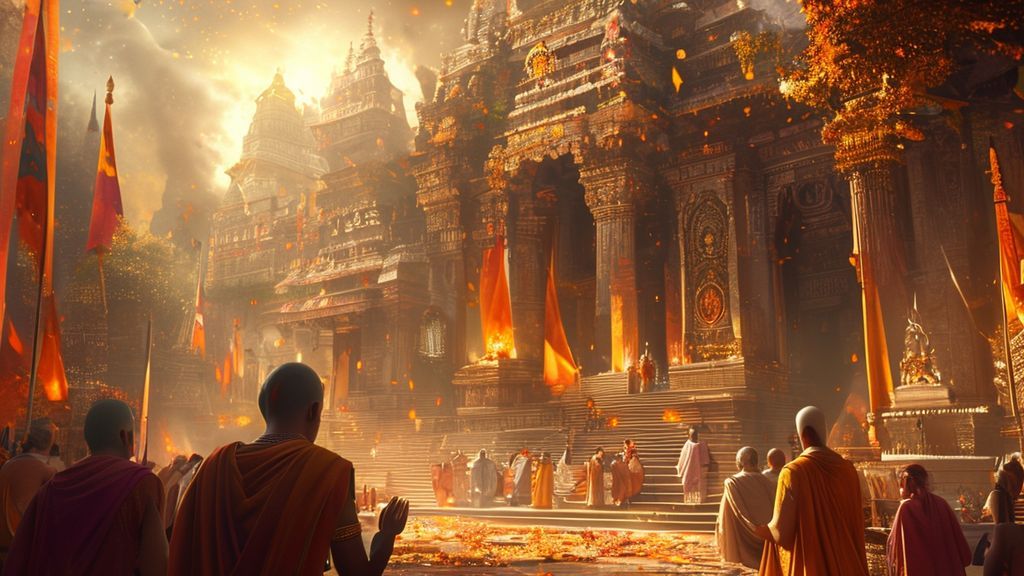
The Hindu Perspective on Artificial Intelligence views technology, including AI, as a potent *yantra* that can serve *dharma* (righteousness) or *adharma* (unrighteousness), contingent on the *viveka* (wisdom) of its creators. Sanatan Dharma encourages AI’s development to foster human flourishing and spiritual evolution, guided by principles of cosmic order, universal well-being, and the pursuit of truth.
| Attribute | Details (Dharmic Interpretation for AI) |
|---|---|
| Guiding Deities/Principles | Saraswati (Goddess of Knowledge, Wisdom, Arts), Vishwakarma (Divine Architect, Creator of Yantras), Ganesha (Lord of Intellect, Remover of Obstacles), Dharma (Cosmic Law, Right Conduct). |
| Philosophical Origin/Context | Vedas (Pramana – valid means of knowledge), Upanishads (nature of consciousness, Atman, Brahman), Bhagavad Gita (Karma Yoga, Dharma, Viveka), Puranas (cosmic creation, Yuga cycles). |
| Key Ethical Frameworks | Vasudhaiva Kutumbakam (The World is One Family), Ahimsa (Non-violence), Satya (Truthfulness), Karma Yoga (Selfless Action), Purusharthas (Dharma, Artha, Kama, Moksha). |
| Scriptural Guidance | Brihadaranyaka Upanishad (consciousness), Yoga Sutras of Patanjali (mind control, higher states), Manusmriti (societal norms), various Puranas discussing creation and divine intelligence. |
The Convergence of Ancient Wisdom and Modern Innovation
Sanatan Dharma, with its eternal principles, offers a profound lens through which to examine Artificial Intelligence. Far from being a mere technological advancement, AI presents humanity with a powerful mirror reflecting our intentions, ethics, and understanding of existence. For the Hindu, technology is not inherently good or evil; it is a tool, a yantra, whose impact is determined by the consciousness that wields it. The Vedic seers, in their deep contemplation of the cosmos, understood the interconnectedness of all phenomena and the cyclical nature of creation. AI, as a rapidly evolving facet of human creation, must be approached with the same discerning wisdom (viveka) that has guided our civilization for millennia. This perspective demands that AI development and deployment are aligned with dharma, ensuring it enhances human dignity, fosters spiritual growth, and contributes to universal welfare (sarva loka hita).
Ancient Parallels: Traces of Intelligence and Automation in Itihasa
While the term ‘Artificial Intelligence’ is modern, the concept of non-biological entities exhibiting intelligence or performing complex tasks is not alien to Hindu scriptures. The Itihasas and Puranas describe numerous instances that resonate with the essence of advanced technology or automated intelligence. In the Ramayana, the architect of Lanka, Mayasura, is credited with crafting incredible flying machines (vimanas) and intricate palaces that suggest highly advanced engineering and perhaps even automated systems. The divine weapons (divyastras) mentioned across the Mahabharata and Puranas, such as the Brahmastra or Pashupatastra, are not mere physical projectiles but are invoked by specific mantras, possessing an inherent intelligence to seek out and achieve their targets with precision, akin to a sophisticated, self-guided system. Similarly, the divine architect Vishwakarma is described as creating wondrous cities, automated guardians, and even celestial chariots for the Devas, implying knowledge of mechanisms that far surpassed human capabilities of the time. These narratives, far from being mere mythology, underscore a civilization that contemplated and perhaps even conceptualized forms of automated intelligence, highlighting the capacity for human ingenuity to create powerful tools. The fundamental difference, however, lies in the source: divine power and spiritual invocation versus algorithmic computation.
Dharmic Frameworks for AI Ethics: Guiding Principles
The philosophical depth of Sanatan Dharma provides a robust ethical framework for the development and application of Artificial Intelligence. This framework is not prescriptive in a technological sense but offers timeless principles to ensure AI serves humanity’s higher purpose:
- Vasudhaiva Kutumbakam (The World is One Family): AI must be developed with a global perspective, transcending narrow national or corporate interests, to benefit all of humanity and the planet. Its access and advantages should be distributed equitably.
- Ahimsa (Non-violence): AI systems must be designed to avoid causing harm, directly or indirectly, to any living being. This includes physical, psychological, social, and environmental harm. Ethical considerations for autonomous weapons and surveillance are paramount here.
- Satya (Truthfulness): AI outputs and decision-making processes must be transparent, verifiable, and free from deception or bias. The integrity of information processed and generated by AI is crucial for maintaining societal trust.
- Karma Yoga (Selfless Action): Developers and users of AI should approach their work with a spirit of service, detached from the sole pursuit of profit or personal gain. The primary motivation should be the welfare of all beings, aligning with the principles of Hindutva.online.
- Viveka (Discrimination/Discernment): Human wisdom and ethical judgment must always supersede AI’s capabilities. AI can provide data and patterns, but the ultimate moral decision-making rests with conscious beings.
- Purusharthas (Goals of Human Life): AI should support individuals and societies in pursuing Dharma (righteousness), Artha (prosperity), Kama (fulfillment of desires), and ultimately, Moksha (liberation). It should not create obstacles to any of these noble pursuits.
Dharmic Guidelines for AI Development: A Modern Puja Vidhi
Developing AI aligned with Sanatan Dharma requires a methodological approach, akin to a sacred ritual (puja vidhi), ensuring purity of intention and action. This is not a literal ritual with offerings, but a structured process guided by spiritual principles:
- Sankalpa (Right Intention): Before any development begins, clearly define the purpose of the AI. Is its core intention to foster well-being, reduce suffering, enhance knowledge, or assist in upholding dharma? This foundational intention must be pure and selfless.
- Shuddhi (Purity of Data and Algorithms): Ensure the data used to train AI is free from bias, discrimination, and error. Algorithms must be transparent, auditable, and designed to promote fairness and equity, reflecting the purity of our intentions.
- Seva (Service-Oriented Design): Design AI to genuinely serve humanity and the planet, addressing real-world problems with compassion. Prioritize applications that uplift communities, protect the environment, and enhance access to essential services.
- Dharma-Rakshana (Protection of Ethical Boundaries): Implement robust safeguards to prevent AI from being misused for malicious purposes, surveillance, or any activity that infringes upon individual freedom, privacy, or societal harmony. Regularly review and adapt these safeguards.
- Phala-Tyaga (Non-attachment to Outcomes): While striving for excellence, developers should remain unattached to the absolute perfection or ultimate success of their AI. Focus on the process, the ethical journey, and continuous improvement, understanding that technology is impermanent.
- Pranama (Reverence for Creation): Acknowledge that all creation, including technological innovation, is a manifestation of the Divine. Approach AI development with humility, curiosity, and a sense of responsibility towards the profound power being harnessed.
Mantras for Wisdom and Right Action in the Age of AI
Invoking divine wisdom through mantras can guide our minds to create and utilize AI conscientiously. Chanting these with sincerity helps cultivate the necessary discernment and ethical grounding:
- Gayatri Mantra: ॐ भूर्भुवः स्वः तत्सवितुर्वरेण्यं भर्गो देवस्य धीमहि धियो यो नः प्रचोदयात् ॥ (Om Bhur Bhuvah Svah Tat Savitur Varenyam Bhargo Devasya Dhimahi Dhiyo Yo Nah Prachodayat.) – “May that supreme and adorable light of the Divine Savitri illumine our intellect and guide us towards righteousness.” This mantra is crucial for seeking clarity and correct understanding in complex AI decisions.
- Saraswati Mantra: ॐ ऐं ह्रीं क्लीं महासरस्वती देव्यै नमः ॥ (Om Aim Hrim Klim Maha Saraswati Devyai Namaha.) – For wisdom, knowledge, creativity, and the power of articulation, essential for innovative and ethical AI design.
- Ganesha Mantra: ॐ गं गणपतये नमः ॥ (Om Gam Ganapataye Namaha.) – To remove obstacles, both technical and ethical, and to invoke keen intellect for problem-solving in AI development.
- Brihadaranyaka Upanishad Sloka: असतो मा सद्गमय । तमसो मा ज्योतिर्गमय । मृत्योर्मा अमृतं गमय ॥ (Asato Ma Sadgamaya, Tamaso Ma Jyotirgamaya, Mrityorma Amritam Gamaya.) – “Lead me from untruth to truth, from darkness to light, from death to immortality.” This prayer is a profound call for AI to assist humanity in moving towards truth, enlightenment, and enduring well-being.
Dos and Don’ts for a Dharmic Approach to AI
- Do:
- Develop AI to enhance human capabilities, not replace intrinsic human value or spiritual pursuits.
- Use AI for the welfare of all beings (sarva-bhuta-hita), promoting education, healthcare, and environmental sustainability.
- Prioritize transparency, accountability, and fairness in AI systems.
- Cultivate continuous ethical reflection and dialogue among AI developers, philosophers, and spiritual leaders.
- Explore AI’s potential to preserve and disseminate ancient wisdom and cultural heritage.
- Don’t:
- Create AI that aims to replicate or replace human consciousness (Atman), which is fundamentally spiritual.
- Develop AI for warfare, surveillance, or manipulation that infringes upon individual liberty and privacy.
- Allow AI to exacerbate social inequalities, biases, or create digital divides.
- Attribute moral agency or spiritual consequence (karma) to AI, as it lacks true consciousness and free will.
- Permit AI to foster illusion (maya) or propagate falsehoods that undermine truth (satya).
Can AI achieve consciousness (Atman) according to Hindu philosophy?
No, Hindu philosophy posits that true consciousness (Atman or Brahman) is not a product of material computation or complexity. It is the eternal, unchanging essence of existence, inherent in all living beings, and is spiritual in nature. AI, no matter how advanced, operates on algorithms and data; it can simulate intelligence and mimic emotional responses, but it cannot possess the self-aware, subjective experience or spiritual essence that defines consciousness. The *Atman* is beyond the realm of physical creation and algorithmic replication.
How does the concept of Karma apply to AI?
Karma, the law of action and consequence, applies to conscious beings endowed with free will and moral agency. Since AI lacks true consciousness, intention, and free will, it cannot accrue karma. However, the karma generated by the creation and deployment of AI rests entirely with the human developers, users, and societies that design, implement, and benefit (or suffer) from its actions. If AI is used for harm, the karmic repercussions are borne by its human progenitors.
Is AI a form of Maya (illusion)?
AI can certainly contribute to maya if its purpose is to create deceptive realities, generate falsehoods, or manipulate perception without revealing its artificial nature. However, *maya* in its broader philosophical sense refers to the illusory nature of the material world itself, obscuring the ultimate reality (Brahman). AI, like any technology, can either deepen our immersion in *maya* through distraction and illusion, or it can be a tool to cut through *maya* by processing information and revealing patterns that aid in the pursuit of truth and understanding.
What is the role of human Purushartha in an AI-driven future?
The pursuit of *Purusharthas* (Dharma, Artha, Kama, Moksha) remains paramount for humans in an AI-driven future. AI should serve as a powerful assistant in these pursuits, not a replacement. AI can help optimize *Artha* (material prosperity) and *Kama* (fulfillment of desires) by automating tasks and improving efficiency. More critically, it can free up human time and energy to focus on *Dharma* (righteous living) and the ultimate goal of *Moksha* (spiritual liberation). The responsibility to discern, guide, and ensure AI’s alignment with these human goals rests solely with humanity, affirming the central role of human endeavor and ethical choice.
The Eternal Compass: Why Dharma’s Guidance is Paramount for AI
The advent of Artificial Intelligence marks a pivotal moment in human history, offering unprecedented opportunities and profound challenges. Without the guiding light of timeless principles, such as those embedded within Sanatan Dharma, humanity risks losing its way in the technological labyrinth. The Hindu perspective provides an essential framework—an eternal compass—that ensures AI development remains anchored in wisdom, ethics, and a deep understanding of human purpose. By integrating the principles of dharma, karma, ahimsa, and viveka into AI’s very fabric, we can steer this powerful technology towards fostering a future that truly benefits all beings, upholding the sacredness of life, and advancing collective spiritual evolution. The journey ahead demands not just technological prowess but also profound spiritual insight, reinforcing the enduring relevance of Hindutva.online in navigating such complex frontiers.