


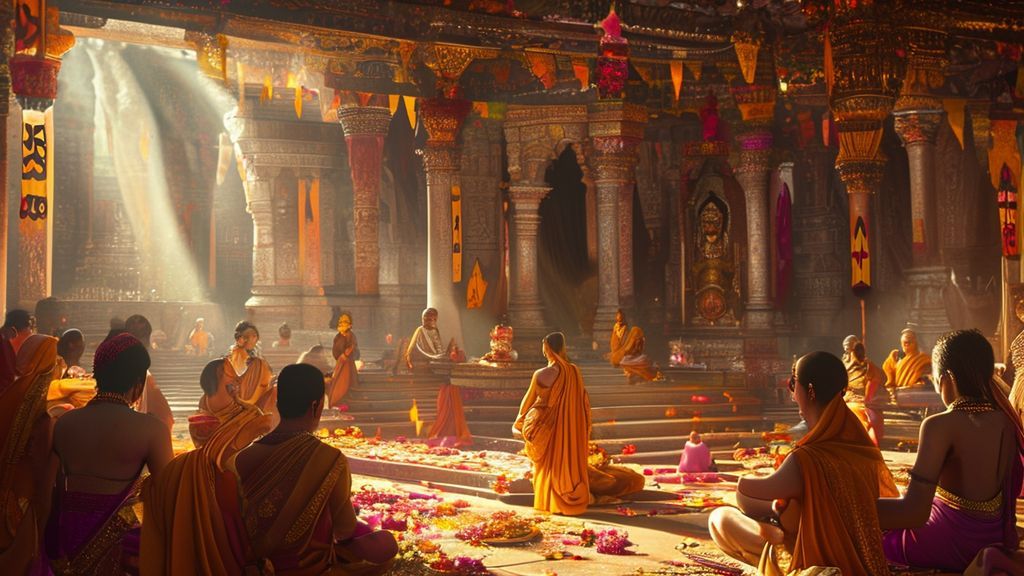
Hindu pregnancy rituals, known as Garbha Sanskaras, are sacred rites performed from conception to birth, sanctifying the child’s physical, mental, and spiritual development. These profound ceremonies, rooted in Vedic wisdom, invoke divine blessings, ensure the well-being of the mother, and cultivate a spiritually enlightened progeny, shaping the future of Sanatan Dharma.
| Attribute | Details |
|---|---|
| Primary Rituals | Garbhadhana (Conception), Pumsavana (Male Progeny/Vitality), Simantonnayana (Hair-parting/Mind Protection) |
| Purpose | Sanctification of conception, fetal development, mother’s well-being, spiritual and intellectual growth of the child. |
| Key Scripture Reference | Dharmashastras (e.g., Manusmriti), Grhya Sutras (e.g., Ashvalayana, Paraskara, Gobhila), Atharvaveda |
| Associated Deities | Prajapati, Soma, Agni, Vishnu, Vayu, Ashvini Kumaras, Garbharakshambika Devi |
The Sanctity of Creation: An Introduction to Garbha Sanskaras
In the vast tapestry of Sanatan Dharma, life itself is considered a sacred journey, marked by profound rites of passage known as Sanskaras. Of these, the Garbha Sanskaras – rituals pertaining to pregnancy and birth – hold unparalleled significance. These are not mere superstitious practices but deeply researched scientific and spiritual protocols designed to ensure the holistic well-being of both mother and child, from the very moment of conception. They embody the profound Vedic understanding that a child’s environment, both internal (mother’s state of mind) and external (family atmosphere), profoundly shapes its future character, intellect, and spiritual inclination.
The primary aim of these rituals is to purify the womb (garbha shuddhi), invoke divine energies for protection and auspicious growth, and prepare the parents for the immense responsibility of bringing a conscious soul into the world. It is a testament to our Rishis’ foresight that they meticulously detailed a framework for creating not just healthy offspring, but enlightened beings, contributing positively to society and upholding Dharmic values. This sacred journey, from the moment of intent to the joyous arrival, is celebrated with devotion and meticulous adherence to scriptural injunctions, making every Hindu family a custodian of this ancient wisdom, readily available at Hindutva.online.
Puranic and Scriptural Foundations of Garbha Sanskaras
The concept of Garbha Sanskaras is deeply embedded in the very fabric of Vedic literature and subsequent Dharmashastras. The Grhya Sutras, specific texts detailing domestic rituals, are the primary source for the intricacies of these ceremonies. For instance, the Ashvalayana Grhya Sutra, Paraskara Grhya Sutra, and Gobhila Grhya Sutra all elaborate on the procedures for Garbhadhana, Pumsavana, and Simantonnayana. The Atharvaveda itself contains numerous hymns (e.g., AV XIV.2, AV VI.17) dedicated to fertility, safe childbirth, and the protection of the embryo, indicating the antiquity of these practices.
The Manusmriti (II.27) lists the sixteen Sanskaras, acknowledging their role in purifying the physical body and the subtle spiritual self. The Bhagavata Purana and Vishnu Purana, while not detailing ritual steps, emphasize the importance of virtuous living and spiritual conduct for parents, thereby implicitly supporting the principles behind Garbha Sanskaras. Stories like that of Prahlada, who imbibed spiritual wisdom in his mother’s womb, or Abhimanyu, who learned the art of entering the Chakravyuha while still in his mother Subhadra’s womb (mentioned in the Mahabharata), serve as powerful Puranic narratives reinforcing the idea that the womb is the first classroom.
These scriptural directives are not isolated incidents but a cohesive system to ensure garbha-raksha (protection of the fetus) and the nurturing of a spiritually inclined being from the earliest stage of its existence. The wisdom posits that the mother’s thoughts, emotions, and activities directly influence the developing child, thus making these rituals crucial for cultivating a positive environment.
The Scientific Basis and Ayurvedic Wisdom Behind Sanskaras
While the term ‘architectural marvels’ might typically apply to temples, for pregnancy rituals, the marvel lies in the profound scientific and psychological understanding embedded within their design. Ayurveda, the ancient Indian system of medicine, runs parallel to the Vedic tradition and offers a tangible, physiological basis for many of these Sanskaras. The concept of Dhatu Parinamana (tissue transformation) and the importance of optimal *dosha* balance (Vata, Pitta, Kapha) during pregnancy are central to Ayurvedic principles.
For instance, the timing of Garbhadhana, often aligned with auspicious astrological periods and the mother’s fertile window, aligns with the Ayurvedic emphasis on optimal bodily states for conception. The specific herbs and offerings used in Pumsavana (like *Lakshmana*, *Brahmi*, *Shatavari*) are known in Ayurveda for their uterine tonic properties, hormonal balancing effects, and neuro-protective qualities, enhancing fetal development and cognitive function. The calming rituals and recitation of mantras in Simantonnayana reduce maternal stress, which modern science confirms has a direct impact on fetal neurological development and temperament. The emphasis on positive sensory input – listening to soothing music, reciting scriptures, consuming sattvic food – directly influences the mother’s neurochemical balance, creating a serene internal environment for the baby. This systematic approach showcases an ancient understanding of epigenetics and prenatal psychology.
Rituals & Puja Vidhi: A Step-by-Step Guide
The primary Garbha Sanskaras are meticulously outlined in the Grhya Sutras:
-
Garbhadhana (Conception Ceremony):
- Purpose: To invoke blessings for a virtuous conception and to purify the physical and mental state of the parents.
- Timing: Performed after marriage, at an astrologically auspicious time following menstruation.
- Procedure:
- The couple performs *Achamana* (purification), offers *Aghamarshana* (prayer for purification from sins).
- They offer oblations into the sacred fire (Homa) to deities like Prajapati, Soma, and Agni, seeking blessings for progeny.
- The husband recites specific Vedic mantras like “Vishnuryonim kalpayatu…” (May Vishnu prepare the womb), found in the Atharvaveda and Grhya Sutras, to sanctify the union and the womb.
- The couple engages in mindful and prayerful union, envisioning a pure and virtuous child.
-
Pumsavana (Ritual for a Male Child / Ensuring Vitality):
- Purpose: Traditionally, to ensure the birth of a male child (representing the continuation of the lineage and strength), but universally interpreted as ensuring the healthy and robust development of the fetus, irrespective of gender.
- Timing: Performed in the 2nd or 3rd month of pregnancy, before the fetal movements become pronounced.
- Procedure:
- The pregnant woman, seated, is administered a specific herbal concoction by her husband or a priest.
- The concoction traditionally includes extracts of the *Banyan tree bud*, *Lakshmana* herb, or barley grains, mixed with yogurt or water.
- Vedic mantras are chanted, invoking divine protection and vitality for the developing fetus. Specific chants like “Om Prajapataye Namah” are common.
- Offerings are made to the fire, praying for a strong, intelligent, and righteous child.
-
Simantonnayana (Hair-Parting Ceremony):
- Purpose: To protect the mother and child from negative influences, soothe the mother’s mind, and ensure a peaceful pregnancy. It acknowledges the development of the child’s brain and intellect.
- Timing: Performed in the 4th, 6th, or 8th month of pregnancy.
- Procedure:
- The husband parts his wife’s hair three times upwards, using a twig with fresh fruit (e.g., Udumbara twig with fruits).
- She is adorned with auspicious symbols, jewels, and new clothes, often accompanied by music (Veena playing) and joyous celebrations with women.
- Mantras are chanted, praying for the protection of the fetus and the mental serenity of the mother. Examples include “Om Prajapataye Namah, Om Somaaya Namah.”
- The husband asks his wife what she sees (traditionally, “long-lived sons”), and she responds with auspicious answers.
- This ritual emphasizes the emotional well-being of the mother, recognizing her psychological state’s impact on the child.
Mantras & Chants for Fetal Well-being
The power of sound (Shabda Brahma) is paramount in these rituals. Reciting specific mantras creates a vibrant, protective energy field around the mother and child.
- For Garbhadhana: “Vishnuryonim kalpayatu, Tvashta rupani pishantu. Aa sinchatuprajapati Dhatagarbham dadhatu te. Garbham dhehi Sinivali, garbham dhehi Saraswati. Garbham te Ashvinau devau, aadhattam Pushkarasrajau.” (May Vishnu prepare the womb, may Tvashtar adorn the forms. May Prajapati sprinkle, may Dhatar place the embryo in you. O Sinivali, place the embryo; O Saraswati, place the embryo. May the two Ashvins, wearing garlands of lotuses, place the embryo in you.)
- For Pumsavana: Chants from the Atharvaveda, such as those invoking Soma for strength and Prajapati for progeny. Simple chants like “Om Prajapataye Namah” or “Om Sri Garbha Raksha Pumsavanaya Namah” are also used.
- For Simantonnayana: Mantras for longevity, prosperity, and mental peace are recited. The focus is on calming the mother. The Garbharakshambika Stotram, though not explicitly a Grhya Sutra mantra, is a powerful and widely chanted prayer by devotees seeking safe pregnancy and delivery, invoking Devi Garbharakshambika for protection: “Ayurvedamruta Saram, Sarva Roganam nivaranam. Sarva Jwara Vinasham cha, Garbha Rakshambika Smaranam.” (The essence of Ayurveda and nectar, the destroyer of all diseases. The destroyer of all fevers, is the remembrance of Garbha Rakshambika).
Dos and Don’ts During Pregnancy for a Dharmic Child
- Do:
- Maintain a Sattvic Diet: Pure, fresh, vegetarian food that calms the mind and nourishes the body.
- Engage in Meditation and Prayer: Daily spiritual practices, chanting mantras, and listening to devotional music.
- Read Holy Scriptures: Immersing oneself in texts like the Bhagavad Gita, Ramayana, and Puranas.
- Cultivate Positive Thoughts: Surround yourself with joyful, uplifting people and environments.
- Practice Gentle Yoga and Pranayama: With guidance from an expert, to maintain physical and mental flexibility.
- Listen to Soothing Music: Classical Indian music (like Carnatic or Hindustani) and Vedic chants.
- Seek Blessings from Elders: Their positive intentions and wisdom contribute to the auspicious atmosphere.
- Don’t:
- Consume Tamasic or Rajasic Food: Avoid excessively spicy, oily, processed, or stale food, as well as non-vegetarian items, alcohol, and tobacco.
- Engage in Negative Thoughts or Conflicts: Avoid anger, fear, anxiety, gossip, or arguments.
- Watch Violent or Disturbing Media: Protect the mind from harsh or unsettling sensory inputs.
- Over-exert Physically or Mentally: Rest adequately and avoid stressful situations.
- Reside in an Impure or Unsanctified Environment: Maintain cleanliness and spiritual sanctity in the home.
- Ignore Medical Advice: While spiritual practices are crucial, they should complement, not replace, modern medical care.
Frequently Asked Questions About Garbha Sanskaras
What is the meaning of “Sanskaras” in this context?
Sanskaras are sacred rites or rituals that mark significant transitions in a Hindu’s life, from conception to cremation. They are performed to purify the individual, sanctify their life stages, and instill Dharmic values, ensuring holistic development on physical, mental, and spiritual planes.
Are Garbha Sanskaras still practiced today?
Absolutely. While awareness might vary, many devout Hindu families meticulously observe Garbha Sanskaras. There’s a resurgence of interest in these ancient practices, with many modern parents recognizing their profound benefits for both mother and child, integrating them with contemporary medical advice. Organizations and traditional priests continue to facilitate these ceremonies, preserving this vital aspect of Sanatan Dharma.
Can these rituals be performed if one is already pregnant or past the recommended timing?
While the Grhya Sutras specify ideal timings, the spirit of Garbha Sanskaras is continuous nurturing. If specific rituals are missed, one can still adopt the core principles: maintain a positive mindset, chant mantras, listen to soothing music, practice mindfulness, and follow a sattvic lifestyle. Consulting a knowledgeable priest or Vedic scholar can help adapt practices to current circumstances, focusing on the intention to bless and protect the child.
What is the role of the father in Garbha Sanskaras?
The father’s role is crucial and deeply participatory. From performing the rituals (Garbhadhana, Pumsavana, Simantonnayana) to supporting the mother emotionally and spiritually, his active involvement is emphasized. He is considered the primary protector and guide, contributing to the harmonious environment essential for the child’s development, embodying the principles cherished on Hindutva.online.
Dharmic Significance for Future Generations
The Garbha Sanskaras are far more than archaic ceremonies; they are foundational pillars for the perpetuation of Sanatan Dharma and the creation of a virtuous society. By consciously preparing the ground for a new life, parents ensure that the incoming soul is nurtured in an environment imbued with spirituality, intellect, and positive vibrations. These rituals awaken a sense of responsibility and reverence for life itself, teaching us that every child is a divine gift, deserving of the purest beginning. They instill in parents the profound understanding that their thoughts, actions, and spiritual discipline directly shape the future generation. Through these timeless practices, we not only bless our children but also reaffirm our commitment to preserving the ancient wisdom that illuminates the path to a life of Dharma, Artha, Kama, and Moksha, ensuring that the legacy of our Rishis continues to flourish for millennia to come.