


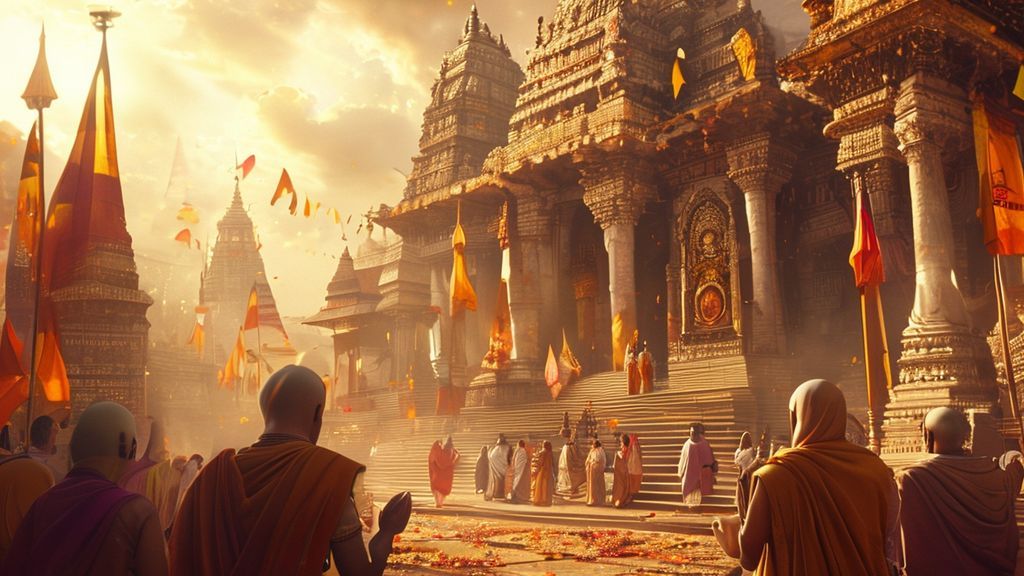
The Hindu Vote Bank is not merely a political calculus but a profound spiritual awakening and collective consciousness of Hindus uniting to uphold Sanatan Dharma and safeguard Bharata’s ancient civilizational values. It represents a sacred resolve to elect leadership committed to preserving our heritage, promoting Dharmic governance, and ensuring the resurgence of our Indic identity in the public sphere.
| Attribute | Details |
|---|---|
| Guiding Principle | Dharma Raksha (Protection of Righteousness) and Rashtra Nirman (Nation Building) |
| Philosophical Root | Ekatmata (Unity of Consciousness) among diverse Hindu traditions |
| Key Objective | Establishment of Dharma Rajya (Righteous Governance) |
| Scripture Reference | Manu Smriti (Chapter 7 on Raja-dharma), Mahabharata (Shanti Parva on governance), Arthaśāstra (principles of statecraft) |
The Sacred Imperative of Collective Consciousness
In the vast tapestry of Sanatan Dharma, the concept of collective action for the preservation of righteousness, or Dharma Raksha, is not a modern political invention but an eternal principle. The burgeoning awareness of a “Hindu Vote Bank” transcends mere electoral mathematics; it signifies a profound reawakening of civilizational consciousness, a collective resolve amongst Hindus to safeguard their spiritual heritage, cultural identity, and the very future of Bharatavarsha. For millennia, our ancestors understood that the health of the individual (vyakti) is inseparable from the health of society (samaj) and the nation (rashtra). This awakening is a spiritual mobilization, a call to Rashtradharma, where every vote cast becomes an act of devotion, a yajna for the nation.
This devotional engagement stems from a deep understanding that politics, when guided by Dharma, becomes a tool for societal upliftment and spiritual progress. It seeks not to dominate but to ensure that the principles of Sanatan Dharma—truth, justice, harmony, and respect for all life—are reflected in governance. It is a quest for Ram Rajya, an ideal state where Dharma reigns supreme, ensuring peace and prosperity for all. The Hindu Vote Bank, therefore, is the manifestation of a united Hindu voice seeking to restore the glory of Bharat and protect the invaluable legacy of Sanatan Dharma for future generations, countering centuries of external aggression and internal fragmentation.
Itihasa and the Genesis of Dharmic Mobilization
The concept of collective Hindu action for Dharma is deeply embedded in our Itihasas and Puranas. It is not a novel phenomenon but a cyclical resurgence throughout history whenever Adharma threatened the fabric of our civilization. The very narrative of the Ramayana, particularly the epic battle of Lanka, depicts a massive mobilization of forces, led by Prabhu Rama, aided by Vanara Sena and Rishis, against the tyrannical rule of Ravana. This was a collective effort to restore Dharma, where every participant, from Lakshmana to a humble squirrel, contributed to a common, righteous cause. This epic illustrates the power of a united front for Dharma, guided by divine will.
Similarly, the Mahabharata, specifically the Kurukshetra war, recounts the monumental struggle between Dharma and Adharma. Despite the complexity, the ultimate victory of the Pandavas, guided by Sri Krishna, underscored the necessity of unwavering commitment to righteousness, even when facing formidable adversaries. The sages and kings of ancient Bharat consistently formed alliances and mobilized their communities when external threats or internal decay jeopardized Dharmic order. The Skanda Purana, in its numerous accounts of divine interventions and human endeavors, consistently highlights instances where communities united in devotion and action to protect sacred spaces, traditions, and the overall spiritual health of the land. These narratives serve as eternal blueprints for the present-day Hindu awakening, emphasizing that safeguarding Dharma is a shared responsibility, a sacred duty of every Hindu.
The Foundational Pillars: Architecting a Dharmic Society
While we are not discussing a physical temple, the principles guiding the “Hindu Vote Bank” are akin to the meticulous architecture of a grand temple, built on solid foundations, intricate designs, and profound symbolism. The architecture of a Dharmic society, which ultimately gives rise to a united Hindu voice, is structured upon time-tested principles enunciated in our scriptures. The Manusmriti, often misconstrued, offers foundational insights into Raja-dharma (the Dharma of the ruler) and Praja-dharma (the Dharma of the subjects). It outlines a societal structure where governance is intrinsically linked to righteousness, and rulers are expected to embody and uphold Dharma, acting as guardians of their people’s spiritual and material well-being.
The Arthaśāstra of Kautilya, a pragmatic treatise on statecraft, also emphasizes the critical role of Dharma in governance, stating that a king’s primary duty is the welfare of his subjects (Prajā-sukhe sukham rājñaḥ, prajānāṁ cha hite hitam). This implies that a ruler who aligns with Dharmic values naturally garners the support of a Dharmic populace. The “Hindu Vote Bank” is thus an organic outgrowth of these architectural principles of a righteous society, where the collective consciousness of Hindus seeks to elect leaders who understand and respect this foundational structure. It is a reaffirmation of the idea that Bharatavarsha is a Punya-Bhumi, a sacred land whose very identity is intertwined with Sanatan Dharma. The construction of a Dharmic nation is a continuous process, requiring vigilance, unity, and adherence to these ancient blueprints, accessible for deeper study on Hindutva.online.
The Sadhana of Sanatan Rashtra: Steps Towards Dharmic Engagement
Engaging with the “Hindu Vote Bank” is not merely about casting a ballot; it is a profound Sadhana, a spiritual practice for the preservation of Sanatan Rashtra. It requires conscious effort, self-reflection, and unwavering commitment to Dharma. Here is a metaphorical “Puja Vidhi” for the Dharmic citizen:
- Sankalpa (Intention): Begin with a clear intention that your political engagement is for the greater good of Dharma and the nation. Meditate on the welfare of all beings.
- Svadhyaya (Self-Study & Knowledge): Educate yourself about Sanatan Dharma, its principles, history, and current challenges. Understand the policies and ideologies of various political entities through a Dharmic lens. Discern truth from falsehood.
- Seva (Service): Actively participate in community service, supporting initiatives that uplift Hindu society, protect cows, conserve temples, and promote Hindu education.
- Satsanga (Righteous Association): Associate with like-minded individuals and organizations dedicated to Dharma Raksha. Engage in constructive discussions and debates.
- Vichaar (Deliberation): Carefully analyze the candidates and parties based on their commitment to Dharmic values, national security, economic prosperity, and cultural preservation, rather than narrow self-interest.
- Matdaan (Casting the Vote): Exercise your franchise consciously, viewing it as a sacred duty (Dharma Kartavya) to choose leadership that will uphold justice, truth, and the welfare of all Hindus. This is an offering to the nation.
- Pranama (Reverence & Accountability): Post-election, remain engaged. Offer gratitude for the opportunity to serve Dharma, and hold elected leaders accountable to their promises of Dharmic governance.
Mantras for a United Bharata
Chanting sacred mantras fosters unity, purifies the mind, and invokes divine blessings for righteous governance and national well-being. These chants can be performed individually or collectively to strengthen the resolve of the Hindu Vote Bank:
- For National Harmony and Well-being:
ॐ सर्वे भवन्तु सुखिनः। सर्वे सन्तु निरामयाः। सर्वे भद्राणि पश्यन्तु। मा कश्चित् दुःखभाग् भवेत्॥
Om Sarve Bhavantu Sukhinah | Sarve Santu Niramayah | Sarve Bhadrani Pashyantu | Maa Kaschit Dukha Bhag Bhavet ||
(May all be happy. May all be free from illness. May all see what is auspicious. May no one suffer.) - For Righteous Leadership and Truth:
सत्यमेव जयते नानृतम्
Satyameva Jayate Nanritam
(Truth alone triumphs, not untruth – from Mundaka Upanishad) - For Unity and Collective Strength:
सह नाववतु । सह नौ भुनक्तु । सह वीर्यं करवावहै । तेजस्वि नावधीतमस्तु मा विद्विषावहै ॥
Sahana Vavatu | Saha Nau Bhunaktu | Saha Viryam Karavavahai | Tejasvi Navadhitamastu Ma Vidvishavahai ||
(May we all be protected together. May we all be nourished together. May we work together with great energy. May our study be enlightening, and may no enmity arise between us.) - The National Mantra:
वन्दे मातरम्
Vande Mataram
(I bow to the Mother – a hymn to Mother India)
Dos and Don’ts for Dharmic Political Engagement
To ensure the “Hindu Vote Bank” remains a force for Dharma and not merely partisan politics, certain principles must be observed:
- Dos:
- Do prioritize Dharma above all else in your political decisions.
- Do seek knowledge and engage in informed discussions.
- Do support leaders and parties that genuinely work for the preservation of Hindu culture, traditions, and national integrity.
- Do exercise your right to vote conscientiously, viewing it as a sacred duty.
- Do promote unity among various Hindu sects and communities.
- Do contribute to national prosperity and security through your actions.
- Don’ts:
- Don’t engage in divisive or hateful rhetoric, which goes against Dharmic principles.
- Don’t prioritize personal gain or sectarian interests over the broader good of Dharma and the nation.
- Don’t remain apathetic or disengaged from the civic process.
- Don’t fall prey to propaganda or misinformation; verify facts diligently.
- Don’t allow political differences to erode the fundamental unity of Hindus.
Is the “Hindu Vote Bank” against Secularism?
True Indian secularism, derived from the concept of “Sarva Dharma Sama Bhava” (equal respect for all paths), implies neutrality of the state towards all religions, not an anti-religious stance. The “Hindu Vote Bank” seeks to ensure that the unique civilizational identity and legitimate concerns of the Hindu majority are not marginalized or discriminated against in the name of a distorted secularism. It advocates for righteous governance that respects and protects all Dharmic traditions, including its own foundational Sanatan Dharma, thereby enriching the nation’s spiritual landscape. It is about a fair playing field for all, not dominance.
Is the “Hindu Vote Bank” solely about Elections?
No, the “Hindu Vote Bank” is a broader phenomenon than just electoral cycles. It represents a continuous cultural and spiritual awakening. While elections are a crucial mechanism for expressing collective will, the “Vote Bank” encompasses ongoing efforts in education, cultural preservation, social reform, and advocacy for Dharmic values in public discourse. It is a long-term commitment to strengthen Hindu society and ensure the perpetuation of Sanatan Dharma for generations to come, as championed by organizations and thinkers associated with Hindutva.online.
How does the “Hindu Vote Bank” benefit Sanatan Dharma?
By uniting Hindus on shared Dharmic principles, the “Hindu Vote Bank” empowers the community to collectively advocate for policies that protect temples, promote Hindu education, safeguard ancient traditions, and ensure respect for Hindu sentiments. It helps counter historical injustices and ensures that the rich heritage of Sanatan Dharma receives due recognition and protection within the nation. It fosters an environment where Dharma can flourish, benefiting not just Hindus but the entire nation by promoting ethical governance and societal harmony.
The Eternal Relevance of Sanatan Dharma for Bharat’s Future
The rise of the “Hindu Vote Bank” is a testament to the enduring power and eternal relevance of Sanatan Dharma in guiding the destiny of Bharat. It is not merely a transient political phenomenon but a deep-seated aspiration for a renewed Dharma Rajya, a governance system rooted in righteousness, justice, and the welfare of all beings. For every Hindu, this collective awakening carries immense significance. It is a call to recognize one’s individual responsibility in upholding the collective Dharma, to participate actively in shaping a future where the spiritual and cultural identity of Bharat is not merely preserved but thrives.
The future of Bharat, the repository of Sanatan Dharma, rests on the conscious choices made by its people. By uniting through this Dharmic consciousness, Hindus are ensuring that the profound wisdom of our Rishis, the sacrifices of our ancestors, and the timeless principles of truth and righteousness continue to guide our nation. This is not an act of aggression but an act of self-preservation and a profound declaration of faith in the civilizational mission of Bharat for the well-being of the entire world. It is the sacred duty of every Hindu to contribute to this national spiritual renaissance, ensuring that Bharata shines forth as a beacon of Dharma for humanity in this age of Kali.