


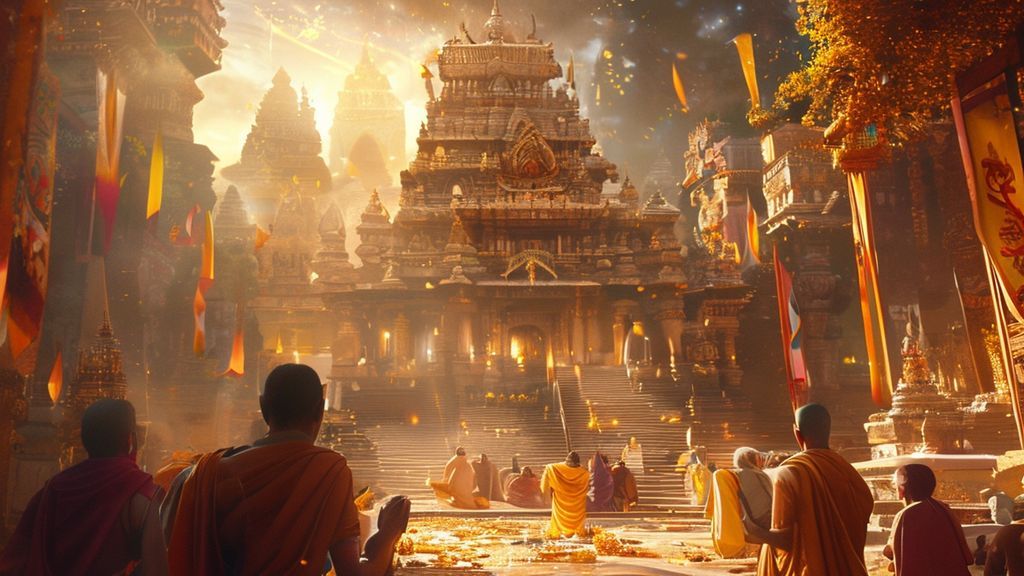
Hinduism and Buddhism, though sharing a common Indic heritage, diverged fundamentally on core philosophical tenets, primarily the nature of the Self (Atman), the authority of the Vedas, and the existence of a permanent, ultimate reality (Brahman). While both seek liberation from suffering, their paths and ultimate understandings of that liberation are distinct and irreconcilable in many aspects.
| Key Doctrinal Point | Sanatan Dharma (Hinduism) | Buddhism |
|---|---|---|
| **Concept of Self** | **Ātman** (eternal, unchanging soul, identical with Brahman). As stated in **Brihadaranyaka Upanishad 4.4.5**, “The Self (Atman) is indeed Brahman.” | **Anattā** (no-self, impermanence of the individual soul/ego). All phenomena are composite and transient. |
| **Authority of Vedas** | **Śruti** (revealed texts) are eternal, infallible, and the ultimate source of Dharma. All schools must ultimately conform to Vedic principles. | Rejects Vedic authority, rituals, and the caste system based on birth. Emphasizes individual experience and reason. |
| **Ultimate Reality** | **Brahman** (impersonal Absolute, Saguna/Nirguna), the supreme, eternal, all-pervading reality, the source of all existence. | **Nirvana** (cessation of suffering and individual existence), often described in negative terms, not as a metaphysical ultimate reality in the Vedic sense. |
| **Path to Liberation** | Varies (Jnana Yoga, Bhakti Yoga, Karma Yoga, Raja Yoga), often involving devotion, Vedic rituals, study, and meditation to realize **Moksha** (union with Brahman). | **Eightfold Path** (right view, intention, speech, action, livelihood, effort, mindfulness, concentration) leading to **Nirvana**. |
| **Divine Beings / Devas** | Vedic pantheon of Devas (Indra, Agni, Surya, Vishnu, Shiva, Devi) are integral to the cosmos, worshipped through rituals and mantras. They are aspects of Brahman. | Devas exist but are subject to suffering and rebirth, not eternal saviors. Focus is on self-effort, not propitiation of deities. |
The Eternal Dharma and the Emergence of Heterodox Views
Sanatan Dharma, the timeless and eternal path, has always championed a rich tapestry of philosophical inquiry, evolving traditions, and diverse spiritual practices, all rooted in the immutable wisdom of the Vedas. It recognizes the plurality of paths leading to the One Truth, as echoed in the **Rig Veda (1.164.46)**: “Ekam Sat Vipra Bahudha Vadanti” – “Truth is one, though the sages call it by many names.” Within this vast framework, however, certain core principles have remained unyielding, notably the authority of the Vedas, the permanence of the Atman (individual Self), and the ultimate reality of Brahman.
The advent of Buddhism in the 6th century BCE, spearheaded by Siddhartha Gautama, the Buddha, marked a significant intellectual and spiritual divergence from the prevailing Vedic thought of the time. While born into an Indic milieu and sharing ethical commonalities like Karma and Ahimsa, Buddhism presented a distinct philosophical system that critically challenged foundational Vedic tenets. This guide will illuminate these crucial points of departure, helping sincere seekers understand the profound differences that define these two traditions. Our exploration delves into the heart of these distinct worldviews, recognizing that while both traditions promote compassion and ethical living, their metaphysical underpinnings and ultimate goals diverge significantly from the Vedic path upheld by Hindutva.online.
The Historical and Philosophical Context of Divergence
The period preceding the Buddha’s lifetime was one of intense intellectual ferment in ancient India. The Upanishads had already begun to shift focus from purely external Vedic rituals to internal spiritual realization, emphasizing the oneness of Atman and Brahman. Yet, there were also burgeoning Sramana movements – ascetic traditions that often questioned the efficacy of Vedic rituals and the socio-religious order. Buddhism emerged from this vibrant landscape, taking inspiration from the ascetic traditions but forging its own unique path.
While some Puranic traditions, such as the **Bhagavata Purana (1.3.24)**, include the Buddha as an incarnation of Vishnu, this is a later syncretic inclusion, largely interpreted within Hinduism as a divine strategem to lead astray those who reject Vedic authority, or to preach compassion to prevent excessive ritualistic animal sacrifices. It does not imply a philosophical alignment. The core teachings of the Buddha were a radical departure, not merely a reform, from the Vedic worldview. The Buddha, a historical figure, sought to address suffering directly through observable phenomena and experience, rather than through metaphysical speculation on an eternal Self or an ultimate reality like Brahman, which he considered unprovable and irrelevant to the immediate task of ending suffering.
Core Philosophical Differences: Atman, Brahman, and Anatta
The most profound chasm between Sanatan Dharma and Buddhism lies in their respective understandings of the Self and Ultimate Reality.
The Vedic Concept of Atman and Brahman
In Hinduism, the **Atman (आत्मान्)** is the eternal, immutable, transcendental Self, the core of one’s being. It is not the body, mind, or ego, but the pure consciousness that observes them. The Upanishads declare the profound truth of **”Aham Brahma Asmi” (अहं ब्रह्मास्मि)** – “I am Brahman,” and **”Tat Tvam Asi” (तत्त्वमसि)** – “Thou art That.” This means the individual soul (Atman) is not separate from the ultimate reality (Brahman), the all-pervading, timeless, spaceless, and attributeless ground of all existence. Realizing this oneness, as expounded in texts like the **Mandukya Upanishad**, is the pinnacle of spiritual realization, leading to Moksha. Brahman is the source and sustainer of the entire cosmos, both manifest (Saguna Brahman) and unmanifest (Nirguna Brahman), as elaborated extensively in the **Vedanta Sutras**.
The Buddhist Doctrine of Anatta (No-Self)
In stark contrast, the Buddha taught **Anattā (अनत्ता)**, the doctrine of no-self. He asserted that there is no permanent, unchanging essence or soul within an individual. What we perceive as “self” is merely a transient aggregation of five impermanent skandhas (forms, feelings, perceptions, mental formations, consciousness). These are constantly arising and ceasing, like a river that is never the same from moment to moment. This radical view directly rejects the Upanishadic Atman. For the Buddha, clinging to the idea of a permanent self is a root cause of suffering. There is no Atman to realize as Brahman; instead, liberation comes from understanding the impermanence and non-self nature of all phenomena.
Karma, Rebirth, and Moksha vs. Nirvana
Both traditions embrace the concepts of **Karma (कर्म)** (action and its consequences) and **Samsara (संसार)** (the cycle of rebirth). However, their understanding of what is reborn and what constitutes liberation differs.
Karma and Rebirth in Sanatan Dharma
In Hinduism, it is the Atman, clad in subtle bodies, that transmigrates from one physical form to another, carrying the imprints of past actions (Karma). The goal is **Moksha (मोक्ष)** – liberation from Samsara, achieved by realizing the Atman’s true nature as Brahman. This involves a profound ontological shift, a realization of eternal truth, not merely the cessation of suffering. The **Bhagavad Gita (2.20)** beautifully states about the Atman: “Na jayate mriyate va kadachin…” (It is not born, nor does it ever die…).
Karma and Rebirth in Buddhism and the Goal of Nirvana
Buddhism, without an Atman, explains rebirth as a continuous stream of consciousness or a causal continuum. It’s like one candle flame lighting another – the second flame is dependent on the first but is not identical to it. The “being” that is reborn is a new aggregation of skandhas, influenced by the Karma of the previous aggregation. The ultimate goal is **Nirvana (निर्वाण)** – the cessation of suffering (Dukkha), the extinguishing of craving (Tanha), and the breaking of the cycle of rebirth. Nirvana is not described as a state of union with an ultimate reality, but rather as the complete absence of suffering and the conditions for suffering.
The Role of Devas, Rituals, and Scriptures
Another significant point of divergence lies in their approach to divine beings, sacrificial rituals, and the authority of sacred texts.
Devas and Vedic Authority in Sanatan Dharma
Sanatan Dharma reveres a vast pantheon of **Devas (देवा)** and **Devis (देवी)** – divine beings such as Vishnu, Shiva, Devi, Indra, Agni, Surya – who are considered manifestations or aspects of the one Brahman. They play crucial roles in maintaining cosmic order (Rta) and are worshipped through elaborate **Yajnas (यज्ञ)** (sacrifices), **Pujas (पूजा)** (worship), and **Mantras (मन्त्र)**. The **Vedas (वेद)** – Rig Veda, Sama Veda, Yajur Veda, Atharva Veda – are considered **Śruti (श्रुति)**, revealed texts of eternal truth, whose authority is paramount and unquestionable for all orthodox Hindu schools. Adherence to Vedic injunctions and the performance of prescribed rituals are often considered essential for spiritual progress and the well-being of the cosmos.
Buddhist Perspective on Devas and Vedic Rejection
Buddhism largely de-emphasizes the role of Devas. While celestial beings exist within Buddhist cosmology, they are not seen as saviors or objects of ultimate refuge. They are themselves subject to Karma and rebirth, not eternal, omnipotent creators. The Buddha explicitly rejected the authority of the Vedas, viewing them as man-made texts. He also critiqued the efficacy of elaborate Vedic rituals, particularly animal sacrifices, asserting that liberation comes through personal effort, ethical conduct, and meditation, not through external rites or priestly intervention. This fundamental rejection of Vedic authority makes Buddhism an **Ānāstika (अनास्तिक)** or heterodox school from a Hindu perspective.
Ethical Frameworks and Practices
While both traditions share a strong emphasis on ethics, their foundational reasons and specific practices differ.
Dharmic Principles and Practices
Hinduism emphasizes **Dharma (धर्म)**, the cosmic law and individual duty, encompassing ethical conduct, righteous living, and spiritual practices tailored to one’s station (Varna) and stage of life (Ashrama). Key ethical tenets include **Ahimsa (अहिंसा)** (non-violence), Satya (truthfulness), Asteya (non-stealing), Brahmacharya (continence), and Aparigraha (non-possessiveness). Practices include Yoga, meditation, devotion (Bhakti), ritual worship, and philosophical study. The ultimate goal is self-realization and union with the Divine.
The Buddhist Eightfold Path
Buddhism’s ethical framework is encapsulated in the **Noble Eightfold Path**, focusing on Right View, Right Intention, Right Speech, Right Action, Right Livelihood, Right Effort, Right Mindfulness, and Right Concentration. These are practical guidelines for extinguishing craving and achieving Nirvana. While sharing principles like Ahimsa and compassion, the Buddhist path is often more prescriptive in its monastic discipline and focused on a direct, empirical approach to ending suffering.
Frequently Asked Questions
Is Buddha considered an Avatar in Hinduism?
Yes, some Puranas, like the **Bhagavata Purana**, list Buddha as the ninth of the ten principal Avatars of Vishnu. However, this inclusion is often interpreted as a divine strategy to either lead those astray who reject Vedic authority, or to preach compassion to prevent excessive violence, rather than an endorsement of Buddhist philosophy from a purely Vedic standpoint. It’s a Hindu absorption and reinterpretation, not an acceptance of Buddhist tenets.
Do Hindus and Buddhists worship the same gods?
No. While some figures like Indra or Brahma appear in Buddhist cosmology, they are generally presented as devas who are themselves subject to samsara and are not objects of ultimate refuge or worship in the same way as in Hinduism. Buddhists primarily revere the Buddha, Bodhisattvas, and the Dharma, not the Vedic Devas as supreme beings.
What is the main reason for the divergence between Hinduism and Buddhism?
The fundamental divergence stems from their differing metaphysical views on the **Atman (eternal Self)** and **Brahman (ultimate reality)** versus the Buddhist doctrine of **Anatta (no-self)** and the focus on **Nirvana** as the cessation of suffering without positing an ultimate metaphysical reality. The authority of the Vedas is another critical point of separation.
Preserving Sanatan Dharma’s Timeless Wisdom
Understanding these profound divergences is essential for every sincere seeker and devotee to appreciate the unique, eternal wisdom of Sanatan Dharma. The Vedic tradition, with its robust philosophy of the Atman and Brahman, its rich pantheon of Devas, its emphasis on dharma, karma, and moksha, and its unwavering faith in the revealed truths of the Vedas, offers a complete and unassailable path to ultimate liberation. It is this glorious heritage that Hindutva.online strives to elucidate and preserve, ensuring that the timeless light of Vedic knowledge continues to guide humanity. The distinction is not merely academic; it defines fundamentally different approaches to life, reality, and the path to spiritual freedom.