


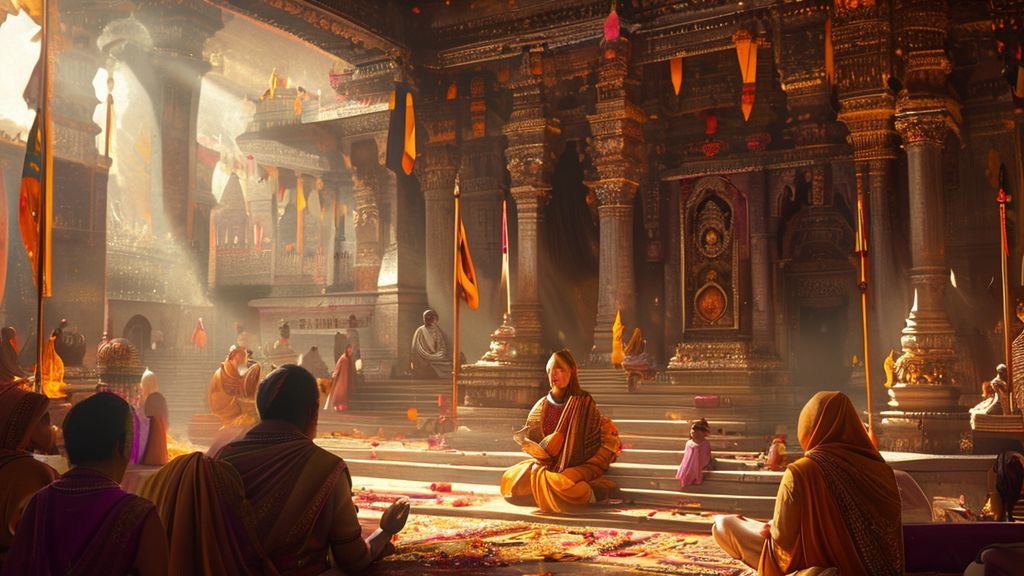
Hindustani Music, the revered North Indian classical music system, is a profound spiritual discipline rooted in Sanatan Dharma, an ancient sonic tradition evolving from Vedic chants and devotional practices. It embodies the pursuit of Nada Brahma through intricate Ragas (melodic frameworks) and Talas (rhythmic cycles), serving as a path to self-realization and divine communion.
| Attribute | Details |
|---|---|
| Origin | Ancient India, primarily North Indian subcontinent; developed from Vedic chanting and devotional traditions. |
| Key Elements | Raga (melodic mode), Tala (rhythmic cycle), Shruti (microtonal intervals), Alap (unmetered improvisation), Bandish (composition). |
| Core Philosophy | Nada Yoga – union with the Divine through sound; music as a path to moksha (liberation) and spiritual awakening. |
| Scripture Reference | Samaveda, Natya Shastra, Brihaddeshi, Sangeet Ratnakara, various Puranas. |
| Prominent Gharanas | Gwalior, Agra, Kirana, Patiala, Rampur-Sahaswan, Jaipur-Atrauli (for vocal); Maihar, Senia (for instrumental). |
The Resonance of the Divine: An Introduction to Hindustani Classical Music
Hindustani Music is not merely an art form; it is a profound spiritual journey, a sonic expression of the infinite, and a cornerstone of Sanatan Dharma. For millennia, the sacred sounds, or Nada, have been a medium for connecting with the divine, a path to self-realization, and a vehicle for expressing the deepest human emotions. This majestic tradition, primarily flourishing across the North Indian subcontinent, represents an unbroken lineage of knowledge passed down from Guru to Shishya, embodying the very essence of spiritual discipline and artistic mastery.
At its heart, Hindustani classical music seeks to elevate consciousness. Its intricate melodic structures, known as Ragas (राग), and complex rhythmic patterns, or Talas (ताल), are not arbitrary constructions but carefully crafted frameworks designed to evoke specific moods, invoke deities, and resonate with the cosmic energies of different times of day or seasons. Each note, each phrase, each subtle microtone (Shruti) is imbued with spiritual significance, guiding the devotee towards an inner stillness where the sound of the universe, Nada Brahma (नाद ब्रह्म), can be perceived. It is through this sublime art that one can experience the omnipresence of the Divine.
Puranic History & The Divine Origins of Nada
The genesis of Hindustani Music is inextricably linked to the sacred texts and mythological narratives of Sanatan Dharma. Its roots are traced back to the Samaveda (सामवेद), one of the four Vedas, which contains hymns set to musical notations – the earliest known systematic musical forms in human history. These Vedic chants, known as Samagana, were not just recitations but intricate melodic structures intended to invoke specific deities and manifest cosmic powers. The very act of chanting was a spiritual sacrifice, a Yajna of sound.
Puranic lore abounds with stories of divine musicians and celestial beings who pioneered the art of music. Narada Muni, the divine sage, is often hailed as the primordial master of music, capable of traversing the three worlds while singing praises of Vishnu. The Bhagavata Purana and Vishnu Purana narrate his cosmic journeys, always accompanied by his Veena, demonstrating music as a tool for devotion and communication with the gods. Similarly, Tumburu, another Gandharva (celestial musician), is celebrated for his unparalleled vocal prowess. Lord Shiva Himself is depicted as Nataraja, the cosmic dancer, whose rhythmic movements produce the primal sound and rhythm of creation, embodying the dynamic interplay of Raga and Tala.
The theoretical foundations of Indian classical music were meticulously codified by ancient Rishis and scholars. Bharata Muni’s Natya Shastra (नाट्यशास्त्र), dated between 200 BCE and 200 CE, serves as the earliest comprehensive treatise on performing arts, including detailed sections on music, dramaturgy, and dance. It describes the concept of *jati* (precursor to Raga), *swaras* (notes), and *talas* with remarkable precision. Later works like Matanga’s Brihaddeshi (9th century CE) further elaborated on the concept of Raga, defining it as that which “colors the mind.” The monumental Sangeet Ratnakara by Sharngadeva (13th century CE) is another encyclopedic text, often called “the ocean of music,” which meticulously documents the theoretical and practical aspects of Indian music, preserving knowledge that forms the bedrock of both Hindustani and Carnatic traditions. These scriptures not only detail musical theory but also emphasize the spiritual efficacy of Nada, establishing music as a path to realization, a true Nada Yoga (नादयोग).
The Architectural Science of Nada: Raga, Tala, and Shruti
The structure of Hindustani Music is a marvel of intricate design and profound scientific precision, akin to the meticulously crafted temples that stand as testaments to our spiritual heritage. Unlike Western classical music based on tempered scales, Hindustani music thrives on the subtle nuances of Shruti (श्रुति) – microtonal intervals, often described as 22 perceptible microtones within an octave, though their practical application is much more fluid. These Shruti are not just smaller notes; they are the “spirit” of the notes, giving each Raga its unique emotional contour and character. A change in a single Shruti can completely alter the mood and identity of a Raga, much like a subtle alteration in a temple’s carving can change its devotional impact.
A Raga is far more than a scale; it is a melodic personality, a living entity endowed with specific ascending (Aroh) and descending (Avaroh) patterns, a predominant note (Vadi), and a secondary important note (Samvadi). It possesses characteristic phrases (Pakad) and evokes a particular emotional flavor (Rasa) and spiritual mood (Bhava). The selection of a Raga is deeply tied to the time of day, season, or even specific festivals, aligning human consciousness with cosmic rhythms. For instance, Raga Bhairav is associated with the morning and invokes solemnity and devotion, while Raga Malkauns is a late-night Raga, evoking tranquility and introspection.
Complementing the Raga is the Tala, the rhythmic framework that provides the pulse and structure. Talas are complex cycles, not mere beats, comprising specific divisions (Vibhags) and accents (Sam). Popular Talas like Teentaal (16 beats), Ektaal (12 beats), and Roopak Taal (7 beats) demonstrate mathematical precision and rhythmic ingenuity. The interplay between the fixed rhythmic cycle and the improvisational melodic lines creates a dynamic tension and release, leading the listener through a journey of sonic exploration. The mastery of Tala is a deep meditation in itself, requiring immense focus and understanding of cyclic time, reflecting the cyclical nature of creation and destruction in Hindu cosmology.
The Sadhana of Swara: Practice and Pedagogy
Learning Hindustani Music is a sacred discipline, a Sadhana (साधना) that requires unwavering dedication, humility, and profound respect for the tradition. The Guru-Shishya Parampara (गुरु-शिष्य परम्परा), the ancient tradition of spiritual and intellectual lineage, is the bedrock of this transmission of knowledge. The student (Shishya) lives with or dedicates themselves entirely to the Guru (teacher), not just learning music but imbibing the Guru’s wisdom, discipline, and way of life. This immersive education ensures the continuity of the tradition and the purity of its spiritual essence.
Stages of Musical Sadhana:
- Swara Sadhana (Note Practice): Rigorous practice of individual notes (Sa, Re, Ga, Ma, Pa, Dha, Ni) to achieve perfect pitch and clarity. This forms the foundation of all vocal and instrumental training.
- Alankars & Palte (Exercises): Systematic melodic patterns that develop vocal agility, breath control, and an understanding of Raga aesthetics.
- Raga Vistar (Raga Elaboration): Learning the structure, characteristic phrases, and emotional essence of different Ragas through extensive improvisation (Alap, Jod, Jhala) and composed pieces (Bandish, Gat).
- Tala Practice: Mastering complex rhythmic cycles through hand gestures (Kriyas), rhythmic chanting (Bol-s), and instrumental practice.
- Riyaz (Daily Practice): The lifelong commitment to daily practice, a form of spiritual austerity, essential for refining one’s artistry and deepening one’s connection to Nada.
Every practice session, every performance, is an offering, a Puja to Saraswati, the Goddess of knowledge and arts. This journey transforms the musician, refining their mind, body, and spirit, making music an integral part of their spiritual quest. More information on the spiritual aspects of this tradition can be found on Hindutva.online.
Mantras & Chants for Musical Devotion
Devotion to the divine through sound is central to Hindustani music. Here are some significant invocations:
- Saraswati Vandana:
या कुन्देन्दुतुषारहारधवला या शुभ्रवस्त्रावृता ।
या वीणावरदण्डमण्डितकरा या श्वेतपद्मासना ॥
या ब्रह्माच्युतशंकरप्रभृतिभिर्देवैः सदा वन्दिता ।
सा मां पातु सरस्वती भगवती निःशेषजाड्यापहा ॥(Ya Kundendu Tushar Har Dhavala, Ya Shubhra Vastravrita |
Ya Veena Varadanda Manditakara, Ya Shweta Padmasana ||
Ya Brahmachyuta Shankara Prabhrutibhir Devaih Sada Vandita |
Sa Mam Patu Saraswati Bhagawati Nihshesh Jadyapaha ||)Meaning: May Goddess Saraswati, who is white like a jasmine, adorned with a garland of snow-white pearls, dressed in pure white garments, whose hands are adorned with a Veena, who is seated on a white lotus, and who is ever adored by Brahma, Vishnu, and Shiva, protect me and remove all my ignorance.
- Om Nada Brahma: A fundamental chant recognizing the universe as pure sound, the ultimate reality.
- Guru Mantra:
गुरुर्ब्रह्मा गुरुर्विष्णुः गुरुर्देवो महेश्वरः ।
गुरुः साक्षात् परब्रह्मा तस्मै श्री गुरवे नमः ॥(Gurur Brahma Gurur Vishnu, Gurur Devo Maheshwara |
Guru Sakshat Param Brahma, Tasmai Shri Gurave Namah ||)Meaning: The Guru is Brahma, the Guru is Vishnu, the Guru is Lord Maheshwara (Shiva). The Guru is verily the supreme Brahman. Salutations to that revered Guru.
Dos and Don’ts for the Devoted Musician and Listener
- DO:
- Approach music with reverence and humility, recognizing its spiritual origins.
- Seek instruction from a qualified Guru within the Guru-Shishya Parampara.
- Practice daily (Riyaz) with dedication and focus, treating it as a spiritual offering.
- Listen attentively and respectfully to performances, appreciating the nuances and devotion.
- Understand the appropriate time and season for each Raga.
- Support and encourage artists and traditional institutions dedicated to preserving this heritage.
- DON’T:
- Treat classical music merely as entertainment; acknowledge its deeper purpose.
- Disrespect the Guru, the tradition, or the art form through casual or irreverent behavior.
- Attempt to perform a Raga without proper understanding of its structure and emotional essence.
- Interrupt a performance or engage in distracting activities during a concert.
- Dilute the purity of the Ragas or Talas for commercial gain without a profound understanding of tradition.
Frequently Asked Questions About Hindustani Music
What is the difference between Hindustani and Carnatic music?
While both stem from ancient Indian traditions, Hindustani (North Indian) and Carnatic (South Indian) music diverged around the 13th-14th centuries due to various socio-political influences, including the Persian and Mughal presence in the North. Hindustani music emphasizes improvisation (Alap, Jod, Jhala), has a more flexible Raga structure, and uses instruments like Sitar, Sarod, Tabla. Carnatic music is more composition-oriented, with less scope for individual improvisation within a performance, and uses instruments like Veena, Mridangam, Violin.
Can anyone learn Hindustani Classical Music?
Yes, absolutely. While it demands immense dedication and patience, the spiritual and intellectual rewards are profound. Beginning with basic Swara Sadhana under the guidance of a Guru is the ideal path. Age is no barrier to embarking on this sacred journey of sound. Many devotees find solace and spiritual growth through its disciplined practice.
How does Hindustani Music promote spiritual well-being?
Hindustani Music, through Nada Yoga, helps align the mind, body, and spirit. The focused practice of Ragas and Talas cultivates concentration, discipline, and emotional balance. The specific vibrations of Ragas are believed to influence the chakras and subtle energies of the body, leading to inner peace, reduced stress, and heightened spiritual awareness, ultimately facilitating a connection to the divine consciousness.
The Eternal Resonance: Why Hindustani Music Matters for Sanatan Dharma
Hindustani Music is more than a cultural treasure; it is a living embodiment of Sanatan Dharma itself. It reminds us that the entire cosmos is a manifestation of sound, a divine symphony. By engaging with this ancient art form, either as a practitioner or an appreciative listener, we are not merely enjoying melodies and rhythms; we are participating in a timeless ritual, a sonic pilgrimage towards the ultimate truth. The preservation and promotion of Hindustani classical music are therefore not just academic or aesthetic endeavors, but a vital service to Sanatan Dharma, ensuring that future generations can continue to experience the transformative power of Nada. This profound tradition offers a unique pathway to spiritual awakening, affirming that the path to the divine can indeed be sung, played, and deeply felt. Explore more about our rich heritage at Hindutva.online.