

How Did Hanuman Get His Powers Lord Hanuman stands among Hinduism’s most beloved and powerful deities—revered for his superhuman strength, ability to change size at will, immortality, mastery over eight mystical siddhis (supernatural powers), unwavering devotion to Lord Rama, and his eternal role as protector of devotees across all ages.

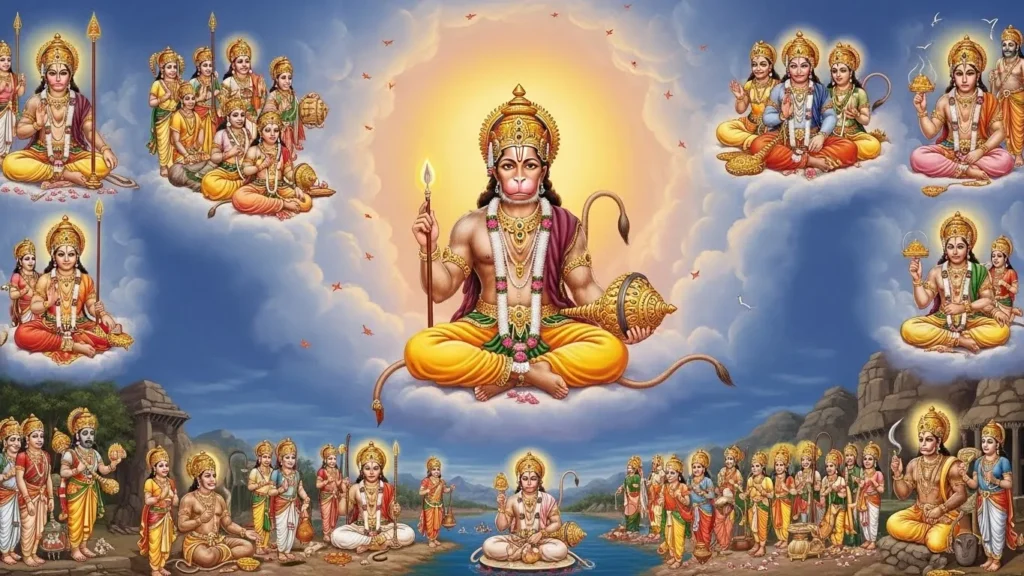
Yet the question naturally arises: how did this monkey-faced deity acquire such extraordinary abilities that enabled him to leap across oceans, lift entire mountains, survive being struck by Indra’s thunderbolt, burn the golden city of Lanka, and remain immortal across yugas? The answer lies in a remarkable combination of divine birth, childhood miracles, and blessings from virtually every major deity in the Hindu pantheon following a dramatic incident that would shape his destiny forever.
Hanuman’s powers originated not from a single source but through multiple divine interventions beginning with his miraculous birth to the celestial nymph Anjana and Vayu (the Wind God), continuing through his audacious childhood attempt to swallow the sun—mistaking it for a ripe fruit—which resulted in Indra striking him with the vajra (thunderbolt), and culminating in an unprecedented gathering of gods offering boons to the injured child to appease his enraged father Vayu,
whose strike threatened all life on earth. Additionally, Hanuman is considered the eleventh Rudra avatar—an incarnation of Lord Shiva himself—sent to assist Lord Rama (Vishnu’s avatar) in his mission to defeat Ravana and rescue Sita, which explains his inherent divine nature and connection to cosmic powers beyond those granted through boons alone.
His education under Surya (the Sun God) further refined these raw abilities, teaching him the Vedas, scriptures, and how to harness the eight siddhis that would become instrumental during the Ramayana, while a sage’s curse that made him forget his powers until reminded ensured these immense abilities would be deployed only at the right cosmic moment for righteous purposes rather than childhood mischief.
This comprehensive exploration examines Hanuman’s divine origins, the famous sun-swallowing incident, the specific blessings from each deity, his education and training, the curse of forgotten powers, and the spiritual symbolism behind this extraordinary accumulation of divine gifts.
The Divine Birth: Anjana, Vayu, and Shiva’s Blessing
Hanuman’s birth itself was no ordinary event but the result of divine intervention, celestial curses, and cosmic planning involving multiple deities working in concert.
Anjana: The Cursed Apsara
Hanuman’s mother was Anjana, a celestial nymph (apsara) who had been cursed to live on earth in the form of a vanara (monkey-like being). According to various Puranic accounts, she had been cursed by a sage whom she had offended, condemning her to earthly existence until she gave birth to an incarnation of Lord Shiva.
Anjana married Kesari, a brave and noble vanara king known for his valor and devotion. Despite their happy marriage, they remained childless for years. Desperate to break her curse and fulfill her destiny, Anjana performed intense tapasya (penance) to Lord Shiva, meditating for years in the forests, fasting, and praying for a divine child who would be an avatar of Shiva himself.
The Divine Payasam: Connection to Rama’s Birth
The most fascinating aspect of Hanuman’s birth is its direct connection to Lord Rama’s incarnation. At precisely the time Anjana was deep in meditation, King Dasharatha of Ayodhya was performing the Putrakameshti Yagya—a sacred ritual to beget sons. The sage Rishyasringa conducted the yajna, and from the sacrificial fire emerged a divine being carrying a golden vessel of payasam (sacred pudding).
King Dasharatha distributed this divinely blessed pudding among his three wives: Kausalya, Kaikeyi, and Sumitra. This payasam would result in the birth of Rama, Bharata, Lakshmana, and Shatrughna—the four sons who would restore dharma.
Vayu’s Divine Intervention
However, an extraordinary cosmic synchronicity occurred. According to the Shiva Purana, a celestial bird snatched a portion of the divine payasam from Queen Sumitra’s portion while flying over Ayodhya. As the bird flew southward, Vayu (the Wind God), following Lord Shiva’s divine plan, blew gently, causing the payasam to fall from the bird’s claws directly into the outstretched hands of Anjana, who was meditating nearby.
Anjana, recognizing this as Shiva’s blessing and the answer to her prayers, consumed the divine pudding. Soon after, she conceived and gave birth to Hanuman—a child who would possess the physical form and strength of Vayu, the devotional essence toward Rama (connecting him eternally to Vishnu’s avatar), and the spiritual power of Shiva’s incarnation.
Multiple Parentage: A Divine Mystery
This explains why Hanuman is referred to by multiple names indicating different parentage:
- Anjaneya/Anjaneyan: Son of Anjana (his birth mother)
- Pavanputra/Vayuputra/Maruti: Son of Vayu/Pavan (the Wind God, his spiritual father)
- Kesari Nandan: Son of Kesari (his earthly father)
- Shiva Avatar: The eleventh Rudra incarnation of Lord Shiva
In Hindu theology, such multiple parentage is not contradictory but represents different dimensions of divine manifestation—biological, elemental, devotional, and avatara aspects all contributing to Hanuman’s unique identity.
The Eleventh Rudra Avatar
The Shiva Purana explicitly states that Hanuman is the eleventh Rudra—one of the fierce manifestations of Lord Shiva. The text explains that when Vishnu incarnated as Rama to destroy Ravana and restore dharma, Shiva decided to manifest alongside him to assist in this cosmic mission. Rather than appearing in his usual fearsome form, Shiva took birth as Hanuman—retaining his immense power but channeling it through devotion and service to Rama rather than through destruction.
This explains Hanuman’s inherent divinity, his natural possession of powers that would normally require years of spiritual practice, and his eternal celibacy (brahmacharya)—as Shiva’s fierce energy transmuted into perfect devotional service.
The Sun-Swallowing Incident: Childhood Audacity
The most famous story explaining how Hanuman acquired his multitude of divine blessings involves his audacious childhood attempt to swallow the sun, which triggered a cosmic crisis and unprecedented divine response.
Mistaking the Sun for Fruit
As an infant, Hanuman possessed immense natural strength and curiosity inherited from his divine parentage. One morning, he woke up feeling hungry and looked up at the sky where the sun was rising—glowing orange-red like a ripe mango or other delicious fruit.
In his innocent hunger and with no understanding of cosmic order, Hanuman decided to leap into the sky and grab this “fruit” to satisfy his appetite. Using his innate ability to fly (inherited from Vayu), he soared upward with incredible speed, traveling millions of miles across the sky toward the sun.
The Cosmic Panic
As Hanuman approached and began swallowing the sun, darkness suddenly fell across the three worlds. Day turned to night instantaneously. The sudden disappearance of the sun threw both celestial and earthly realms into chaos—crops stopped growing, nocturnal creatures emerged confused, and the cosmic order governing time, seasons, and life itself began breaking down.
The gods, witnessing this unprecedented crisis, panicked. They rushed to Brahma crying: “A monkey child has swallowed the sun! If he succeeds, all creation will end—plants will die without photosynthesis, the cycle of day and night will collapse, and the universe will freeze in eternal darkness!”
Even Rahu, the demon who causes solar eclipses by periodically swallowing the sun according to Hindu cosmology, attempted to approach the sun during this chaos but fled in terror upon seeing the powerful monkey child already there.
Indra’s Vajra Strike
Indra, the king of gods and protector of cosmic order, immediately acted to stop this catastrophe. He hurled his most powerful weapon—the vajra (thunderbolt), the same weapon that had defeated countless demons and maintained celestial authority for eons.
The vajra struck the infant Hanuman with tremendous force, hitting him on the jaw or chin. The impact sent Hanuman plummeting back to earth, falling unconscious from the sky. He crashed onto a mountainside, his jaw injured and body motionless.
This incident gave Hanuman one of his names: Hanuman itself is sometimes etymologically derived from “Hanu” (jaw) + “man” (one who has), referring to “one with a prominent/injured jaw.”
Vayu’s Strike: The Crisis Escalates
What followed Indra’s attack would prove even more dangerous than Hanuman swallowing the sun.
A Father’s Rage
Vayu, witnessing his beloved son struck down and lying injured, exploded in uncontrollable rage. As the Wind God—essential for all life, weather, breathing, and atmospheric circulation—Vayu possessed the power to make existence impossible for all beings.
In his fury and grief, Vayu decided to go on strike. He withdrew all wind from the three worlds completely. Suddenly:
- No breeze blew to cool the blazing sun
- No rain-bearing clouds could move across the sky
- No breath of air entered the lungs of any living creature
- The atmosphere became stagnant and suffocating
- Heat became unbearable without any cooling wind
- Plants couldn’t perform transpiration
- Ocean currents stopped circulating
The Existential Threat
Within moments, all life across the three worlds began suffocating. Humans, animals, gods, and demons alike gasped for breath that wouldn’t come. The crisis had escalated from temporary darkness to imminent universal death by asphyxiation.
The gods realized their grave error—in stopping Hanuman, they had provoked something far more dangerous: a grieving, enraged father with absolute power over life’s most fundamental requirement—breath itself.
The Divine Boons: Eight Gods Bestow Powers
To resolve the crisis and appease Vayu, the gods gathered around the unconscious Hanuman and offered unprecedented boons—each deity contributing unique powers that would make Hanuman invincible, immortal, and supremely capable.
Brahma’s Boon: Protection from Weapons and Supreme Wisdom
Lord Brahma, the creator, offered the first blessing: “No weapon—divine, celestial, or earthly—shall ever be able to kill you. You will have the ability to change your form at will, becoming as large as a mountain or as small as an insect. You shall possess knowledge and wisdom surpassing even mine, and no curse shall affect you.”
This boon established Hanuman’s invincibility in combat and his shapeshifting abilities that would prove crucial during the Ramayana—shrinking to enter Lanka undetected and expanding to massive size during battles.
Indra’s Boon: Invulnerability to the Vajra
Indra, feeling remorseful for striking the innocent child, declared: “The vajra that struck you shall never harm you again. Your body shall become stronger than my thunderbolt itself. I grant you the power that your death shall occur only by your own will—you cannot be killed against your wishes.”
This boon made Hanuman’s body vajra-like—unbreakable and indestructible—and gave him control over his own lifespan, a crucial component of his eventual immortality.
Varuna’s Boon: Immunity from Water
Varuna, the god of oceans and water, granted: “Water in any form shall never harm you. You shall be immune to drowning, you can survive in the deepest oceans, and water-based weapons shall have no effect upon you.”
This power enabled Hanuman to fearlessly leap across the vast ocean to Lanka and survive any aquatic dangers.
Agni’s Boon: Immunity from Fire
Agni, the god of fire, blessed him: “Fire shall never burn you. You shall be immune to flames, heat shall not affect you, and fire-based weapons cannot injure you.”
This blessing proved crucial when Ravana’s forces set Hanuman’s tail on fire in Lanka—instead of being harmed, Hanuman used the flaming tail to burn down the golden city, turning their attack into Lanka’s destruction.
Vayu’s Boon: Speed and Strength Beyond Measure
Vayu, finally pacified by the gods’ offerings to his son, granted his own blessing: “You shall possess a fraction of my speed—able to move faster than wind itself. Your strength shall be limitless, growing according to need. You shall be able to travel anywhere—across oceans, through the sky, to the heavenly realms—with the swiftness of thought.”
This established Hanuman’s legendary speed and the limitless strength that enabled him to lift the Dronagiri mountain and leap across continents.
Surya’s Boon: Size Manipulation and Future Guru
Surya, the Sun God whom Hanuman had tried to swallow, was impressed by the child’s audacity and granted: “I bestow upon you the power to change your size at will—becoming as large as you desire or as minuscule as an atom. I shall also become your guru and teach you all knowledge when you are ready.”
This promise would later be fulfilled when Hanuman became Surya’s disciple and learned the Vedas and scriptures.
Yama’s Boon: Immortality and Perfect Health
Yama, the god of death, granted the most precious boon: “I grant you freedom from my dominion. You shall be immortal—never aging, never falling to disease, never subject to my rod of chastisement. You shall enjoy perfect health throughout eternity and become one of the Chiranjivis (immortals) who live across all yugas.”
This established Hanuman as one of the eight immortals still believed to be present on earth.
Vishwakarma’s Boon: Safety from All Constructions
Vishwakarma, the divine architect and craftsman of the gods, granted: “No construction, building, weapon, or tool created by me or any other architect shall ever harm you. You shall be safe from all physical structures and mechanical devices.”
This ensured that even the most sophisticated divine weapons and architectural defenses would pose no threat to Hanuman.
Additional Divine Blessings
Various texts mention additional boons from:
- Kubera: Granting eternal happiness and contentment
- Kamadeva: Ensuring complete freedom from sexual desire, cementing his eternal celibacy (brahmacharya)
- Shiva: Blessing him with spiritual wisdom and yoga mastery
- Vishnu: Ensuring his eternal role as devotee and servant of Rama
The cumulative effect of these boons made Hanuman virtually invincible, immortal, extraordinarily powerful, and uniquely equipped for his destiny as Rama’s greatest devotee and servant.
Education Under Surya: Mastering Knowledge and Siddhis
Beyond the boons granted in childhood, Hanuman underwent formal education under the Sun God Surya, acquiring knowledge and mastering the eight mystical siddhis.
Becoming Surya’s Disciple
As Hanuman grew older, his parents Anjana and Kesari sent him to Surya Dev to receive proper education. Hanuman approached the Sun God humbly and requested: “O Surya Deva, please accept me as your disciple and teach me the Vedas, Vedangas, Upanishads, and all scriptural knowledge.”
Surya initially hesitated, saying: “I am always in motion across the sky as ordained by the Almighty. How can I teach you while constantly moving?”
Hanuman replied with extraordinary determination: “I shall position myself in front of you in the sky, facing you while moving backwards at the same speed, so I can always look at you while receiving instruction without impeding your cosmic duty.”
Impressed by this unprecedented dedication, Surya agreed.
The Extraordinary Education
Hanuman mastered the entire corpus of Vedic knowledge in merely 60 hours—a feat that would normally require decades of study. His phenomenal concentration, divine intelligence, and perfect discipline enabled him to absorb vast amounts of complex philosophical, spiritual, and practical knowledge instantaneously.
During this education, Surya taught Hanuman not just theoretical knowledge but also the practical application of the eight siddhis—mystical powers that yogis typically acquire only after lifelong spiritual practice.
Guru Dakshina: Service to Sugriva
When the education was complete, Hanuman asked Surya what guru dakshina (teacher’s fee) he desired. Surya replied: “Teaching a dedicated student like you is reward enough. However, since you insist, I ask only this: please help my spiritual son Sugriva become a good king and guide him wisely.”
This guru dakshina would later bring Hanuman into contact with Rama—as Sugriva’s minister and companion, Hanuman would meet the exiled prince searching for his kidnapped wife Sita, beginning his greatest service and fulfilling his life’s ultimate purpose.
The Eight Siddhis: Mystical Powers of Spiritual Mastery
During his education under Surya and through his intense devotion to Rama, Hanuman mastered the Ashta Siddhis—eight supernatural powers mentioned in the Hanuman Chalisa’s famous verse: “Ashta siddhi nava nidhi ke data, asa bara dinha Janaki Mata” (The giver of eight siddhis and nine nidhis, such is the boon given by Mother Sita).
Anima: Power to Become Minute
The ability to reduce oneself to the size of an atom or smaller. Hanuman used this power to enter Lanka undetected, shrinking to insect-size to slip past guards and explore Ravana’s palace without being noticed.
Mahima: Power to Expand Infinitely
The ability to increase one’s size limitlessly. During battles, Hanuman would expand to mountain-size, towering over demons and crushing enemy formations beneath his massive form.
Garima: Power to Become Heavy
The ability to increase one’s weight infinitely. When sitting on Ahiravana’s throne, Hanuman made himself so heavy that even the powerful demon could not lift or move him, establishing dominance through immovable presence.
Laghima: Power to Become Weightless
The ability to become lighter than air, enabling effortless flight. Hanuman’s famous leap across the ocean to Lanka—covering hundreds of miles in a single bound—was accomplished through this siddhi.
Prapti: Power to Obtain Anything
The ability to acquire anything desired, regardless of distance. When Lakshmana lay dying and required the Sanjeevani herb from the Dronagiri mountain, Hanuman obtained it (along with the entire mountain) through this power.
Prakamya: Power to Fulfill Desires
The ability to manifest one’s desires and intentions into reality. Hanuman used this power sparingly and only for dharmic purposes, never for personal gain.
Ishita: Power to Control Creation
The ability to control natural forces, perform miracles, and manipulate matter. When his tail was set on fire, Hanuman controlled the flames, preventing them from harming him while using them to burn Lanka.
Vashita: Power to Subdue All
The ability to influence others and control their will or mind. Hanuman never used this to dominate but his mere presence subdued evil and comforted the righteous through the power of his purity and devotion.
The Devotional Difference
What makes Hanuman unique among siddhi-holders is that he acquired these powers not through ambition, tapasya, or yogic striving, but purely as byproducts of his devotion to Rama. He never sought powers for their own sake—they manifested naturally as his bhakti (devotion) deepened.
The Curse of Forgotten Powers: Divine Timing
Despite possessing all these extraordinary abilities from childhood, Hanuman was cursed by a group of sages to forget his divine powers until someone reminded him—ensuring these immense capabilities would be deployed only at the right moment for righteous purposes.
The Childhood Mischief
As a young boy, Hanuman’s combination of immense power and playful nature made him quite mischievous. He would disrupt sages during their meditation—interrupting their rituals, moving their sacred articles, playing pranks, and generally causing chaos with his supernatural abilities.
The frustrated sages, recognizing they couldn’t harm or control this divinely protected child, decided on a different approach.
The Strategic Curse
A group of powerful rishis cursed Hanuman: “You shall forget all your divine powers—your strength, your abilities to fly and change size, and all your siddhis—until someone reminds you of your true potential at a crucial moment.”
This curse was not punitive but protective and strategic. It ensured that:
- Hanuman’s powers wouldn’t be misused during childhood
- His abilities would emerge only when truly needed
- The revelation would occur at the perfect cosmic timing
- Hanuman would develop humility rather than pride in his powers
Jambavan’s Reminder: The Awakening
The curse remained in effect throughout Hanuman’s youth and early adulthood. When Rama’s monkey army reached the southern shores facing the vast ocean to Lanka, they despaired—how could they possibly cross such an immense distance to rescue Sita?
Jambavan, the wise bear-king and veteran of countless cosmic battles, looked at the assembled vanaras and suddenly realized that Hanuman—sitting quietly among them—possessed exactly the abilities needed but had forgotten them.
Jambavan approached Hanuman and spoke powerfully: “Do you not remember who you are? You are the son of Vayu, blessed by all the gods, possessor of limitless strength, master of the siddhis! You can fly faster than wind, leap across oceans, change size at will. The entire universe’s divine powers reside within you. Remember your true nature!”
As Jambavan recounted Hanuman’s divine lineage, childhood blessings, and inherent powers, the curse broke. Suddenly, Hanuman remembered everything—his encounter with the sun, the boons from the gods, his education under Surya, his mastery of siddhis. Energy surged through him, and he grew in size and confidence, ready to accomplish the impossible leap to Lanka.
Sita’s Final Blessing: Complete Immortality
While Hanuman had received the boon of immortality from Yama, Mother Sita granted him an even more comprehensive blessing that completed his status as Chiranjivi.
The Pearl Necklace Test
When Hanuman met Sita in the Ashoka grove in Lanka, he delivered Rama’s message and reassured her of imminent rescue. Moved by Hanuman’s pure devotion, Sita gave him her precious pearl necklace as a gift.
Later, when the victorious group returned to Ayodhya, Hanuman took Sita’s pearl necklace and began breaking each pearl, examining the pieces intently. When questioned about this seemingly disrespectful behavior, he replied: “I am searching for Rama and Sita within these pearls. If they are not present, what value do these pearls hold for me?”
Rama and Sita in His Heart
To prove that Rama and Sita truly resided in his heart, Hanuman tore open his chest, revealing an image of Rama and Sita seated within his heart. This extraordinary vision convinced everyone of his unparalleled devotion.
Moved by this display, Sita declared: “Since Hanuman wishes only to serve Rama and his devotees eternally, I grant him complete immortality. He shall live across all yugas—Satya, Treta, Dvapara, and Kali—forever present to assist those who call upon Rama with devotion.”
This final blessing completed Hanuman’s status as Chiranjivi—one of the eight immortals who continue to exist on earth, available to devotees who call upon him with sincere faith.
Spiritual Symbolism: Why These Powers?
Beyond the mythological narrative, Hanuman’s powers carry profound spiritual symbolism relevant to the inner journey every seeker undertakes.
Powers as Devotional Capacity
Each physical power represents a spiritual capacity:
Strength: The inner strength to resist temptation and maintain dharma under pressure
Flight/Speed: The ability to quickly progress on the spiritual path when devotion intensifies
Size Manipulation: The humility to become small (ego-less) or the courage to expand (take on responsibility) as circumstances require
Immortality: The eternal nature of the soul (atman) that transcends physical death
Immunity from Elements: Detachment from material pleasures and pains symbolized by fire, water, weapons, etc.
Siddhis: The spontaneous flowering of spiritual capacities when consciousness is purified through devotion
The Devotion-Power Relationship
Hanuman’s story teaches that spiritual power arises naturally from devotion rather than from seeking power itself. He never desired siddhis, strength, or immortality for personal benefit—these capabilities emerged as byproducts of his single-pointed love for Rama.
This inverts the typical spiritual narrative where aspirants seek powers through tapasya (austerity) or yoga practice. Hanuman demonstrates that when devotion becomes total, all powers become available automatically—not as personal possessions but as instruments for divine service.
The Forgotten Powers Teaching
The curse that made Hanuman forget his powers until reminded carries profound psychological insight. Many spiritual traditions teach that we are already divine—already possessing infinite capacity—but have forgotten our true nature through identification with limited ego.
The role of the guru (represented by Jambavan) is to remind us of what we already are rather than giving us something new. Spiritual awakening is remembering, not acquiring.
Hanuman’s Powers in Contemporary Devotional Practice
Millions of Hanuman devotees worldwide believe that calling upon Hanuman sincerely activates his protective powers in their lives.
The Hanuman Chalisa
The 40-verse Hanuman Chalisa, composed by Tulsidas, remains one of Hinduism’s most recited texts. Devotees chant it to:
- Overcome obstacles and difficulties
- Gain strength and courage
- Receive protection from negative forces
- Progress spiritually through devotion
- Remember their own forgotten divine potential
Tuesday Worship
Tuesdays are traditionally dedicated to Hanuman worship. Devotees:
- Fast or observe dietary restrictions
- Visit Hanuman temples
- Offer sindoor (vermillion), flowers, and sweets
- Recite the Hanuman Chalisa multiple times
- Meditate on Hanuman’s qualities of strength, devotion, and selfless service
The Immortal Protector
As a Chiranjivi still present on earth, Hanuman is invoked for immediate assistance. Devotees believe that sincere prayer to Hanuman brings:
- Protection during travel and danger
- Strength during illness or weakness
- Courage when facing adversity
- Resolution of seemingly impossible problems
- Grace to progress on the spiritual path
Frequently Asked Questions
How did Hanuman get his powers?
Hanuman received his extraordinary powers through multiple sources: divine birth as the son of Vayu (Wind God) and incarnation of Shiva; blessings from eight major gods (Brahma, Indra, Varuna, Agni, Vayu, Surya, Yama, and Vishwakarma) after Indra struck him for trying to swallow the sun; education under Surya that taught him the eight siddhis (mystical powers); and Sita’s final blessing of complete immortality. His powers include superhuman strength, ability to change size, immunity from fire and water, immortality, speed faster than wind, and mastery over supernatural abilities. These powers emerged not from personal ambition but as natural expressions of his devotion to Rama.
Why did Hanuman try to swallow the sun?
As an infant, Hanuman woke up hungry and saw the rising sun glowing orange-red like a ripe mango or fruit. In his innocent hunger and lack of understanding about cosmic order, he decided to leap into the sky and grab this “fruit” to satisfy his appetite. Using his innate flying ability inherited from Vayu, he soared millions of miles toward the sun and began swallowing it. This caused darkness to fall across the three worlds, triggering cosmic panic. Indra struck Hanuman with his vajra (thunderbolt) to stop the crisis. This childhood incident led to all the gods blessing Hanuman with extraordinary powers to appease his enraged father Vayu.
What are the eight boons Hanuman received?
The eight major boons Hanuman received were: Brahma granted invincibility from weapons and shapeshifting ability; Indra made his body stronger than the vajra and gave him control over his lifespan; Varuna granted immunity from water; Agni granted immunity from fire; Vayu bestowed limitless strength and speed faster than wind; Surya gave him size-changing powers and promised to become his guru; Yama granted immortality and freedom from disease; Vishwakarma protected him from all constructions and weapons. Additional gods like Kubera, Kamadeva, Shiva, and Vishnu also blessed him with various spiritual and material powers, making him invincible and immortal.
What are the eight siddhis of Hanuman?
The Ashta Siddhis (eight mystical powers) Hanuman mastered are: Anima (becoming minute/atomic size), Mahima (expanding infinitely large), Garima (becoming infinitely heavy), Laghima (becoming weightless for flight), Prapti (obtaining anything regardless of distance), Prakamya (fulfilling desires and manifesting intentions), Ishita (controlling natural forces and creation), and Vashita (subduing and influencing others). Hanuman learned these from Surya and through devotion to Rama. The Hanuman Chalisa references these: “Ashta siddhi nava nidhi ke data” (giver of eight siddhis and nine treasures). Unlike typical yogis who seek these powers through austerities, Hanuman received them as natural byproducts of pure devotion.
Why did Hanuman forget his powers?
Hanuman was cursed by frustrated sages to forget his divine powers until someone reminded him at a crucial moment. As a child, his combination of immense power and playful nature made him mischievous—he would disrupt meditation sessions, move sacred articles, and cause chaos with his supernatural abilities. The sages, unable to harm this divinely protected child, cursed him to forget his powers until reminded. This was actually protective and strategic, ensuring his abilities would emerge only when truly needed for righteous purposes rather than childhood mischief. Jambavan later reminded Hanuman of his powers when needed to cross the ocean to Lanka, breaking the curse.
Is Hanuman an avatar of Shiva?
Yes, Hanuman is considered the eleventh Rudra avatar—an incarnation of Lord Shiva. The Shiva Purana states that when Vishnu incarnated as Rama to destroy Ravana, Shiva decided to manifest alongside him to assist in this cosmic mission. Rather than appearing in his usual fierce form, Shiva took birth as Hanuman—retaining immense power but channeling it through devotion and service to Rama. This explains Hanuman’s inherent divinity, his natural possession of powers requiring lifelong spiritual practice, and his eternal celibacy (brahmacharya). His divine parentage thus includes being Shiva’s avatar, Vayu’s spiritual son, and Anjana’s biological child—multiple dimensions of divine manifestation.
How did Hanuman learn the Vedas?
Hanuman received education from Surya (Sun God) after approaching him as a disciple. When Surya said he couldn’t teach while constantly moving across the sky, Hanuman promised to position himself facing Surya while moving backwards at the same speed, maintaining perfect eye contact without impeding his cosmic duty. Impressed by this dedication, Surya accepted him. Hanuman mastered the entire corpus of Vedic knowledge—Vedas, Vedangas, Upanishads, and all scriptural knowledge—in merely 60 hours, a feat normally requiring decades. Surya also taught him practical application of the eight siddhis. As guru dakshina (teacher’s fee), Hanuman agreed to help Sugriva, which later brought him into contact with Rama.
Why is Hanuman immortal (Chiranjivi)?
Hanuman’s immortality comes from multiple sources: Yama (god of death) granted him freedom from death’s dominion, ensuring he would never age or fall to disease; Indra gave him control over his lifespan so death could occur only by his own will; Sita granted final comprehensive immortality, declaring he would live across all yugas (Satya, Treta, Dvapara, Kali) to assist Rama’s devotees. This made Hanuman one of the eight Chiranjivis (immortals) still present on earth. His immortality serves the purpose of eternally protecting and guiding those who call upon Rama with devotion, demonstrating that true devotion transcends physical death and that the highest spiritual beings remain accessible across ages.
About the Author
Arvind Mehta – PhD in Vedic Studies and Ancient Indian History
Arvind Mehta is a distinguished scholar specializing in ancient Indian history, Vedic traditions, and Hindu cultural practices. With over 15 years of research experience focused on decolonizing historical narratives, he has published extensively on Hindu mythology, Ramayana studies, devotional theology, the concept of avatars, mystical powers (siddhis) in yogic traditions, and the intersection of mythology and spiritual practice. His work bridges academic rigor with devotional accessibility, making complex theological and mythological concepts understandable to contemporary audiences seeking authentic knowledge about Hindu wisdom traditions and their transformative potential for spiritual development.