


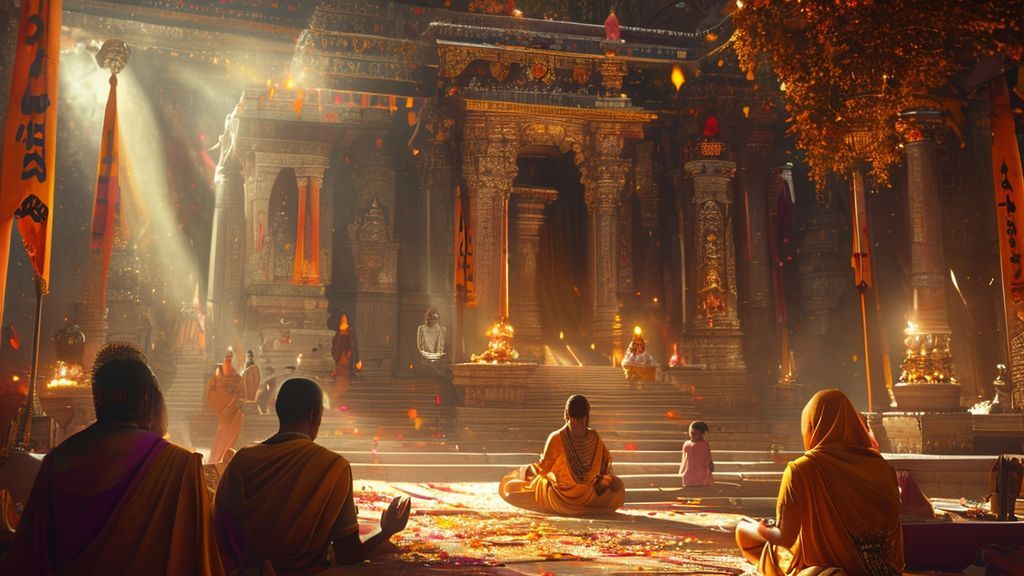
The Mahamrityunjaya Mantra, a powerful Vedic hymn dedicated to Lord Shiva, is chanted to invoke divine protection, promote healing, and overcome the fear of death. Its proper recitation involves precise Sanskrit pronunciation, sincere devotion, and adherence to specific ritual guidelines, ensuring spiritual efficacy and profound inner peace for the devotee.
| Attribute | Details |
|---|---|
| Deity | Lord Shiva (Tryambaka – the three-eyed one) |
| Origin/Root Text | Rigveda (Mandala 7, Sukta 59, Mantra 12) |
| Key Festivals for Chanting | Maha Shivaratri, Shravan Maas, Mondays, during illness or crisis |
| Primary Scripture References | Rigveda, Yajurveda, Shiva Purana, Markandeya Purana |
The Immortalizing Resonance of Tryambaka
In the vast ocean of Sanatan Dharma, certain sacred utterances stand as luminous beacons, guiding humanity through life’s vicissitudes towards spiritual liberation. Among these, the Mahamrityunjaya Mantra, often revered as the “Great Death-Conquering Mantra,” holds a paramount position. It is not merely a sequence of sounds but a potent invocation of Lord Shiva, the ultimate reality, the destroyer of ignorance, and the bestower of Moksha. This divine mantra is a prayer for health, longevity, protection from untimely death, and spiritual nourishment, embodying the essence of Vedic wisdom concerning life, death, and immortality. For sincere seekers, understanding its profound meaning, precise pronunciation, and dedicated practice offers a pathway to transcend worldly fears and connect with the eternal self.
The Legend of Rishi Markandeya and the Mantra’s Revelation
The genesis of the Mahamrityunjaya Mantra is intricately woven into the Puranic narratives, particularly highlighted in the Shiva Purana and the Markandeya Purana. The most cherished legend concerns the sage Mrikandu and his wife, Marudmati, who, after years of fervent penance, were granted a boon by Lord Shiva: a choice between a hundred dull-witted sons or one exceptionally brilliant, spiritually advanced son destined for a short life of just sixteen years. They chose the latter, and thus, Markandeya was born.
As Markandeya approached his sixteenth birthday, Yama, the deity of death, arrived to claim him. Young Markandeya, steeped in devotion to Lord Shiva, took refuge in the inner sanctum of the Jyotirlingam at the present-day Markandeya Tirtha. Embracing the Lingam tightly, he began chanting a powerful mantra with unwavering faith. Yama, bound by his duty, attempted to cast his noose around Markandeya, but the noose inadvertently fell upon the Lingam itself.
Incensed by this transgression against his devotee and his sacred form, Lord Shiva manifested from the Lingam as Kalantaka (the conqueror of death). With a thunderous roar, Shiva admonished Yama, declaring that Markandeya would live eternally as a sixteen-year-old. It was this potent mantra, chanted by Markandeya in his moment of ultimate surrender and crisis, that is believed to be the Mahamrityunjaya Mantra. Through Markandeya’s unwavering devotion and Shiva’s grace, the mantra became known to humanity as a profound tool for averting death, curing illness, and achieving spiritual vitality. This narrative underscores the mantra’s efficacy, not just as a prayer for physical well-being, but as a testament to the power of devotion and divine intervention.
The Vibrational Science of Nada Yoga
While temples offer architectural marvels, a mantra like Mahamrityunjaya is a marvel of sound engineering – a subtle science known as Nada Yoga. Each syllable in the Mahamrityunjaya Mantra is not random; it is a meticulously crafted sound vibration, or “bija” (seed sound), designed to resonate with specific energy centers (chakras) within the human body and subtle energy fields. The Vedic rishis, through deep meditative states, apprehended these primordial sounds and organized them into mantras.
When chanted correctly, the vibrations generated by “Om Tryambakam” resonate in the Ajna chakra (third eye), invoking clarity and intuition. “Yajamahe Sugandhim” stimulates the Anahata chakra (heart center), fostering compassion and spiritual love. “Pushtivardhanam” activates the Manipura chakra (solar plexus), promoting vitality and growth. “Urvarukamiva Bandhanan Mrityor Mukshiya Maamritat” creates a harmonizing effect across all chakras, culminating in a powerful release from mental and physical constraints, akin to a ripe cucumber detaching effortlessly from its vine. The repetition (Japa) of these specific sonic patterns creates a cumulative effect, reorganizing cellular structures, calming the nervous system, and connecting the individual consciousness with the cosmic consciousness of Shiva. This profound practice is an internal pilgrimage, transforming the physical body into a temple of divine resonance.
Rituals and Puja Vidhi for Chanting the Mahamrityunjaya Mantra
Chanting this sacred mantra with proper intention and procedure amplifies its benefits. Here is a step-by-step guide for sincere devotees:
- Purification (Shuddhi): Begin with a bath to purify the body. Wear clean, comfortable clothes.
- Setting the Ambiance: Find a peaceful and clean space. Sit on a comfortable Aasan (mat), preferably facing East or North. Light a ghee lamp (diya) and incense sticks, creating a serene atmosphere.
- Sankalpa (Intention): Before starting, make a clear intention. Hold some water in your right palm, state your purpose for chanting (e.g., for health, protection, spiritual growth, or for a loved one), and then pour the water onto the ground, symbolizing the firm resolve.
- Preliminary Mantras:
- Chant an invocation to Lord Ganesha (e.g., ॐ गं गणपतये नमः – Om Gam Ganapataye Namaha) for removing obstacles.
- Chant a Guru Mantra (if you have one) to seek your spiritual teacher’s blessings.
- The Japa Mala: Use a Rudraksha Mala (rosary beads), ideally with 108 beads plus a Meru (guru bead). Hold the mala in your right hand, letting the beads pass between your thumb and middle finger. Do not cross the Meru bead; reverse direction after completing 108 chants.
- Pronunciation: Focus on clear and correct pronunciation of each syllable. The rhythm and intonation are crucial. Refer to reliable sources for accurate recitation guidance.
- Focused Chanting: Close your eyes gently. Concentrate on the meaning of the mantra, visualizing Lord Shiva. Allow the vibrations to permeate your being. Chant slowly and distinctly, not rushing.
- Counting Japa: Traditionally, a minimum of 108 repetitions (one mala) is performed. For specific purposes, multiple malas (e.g., 5, 11, 21, or even lakhs over days/weeks) may be prescribed.
- Completion: After completing your desired number of chants, sit in silence for a few moments, absorbing the energy. Offer a prayer of gratitude to Lord Shiva. You may then offer water to the Sun God (Surya Arghyam).
The Great Death-Conquering Mantra and Its Transliteration
The Mahamrityunjaya Mantra is a profound invocation seeking protection and immortality. Its power lies in its precise sound and meaning:
Devanagari:
ॐ त्र्यम्बकं यजामहे सुगन्धिं पुष्टिवर्धनम्।
उर्वारुकमिव बन्धनान्मृत्योर्मुक्षीय माऽमृतात्॥
Transliteration:
Om Tryambakam Yajamahe Sugandhim Pushtivardhanam |
Urvarukamiva Bandhanan Mrityor Mukshiya Maamritat ||
Meaning: We worship the three-eyed one (Lord Shiva) who is fragrant and nourishes all beings. May He liberate us from the bondage of death, like a ripe cucumber effortlessly separates from its vine, and lead us to immortality.
For a deeper dive into the mystical origins and various interpretations of this and other Vedic chants, explore the extensive resources available at Hindutva.online.
Dos and Don’ts for Chanting
- Do: Chant with devotion (shraddha) and focus (dhyana).
- Do: Maintain physical and mental purity before and during chanting.
- Do: Chant at fixed times daily to build spiritual discipline.
- Do: Use a Rudraksha mala; it amplifies the energy.
- Don’t: Chant haphazardly or without understanding the meaning.
- Don’t: Engage in gossip or negative thoughts during your Japa practice.
- Don’t: Interrupt your chanting mid-way unless absolutely necessary.
- Don’t: Chant while feeling anger, jealousy, or intense agitation.
Who can chant the Mahamrityunjaya Mantra?
The Mahamrityunjaya Mantra is universal and can be chanted by anyone, irrespective of gender, age, or caste. It is a prayer for well-being that transcends all artificial boundaries. Sincere devotion and a pure heart are the only prerequisites. Even those new to Sanatan Dharma can benefit greatly from its vibrations.
What is the best time to chant this mantra?
While the mantra can be chanted at any time, the early morning hours (Brahmamuhurta, roughly 96 minutes before sunrise) are considered most auspicious. Evening hours (Pradosh Kaal, around sunset) are also highly potent, particularly for Shiva worship. Consistency is more important than a specific time.
How many times should one chant the Mahamrityunjaya Mantra?
Traditionally, one full mala (108 repetitions) is the minimum recommended for daily practice. For specific purposes or during challenging times, devotees may chant 1,25,000 (one lakh twenty-five thousand) times over a period, or even multiples of that. The number often depends on the intention and guidance from a Guru, but even a few sincere chants daily are beneficial.
Can the Mahamrityunjaya Mantra be chanted for others?
Yes, absolutely. The Mahamrityunjaya Mantra is frequently chanted by devotees, priests, or family members on behalf of a loved one who is ill, facing danger, or nearing the end of their life. The power of collective or dedicated chanting for another’s well-being is a profound aspect of Hindu spiritual practice, demonstrating selfless compassion.
Preserving Sanatan Dharma Through Sacred Sound
The Mahamrityunjaya Mantra is far more than a mere prayer; it is a profound pillar of Sanatan Dharma, offering solace, protection, and a pathway to higher consciousness. Its continued practice ensures the preservation of ancient Vedic wisdom, reminding us of the eternal truths about life, death, and the divine’s omnipresent grace. By diligently chanting this mantra, we not only invite blessings for ourselves but also contribute to the spiritual upliftment of the entire cosmos, strengthening the Dharmic fabric of society. It is a testament to the fact that true immortality lies not in escaping death, but in recognizing our imperishable spiritual essence, an understanding that empowers us to live fearlessly and purposefully, in harmony with the cosmic rhythms. This sacred sound serves as a timeless bridge between the mundane and the transcendental, allowing every Hindu to connect directly with the liberating power of Lord Shiva. To delve deeper into such profound spiritual tools, visit Hindutva.online for expert guidance and comprehensive resources.