


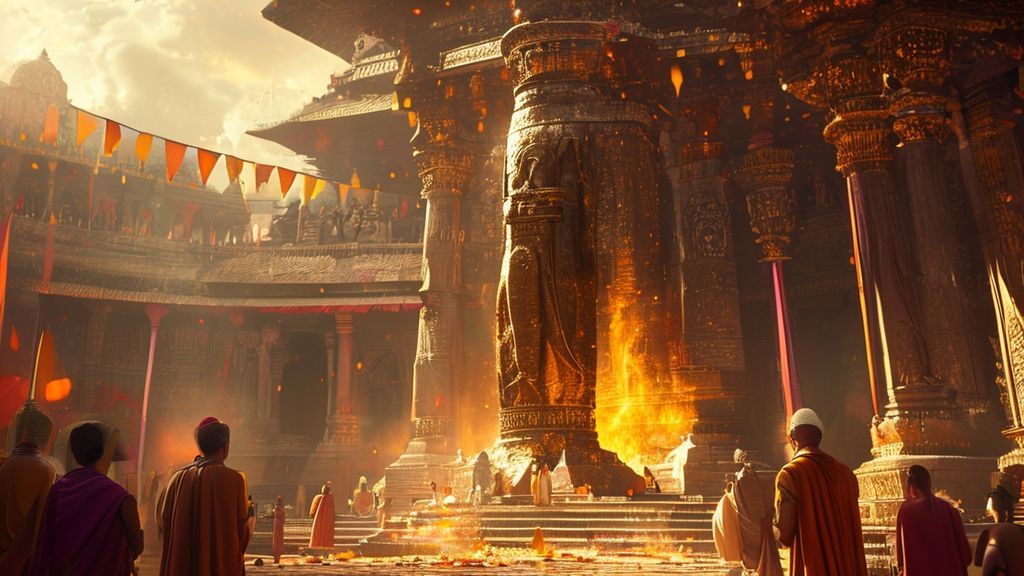
The Iron Pillar of Delhi, a colossal metallurgical marvel standing proudly in the Qutub Complex, is an unparalleled testament to ancient Indian scientific prowess, defying corrosion for over 1600 years. This enduring monument, forged with advanced ferrous metallurgy techniques, symbolizes the profound depths of Sanatan Dharma’s knowledge tradition, integrating engineering brilliance with spiritual insight.
| Attribute | Details |
|---|---|
| Deity/Patronage | King Chandra (identified with Chandragupta II Vikramaditya); dedicated to Lord Vishnu as a Dhwaja Sthambha. |
| Location/Origin | Originally Udayagiri (Madhya Pradesh), now Mehrauli, Delhi; erected circa 4th-5th Century CE. |
| Key Significance | Astounding corrosion resistance; evidence of ancient Indian metallurgical mastery. |
| Scripture Reference | Reflects principles of *Shilpa Shastras* and the advanced *karma-yoga* of ancient artisans, akin to divine engineering by Vishwakarma (Rig Veda, Puranas). |
The Immortal Pillar: A Beacon of Sanatani Ingenuity
In the heart of what is now Delhi stands an enigma, a silent sentinel witnessing the ebb and flow of millennia – the Iron Pillar. Far from being a mere relic, this incredible monument is a vibrant symbol of our ancient civilization’s advanced scientific knowledge, deeply rooted in the philosophical and practical tenets of Sanatan Dharma. It challenges modern assumptions about primitive antiquity, asserting a legacy of unparalleled metallurgical skill and devotional dedication. For the sincere seeker, the pillar is not just iron and rust-resistance; it is a manifestation of *vidya* (knowledge), *shilpa* (craft), and *shraddha* (faith), intertwined to create something enduring and divinely inspired. It exemplifies how our ancestors viewed technology as a means to express devotion and elevate human endeavor, not merely for utility, but for eternal glory.
Puranic History & The Legacy of King Chandra
The history of the Iron Pillar, though not directly cataloged in a singular Puranic narrative, resonates with the spirit of ancient India’s devotional kings and the divine origin of crafts. The pillar’s primary Sanskrit inscription credits its erection to a powerful king named Chandra, a devout worshipper of Vishnu, who conquered vast territories and established a glorious empire. While scholars largely identify him with the illustrious Chandragupta II Vikramaditya of the Gupta dynasty (circa 375-415 CE), the inscription itself evokes the heroic virtues extolled in the Itihasas and Puranas – a monarch whose prowess was likened to the might of Vishnu Himself.
The construction of such a monumental iron structure, weighing over six tons and standing more than seven meters tall, speaks to an era where the science of metallurgy was not merely empirical but perhaps guided by esoteric principles passed down through generations of *acharya* and *shilpi*. The divine architect, Vishwakarma (विश्वकर्मा), as described in the Rig Veda (X.81, X.82) and various Puranas like the Brahma Purana and Skanda Purana, is the celestial patron of all arts and crafts. It is plausible that the master metallurgists who forged this pillar viewed their work as an act of divine service, drawing upon a tradition of knowledge believed to originate from Vishwakarma himself. The excellence in their craft was their *yagya*, their offering. The pillar was originally a Dhwaja Sthambha (ध्वजस्तंभ), a flagstaff, for a Vishnu temple, likely at Udayagiri, reaffirming its sacred purpose before its relocation to Delhi.
Architectural & Scientific Marvels: The Secret of Eternal Iron
The true marvel of the Iron Pillar lies in its extraordinary resistance to corrosion, a phenomenon that has puzzled metallurgists for centuries. Unlike modern iron structures that succumb to rust, this ancient pillar, exposed to the elements for over sixteen centuries, stands remarkably preserved. This resilience is not accidental but a result of sophisticated ancient Indian metallurgy, often referred to as Wrought Iron Metallurgy.
The scientific secret lies in its unique chemical composition and the specific forging process. The iron used has an unusually high phosphorus content (around 0.25-0.5%), significantly higher than modern iron. Critically, it contains very low levels of sulfur and manganese, which are common impurities that accelerate corrosion. During its repeated forging and hammering, a thin, uniform passive protective layer of misawite (a complex iron oxy-hydroxide, FeOOH), also known as “Delhi Rust,” formed on its surface. This layer acts as a barrier, preventing oxygen and moisture from reaching the underlying metal, effectively halting further corrosion.
This process demonstrates a profound understanding of iron chemistry and thermodynamics, far exceeding what was thought possible for its time. The master craftsmen understood the precise temperatures, the number of hammer blows, and the composition of the iron ore to achieve this specific alloy and surface passivation. This was not haphazard experimentation but a refined scientific process, embodying the principles detailed in ancient texts that guided everything from temple construction to metallurgy. The pillar’s very existence points to a civilization that understood material science at a foundational level, an impressive legacy that continues to inspire reverence and scientific inquiry today at Hindutva.online.
Reverence & Rituals for the Pillar of Knowledge
While the Iron Pillar is not a deity for traditional *puja* with *arati* and *prasad*, it is a profound object of reverence, representing the divine knowledge and skill bestowed upon our ancestors. For a devotee, approaching the pillar is an act of acknowledging and honoring the glorious past of Sanatan Dharma.
Here’s how one can offer respectful homage:
- Pradakshina (Circumambulation): Perform a clockwise circumambulation around the pillar, if permitted, with a heart full of respect for the ancient *shilpis* and King Chandra. This symbolic walk represents seeking blessings and wisdom from the past.
- Dhyana (Meditation): Stand before the pillar in quiet contemplation. Reflect on the immense knowledge, perseverance, and dedication of those who created it. Meditate on the concept of *Akhand Bharat* and the enduring spirit of Sanatan Dharma.
- Sankalpa (Intention): Make a silent *sankalpa* to imbibe the qualities of resilience, knowledge, and devotion exemplified by the pillar and its creators.
- Offering of Gratitude: Mentally offer gratitude to all *rishis*, *acharyas*, and artisans who preserved and propagated such profound scientific and spiritual wisdom.
This act of reverence reinforces our connection to a rich intellectual heritage, proving that our traditions were not merely spiritual but also scientific, philosophical, and technological.
Mantras & Chants for Knowledge and Craft
Though no specific mantra exists for the Iron Pillar itself, one can chant mantras that invoke divine knowledge, the spirit of craftsmanship, and the blessings of Vishwakarma for wisdom and skill.
-
For Vishwakarma (The Divine Architect):
ॐ विश्वकर्मणे नमः (Om Vishwakarmane Namah)
*Meaning:* Salutations to Vishwakarma, the creator of the universe and patron of all crafts. -
For Saraswati (Goddess of Knowledge):
ॐ ऐं ह्रीं श्रीं सरस्वत्यै नमः (Om Aim Hrim Shrim Saraswatyai Namah)
*Meaning:* Salutations to Saraswati, the goddess of learning, wisdom, and arts. -
General Mantra for Wisdom:
असतो मा सद्गमय। तमसो मा ज्योतिर्गमय। मृत्योर्मा अमृतं गमय। (Asato Ma Sadgamaya, Tamaso Ma Jyotirgamaya, Mrityorma Amritam Gamaya)
*Meaning:* From untruth lead me to truth. From darkness lead me to light. From death lead me to immortality. (Brihadaranyaka Upanishad 1.3.28)
Chanting these mantras with devotion can help one connect with the essence of knowledge and skillful action that the Iron Pillar represents.
Dos and Don’ts for Visiting the Iron Pillar
To ensure a respectful and spiritually enriching experience while visiting this monument:
- Do approach the pillar with reverence and an appreciation for its historical and scientific significance.
- Do maintain silence and decorum, especially when contemplating its marvel.
- Do respect the barricades and protective measures around the pillar; do not attempt to touch or climb it.
- Do observe the intricate Sanskrit inscription and ponder its meaning.
- Don’t litter or deface the monument or its surroundings.
- Don’t engage in loud conversations or disruptive behavior.
- Don’t treat it merely as a tourist attraction, but as a site of profound historical and scientific learning.
- Don’t bring any prohibited items into the complex.
Frequently Asked Questions About the Iron Pillar
What is the primary significance of the Iron Pillar?
The primary significance of the Iron Pillar lies in its extraordinary corrosion resistance for over 1600 years, showcasing the advanced metallurgical knowledge and engineering capabilities of ancient India, a testament to Sanatani scientific excellence.
Who built the Iron Pillar and for what purpose?
The pillar was commissioned by King Chandra, widely identified as Chandragupta II Vikramaditya of the Gupta Empire (circa 4th-5th Century CE). It was originally erected as a Dhwaja Sthambha (flagstaff) for a Vishnu temple, serving both as a commemorative monument to the king’s victories and a sacred offering to Lord Vishnu.
How does the Iron Pillar resist rust?
The Iron Pillar resists rust due to its unique high phosphorus content and very low sulfur/manganese impurities. This composition, combined with ancient forging techniques, allowed a thin, protective passive layer of misawite (iron oxy-hydroxide) to form on its surface, preventing further corrosion.
Why does this matter for every Hindu?
The Iron Pillar stands as a powerful, tangible proof of the profound scientific and technological achievements that blossomed within the framework of Sanatan Dharma. It shatters the misconception of ancient India as merely spiritual or mystical, without practical, empirical knowledge. Instead, it reveals a civilization that integrated deep spiritual wisdom with advanced material science, architecture, and engineering. For every Hindu, the pillar is a source of immense pride, connecting us to a lineage of brilliant ancestors whose contributions to human knowledge were immense and enduring. It inspires us to reclaim and celebrate our heritage, to understand that knowledge in Sanatan Dharma was holistic, encompassing both the inner and outer worlds. It is a beacon, reminding us that our roots are not just spiritual but also intellectual and scientific, encouraging us to strive for excellence in all fields of endeavor, just as our predecessors did. This magnificent monument, therefore, is not merely a historical artifact but a living inspiration for the present and future generations of Bharat at Hindutva.online.