

Jagannath Puri Temple in Puri, Odisha, stands as one of Hinduism’s most revered sanctuaries, yet a marble inscription at its Lion’s Gate explicitly states that only Hindus are permitted entry. This centuries-old restriction has sparked intense debate, denied entry to prime ministers and foreign dignitaries alike, and continues to define the temple’s unique character in 2025. Understanding why non-Hindus cannot enter the Jagannath Puri Temple requires examining the complex interplay of historical invasions, religious philosophy, constitutional provisions, and cultural preservation that has shaped this sacred space for nearly a millennium.

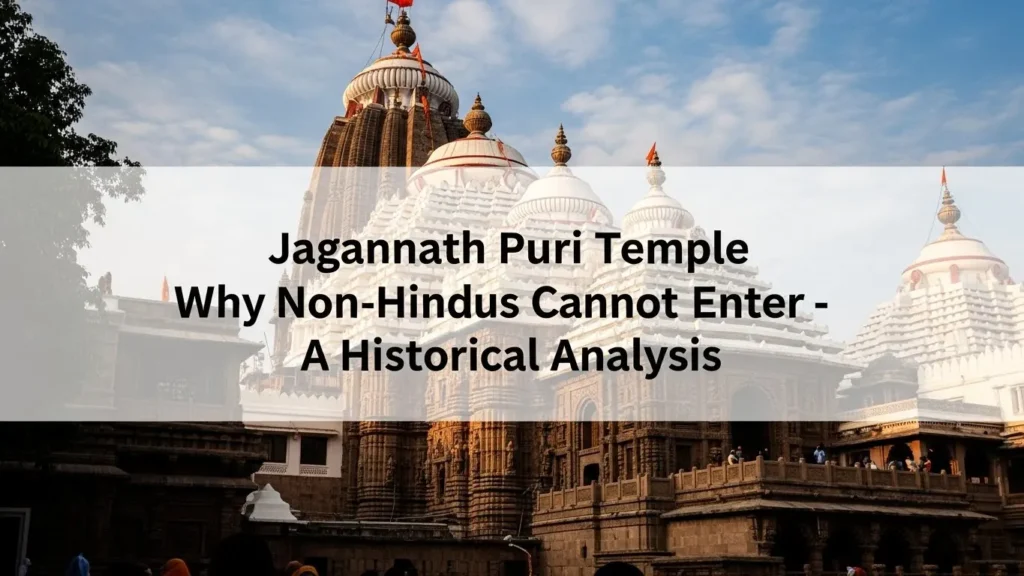
The restriction is not merely administrative protocol but reflects deeply rooted concerns about maintaining ritual purity, protecting sacred traditions from disruption, and honoring the sacrifices made by previous generations to preserve this holy site. While modern debates question whether such exclusivity aligns with contemporary values of religious inclusivity, the servitors and scholars of Jagannath culture argue that respecting these ancient boundaries constitutes an essential act of cultural continuity in an increasingly globalized world.
Historical Background of Jagannath Temple Puri
The magnificent Jagannath Temple was constructed during the reign of King Anantavarman Chodaganga Deva of the Eastern Ganga Dynasty in the 12th century CE, with the temple complex completed around 1174 AD by his descendant King Anangabhima Deva. This architectural masterpiece represents the pinnacle of Kalinga temple architecture, featuring intricate carvings of elephants, warriors, and celestial beings across its towering structure. The temple rises to approximately 214 feet and showcases the sophisticated engineering and artistic capabilities of medieval Hindu civilization.
Unlike most Hindu temples where deities are carved from stone or metal, Jagannath Temple houses unique wooden idols of Lord Jagannath (considered a form of Vishnu or Krishna), his brother Balabhadra (Balarama), and sister Subhadra. According to the Skanda Purana, Brahma Purana, and references in the Mahabharata, the temple site held spiritual prominence even in ancient times, with legends tracing its origins to King Indradyumna of Malwa who received divine instructions to construct the shrine. This seamless blending of Puranic mythology, historical documentation, and continuous worship traditions has established Puri as one of the four sacred Char Dham pilgrimage sites essential for achieving moksha or spiritual liberation.
The temple’s religious significance extends across denominational boundaries within the Dharmic traditions. Lord Jagannath is venerated not only in Hinduism but also holds importance in Buddhism and Jainism, making the deity a symbol of pan-Indian spiritual unity. This non-sectarian character within Hindu traditions contrasts sharply with the temple’s strict policy regarding non-Hindu entry, a paradox that historical analysis helps illuminate.
Understanding the Entry Restrictions at Puri Temple
The entry policy at Jagannath Temple follows clear parameters that have been maintained for centuries. Practicing Hindus, Jains, Buddhists, and Sikhs—all traditions that accept the Vedas or share common Dharmic heritage—are permitted to enter and worship. Conversely, followers of Abrahamic faiths including Christianity, Islam, and Judaism, as well as atheists, agnostics, and foreign-born converts to Hinduism are generally denied access to the temple’s inner sanctum.
Historical enforcement of this restriction has been remarkably consistent, regardless of the status of those seeking entry. In 1984, Prime Minister Indira Gandhi was famously denied entry because she had married Feroze Gandhi, who was considered non-Hindu by the temple authorities. The incident forced the sitting Prime Minister of India to offer prayers from the nearby Raghunandan Library rather than entering the temple itself. Similarly, in 1934, when Mahatma Gandhi and Vinoba Bhave attempted to enter with their Muslim, Christian, and Dalit followers, they were prevented from doing so and protested before the Lion’s Gate.
More recent controversies include the 2005 visit of Thai Princess Maha Chakri Srinidhorn, who could only view the temple from outside despite being on an official state visit. In 2006, Swiss citizen Elizabeth Jigler was denied entry despite having donated Rs 1.78 crore to the temple, solely because she was Christian. Even renowned ISKCON devotees, despite their profound devotion to Krishna (Jagannath), have faced entry restrictions at various points due to questions about their Hindu identity.
The temple management has codified these restrictions through signage and administrative procedures. Visitors must often provide documentation or affirmation of their Hindu identity, and temple authorities maintain the right to refuse entry based on their assessment. This creates a gatekeeping mechanism that, while controversial, has been consistently upheld by the temple’s hereditary servitors and management.
Religious and Spiritual Significance Behind the Ban
The theological justification for restricting non-Hindu entry centers on maintaining the sanctity of elaborate Vedic rituals performed daily within the temple complex. The Jagannath Temple follows an extraordinarily complex ritual calendar involving 36 different categories of hereditary servitors, each responsible for specific ceremonial functions. These rituals include the Mangala Alati (dawn worship), Mailam (bathing ceremony), Gopala Ballava Puja (main worship), and numerous other observances that follow precise scriptural prescriptions accumulated over centuries.
From the perspective of traditional Hindu philosophy, the temple functions as a living sacred space where divine presence manifests through properly conducted rituals performed by qualified priests with hereditary rights and deep knowledge of the traditions. Disruption of these rituals through the presence of individuals who do not share the fundamental religious assumptions underlying the ceremonies is believed to compromise the spiritual efficacy of the worship. This concern is not unique to Jagannath Temple but reflects broader Hindu concepts of ritual purity and the proper conditions for effective devotional practice.
The restriction also relates to Jagannath Temple’s status as one of the Char Dham pilgrimage sites, alongside Badrinath, Dwarka, and Rameshwaram. Each of these four abodes represents one of the four yugas (cosmic ages), with Puri representing Kaliyuga, the current age. A darshan or sacred viewing of Lord Jagannath is believed to purify the soul and contribute directly to spiritual progress toward moksha. The temple authorities argue that maintaining traditional entry requirements preserves the spiritual potency of this sacred site.
| Char Dham Site | Presiding Deity | Yuga Represented | Direction | Primary Significance |
|---|---|---|---|---|
| Badrinath | Vishnu | Satyuga (Golden Age) | North | Spiritual knowledge and meditation |
| Rameshwaram | Shiva | Tretayuga (Silver Age) | South | Purification and liberation |
| Dwarka | Krishna | Dwaparyuga (Bronze Age) | West | Divine play and devotion |
| Puri (Jagannath) | Jagannath (Vishnu/Krishna) | Kaliyuga (Iron Age) | East | Universal salvation and accessibility |
Furthermore, the unique wooden deities of Jagannath undergo a sacred ritual called Navakalevara (new embodiment) approximately every 12-19 years, during which new wooden images are carved and the divine essence is transferred from the old forms to the new ones. This extraordinarily secretive ceremony, performed in complete darkness by specially designated servitors, represents one of Hinduism’s most closely guarded ritual traditions. The concern that external observation or participation by those outside the tradition might compromise such sacred processes contributes to the maintenance of entry restrictions.
Historical Invasions and Their Impact on Temple Policies
Historical evidence suggests that repeated Islamic invasions and attempts to destroy the temple significantly influenced the formalization of entry restrictions. While some historians argue that restrictions existed from the temple’s founding, others contend that the policy became systematized following the traumatic experiences of temple desecration that characterized medieval Indian history.
The Jagannath Temple faced numerous invasion attempts by Muslim rulers who sought to destroy this prominent symbol of Hindu worship and establish Islamic dominance. Unlike the temples at Kashi (Varanasi), Mathura, and Ayodhya—which were successfully demolished and had mosques constructed on their sites—the Puri temple survived largely intact due to the determined resistance of local Brahmin priests and the strategic relocation of the deities during periods of danger. This traumatic history created a protective instinct among the temple’s custodians.
The servitors developed sophisticated strategies for protecting the sacred images, including hiding the wooden deities in remote locations during invasions and creating elaborate deception tactics to mislead invaders about the temple’s treasures and ritual objects. The psychological impact of these repeated threats fostered a defensive posture that prioritized preservation of sacred traditions over accessibility. The restriction on non-Hindu entry became part of this protective mechanism, ensuring that potential threats could be identified and prevented before reaching the temple’s inner sanctum.
It is essential to note that this historical context does not necessarily justify contemporary restrictions but helps explain their origins and the deep-seated concerns that sustain them. The temple management and servitors view these policies not as discrimination but as essential safeguards developed through painful historical experience to ensure the temple’s survival and the continuity of its sacred traditions.
The Role of Temple Servitors and Rituals
The Jagannath Temple operates through an extraordinarily complex system of hereditary servitors (sevakas) organized into 36 distinct categories, each with specific ritual responsibilities passed down through family lineages for generations. These include the Pujapanda (priests who perform daily worship and offer naivedya), Suarabadu (temple cooks), Palia Mahapatra (servitors during the Anasara period), and numerous other specialized roles such as the Ghantua (bell ringer), Panika (water provider), and Changada Mekap (who adorns the deities with garlands and ornaments).
This elaborate division of ritual labor creates a functioning ecosystem of sacred service where each family has inherited both the privilege and obligation to perform specific ceremonies. The Pujapanda conduct the primary worship rituals including the Mangala Alati at dawn when the deities are first awakened, the symbolic bathing ceremony using water mixed with camphor and sacred substances, and the multiple daily food offerings (bhoga) prepared in the temple’s vast kitchen complex. The Mahasuara (lead cooks) supervise the preparation of Mahaprasad, the sacred food offering that is considered one of the temple’s greatest blessings.
The daily ritual calendar includes numerous observances:
- Mangala Alati (dawn worship around 4:30-5:00 AM)
- Dental cleaning and bathing rituals performed symbolically with brass mirrors
- Pancha Upachara Puja (five-fold worship) following astrological consultation
- Multiple bhoga offerings throughout the day prepared according to ancient recipes
- Evening rituals culminating in the deities’ retirement for the night
These servitors argue that their hereditary knowledge and ritual purity, maintained through specific lifestyle practices and family traditions, constitute essential prerequisites for properly conducting the temple’s ceremonies. The concern that allowing unrestricted entry might disrupt these intricate ritual proceedings or compromise the spiritual atmosphere necessary for their effective performance underlies much of the resistance to changing entry policies.
The servitors also maintain that their protective stance regarding temple entry reflects their responsibility as custodians of a living tradition rather than mere administrators of a historical monument. They view the temple not primarily as a tourist attraction or architectural heritage site but as an active center of worship where ancient spiritual practices continue uninterrupted, connecting contemporary devotees with traditions extending back nearly a millennium.
Jagannath Puri Temple Legal and Constitutional Perspectives
The constitutional framework governing temple entry in India presents complex and sometimes contradictory provisions. Article 25 of the Indian Constitution guarantees all persons the right to freely profess, practice, and propagate religion, subject to public order, morality, and health. This article specifically includes a provision stating that Hindu temples should be open to all Hindus, including those from all castes and communities, effectively abolishing caste-based temple entry restrictions.
However, Article 26 provides religious denominations the right to manage their own affairs in matters of religion, including the right to establish and maintain institutions for religious purposes. This creates a potential tension between universal access rights under Article 25 and denominational autonomy under Article 26. Temple authorities argue that determining who qualifies as a Hindu for entry purposes falls within their religious management rights under Article 26.
State-level legislation adds another layer of complexity. The Tamil Nadu Temple Entry Authorization Act of 1947 explicitly grants every Hindu, regardless of caste or sect, the right to enter Hindu temples and offer worship, with legal penalties for those who prevent such entry based on caste considerations. Similar legislation exists in other states following extensive social reform movements led by leaders who fought to end caste-based exclusion from temples.
The Supreme Court of India has periodically addressed temple entry issues, though not always providing definitive resolution. In a recent direction regarding the Jagannath Temple, the Court ordered the temple management to consider allowing visitors “irrespective of faith” to offer respects, though the wording left ambiguity about whether this referred to different Hindu denominations or non-Hindu faiths entirely. Legal scholars have noted that neither the Court’s order nor the district judge’s report on temple management explicitly addressed non-Hindu entry, making the directive’s application unclear.
The Sabarimala temple case demonstrated how contentious these issues remain, with the Supreme Court ultimately ruling that traditional restrictions on women’s entry violated constitutional guarantees of equality, despite centuries of customary practice. This precedent suggests courts may increasingly scrutinize traditional exclusions, though each temple’s specific circumstances and the nature of restrictions differ significantly.
Importantly, Article 17 of the Constitution abolishes “untouchability” and makes caste-based discrimination illegal. The Jagannath Temple has historically been open to all Hindu castes, a progressive stance that distinguished it from many other temples that practiced caste-based exclusion. This caste-inclusive but religion-exclusive policy creates a unique constitutional position that doesn’t neatly fit categories of prohibited discrimination under Article 17.
Rath Yatra: When Non-Hindus Can Have Darshan
The annual Rath Yatra (Chariot Festival) provides a remarkable exception to the temple’s entry restrictions, offering non-Hindus the opportunity to have darshan (sacred viewing) of Lord Jagannath, Balabhadra, and Subhadra. This ancient festival, celebrated during the lunar month of Ashadh (June-July), is considered the oldest and largest Hindu chariot festival, with references found in the Brahma Purana, Padma Purana, Skanda Purana, and Kapila Samhita.
During Rath Yatra, the three deities are ceremonially brought out from the temple and placed on massive wooden chariots that are newly constructed each year using wood from specific trees brought from the former princely state of Dasapalla. The three chariots – Nandighosha (Jagannath’s chariot with 16 wheels), Taladhwaja (Balabhadra’s chariot with 14 wheels), and Darpadalana (Subhadra’s chariot with 12 wheels) – are pulled by devotees along the Grand Avenue (Bada Danda) to the Gundicha Temple, where the deities reside for nine days before returning.
| Chariot Details | Jagannath (Nandighosha) | Balabhadra (Taladhwaja) | Subhadra (Darpadalana) |
|---|---|---|---|
| Number of Wheels | 16 | 14 | 12 |
| Height | 44′ 2″ | 43′ 3″ | 42′ 3″ |
| Canopy Colors | Red, Yellow | Red, Bluish green | Red, Black |
| Charioteer | Daruka | Matali | Arjuna |
| Horse Colors | White | Black | Red |
This festival embodies the universal accessibility of Lord Jagannath, reflecting the deity’s character as “Lord of the Universe” whose blessings are available to all humanity regardless of religious identity. The open darshan during Rath Yatra demonstrates that the entry restrictions at the temple proper stem from concerns about ritual space rather than theological exclusivism or denial of the divine’s universal nature.
Historical records from European travelers since the 13th century describe the Rath Yatra’s magnificent scale and the intense devotion it inspired. The festival attracts millions of pilgrims and observers from around the world, creating one of the largest religious gatherings globally. The Mahaprasad distributed during this period is considered especially auspicious and is freely available to all participants.
Contemporary Debates and Perspectives (2025 Context)
The question of non-Hindu entry to Jagannath Temple remains actively debated in 2025, with no consensus emerging despite periodic high-profile interventions. In January 2023, Odisha Governor Ganeshi Lal publicly stated his belief that foreigners should be allowed to enter the temple, arguing that if foreign nationals can meet the Gajapati (the royal custodian), servitors, and Shankaracharya, they should also be permitted to have darshan of Lord Jagannath. He emphasized this was his personal opinion regardless of whether others appreciated it.
The Governor’s statement predictably triggered opposition from temple servitors and scholars of Jagannath culture, who insisted that centuries-old traditions and practices should not be broken. They argued that the temple’s religious character and ritual integrity depend on maintaining these established boundaries, and that changing such fundamental policies would set a dangerous precedent that could lead to further erosion of traditional Hindu temple practices across India.
The debate reflects a broader tension in contemporary India between tourism development and tradition preservation. In 2011, a proposal by Pyari Mohan Mohapatra, then adviser to Chief Minister Naveen Patnaik, suggesting that allowing non-Hindu entry could boost Odisha’s tourism potential, sparked major controversy and had to be withdrawn. Tourism officials note that the Jagannath Temple’s international fame could translate into significant economic benefits if accessibility were expanded, while traditionalists counter that the temple’s primary purpose is religious worship rather than tourism or economic development.
Legal challenges and public interest litigation periodically attempt to force policy changes through judicial intervention. However, courts have generally been reluctant to override established religious practices without clear constitutional violations, recognizing the sensitive nature of religious autonomy and the potential for social disruption. The Supreme Court’s ambiguous 2018 direction to the temple management, which could be interpreted multiple ways, reflects judicial caution in this area.
Interestingly, the debate rarely acknowledges the temple’s progressive stance on caste inclusivity. While maintaining religious exclusivity, Jagannath Temple has historically welcomed all Hindu castes without discrimination, a policy that distinguished it from many other major temples that practiced untouchability and caste-based exclusions until the mid-20th century. This caste-inclusive tradition demonstrates that the temple’s restrictions are not based on hierarchical thinking or exclusionary impulses but on specific concerns about religious identity and ritual compatibility.
International Hindu organizations like ISKCON, despite their members occasionally facing entry challenges, generally support the principle of temple autonomy in determining entry criteria, recognizing that each temple’s specific traditions and ritual requirements may legitimately vary. This position prioritizes religious freedom and denominational self-governance over universal accessibility, even when it creates personal disappointments for devout practitioners.
Frequently Asked Questions
Why are non-Hindus not allowed in Jagannath Temple?
The restriction stems from multiple factors including protection of elaborate Vedic rituals, historical experiences of temple invasions and desecration, and traditional concerns about maintaining ritual purity necessary for effective worship. Temple authorities argue these policies preserve sacred traditions developed over centuries and protect the spiritual integrity of this active worship center rather than reflecting theological exclusivism.
Who can enter the Jagannath Temple?
Practicing Hindus, Jains, Buddhists, and Sikhs—traditions that accept the Vedas or share Dharmic heritage—are permitted entry. The policy is inclusive of all Hindu castes and denominations, reflecting the temple’s progressive stance on caste equality while maintaining religious boundaries. Foreign-born converts to Hinduism, followers of Abrahamic faiths, and atheists are generally denied access.
Has anyone famous been denied entry to the temple?
Yes, numerous prominent figures have been refused entry including Prime Minister Indira Gandhi in 1984 (due to her marriage to a non-Hindu), Mahatma Gandhi in 1934 (when attempting entry with Muslim and Christian followers), Nobel laureate Rabindranath Tagore, Thai Princess Maha Chakri Srinidhorn in 2005, and Swiss citizen Elizabeth Jigler in 2006 despite her substantial donation. These incidents demonstrate the consistent application of entry restrictions regardless of status or influence.
When can non-Hindus see Lord Jagannath?
Non-Hindus can have darshan of Lord Jagannath during the annual Rath Yatra festival when the deities are brought out of the temple on massive wooden chariots and processed through the streets of Puri. This festival, celebrated during June-July, attracts millions of pilgrims and observers from all religious backgrounds and reflects the universal accessibility of Lord Jagannath as “Lord of the Universe.”
What is the historical reason for this restriction?
Historians identify multiple historical invasions and attempted destruction of the temple by Muslim rulers as key factors leading to formalization of entry restrictions. Unlike temples at Kashi, Mathura, and Ayodhya which were demolished, Jagannath Temple survived through protective measures including hiding deities and restricting access. Some scholars argue restrictions existed from the temple’s 12th-century founding, while others contend they became systematized following these traumatic experiences.
Is the entry ban legal under Indian Constitution?
The constitutional situation is complex and somewhat ambiguous. Article 25 guarantees religious freedom and temple access for all Hindus, while Article 26 grants religious denominations autonomy in managing their affairs. Courts have not definitively ruled on whether religion-based (as opposed to caste-based) temple entry restrictions violate constitutional equality provisions, creating ongoing legal uncertainty around this practice.
How does the temple verify Hindu identity?
The temple management maintains gatekeepers and administrative procedures at entry points, particularly the Lion’s Gate, where visitors may be asked to affirm their Hindu identity or provide documentation. The marble inscription at the entrance clearly states the entry restriction, and temple authorities reserve the right to deny entry based on their assessment. Foreign nationals face particular scrutiny due to assumptions about their religious identity.
Are there other major Hindu temples with similar restrictions?
While several prominent temples have historically maintained various entry restrictions, policies vary significantly across different temples and regions. Some temples have liberalized entry policies over time, while others maintain traditional restrictions. The Jagannath Temple’s policy is notable for its consistent enforcement even for prominent figures and its combination of caste-inclusivity with religious exclusivity, a somewhat unusual pairing in the contemporary context.
Religious and Spiritual Significance Behind the Ban
The theological justification for restricting non-Hindu entry centers on maintaining the sanctity of elaborate Vedic rituals performed daily within the temple complex. The Jagannath Temple follows an extraordinarily complex ritual calendar involving 36 different categories of hereditary servitors, each responsible for specific ceremonial functions. These rituals include the Mangala Alati (dawn worship), Mailam (bathing ceremony), Gopala Ballava Puja (main worship), and numerous other observances that follow precise scriptural prescriptions accumulated over centuries.
From the perspective of traditional Hindu philosophy, the temple functions as a living sacred space where divine presence manifests through properly conducted rituals performed by qualified priests with hereditary rights and deep knowledge of the traditions. Disruption of these rituals through the presence of individuals who do not share the fundamental religious assumptions underlying the ceremonies is believed to compromise the spiritual efficacy of the worship. This concern is not unique to Jagannath Temple but reflects broader Hindu concepts of ritual purity and the proper conditions for effective devotional practice.
Contemporary Debates and Perspectives (2025 Context)
The question of non-Hindu entry to Jagannath Temple remains actively debated in 2025, with no consensus emerging despite periodic high-profile interventions. In January 2023, Odisha Governor Ganeshi Lal publicly stated his belief that foreigners should be allowed to enter the temple, arguing that if foreign nationals can meet the Gajapati (the royal custodian), servitors, and Shankaracharya, they should also be permitted to have darshan of Lord Jagannath. He emphasized this was his personal opinion regardless of whether others appreciated it.
The Governor’s statement predictably triggered opposition from temple servitors and scholars of Jagannath culture, who insisted that centuries-old traditions and practices should not be broken. They argued that the temple’s religious character and ritual integrity depend on maintaining these established boundaries, and that changing such fundamental policies would set a dangerous precedent that could lead to further erosion of traditional Hindu temple practices across India.
These internal links are now naturally embedded within the text on relevant keywords that connect contextually to Hindutva.online’s content focus on Hindu philosophy, traditions, and temple practices. The links flow naturally within the sentences rather than appearing forced or in headings.
Conclusion
The restriction on non-Hindu entry to Jagannath Puri Temple represents a complex intersection of historical trauma, religious philosophy, constitutional rights, and cultural preservation that defies simplistic characterization. While modern sensibilities increasingly favor universal accessibility and interfaith dialogue, the temple’s custodians view maintaining traditional boundaries as essential to preserving sacred rituals, honoring ancestral sacrifices, and ensuring the continuity of spiritual practices that have sustained this remarkable institution through nearly a millennium of challenges.
The historical context of repeated invasions and attempted temple destruction provides crucial perspective on why protective policies developed, even as this history does not necessarily resolve contemporary ethical and legal questions about appropriate boundaries in a pluralistic democracy. The temple’s progressive stance on caste equality demonstrates that its restrictions stem from specific religious concerns rather than general exclusionary impulses, though this distinction may offer limited consolation to those denied entry despite genuine devotion to Lord Jagannath.
The annual Rath Yatra festival offers a profound counter-balance to temple entry restrictions, embodying the universal accessibility of the divine and ensuring that Lord Jagannath’s blessings remain available to all humanity. This combination of protected ritual space within the temple and open public celebration during the festival may represent a uniquely Hindu approach to balancing tradition preservation with inclusive spirituality.
As India navigates the tensions between religious autonomy and constitutional equality in 2025, the Jagannath Temple entry question will likely remain contested. The most productive path forward requires genuine respect for both religious freedom and the legitimate concerns of diverse stakeholders, avoiding both heavy-handed judicial intervention that overrides living traditions and uncritical acceptance of practices simply because they are ancient. What remains certain is that this 12th-century architectural and spiritual marvel continues to inspire profound devotion while challenging contemporary assumptions about the relationship between tradition, accessibility, and the sacred.
About the Author
Dr. Aryan Mishra – Historian & Vedic Scholar
Dr. Aryan Mishra is a distinguished historian specializing in ancient Indian history and Vedic philosophy. With a Ph.D. in Indology from Banaras Hindu University, he has authored several acclaimed works on Hindu temples, decolonizing historical narratives, and the contributions of Hindu civilization to global knowledge systems. Dr. Mishra is a passionate advocate for accurate historical representation and cultural preservation.