


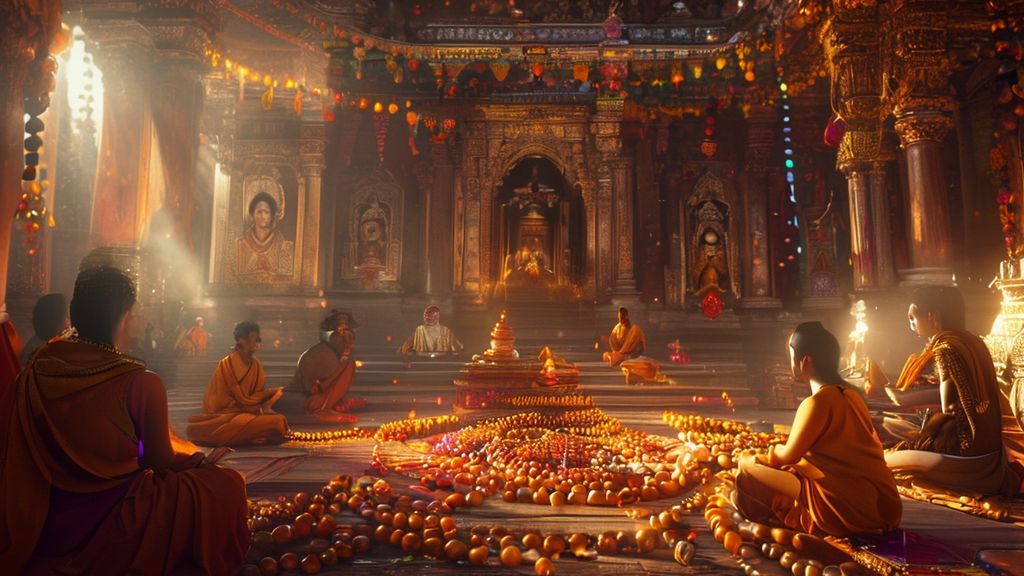
Japa Mala, sacred prayer beads, serves as an indispensable spiritual instrument in Sanatan Dharma, guiding devotees through the disciplined recitation of mantras. It facilitates heightened concentration, purifies the mind, and establishes a profound, rhythmic connection with the Divine during spiritual practices. Using a Japa Mala correctly amplifies the efficacy of one’s Sadhana, leading to deeper meditation and inner peace.
| Attribute | Details |
|---|---|
| Primary Purpose | Mantra recitation (Japa), aiding concentration, Dhyana (meditation), spiritual discipline (Sadhana). |
| Common Materials | Rudraksha (for Shiva/Shakti), Tulasi (for Vishnu/Krishna), Chandan (sandalwood), Sphatik (quartz crystal), Vaijayanti (for Vishnu/Lakshmi). |
| Number of Beads | Traditionally 108 beads plus one Meru (guru) bead, symbolizing completeness and the cosmic order. |
| Scriptural Reference | Mentioned in Tantric texts, Puranas (e.g., Devi Bhagavata Purana, Shiva Purana) discussing specific malas and their benefits. |
| Spiritual Significance | A tool for calibrating spiritual focus, counting repetitions, achieving mental tranquility, and accruing spiritual merit (Punya). |
Introduction to Japa Mala: A Sacred Aid to Spiritual Discipline
In the vast ocean of Sanatan Dharma, the practice of Japa, the repetitive chanting of sacred mantras, stands as a cornerstone of spiritual discipline. An essential companion in this profound journey is the Japa Mala, a string of beads that acts as a tangible anchor for the mind and spirit. Far more than a mere counter, the Japa Mala is a sanctified instrument, embodying centuries of spiritual wisdom and practice. It is a conduit for divine energy, a silent teacher guiding the devotee towards deeper contemplation and unwavering devotion. From the Himalayan caves to bustling city temples, the rhythmic touch of the beads against the fingers has been a constant in the pursuit of self-realization, a symbol of commitment to the chosen deity and the path of Dharma.
Puranic History and Cosmic Legends of Japa
While the exact origin of the Japa Mala as a specific physical artifact might be historically debated, the practice of Japa itself is deeply rooted in the Vedic tradition. The concept of using natural elements for counting prayers is ancient. The Rigveda and later Upanishads speak of the power of sound (Shabda Brahma) and the efficacy of mantra recitation. The Puranas extensively detail the use of various malas by deities and sages. For instance, Lord Shiva is eternally depicted with a garland of Rudraksha beads, signifying his detachment and power. The Shiva Purana eulogizes the Rudraksha, stating that merely seeing, touching, or wearing it can absolve sins and grant liberation (Moksha). Similarly, Lord Vishnu is associated with the Vaijayanti Mala, described in the Vishnu Purana as a garland symbolizing the five primal elements. Devi, in her various forms, is often adorned with malas of pearls, crystals, or seeds, each imbued with specific energies for her devotees. The Devi Bhagavata Purana elaborates on the importance of different types of malas for worshipping various forms of the Divine Mother, emphasizing that the chosen mala should resonate with the specific deity’s energy, enhancing the potency of the Japa.
The Science and Symbolism of the Mala
The Japa Mala is a marvel of spiritual engineering, meticulously designed with profound symbolism. The most striking feature is the number 108 beads, plus one Meru bead. The number 108 holds immense significance in Vedic cosmology and numerology. It is believed that there are 108 principal Upanishads, 108 sacred sites (Divya Deshams), and in astrology, 12 houses multiplied by 9 planets yields 108 possible combinations (Navagraha Chakra). Furthermore, 108 represents the journey from material existence to spiritual enlightenment (1+0+8=9, symbolizing completion and universal love). Each bead represents a single repetition of a mantra, allowing the mind to focus on the sound and meaning rather than counting. The Meru bead, or guru bead, signifies the beginning and end of a complete cycle of Japa and symbolizes the Guru’s presence and guidance. It is never crossed, but rather, the direction of chanting is reversed, honoring the Guru’s place and indicating a pause for reflection. The thread connecting the beads represents the unified consciousness, Brahman, that permeates all existence, holding disparate elements together. The knots between beads, often present in Rudraksha malas, prevent beads from touching and symbolize the individual spiritual knots (granthis) that a Sadhaka strives to untie on the path to liberation.
Rituals and Puja Vidhi: Correctly Using Your Japa Mala
Using a Japa Mala is a sacred act requiring reverence and proper technique to maximize its spiritual benefits. Follow these steps for an authentic Japa practice:
- Purification and Sankalpa: Before beginning, ensure your mala is clean and consecrated. You may purify it with Ganga Jal (Ganges water) or by chanting the Gayatri Mantra. Sit in a clean, quiet space. Establish a clear intention (Sankalpa) for your Japa, dedicating it to your chosen deity or spiritual goal.
- Holding the Mala: Hold the mala in your right hand. The beads should pass over your middle finger, with your thumb gently pulling each bead after a mantra recitation. Crucially, avoid using your index finger, as it is traditionally associated with the ego and can impede spiritual progress.
- Mantra Recitation: Begin chanting your chosen mantra. This can be silent (Manasika Japa), whispered (Upamshu Japa), or audible (Vaikhari Japa), depending on your practice. With each complete recitation of the mantra, gently pull one bead towards you with your thumb.
- Counting and the Meru Bead: Proceed around the mala, bead by bead, until you reach the Meru bead. This bead marks the completion of 108 repetitions. Do not cross the Meru bead. Instead, if you wish to continue, gently turn the mala around and proceed in the reverse direction. This symbolizes respect for the Guru and the cycle of spiritual learning.
- Mindful Engagement: The purpose of the mala is to free the mind from counting, allowing it to fully immerse in the mantra’s sound and meaning. Focus your awareness on the mantra, its vibration, and the presence of the deity.
- Storage: After Japa, store your mala in a clean, sacred pouch, preferably made of silk or cotton, away from impurities.
Mantras and Sacred Chants for Japa
The Japa Mala is a versatile tool for any mantra. Here are some fundamental mantras chanted by millions:
- Om (ॐ): The primordial sound, representing the entirety of creation.
- Om Namah Shivaya (ॐ नमः शिवाय): The Panchakshari Mantra, invoking Lord Shiva, the destroyer of ignorance.
- Om Namo Narayanaya (ॐ नमो नारायणाय): The Ashtakshari Mantra, saluting Lord Narayana (Vishnu), the preserver.
- Hare Krishna Maha Mantra: Hare Krishna Hare Krishna, Krishna Krishna Hare Hare / Hare Rama Hare Rama, Rama Rama Hare Hare. A powerful mantra for Kali Yuga, invoking divine love.
- Gayatri Mantra (ॐ भूर्भुवः स्वः तत् सवितुर्वरेण्यं भर्गो देवस्य धीमहि धियो यो नः प्रचोदयात्): A universal prayer for wisdom and enlightenment, addressed to the Sun God, Savitr.
Before beginning your Japa, it is beneficial to chant a small invocation to infuse the mala with divine energy. A traditional prayer is:
अविघ्नं कुरु माले त्वं गृह्णामि दक्षिणे करे।
जपकाले च सिद्धयर्थं प्रसीद मम सिद्धये॥
(Avighnam kuru māle tvaṃ gṛhṇāmi dakṣiṇe kare | Japakāle ca siddhyarthaṃ prasīda mama siddhaye ||)
Meaning: “O Mala, remove obstacles. I hold you in my right hand. For the accomplishment of Japa, be gracious for my success.”
Dos and Don’ts for Your Japa Mala
To maintain the sanctity and efficacy of your Japa Mala, observe these cultural and spiritual etiquettes:
- Do: Keep your mala clean and sacred.
- Do: Use clean hands when performing Japa.
- Do: Dedicate your mala to a specific mantra or deity, if possible.
- Do: Store your mala in a clean cloth pouch, preferably in your personal altar space.
- Do: Revere your mala as a divine tool and an extension of your spiritual practice.
- Don’t: Allow others to touch your Japa Mala without explicit permission, as it absorbs your personal energy.
- Don’t: Drag your mala on the floor or place it in impure locations.
- Don’t: Use your Japa Mala for purposes other than spiritual practices.
- Don’t: Cross the Meru bead; always reverse direction.
- Don’t: Wear it during activities that may be considered impure, such as visiting crematoriums, or during intimate moments.
Frequently Asked Questions About Japa Mala
Can I wear my Japa Mala?
Yes, many devotees wear their Japa Malas, especially Rudraksha or Tulasi, around their neck or wrist as a constant reminder of their devotion and for spiritual protection. However, it is generally recommended to keep it concealed beneath clothing and remove it during activities that might compromise its sanctity. For active Japa, some prefer a separate mala.
How do I choose the right Japa Mala material for myself?
The choice of mala material often depends on your chosen deity (Ishta-Devata) or specific spiritual goals. For example, Rudraksha is ideal for Shiva, Devi, and Tantric practices; Tulasi for Vishnu, Krishna, and Rama; Sphatik (crystal) for Saraswati, healing, and calming energy; and Chandan (sandalwood) for general peace and devotion. Listen to your intuition and seek guidance from a Guru if unsure.
What if a bead on my Japa Mala breaks?
If a bead breaks, it is often seen as a sign that the mala has absorbed enough negative energy or completed a cycle. You should respectfully dispose of the broken bead (e.g., in a sacred river or buried under a tree) and then repair the mala with a new bead or obtain a new one. Some interpret a broken mala as a spiritual turning point or a need to re-evaluate one’s practice.
Is there a specific time recommended for Japa?
While Japa can be performed at any time, the early morning hours, particularly during Brahmamuhurta (approximately 96 minutes before sunrise), are considered most auspicious. The atmosphere is calm, the mind is fresh, and spiritual energies are thought to be more potent. However, consistency is more important than a strict schedule; regular Japa, even for short periods, yields profound benefits.
Why This Matters for Every Hindu: Preserving Sanatan Dharma
The Japa Mala is more than an accessory; it is a profound symbol and a potent instrument for upholding and experiencing the timeless wisdom of Sanatan Dharma. In an age of relentless distraction, the mala provides a tangible link to our spiritual core, fostering focus, discipline, and a deep connection to the divine. It helps preserve the ancient practice of mantra Japa, a powerful means of purifying consciousness and realizing the self. By embracing the correct use of the Japa Mala, we not only enrich our personal spiritual journey but also contribute to the vibrant continuity of our sacred traditions. This venerable tool reminds us that true progress lies not in external acquisition but in inner transformation, guiding us towards liberation (Moksha) and unwavering devotion. Explore more on Sanatan Dharma practices and their significance at Hindutva.online. Engaging with the Japa Mala is a step towards a more mindful, devotional, and Dharmic life, anchoring us in the eternal truths taught by our Rishis.