


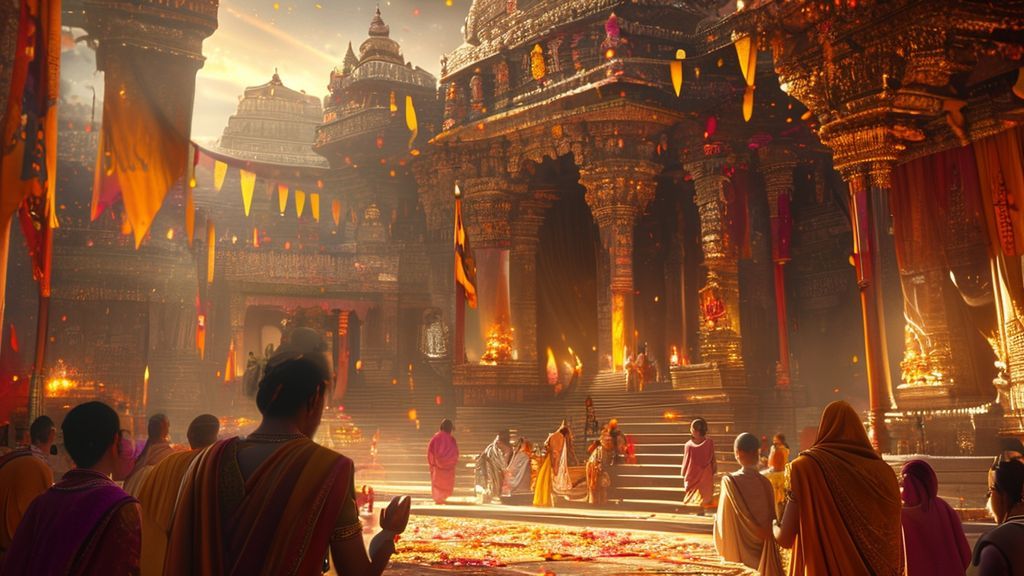
Kathak, one of India’s pre-eminent classical dance forms, is a sublime art of storytelling originating from ancient `Kathakars` (storytellers) who narrated epic tales through song, dance, and mime. Rooted deeply in Sanatan Dharma, this devotional expression, characterized by intricate footwork, graceful pirouettes, and evocative `abhinaya` (expression), serves as a profound medium for conveying spiritual narratives and philosophical truths.
| Attribute | Details |
|---|---|
| Deity Associated | Nataraja (Lord Shiva as the Cosmic Dancer), Saraswati (Goddess of Arts and Learning), Krishna (through `Rasa Lila` narratives). |
| Location/Origin | Northern India, particularly Uttar Pradesh (Lucknow, Jaipur, Benares `gharanas`). |
| Key Festival | Mahashivaratri (honouring Nataraja), Basant Panchami (Saraswati Puja), Janmashtami (Krishna’s birth, inspiring `Rasa Lila`). |
| Scripture Reference | `Natyashastra` by Bharata Muni, `Bhagavata Purana`, `Ramayana`, `Mahabharata`. |
The Sacred Narrative: Kathak’s Spiritual Significance
Kathak, whose very name derives from the Sanskrit word `katha` (story) and `kathakar` (storyteller), represents a living continuum of India’s ancient `parampara` (tradition) of sacred narrative. It is far more than mere entertainment; it is a profound devotional practice, a `sadhana` (spiritual discipline) through which the dancer becomes a conduit for divine stories and emotions. For millennia, `Kathakars` served as custodians of cultural and religious knowledge, ensuring the timeless wisdom of the Vedas, Puranas, and Itihasas resonated within the hearts of common folk. This exquisite dance form embodies the Hindu philosophy of art as a path to `moksha` (liberation), where aesthetic experience (`rasanubhuti`) elevates the soul, drawing it closer to the divine. It exemplifies how the physical body, through rigorous training and spiritual dedication, can transcend its material limitations to express the ineffable truths of Sanatan Dharma.
From Ancient Temples to Royal Courts: The Puranic History & Legend of Kathak
The genesis of Kathak is inextricably linked to the devotional fervour that characterized ancient Hindu society. Its roots can be traced back to the `Natyashastra`, the foundational treatise on performing arts attributed to Bharata Muni, believed to have been compiled between 200 BCE and 200 CE. This encyclopedic text outlines the principles of `nritta` (pure dance), `nritya` (expressive dance), and `natya` (drama), all integral to Kathak. The `Kathakars` of yore were temple performers, narrating episodes from the `Ramayana`, `Mahabharata`, and various `Puranas`, especially the `Bhagavata Purana`, which vividly describes Lord Krishna’s divine `lilas` (plays) and the mesmerizing `Rasa Lila` with the `gopis`. These performances, often conducted within the `mandapa` (hall) of temples, were `seva` (service) to the presiding deity, intended to invoke `bhakti` (devotion) among the congregation. As mentioned in the `Kashi Khanda` of the `Skanda Purana`, various forms of sacred performances were part of temple rituals, ensuring spiritual upliftment and cultural transmission.
During the Bhakti movement, Kathak flourished as a popular medium for propagating the devotional tenets, particularly focusing on the lives of Krishna and Radha. The art form later transitioned to the courts of Mughal emperors and Hindu kings, where it underwent significant refinement. While retaining its spiritual core, it absorbed Persian influences, leading to the development of complex rhythmic patterns and a greater emphasis on `nritta`. This period saw the emergence of the distinct `gharanas` (schools) – Lucknow, Jaipur, and Benares – each with its unique aesthetic and technical emphasis, yet all preserving the fundamental spirit of storytelling and devotion. This rich historical trajectory showcases Kathak’s adaptability and enduring commitment to narrating India’s spiritual heritage.
Architectural Harmony & Scientific Precision: Kathak’s Interplay with Design and Cosmology
While Kathak is not a static architectural marvel, its very structure and performance embody principles found in ancient Indian architecture and scientific thought. The temple, as the original stage for `Kathakars`, influenced the performance space and the spiritual aura of the dance. The intricate carvings and depictions of dancers and musicians on temple walls, particularly in places like Khajuraho or Konark, serve as visual parallels to Kathak’s expressive `mudras` and `bhavas`. These sculptures often illustrate poses and narratives that resonate with the dance’s vocabulary, suggesting a shared aesthetic and spiritual iconography.
Scientifically, Kathak’s profound reliance on `tala` (rhythmic cycle) and `laya` (tempo) reflects ancient Indian understanding of mathematical precision and cosmic order. The complex `bols` (rhythmic syllables) articulated through `tatkar` (footwork) are not random but follow an intricate mathematical progression, mirroring the astronomical calculations found in ancient texts. The `chakkar` (pirouettes), executed with breathtaking speed and control, represent the cyclical nature of time and creation (`kala chakra`). The harmony between `abhinaya` (expression) and `nritta` (pure dance) is akin to the balance between form and function in temple architecture, where every element contributes to a unified, spiritually charged whole. The dancer, through perfect alignment and controlled movement, emulates the equilibrium inherent in the cosmos, making the performance a microcosmic representation of divine order.
The Sacred Offering: Rituals & Puja Vidhi in Kathak Performance
A Kathak performance, especially in its traditional setting, is imbued with the solemnity of a `puja` (worship). It begins not merely as an act but as a sacred offering. The journey of a Kathak dancer is a continuous `sadhana`, a devotion expressed through tireless practice and spiritual dedication. Here is a typical ritualistic progression:
- `Rangamanch Pravesh` (Entry onto Stage): The dancer enters the stage with humility and reverence, often bowing to the stage (`bhumi pranam`), acknowledging it as a sacred space and a representation of the divine.
- `Pushpanjali` (Offering of Flowers) / `Vandana` (Invocation): The performance commences with an invocation to deities like Ganesha (remover of obstacles), Saraswati (goddess of knowledge and arts), and Nataraja (Lord Shiva, the cosmic dancer). This may involve a devotional song (`bhajan`) or a pure dance piece (`thumri`) in praise of the chosen deity.
- `Amad` (Entry): A formal, grand entry piece, often involving a stately walk and opening `bols` (rhythmic phrases) that announce the dancer’s presence and technical prowess.
- `Thaat` (Poetic Movement): A graceful, slow, and aesthetic movement where the dancer assumes a pose, establishing the visual beauty and emotional depth of the dance.
- `Nritta` (Pure Dance): This section showcases technical brilliance, focusing on `tala`, `laya`, and intricate `tatkar` (footwork). It includes `todas`, `tukras`, `parans`, and `tihais`, all complex rhythmic compositions.
- `Nritya` (Expressive Dance) / `Abhinaya`: Here, the storytelling aspect takes prominence. The dancer interprets `bhajans`, `ghazals`, or `thumris`, conveying `rasas` (emotions) and narratives through `mudras` (hand gestures), `bhavas` (facial expressions), and body language. Lord Krishna’s `lilas` are a frequent theme.
- `Tarana` or `Tillana` (Concluding Nritta): A vibrant and fast-paced pure dance piece that brings the performance to a crescendo, often culminating in an elaborate `tihais` and `chakkars` (pirouettes).
- `Samapan` (Conclusion): The dancer concludes the performance with a final bow, often touching the earth again, expressing gratitude and humility, signifying the completion of the sacred offering.
Mantras & Chants: Echoes of the Divine in Kathak
Devotion in Kathak is often deepened through the chanting of specific mantras and `stutis` (hymns). Dancers and gurus frequently invoke the blessings of deities before and during their practice. These chants not only purify the atmosphere but also attune the artist to higher vibrations, enhancing their connection to the divine source of art.
Saraswati Vandana: For artistic grace and wisdom.
या कुन्देन्दुतुषारहारधवला या शुभ्रवस्त्रावृता ।
या वीणावरदण्डमण्डितकरा या श्वेतपद्मासना ॥
या ब्रह्माच्युतशंकरप्रभृतिभिर्देवैः सदा वन्दिता ।
सा मां पातु सरस्वती भगवती निःशेषजाड्यापहा ॥
(Meaning: “May that Goddess Saraswati protect me, who is white like the Kunda flower, the moon, or a snow garland, who is clad in white, whose hands are adorned with a Veena, who is seated on a white lotus, who is always worshipped by Brahma, Vishnu, and Shiva. May she remove all my inertness and dullness.”)
Nataraja Stuti: For the cosmic dance and rhythm.
आनन्द ताण्डव रसानन्द शिवं शिवम्।
शंभो शंभो शिवं शिवं हर हर हर शिवं शिवम्॥
(Meaning: “Shiva, who dances the blissful cosmic dance, Shiva, the benevolent one. Shambho, Shiva, Hara, the benevolent one.”)
Guru Vandana: Honoring the spiritual teacher.
गुरुर्ब्रह्मा गुरुर्विष्णुः गुरुर्देवो महेश्वरः ।
गुरुः साक्षात् परब्रह्म तस्मै श्री गुरवे नमः ॥
(Meaning: “The Guru is Brahma, the Guru is Vishnu, the Guru is verily the great Lord Maheshwara. The Guru is directly the Supreme Brahman, to that revered Guru, I offer my salutations.”)
Dos and Don’ts for the Sincere Devotee and Art Connoisseur
To truly appreciate and uphold the sanctity of Kathak, both performers and audience members must adhere to certain dharmic etiquettes:
- DO approach the dance with reverence, understanding its spiritual roots and devotional intent.
- DO applaud gracefully and respectfully, especially after intricate `nritta` sections or evocative `abhinaya`.
- DO dress modestly and appropriately when attending a classical Kathak performance, especially in a temple or traditional setting.
- DO learn about the stories and `rasas` being depicted to deepen your appreciation of the `abhinaya`.
- DON’T interrupt the performance with loud conversations or inappropriate behaviour.
- DON’T use flash photography or engage in recording without explicit permission, as it can be distracting and disrespectful.
- DON’T clap during the intricate rhythmic cycles (`tihais`) as it can disturb the artist’s concentration and the `laya` of the music.
- DON’T treat Kathak solely as a form of entertainment; recognize it as a profound cultural and spiritual offering.
What is the spiritual significance of Kathak’s intricate footwork?
The intricate footwork (`tatkar`) in Kathak, characterized by precise rhythmic patterns and the resounding `ghungroos` (ankle bells), signifies more than mere technical prowess. It is a meditative practice, a dialogue between the dancer’s body and the cosmic rhythm (`kala`). Each beat, each turn, represents a connection to the primordial sound (`nada`) and the cyclical nature of creation. It is a devotion performed through synchronized movement, grounding the dancer in the present moment while elevating their consciousness towards the divine `tala` of the universe. This rigorous discipline purifies the body and mind, making the dancer a vessel for higher expression.
How does Kathak preserve Hindu mythology and philosophy?
Kathak fundamentally preserves Hindu mythology and philosophy by transforming ancient scriptures and epic tales into a living, breathing art form. Through `abhinaya` (expression), dancers embody characters from the `Ramayana`, `Mahabharata`, and `Puranas`, making these narratives accessible and emotionally resonant. The tales of Krishna’s `lilas`, Shiva’s `tandava`, and the adventures of Rama and Sita are not just recited but *experienced* by the audience, fostering `bhakti` (devotion) and transmitting ethical and philosophical lessons. The dance serves as a dynamic `dharma grantha`, a sacred text in motion, ensuring the continuity of Sanatan values across generations. More resources can be found at Hindutva.online.
What role do the `ghungroos` play in Kathak’s spiritual journey?
The `ghungroos`, or ankle bells, are not merely an accessory but an integral sacred instrument in Kathak. Tied securely around the dancer’s ankles, they symbolize the resonance of `nada brahma`, the cosmic sound. Each step, each rhythmic pattern articulated by the `ghungroos`, becomes an offering of sound to the divine. The sound of the bells helps the dancer maintain `tala` and `laya`, but more importantly, it is believed to create a spiritual vibration that purifies the performance space and evokes a meditative state for both the performer and the audience. They are consecrated objects, treated with utmost respect, signifying the dancer’s dedication to their art as a form of worship.
Why This Matters for Every Hindu: Kathak as a Living Dharma
Kathak is a radiant jewel in the crown of Sanatan Dharma, a testament to the enduring power of art as a spiritual force. For every Hindu, understanding and cherishing Kathak is not merely an appreciation of cultural heritage; it is an affirmation of our deep-seated `dharma`. This dance form is a living `veda`, conveying profound spiritual truths through aesthetic beauty. It teaches discipline, devotion, and the art of storytelling – skills essential for preserving our `itihaas` and transmitting timeless wisdom. In an age of fleeting trends, Kathak stands as an unwavering pillar, reminding us of the cosmic rhythm (`Rta`) that governs existence and the inherent divinity within every creative act. By supporting and engaging with Kathak, we not only honour our ancestors but also contribute to the spiritual enrichment of future generations, ensuring that the flame of Sanatan Dharma continues to burn brightly. Explore more on the depth of Hindu traditions at Hindutva.online.