


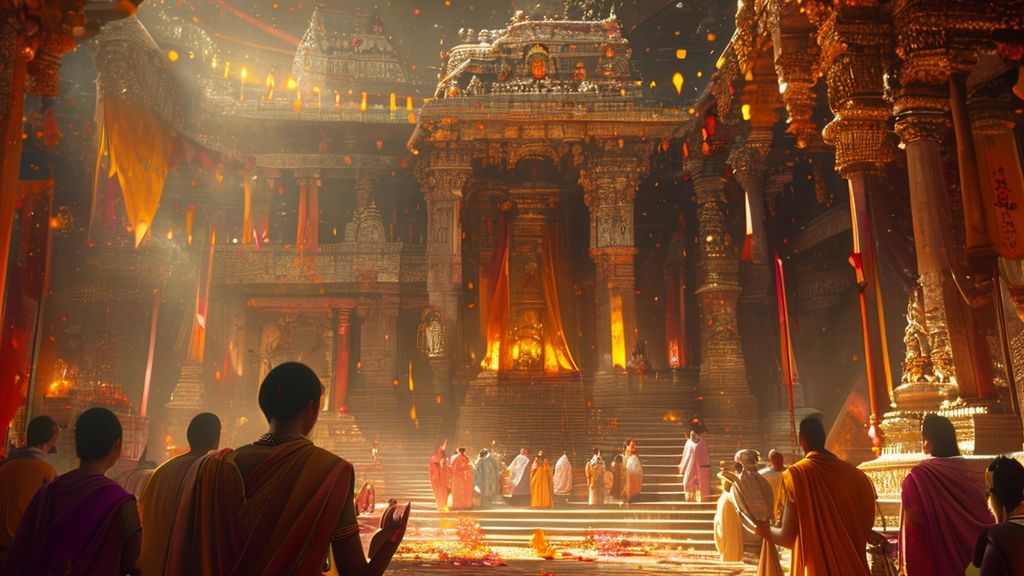
Lalita Sahasranamam is a sacred Hindu text, a profound hymn detailing the 1,000 glorious names of the Divine Mother, Goddess Lalita Tripurasundari. Originating from the Brahmanda Purana, it serves as a central devotional practice in Shaktism, offering immense spiritual benefits, deep philosophical insights, and a direct path to experiencing the ultimate reality of Devi as the supreme Brahman.
| Attribute | Details |
|---|---|
| Deity | Devi Lalita Tripurasundari (Adi Shakti, Para Brahman) |
| Location/Origin | Naimisharanya Forest, as narrated by Hayagriva to Agastya Rishi |
| Key Festival | Navaratri, especially Lalita Panchami, Purnima (full moon) days |
| Scripture Reference | Brahmanda Purana (Uttar Khanda), particularly the Lalita Mahatmyam |
| Composer | The eight Vagdevatas (Vasini, Kameshvari, Modini, Vimala, Aruna, Jayini, Sarveshvari, Kaulini) under Devi’s direct command |
Introduction: Unveiling the Supreme Mother’s Glory
The Lalita Sahasranamam stands as a resplendent jewel in the crown of Sanatan Dharma, particularly for devotees of the Divine Mother. It is not merely a compendium of names but a profound spiritual treatise, a sacred map to understanding the multifaceted nature of Goddess Lalita Tripurasundari – the most beautiful in the three worlds, the presiding deity of the Shri Chakra, and the embodiment of absolute consciousness (Chit-Shakti). Each of the thousand names (सहस्रनाम – Sahasranama) is a potent Bija Mantra, encapsulating an aspect of her form, attributes, powers, and cosmic functions. Chanting this hymn is believed to purify the mind, grant material prosperity, dissolve karmic impediments, and ultimately lead to self-realization and liberation (मोक्ष – Moksha).
For millennia, sages, rishis, and earnest seekers have found solace, strength, and enlightenment through the devotional recitation of these sacred names. It is a testament to the boundless compassion and infinite majesty of the Mother Principle, acknowledging Devi as the primordial energy that creates, sustains, and dissolves all existence. This guide offers an authoritative insight into its divine origin, its profound structure, and the proper methods for its devotional practice, serving as a beacon for all who seek to connect with the ultimate reality of Hindutva.online.
Puranic History & Legend: The Divine Revelation
The genesis of the Lalita Sahasranamam is beautifully narrated in the Brahmanda Purana, specifically within the Lalita Mahatmyam of its Uttar Khanda. The story unfolds in the sacred Naimisharanya forest, where a gathering of sages sought spiritual guidance from the great sage Suta. Suta Rishi, in turn, recounted the conversation between the venerated Rishi Agastya and Lord Hayagriva, an incarnation of Vishnu and the repository of all wisdom.
Agastya, renowned for his intense devotion to Devi, was deeply distraught by the proliferation of negative forces and the suffering they caused. He earnestly prayed to Lord Hayagriva, seeking a powerful and universal means to worship the Supreme Mother, one that would grant both worldly prosperity (भुक्ति – Bhukti) and spiritual liberation (मुक्ति – Mukti). He specifically requested a Sahasranamam that was untainted by repetition of names (पुनरुक्ति दोष – Punarakti Dosha), free from the error of containing short, meaningless names (अल्प नामत्व – Alpa Nāmātva), and devoid of fear-inducing or inauspicious names (भीमा नामत्व – Bhīmā Nāmātva). Such a pure and potent hymn, he knew, would be the greatest boon to humanity.
In response, Lord Hayagriva revealed the divine origin of the Lalita Sahasranamam. He explained that Devi Lalita Tripurasundari herself, having annihilated the formidable demon Bhandasura, commanded the eight celestial deities known as the Vagdevatas (वाग्देवताः) to compose this unparalleled hymn. The Vagdevatas – Vasini, Kameshvari, Modini, Vimala, Aruna, Jayini, Sarveshvari, and Kaulini – are the goddesses of speech, poetry, and knowledge. Under Devi’s direct inspiration, they spontaneously articulated these thousand sacred names, each one a perfect expression of her glorious being.
The context of Bhandasura’s destruction is crucial. Bhandasura was born from the ashes of Kama Deva, who was immolated by Lord Shiva’s third eye. His oppressive reign symbolized ignorance, ego, and the materialistic tendencies that bind souls. Devi Lalita emerged from a great Yajna fire (चिदग्नि कुण्ड सम्भूता – Chidagni Kunda Sambhuta) performed by the Devas, specifically to vanquish Bhandasura and re-establish Dharma. The recitation of her names celebrates this divine victory and her role as the cosmic savior.
Philosophical & Structural Marvels of Lalita Sahasranamam
While the concept of “Architectural Marvels” might not apply literally to a spiritual text, the Lalita Sahasranamam is a profound marvel of spiritual engineering and philosophical exposition. Its structure is meticulously crafted, reflecting the entire spectrum of Devi’s manifestation, from the subtle to the gross, from the transcendental to the immanent.
- Systematic Progression: The names are arranged not randomly, but with a logical and devotional flow. They begin by describing Devi’s transcendental nature (परब्रह्म स्वरूपिणी – Parabrahma Swarupini), her divine form (रूपम् – Rupam), her abode (श्रीपुर – Shripura), her attendants, her weapons, and her heroic exploits against Bhandasura. Subsequently, they delve into her various attributes (गुणम् – Gunam) as the mother of the universe, the bestower of boons, the dispeller of fear, and the embodiment of wisdom. Finally, they reveal her as the ultimate reality (सच्चिदानंद रूपिणी – Satchidananda Rupini), the Self within all beings, leading the devotee through a journey from external worship to internal realization.
- Each Name a Mantra: Every single name (नाम – Nama) in the Sahasranamam is considered a powerful mantra in itself, capable of invoking a specific aspect of Devi’s energy. This makes the text an inexhaustible source of spiritual power, with each recitation serving as a concentrated act of devotion and meditation.
- Integration with Shri Chakra: Many names subtly refer to the geometry and symbolism of the Shri Chakra, the most revered yantra in Shaktism. Devi Lalita Tripurasundari is the “Shri Chakraraja Nilaya” (residing in the king of chakras) and “Shri Chakraraja Simhasaneshwari” (seated on the throne of the king of chakras). The progression of names often mirrors the ascent through the various layers (आवर्ण – Avarana) of the Shri Chakra, guiding the practitioner towards the central bindu (बिन्दु – Bindu), where Devi resides.
- Non-Dual Philosophy (Advaita): The Sahasranamam beautifully encapsulates the tenets of Advaita Vedanta and Kashmiri Shaivism, asserting Devi as the supreme Brahman, non-dual, beyond attributes, yet manifesting as the entire universe. Names like “शिव शक्ति ऐक्य रूपिणी” (Shiva Shakti Aikya Rupini – the form of unity of Shiva and Shakti) emphasize her identity with the ultimate reality, transcending all distinctions.
Rituals & Puja Vidhi: Chanting the Divine Names
Reciting the Lalita Sahasranamam is a powerful form of worship (पारायण – Parayana). While devotion (भक्ति – Bhakti) is paramount, following a structured approach enhances the spiritual benefits.
- Purification (शुद्धि – Shuddhi): Begin with a refreshing bath and wear clean clothes. Ensure your body and mind are pure.
- Preparation of Space: Choose a clean, quiet space. Place an image or idol of Devi Lalita, preferably on an altar. Light a lamp (दीपक – Deepaka) and incense sticks (धूप – Dhupa). Offer flowers, fruits, and a small quantity of sweets (नैवेद्य – Naivedya).
- Sankalpa (संकल्प – Sankalpa): Formally state your intention for performing the recitation. This involves stating your name, gotra, the date (tithi), and the specific purpose of the chanting, e.g., “For the spiritual welfare of all beings,” or “For attaining Devi’s grace.”
- Guru Vandana (गुरु वन्दन – Guru Vandana): If you have a Guru, mentally or verbally offer salutations to them. Seek their blessings for the successful completion of the puja.
- Dhyanam (ध्यानम् – Dhyanam): Meditate on the glorious form of Devi Lalita Tripurasundari as described in the Dhyana Shlokas (meditation verses) preceding the Sahasranamam. Visualize her radiant, benevolent, and omnipotent presence.
- Recitation (पारायणम् – Parayanam): Begin chanting the Sahasranamam with reverence and concentration. Each name can be preceded by “Om” (ॐ) and followed by “Namaha” (नमः) if desired, e.g., “ॐ श्री माता नमः” (Om Shri Mata Namaha). Maintain a steady pace, focusing on the meaning and sound vibrations.
- Archana (अर्चन – Archana): While chanting, you may offer flowers, kumkum, or akshata (rice grains mixed with turmeric) at the feet of the Devi’s image for each name or in groups of names.
- Phala Shruti (फल श्रुति – Phala Shruti): After completing the 1000 names, recite the “Phala Shruti” section, which details the immense benefits and spiritual rewards of chanting the Lalita Sahasranamam. This reinforces faith and gratitude.
- Mangala Arati (मंगल आरती – Mangala Arati) & Pradakshina (प्रदक्षिणा – Pradakshina): Conclude with an Aarti, waving a lamp before the deity, and perform circumambulations.
- Prayer & Pranama (प्रणाम – Pranama): Offer a final prayer, express gratitude, and bow down, surrendering the fruits of your worship to Devi.
Mantras & Chants: Invoking Devi’s Presence
Before embarking on the full Sahasranamam, it is customary to chant certain introductory mantras and Dhyana Shlokas to invoke Devi’s presence and prepare the mind.
Dhyana Shlokas (Meditation Verses)
One of the most common Dhyana Shlokas, found at the beginning of the Lalita Sahasranamam, describes Devi’s sublime form:
अरुणां करुणा तरङ्गिताक्षीं, धृतपाशाङ्कुश पुष्पबाणचापाम् ।
अणिमादिभिरावृतां मयूखैः, अहमित्येव विभावये भवानीम् ॥
“Aruṇāṁ karuṇā taraṅgitākṣīṁ, dhṛtapāśāṅkuśa puṣpabāṇacāpām.
Aṇimādibhirāvr̥tāṁ mayūkhaiḥ, ahamityeva vibhāvaye bhavānīm.”
Meaning: “I meditate upon Bhavani, who is crimson in color, whose eyes are filled with waves of compassion, who holds in her hands the noose, the goad, the flowery arrows, and the bow. She is surrounded by rays of light, accompanied by the Siddhis like Anima, and I meditate upon her as my very self.”
Key Names from the Sahasranamam
While all 1000 names are potent, some are particularly significant and can be chanted individually or as part of other pujas:
- ॐ श्री माता नमः (Om Shri Mata Namaha) – Salutations to the Respected Mother.
- ॐ श्री महाराजाज्ञी नमः (Om Shri Maharajagyi Namaha) – Salutations to the Supreme Empress.
- ॐ श्रीमत्सिंहासनेश्वरी नमः (Om Shrimatsimhasaneshvari Namaha) – Salutations to the Goddess seated on the auspicious throne.
- ॐ चिदग्नि कुण्ड संभूतायै नमः (Om Chidagni Kunda Sambhutayai Namaha) – Salutations to her who emerged from the fire-pit of consciousness.
- ॐ ललितांबिकायै नमः (Om Lalitambikayai Namaha) – Salutations to the Divine Mother Lalita.
Dos and Don’ts for Chanting Lalita Sahasranamam
Adherence to certain principles enhances the efficacy and spiritual benefit of chanting this sacred hymn.
Dos:
- Maintain Purity: Chant with a clean body and mind.
- Devotion and Focus: Approach the recitation with utmost faith (श्रद्धा – Shraddha) and concentration.
- Understand Meanings: Even a basic understanding of the names’ meanings deepens the meditative experience. Many commentaries are available at Hindutva.online.
- Regular Practice: Consistency is key. Daily or weekly recitation yields profound results over time.
- Respect the Text: Treat the Sahasranamam as a living embodiment of Devi herself.
- Be Humble: Approach Devi with a sense of humility and surrender.
Don’ts:
- Lack of Cleanliness: Do not chant in an impure state.
- Distractions: Avoid distractions like mobile phones or engaging in conversations during recitation.
- Ego or Arrogance: Do not chant with a sense of superiority or to show off.
- Disrespect: Never treat the names lightly or use them irreverently.
- Negative Intent: Do not chant with harmful or selfish intentions towards others.
- Rushing: Avoid chanting too quickly without proper pronunciation or internalizing the meaning.
Frequently Asked Questions
Who composed the Lalita Sahasranamam?
The Lalita Sahasranamam was composed by the eight celestial Vagdevatas (goddesses of speech and poetry) – Vasini, Kameshvari, Modini, Vimala, Aruna, Jayini, Sarveshvari, and Kaulini – under the direct command and inspiration of Devi Lalita Tripurasundari herself. This ensures its divine purity and potency.
What are the primary benefits of chanting Lalita Sahasranamam?
Chanting the Lalita Sahasranamam bestows numerous benefits as described in its Phala Shruti. These include purification of sins, removal of obstacles, attainment of wealth, health, progeny, and protection from all evils. On a spiritual level, it grants wisdom, devotion, peace of mind, self-realization, and ultimately, liberation (Moksha) by realizing the non-duality with the Divine Mother.
Is it necessary to have initiation (Diksha) to chant Lalita Sahasranamam?
While initiation (Diksha) from a qualified Guru can undoubtedly deepen one’s practice and understanding, it is not strictly mandatory for chanting the Lalita Sahasranamam. The Phala Shruti explicitly states that anyone, irrespective of caste, creed, or gender, can chant it with devotion and sincerity to receive Devi’s blessings. It is considered a universal hymn accessible to all sincere seekers.
Can men chant the Lalita Sahasranamam, or is it exclusively for women?
The Lalita Sahasranamam is a universal hymn meant for all sincere devotees of the Divine Mother, regardless of gender. Many great male sages, including Agastya Rishi himself, and countless male practitioners throughout history, have chanted it and attained profound spiritual benefits. Devi’s grace is equally available to all who approach her with pure devotion.
Dharmic Significance: Preserving Sanatan Dharma Through Devi’s Names
The Lalita Sahasranamam is far more than a devotional hymn; it is a foundational pillar of Sanatan Dharma, preserving and propagating the profound truths of Shaktism. In a world increasingly beset by distractions and materialistic pursuits, the Sahasranamam serves as a potent spiritual anchor, reminding us of the ultimate reality of the Divine Mother as the source and sustainer of all existence.
Through its thousand names, it teaches us that divinity is not a distant, abstract concept, but an all-pervading, benevolent, and dynamic force intimately connected to every aspect of our lives. It fosters a deep sense of reverence for the feminine principle (शक्ति – Shakti), reminding us of the cosmic balance between Shiva (consciousness) and Shakti (energy). By internalizing these names, devotees purify their consciousness, align themselves with divine will, and contribute to the collective spiritual upliftment of humanity. The practice of chanting Lalita Sahasranamam is, therefore, a sacred act that not only benefits the individual but also reinforces the timeless values and spiritual heritage of Sanatan Dharma for generations to come.