


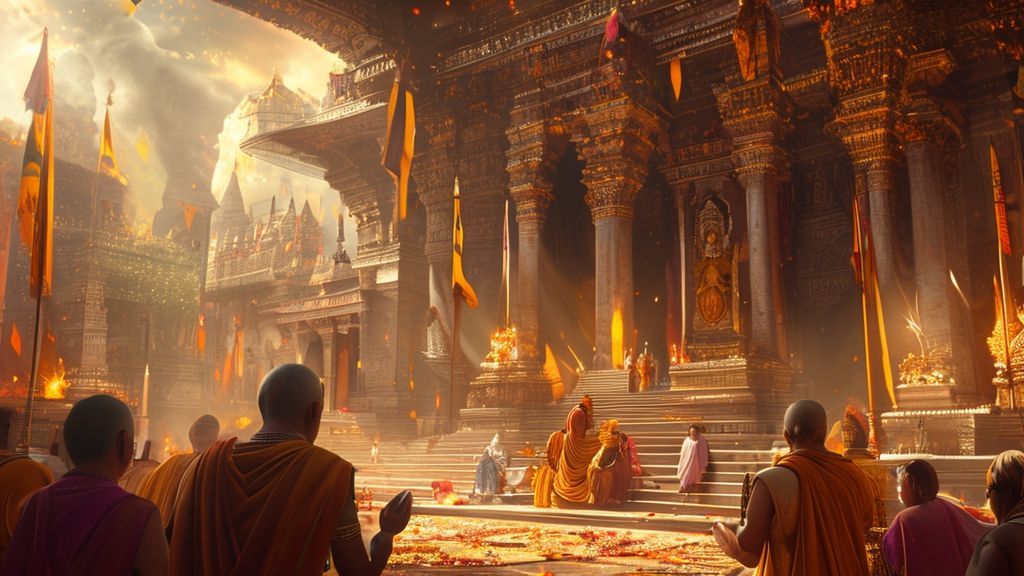
Madhvacharya (c. 1238-1317 CE), revered as Purna Prajna and Ananda Tirtha, is the illustrious founder of the Dvaita (dualistic) school of Vedanta. A direct incarnation of Vayu Deva, he vehemently asserted the fundamental, eternal distinction between God (Brahman), the individual soul (Jiva), and matter (Jagat), presenting a profound philosophical framework vital to Sanatan Dharma.
| Attribute | Details |
|---|---|
| Deity (Incarnation) | Vayu Deva (Chief Prana), as foretold in the Mahabharata Tatparya Nirnaya. |
| Location/Origin | Pajaka Kshethra, near Udupi, Karnataka, Bharatavarsha. |
| Key Festival | Madhva Navami (Shukla Paksha Navami in Magha month), commemorating his disappearance. |
| Scripture Reference (Key Works) | Gita Bhashya, Brahma Sutra Bhashya, Mahabharata Tatparya Nirnaya, Sarva Moola Granthas (37 works). |
The Guiding Light of Dvaita Siddhanta
In the vast ocean of Sanatan Dharma, Acharya Madhva shines as a beacon of unyielding devotion and intellectual prowess. His Dvaita (द्वैत) philosophy stands as one of the three foundational pillars of Vedanta, alongside Advaita and Vishishtadvaita. Madhvacharya’s teachings brought a renewed vigor to the Bhakti movement, emphasizing the supreme transcendence and absolute independence of Lord Vishnu (Hari), thereby offering solace and spiritual clarity to countless seekers across Bharatavarsha. His system, often called Hindutva.online Tatvavada (the philosophy of truth), meticulously delineates the reality of the universe and the distinct nature of the divine, the soul, and matter, countering monistic interpretations prevalent in his era.
Puranic History & Divine Lineage
The advent of Madhvacharya was no ordinary event; it was a divine manifestation. Born Vasudeva in 1238 CE in Pajaka Kshethra, Karnataka, to Madhyageha Bhatta and Vedavati, his birth was prophesied. As recounted in his own work, the Mahabharata Tatparya Nirnaya, and extensively in the Sumadhva Vijaya by Narayana Panditacharya, he is identified as the third incarnation of Vayu Deva, following Hanuman and Bhima. From a tender age, Vasudeva displayed extraordinary intellectual acumen and a profound spiritual inclination, performing miracles and engaging in deep philosophical discussions that astonished even seasoned scholars.
At the age of eleven, he renounced the world, taking Sannyasa from Achyutapreksha, an Advaita scholar, who bestowed upon him the name Purna Prajna (पूर्णप्रज्ञ). Later, due to his profound insights into the nature of bliss, he became known as Ananda Tirtha (आनंदतीर्थ). He undertook extensive tours across Bharatavarsha, engaging in debates with prominent scholars of various schools, including Kashmir and Gaya, consistently establishing the supremacy of Dvaita Siddhanta. His pilgrimage to Badarikashrama led him to meet none other than Vedavyasa himself, from whom he received direct instruction and permission to write his commentary on the Brahma Sutras, the Brahma Sutra Bhashya.
Philosophical & Epistemological Foundations of Dvaita
While Madhvacharya did not establish architectural marvels in the traditional sense, his philosophical edifice is a profound intellectual marvel. His Dvaita Siddhanta is built upon the fundamental premise of Pancha Bheda (पंच भेद) – the five eternal, irreducible differences:
- Difference between God and the individual soul (Ishvara-Jiva Bheda).
- Difference between God and matter (Ishvara-Jagat Bheda).
- Difference between one individual soul and another (Jiva-Jiva Bheda).
- Difference between the individual soul and matter (Jiva-Jagat Bheda).
- Difference between one form of matter and another (Jagat-Jagat Bheda).
Central to his philosophy is the principle of Hari Sarvottamatva (हरि सर्वोत्तमत्व) – the supremacy of Lord Hari (Vishnu) as the independent, all-powerful, and transcendental reality. All other entities, including souls and matter, are eternally distinct and dependent on Him. Complementary to this is Vayu Jivottamatva (वायु जीवोत्तमत्व), which posits Vayu Deva as the highest among all Jivas, the chief intermediary between the individual souls and the Supreme Lord, facilitating spiritual knowledge and liberation.
Madhvacharya’s epistemological framework accepts three Pramanas (sources of valid knowledge): Pratyaksha (perception), Anumana (inference), and Shabda (scriptural testimony). He emphasized that the Vedas, Puranas, and Itihasas (especially the Mahabharata and Bhagavata Purana) are the authoritative sources for understanding the true nature of reality, and they must be interpreted harmoniously to reveal the Dvaita truth.
Rituals & Puja Vidhi in Dvaita Tradition
Devotees following the Dvaita tradition adhere to a strict regimen of worship, centered on the personal devotion to Lord Vishnu. The core of this practice is the unwavering belief in Hari’s absolute supremacy and the soul’s eternal servitude to Him. The daily Puja Vidhi typically involves:
- Sankalpa: A solemn resolve to perform the worship, invoking the Lord’s blessings.
- Avahana: Inviting the deity to be present in the idol or image.
- Upacharas: Offering various services such as Padya (water for feet), Arghya (water for hands), Achamaniya (sipping water), Snana (bathing), Vastram (clothing), Yajnopavita (sacred thread), Gandha (fragrances), Pushpa (flowers), Dhupa (incense), Deepa (lamp), Naivedyam (food offering), Tambula (betel leaves).
- Archana: Chanting the Sahasranama (thousand names) or Ashtottarashata Namavali (108 names) of Lord Vishnu.
- Mantra Japa: Repeated recitation of specific mantras dedicated to Lord Vishnu.
- Stuti and Prarthana: Praising the Lord and offering prayers for spiritual upliftment.
- Mangala Arati: Waving a lamp before the deity.
- Pradakshina and Namaskara: Circumambulation and prostration before the deity.
- Visarjana/Prasada Svikara: Bidding farewell to the deity (if not a permanent idol) and partaking of the blessed food (Prasada).
The worship is always performed with the understanding that the devotee is a servant of Lord Hari, and liberation (Moksha) is achieved through His grace (Anugraha), earned through sincere Bhakti and righteous conduct.
Mantras & Chants for Devotees
The Dvaita tradition encourages chanting various Vishnu mantras to deepen devotion and connect with the Supreme Lord. Some significant ones include:
- The simple yet potent “Om Namo Narayanaya” (ॐ नमो नारायणाय).
- The Dwadasha Akshari Mantra: “Om Namo Bhagavate Vasudevaya” (ॐ नमो भगवते वासुदेवाय).
- Specific mantras from the Puranas, such as those dedicated to Sri Krishna or Sri Rama.
- For devotees wishing to honor Acharya Madhva himself, the Dhyana Shloka:
“वन्देऽहं मध्वमाद्यं त्रिभुवनमहितं सत्यसिद्धान्तरम्यम्।
वेदव्यासं गुरुं मे प्रणमति च सदा पूर्णबोधाभिरामम्।।”
(Vande’ham Madhvamadyam Tribhuvanamahitam Satyasiddhantaramyam।
Vedavyāsam Gurum Me Pranamati Cha Sada Purnabodhābhiramam।।)
(I bow to Madhva, the primal one, worshipped in the three worlds, delightful with his true Siddhanta. He ever bows to my Guru Vedavyasa, enchanting with his perfect knowledge.)
Dos and Don’ts for Dvaita Adherents
- Do: Engage in rigorous study of the Puranas, Upanishads, and Acharya Madhva’s Sarva Moola Granthas under a qualified Guru.
- Do: Observe Ekadashi fasts and other Vratas dedicated to Lord Vishnu with utmost sincerity.
- Do: Cultivate virtues such as compassion, truthfulness, humility, and detachment (Vairagya).
- Do: Always remember Lord Hari’s absolute independence and your complete dependence on Him.
- Don’t: Conflate God, soul, and matter as ultimately one or identical in essence.
- Don’t: Engage in derogatory speech or actions towards other traditions, but firmly uphold the tenets of Dvaita.
- Don’t: Neglect one’s prescribed duties (Svadharma) while pursuing spiritual goals.
- Don’t: Harbor ego or pride, remembering that all achievements are by the grace of Lord Hari.
Frequently Asked Questions
What is the core distinction of Dvaita from other Vedanta schools?
The core distinction of Dvaita is its insistence on the eternal and fundamental difference (Bheda) between God (Brahman), the individual soul (Jiva), and the material world (Jagat), known as Pancha Bheda. Unlike Advaita’s non-dualism or Vishishtadvaita’s qualified non-dualism, Dvaita firmly posits an irreducible dualism between these realities.
How does Dvaita view the concept of Moksha (liberation)?
In Dvaita, Moksha is not the absorption of the individual soul into Brahman but rather the soul’s eternal proximity to, and enjoyment of, the Supreme Lord’s bliss, based on its inherent nature and earned through unwavering devotion and grace. The liberated soul enjoys its true nature in the presence of Vishnu, serving Him eternally.
What are Madhvacharya’s most influential literary contributions?
Madhvacharya’s monumental legacy comprises 37 works, collectively known as the Sarva Moola Granthas. His most influential works include the Brahma Sutra Bhashya (commentary on the Brahma Sutras), Gita Bhashya (commentary on the Bhagavad Gita), and the Mahabharata Tatparya Nirnaya, which systematically expound Dvaita philosophy and interpret the scriptures in light of Hari Sarvottamatva.
Why This Matters for Every Hindu
Madhvacharya’s Dvaita Siddhanta is not merely an academic philosophy; it is a living tradition that offers a vibrant path to spiritual realization for millions. His teachings reinforce the personal aspect of God, fostering intense devotion and a profound sense of purpose. By emphasizing the distinct identity of the soul and its eternal relationship of loving servitude to the Supreme Lord, Madhvacharya provides a robust framework for ethical living, unwavering faith, and the pursuit of genuine liberation. In an age often marked by spiritual confusion, the clarity and devotional fervor of Dvaita serve as a timeless guide, ensuring that the eternal truths of Sanatan Dharma continue to inspire and uplift humanity, enriching the spiritual landscape of Hindutva.online and beyond.