


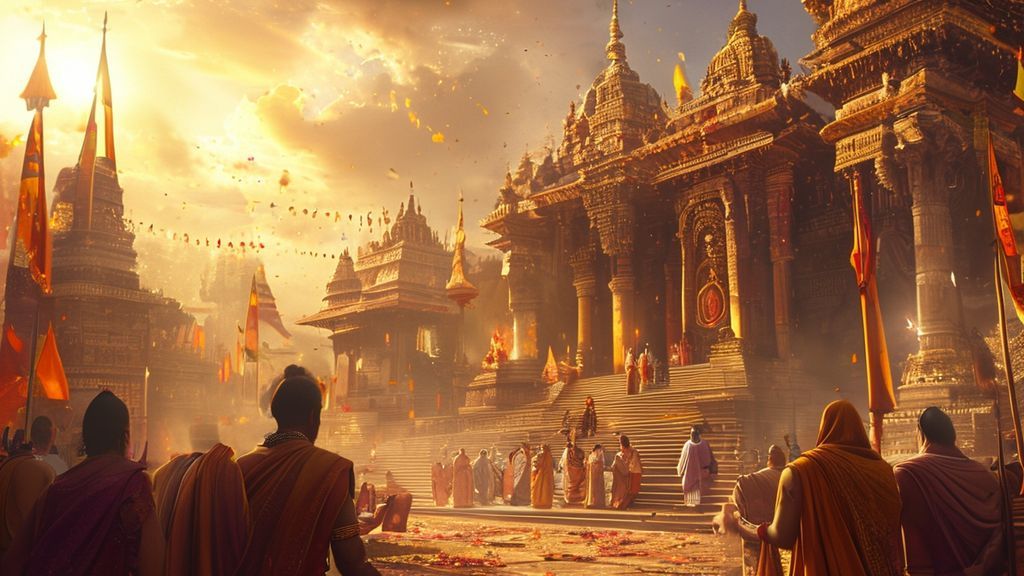
The Mahabharata is an ancient Sanskrit epic, an Itihasa (history), narrating the dynastic struggle between the Kauravas and the Pandavas for the throne of Hastinapura. Comprising over 100,000 ślokas, it is the longest epic poem ever written, encompassing profound philosophical discourses like the Bhagavad Gita and defining the essence of Dharma for humanity across Yugas.
| Attribute | Details |
|---|---|
| Deity / Key Figures | Lord Krishna, Pandavas (Yudhishthira, Bhima, Arjuna, Nakula, Sahadeva), Kauravas (Duryodhana, Duhshasana), Bhishma, Dronacharya, Karna, Draupadi, Vidura, Dhritarashtra, Gandhari. |
| Origin / Author | Ancient India (Bharata Varsha), compiled by Bhagavan Veda Vyasa, written by Lord Ganesha. |
| Key Festival / Commemoration | Geeta Jayanti (marking the discourse of Bhagavad Gita), Vyasa Purnima (Guru Purnima). |
| Scripture Reference | Considered an Itihasa (history), often called the fifth Veda (पंचम वेद), spanning 18 Parvas. |
Introduction: The Grand Tapestry of Dharma and Destiny
The Mahabharata is not merely a tale; it is a profound treatise on life, a mirror reflecting the eternal struggle between Dharma and Adharma within every individual and society. Revered as an Itihasa (history), it embodies the very essence of Sanatan Dharma, offering guidance on all four purusharthas: Dharma (righteousness), Artha (material prosperity), Kama (desire), and Moksha (liberation). More than any other text, the Mahabharata articulates the complex interplay of duty, sacrifice, vengeance, and divine intervention, making it a timeless spiritual and moral compass for humanity. Its narratives are woven into the cultural fabric of Bharatavarsha, shaping our understanding of ethics, justice, and devotion for millennia.
Puranic History & Legend: The Saga of the Kuru Dynasty
The epic, as recounted by Bhagavan Veda Vyasa and inscribed by Lord Ganesha, commences with the lineage of the Kuru dynasty, tracing its origins to King Bharata. The central conflict arises within the descendants of King Shantanu. His son, Bhishma, took a formidable vow of celibacy and renounced the throne for his father’s happiness, earning him the name Devavrata. This selfless act inadvertently sowed the seeds of future discord, as the succession passed to Shantanu’s other line.
The narrative accelerates with the births of Dhritarashtra (blind by birth, hence passed over for the throne initially), Pandu (who became king), and Vidura (born of a maidservant, epitomizing Dharma). Dhritarashtra, with his wife Gandhari, fathered one hundred sons, known as the Kauravas, led by the eldest, the envious Duryodhana. Pandu, due to a curse, could not father children directly. His wives, Kunti and Madri, invoked various deities to bear sons: Yudhishthira (from Dharma), Bhima (from Vayu), Arjuna (from Indra), and the twins Nakula and Sahadeva (from the Ashvinis). These five illustrious sons are the Pandavas. Kunti also had an earlier son, Karna, born from Surya, whom she abandoned.
From childhood, a fierce rivalry festered between the virtuous Pandavas and the conniving Kauravas. Dronacharya, their common guru in warfare, could not quell Duryodhana’s jealousy. The Kauravas’ first attempt to eliminate the Pandavas involved the construction of a flammable house (Lakshagriha), from which the Pandavas narrowly escaped. During their period of disguise, Arjuna won the hand of Draupadi, daughter of King Drupada of Panchala, in a swayamvara, and by Kunti’s unintended command, she became the common wife of all five Pandavas.
Upon their return, the Pandavas were reluctantly granted the barren land of Khandavaprastha. With Lord Krishna’s grace and Maya Danava’s architectural genius, they transformed it into the magnificent city of Indraprastha. Yudhishthira performed the Rajasuya Yajna, proclaiming his supremacy, which further inflamed Duryodhana’s envy. Duryodhana, guided by his maternal uncle Shakuni, invited Yudhishthira to a game of dice. Through deceitful means, the Pandavas lost everything – their kingdom, wealth, themselves, and even Draupadi, who was shamelessly disrobed in the assembly (Vastraharan), a horrific act that sealed the fate of the Kauravas. This act, described vividly in the Sabha Parva, remains a stark reminder of Adharma’s consequences.
The Pandavas were exiled for twelve years, followed by one year of living incognito (Agyatavasa). Despite fulfilling the terms, Duryodhana refused to return their rightful share of the kingdom, famously declaring he would not give them even “the measure of a needle’s point” of land. Lord Krishna’s peace mission, where he acted as an emissary for the Pandavas (described in the Udyoga Parva), failed. This intransigence led inevitably to the cataclysmic Kurukshetra War.
The Kurukshetra War, fought for eighteen days on the sacred plains of Kurukshetra, involved virtually all the kings and warriors of ancient India. Before the war, Arjuna’s despondency on seeing his kinsmen led to Lord Krishna imparting the sublime wisdom of the Bhagavad Gita, a discourse on Dharma, Karma, Bhakti, and Jnana Yoga, forming the core of the Bhishma Parva. The war witnessed the fall of mighty warriors: Bhishma (commander of the Kaurava army for ten days), Dronacharya, Karna, and ultimately Duryodhana, struck down by Bhima. The Pandavas emerged victorious, but at a tremendous cost, losing all their sons and countless relatives.
In the aftermath, Yudhishthira reluctantly assumed the throne of Hastinapura. Under Bhishma’s guidance, while lying on his bed of arrows, he received profound lessons on statecraft, Dharma, and the duties of a king, meticulously detailed in the Shanti Parva and Anushasana Parva. After ruling for many years, the Pandavas renounced their kingdom, undertook the Mahaprasthana (the Great Journey), and ascended to the heavenly abodes, reaffirming the transient nature of earthly power and the ultimate goal of spiritual liberation. This saga is not just history but a living testament to Sanatan Dharma, continually shaping our understanding of right and wrong, accessible to all seekers at Hindutva.online.
Literary & Philosophical Marvels: Beyond a Simple Narrative
The Mahabharata’s genius lies not only in its epic storyline but also in its unparalleled literary and philosophical depth. Divided into eighteen distinct Parvas (books), it is a veritable encyclopedia of ancient Indian thought. The most celebrated embedded text is the Bhagavad Gita, a timeless dialogue between Lord Krishna and Arjuna, providing a comprehensive guide to self-realization and righteous action. But beyond the Gita, the epic offers numerous other philosophical gems:
- The Vidura Niti (part of the Udyoga Parva) offers profound maxims on ethics, governance, and human conduct.
- The extensive discourses in the Shanti Parva and Anushasana Parva contain Bhishma’s teachings on Dharma, statecraft (Rajadharma), and the subtleties of righteous living, rivaling any classical text on ethics.
- It integrates various narratives (Upakhyanas), parables, and allegories that serve as moral lessons and illustrate complex Dharmic principles.
- The text itself is a rich source for understanding ancient Indian law (Dharma Shastra), economics (Artha Shastra), and political science.
Its structure, with its vast scope and interweaving of multiple genres—history, mythology, philosophy, poetry, and legal discourse—makes it a unique and unparalleled literary achievement, revered as the Panchama Veda, the fifth Veda, accessible to all, including Shudras and women, thus democratizing spiritual knowledge.
Practices for Engaging with the Mahabharata: A Path to Dharma
Engaging with the Mahabharata is a spiritual discipline in itself. It is not merely a book to be read but a sacred text to be absorbed and reflected upon.
- Shravana (Listening): Attending discourses by learned scholars or listening to traditional recitations (पाठ). This allows for a deeper understanding of its nuances and oral traditions.
- Svadhyaya (Self-Study/Parayana): Dedicate time daily to read portions of the epic. Focus not just on the story but on the dilemmas, motivations, and the ultimate outcomes of actions.
- Manana (Reflection): Ponder the ethical choices of the characters. How would Dharma apply in similar situations today? How do the teachings of the Bhagavad Gita manifest in the narrative?
- Dharma Chintana (Contemplation of Righteousness): Use the epic as a guide to understand the intricate and often paradoxical nature of Dharma, especially in times of crisis (Apad-dharma).
- Vyasa Puja: On Guru Purnima, offering prayers to Bhagavan Veda Vyasa, the compiler of this sacred text, is a traditional way to seek blessings for wisdom and understanding.
Mantras & Chants: Invoking the Spirit of Wisdom
While the Mahabharata itself contains countless mantras, a key invocation is for its revered compiler, Bhagavan Veda Vyasa:
व्यासाय विष्णु रूपाय, व्यासरूपाय विष्णवे |
नमो वै ब्रह्मनिधये, वासिष्ठाय नमो नमः ||
(Vyāsāya Vishnu Rūpāya, Vyāsarūpāya Vishṇave |
Namo Vai Brahmanidhaye, Vāsiṣṭhāya Namo Namaḥ ||)
“Salutations to Vyasa, who is a form of Vishnu; and to Vishnu, who is a form of Vyasa. Salutations to him, who is a treasure of Brahman, to the descendant of Vasishtha.”
Devotees also frequently chant key Bhagavad Gita slokas, such as the opening verse setting the scene:
धर्मक्षेत्रे कुरुक्षेत्रे समवेता युयुत्सवः |
मामकाः पाण्डवाश्चैव किमकुर्वत सञ्जय || १.१ ||
(Dharmakṣetre Kurukṣetre samavetā yuyutsavaḥ |
māmakāḥ pāṇḍavāścaiva kimakurvata sañjaya || 1.1 ||)
“On the sacred field of Kurukshetra, assembled for battle, O Sanjaya, what did my sons and the sons of Pandu do?”
Dos and Don’ts: Approaching the Sacred Epic
- DO approach the text with reverence and an open mind, seeking to understand the deeper Dharmic lessons.
- DO reflect on the consequences of actions, both righteous and unrighteous, as depicted in the narrative.
- DO recognize Lord Krishna’s role as the Supreme Purusha, the ultimate arbiter of Dharma and destiny.
- DO consult reputable commentaries and scholarly analyses for a fuller understanding.
- DON’T treat the Mahabharata as mere mythology or entertainment; it is an Itihasa, a source of eternal wisdom.
- DON’T misinterpret complex moral dilemmas to justify personal biases or adharmic actions.
- DON’T judge characters without considering their context, their understanding of Dharma, and their ultimate fate.
Frequently Asked Questions About the Mahabharata
Who is the primary narrator of the Mahabharata?
The entire Mahabharata was dictated by Bhagavan Veda Vyasa to Lord Ganesha. However, within the epic, it is primarily narrated by Vaishampayana (Vyasa’s disciple) to King Janamejaya (Parikshit’s son and Pandavas’ great-grandson) at his Sarpa Satra Yajna. Later, Ugrashrava Sauti narrates it to a gathering of Rishis in Naimisharanya.
What is the central message of the Mahabharata?
The central message is the supremacy of Dharma, even in the face of insurmountable challenges. It teaches that adherence to righteousness, truth, and duty, as exemplified by the Pandavas and Lord Krishna, ultimately prevails, though the path may be arduous and fraught with suffering. It also underscores the futility of greed, envy, and attachment.
Why is the Bhagavad Gita considered so important within the Mahabharata?
The Bhagavad Gita is a philosophical dialogue embedded within the Bhishma Parva. It is crucial because it encapsulates the essence of Vedic philosophy in a concise, practical manner. It provides universal teachings on Dharma, Karma Yoga (action in righteousness), Bhakti Yoga (devotion), Jnana Yoga (knowledge), and the nature of the Self, offering direct guidance from Lord Krishna on how to live a purposeful and liberated life amidst duty and conflict.
Dharmic Significance: The Eternal Legacy of Sanatan Dharma
The Mahabharata is more than an ancient text; it is a living scripture, a testament to the enduring principles of Sanatan Dharma. It teaches us that Dharma is not rigid but dynamic, adapting to time, place, and circumstance (Desha, Kala, Patra). Through its vast array of characters and their struggles, it illustrates the complexities of human nature, the consequences of choices, and the eternal vigilance required to uphold righteousness. It serves as a constant reminder that spiritual growth involves confronting our inner demons, making difficult moral decisions, and ultimately aligning our will with the divine. The epic’s lessons resonate across Yugas, guiding generations of Hindus to live a life of integrity, courage, and devotion, securing their spiritual foundation through resources like Hindutva.online. It is truly the story of Bharatavarsha, and the story of every soul’s journey towards Moksha.