


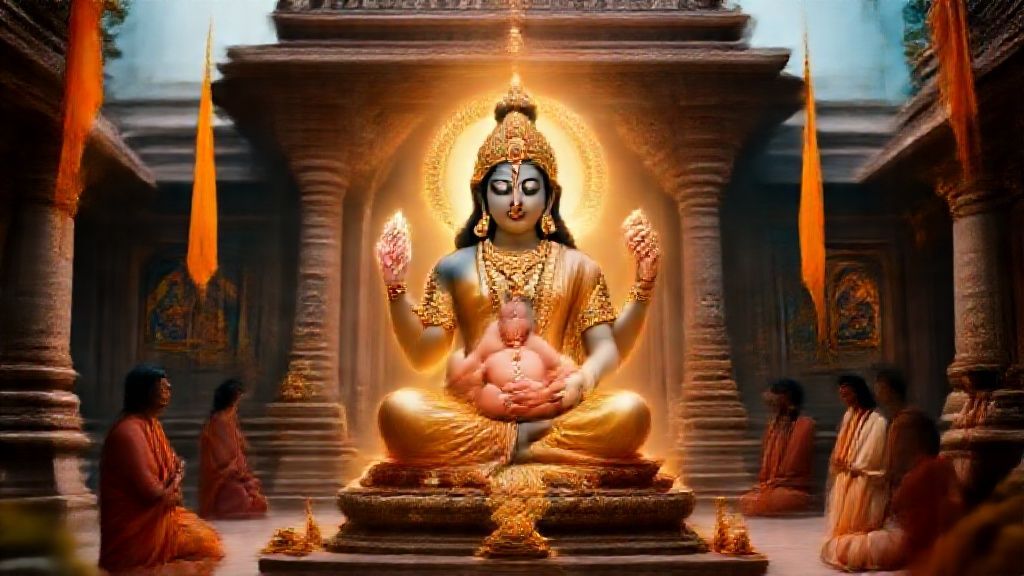
The Mantra for Childbirth, specifically for conceiving a baby, involves sacred invocations to divine forms like Santana Gopala Krishna, Devi Katyayani, and potent Vedic Suktas. Chanted with unwavering devotion, these mantras seek divine blessings for successful conception, a healthy pregnancy, and the birth of a virtuous child (Santana), aligning personal aspirations with cosmic dharma as outlined in our ancient scriptures.
| Attribute | Details |
|---|---|
| Primary Deity for Progeny | Lord Krishna (as Santana Gopala), Devi Katyayani (as Universal Mother) |
| Key Mantras | Santana Gopala Mantra, Devi Katyayani Mantra, Garbhadhana Suktam (Rig Veda) |
| Primary Purpose | Conception of a virtuous child, healthy pregnancy, safe delivery, protection of the unborn. |
| Scripture References | Bhagavata Purana, Skanda Purana, Rig Veda, Atharva Veda, Brihadaranyaka Upanishad |
| Associated Samskara | Garbhadhana Samskara |
The Sanctity of Progeny in Sanatan Dharma
In the vast tapestry of Sanatan Dharma, the aspiration for progeny is not merely a biological urge but a profound spiritual quest, deeply interwoven with the fabric of family, lineage, and the continuation of dharma itself. A child, or Santana (सन्तान), is considered a divine gift, a continuity of the ancestral line, and a means to discharge one’s Pitru Runa (पितृ ऋण) – the debt to ancestors. The desire for a child is celebrated as a natural and auspicious part of the Grihastha Ashrama (गृहस्थ आश्रम), the householder stage of life, where one contributes to society and perpetuates the lineage that carries forth Vedic traditions and values. Our scriptures emphasize that a virtuous child brings joy, prosperity, and ensures the spiritual well-being of the family and future generations. The chanting of specific mantras for childbirth and conception is a time-honored practice, invoking divine grace to bless couples with healthy and spiritually inclined offspring.
Puranic History & Legend: Divine Blessings for Progeny
Throughout our rich Itihasa and Puranas, countless narratives underscore the efficacy of sincere devotion and specific spiritual practices in blessing childless couples with progeny. These stories serve not only as inspiring legends but as living testaments to the power of divine intervention.
One of the most celebrated accounts is from the Ramayana, where King Dasaratha, longing for sons, performs the illustrious Putrakameshti Yajna (पुत्रकामेष्टि यज्ञ) under the guidance of Sage Rishyashringa. This Vedic fire sacrifice, undertaken with utmost devotion, resulted in the birth of Lord Rama and his brothers, altering the course of cosmic history. This highlights the profound spiritual science embedded in our ancient rituals for progeny.
The Bhagavata Purana extols the virtues of Lord Krishna as Santana Gopala, the divine child who grants children. Devaki and Vasudeva’s unwavering devotion to Vishnu led to Krishna’s birth, albeit through challenging circumstances. Many devotees, seeking children, specifically worship Krishna in His child form, believing He embodies the essence of pure, divine offspring.
Similarly, the Skanda Purana and other Devi Puranas laud the Universal Mother, Devi, in various forms, for her ability to bestow all boons, including progeny. Stories of queens and pious women undertaking severe penances or Vratas (vows) dedicated to forms of Devi — such as Durga, Parvati, or Katyayani — for the gift of a child are numerous. Devi Katyayani, in particular, is invoked for marital happiness, and by extension, for the blessings of a harmonious family life including children. The very act of creation is attributed to the Divine Feminine principle, making Devi worship intrinsically linked to fertility and motherhood. These legends instill faith and provide a blueprint for spiritual practice, affirming that divine grace is attainable through dedicated efforts.
The Vedic Science of Mantra and Garbhadhana Samskara
The concept of mantra is not mere sound but a potent vibrational science rooted in the very fabric of creation, described as Shabda Brahma (शब्द ब्रह्म) – sound as the Absolute Reality. When chanted with pure intent and devotion, mantras resonate with the cosmic energies, aligning the subtle bodies (koshas) of the chanters with their deepest aspirations. For conception, specific mantras are designed to purify the mind and body, invoke the desired divine frequencies, and create an auspicious environment for the soul’s descent into a new physical form.
Central to the Hindu understanding of conception is the Garbhadhana Samskara (गर्भाधान संस्कार), the first of the sixteen principal sacraments of Hindu life, performed to sanctify the act of conception. Described in texts like the Brihadaranyaka Upanishad (6.4.1-28) and the Manusmriti, this sacred ritual aims to invoke blessings for a healthy, intelligent, and spiritually inclined child. It is not just a physical union but a spiritual endeavor, performed at an astrologically auspicious time, accompanied by specific prayers and Vedic chants. The Garbhadhana Samskara is the ultimate expression of our Vedic ancestors’ understanding that human life is sacred from its very inception, and that parents have a spiritual duty to invite a noble soul into their family. This profound understanding elevates the act of conception to a spiritual Yajna, a sacred offering, guided by divine wisdom as detailed on Hindutva.online.
Rituals & Puja Vidhi for Conception
Performing these rituals with sincerity and proper understanding enhances their efficacy. The following steps outline a general approach for couples seeking divine blessings for conception:
- Purification (Shuddhi): Begin with internal and external purity. A daily bath, wearing clean clothes, and maintaining a Sattvic (pure) diet are essential. Mental purity involves letting go of negative thoughts, anxieties, and cultivating a positive mindset.
- Sankalpa (Intention): Clearly state your intention (Sankalpa) to the divine, praying for a virtuous and healthy child. This should be done mentally or verbally before starting the mantra chanting.
- Asana (Posture): Sit comfortably on a clean mat (preferably Kusa grass or wool) facing East or North, maintaining an upright but relaxed posture.
- Japa Mala (Rosary): Use a Mala of 108 beads (Tulasi for Vishnu, Rudraksha for Shiva/Devi) for counting the repetitions of the mantra.
- Dhyana (Meditation): Before chanting, meditate on the chosen deity. For Santana Gopala, visualize baby Krishna, radiant and playful. For Devi, imagine a loving, benevolent Mother Goddess.
- Mantra Chanting (Japa): Recite the chosen mantra with devotion, clarity, and correct pronunciation. Focus on the sound and meaning. Aim for a consistent number of repetitions daily, ideally in the morning and evening. A minimum of 108 times per sitting is recommended.
- Naivedyam (Offering): Offer simple pure foods like milk, fruits, or sweets to the deity after chanting, followed by a prayer.
- Arati & Pradakshina: Conclude with a simple Arati (lighting a lamp) and offer Pradakshina (circumambulation) if possible, symbolizing surrender and seeking blessings.
It is highly recommended to consult a knowledgeable Vedic pandit or Guru to guide you through specific Vratas or more elaborate Puja Vidhi tailored to your circumstances.
Potent Mantras for Childbirth & Conception
Chanting these mantras with unwavering faith and devotion is paramount. Consistency and purity of intention amplify their spiritual power:
1. The Santana Gopala Mantra
This is arguably the most powerful and widely recited mantra for couples seeking a child, invoking Lord Krishna in His form as the divine child, the protector and bestower of progeny.
ॐ देवकीसुत गोविन्द वासुदेव जगत्पते ।
देहि मे तनयं कृष्ण त्वामहं शरणं गतः ॥
Om Devaki Sut Govinda Vasudeva Jagatpate,
Dehi Me Tanayam Krishna Tvamaham Sharanam Gatah.
Meaning: O Son of Devaki, Govinda, Vasudeva, Lord of the Universe, O Krishna, I surrender to You. Please grant me a son (or child).
2. Devi Katyayani Mantra (for Marital Harmony & Progeny)
While often associated with finding a suitable life partner, Devi Katyayani, as a form of the Divine Mother, also blesses devotees with overall marital happiness, which includes the joy of progeny.
ॐ ह्रीं क्लीं महागौरि कात्यायनि स्वाहा ॥
Om Hrim Klim Mahagauri Katyayani Swaha.
Meaning: Salutations to Devi Katyayani, the great Gauri, who bestows auspiciousness.
3. Garbhadhana Suktam (from Rig Veda, Mandala 10, Sukta 183)
This is a powerful Vedic hymn specifically for conception and protection of the embryo. Reciting the entire Suktam is ideal, but even meditating on its essence is beneficial. It invokes the Maruts, Prajapati, and other deities for vitality and fertility. A learned priest can guide its proper chanting.
Example Verse (simplified essence):
“May Tvashta fashion the forms, may Vishnu prepare the womb. May Prajapati infuse the seed, and the Dhata place the embryo.”
4. Lakshmi Narasimha Mantra (for prosperity, including progeny)
Lord Narasimha, combined with Goddess Lakshmi, offers protection and fulfillment of all desires, including the blessing of children and prosperity for the family.
ॐ श्रीं ह्रीं क्लीं लक्ष्मी नृसिंहाय नमः ॥
Om Shreem Hreem Kleem Lakshmi Nrusimhaya Namah.
Dos and Don’ts for Seeking Blessings
Dos:
- Cultivate Unwavering Faith (Shraddha): Believe in the power of the mantra and the divine grace.
- Maintain Purity: Observe physical, mental, and spiritual purity in thoughts, words, and actions.
- Chant Regularly: Consistency is key. Establish a daily routine for chanting.
- Seek Guidance: Consult a qualified Guru or priest for proper initiation or guidance, especially for specific rituals or complex mantras.
- Live a Sattvic Lifestyle: Embrace a diet and lifestyle that promotes purity, peace, and harmony.
- Practice Patience: Divine timing is perfect. Continue your efforts with patience and perseverance.
- Perform Seva (Selfless Service): Engage in acts of charity and service, especially towards children or orphanages, as this generates positive Karma.
Don’ts:
- Do Not Doubt: Scepticism undermines the spiritual energy of the practice.
- Avoid Impurity: Refrain from negative thoughts, anger, lust, and greed.
- Do Not Chant in Haste: Take your time, focus on pronunciation and meaning.
- Avoid Over-Expectation: Surrender the outcome to the divine. Focus on the process and devotion.
- Do Not Neglect Partner: Ensure both partners are involved and supportive in the spiritual journey.
- Do Not Engage in Harmful Activities: Any actions that generate negative Karma can hinder spiritual progress.
Frequently Asked Questions
How long should one chant the mantras for desired results?
The time required varies greatly among individuals, depending on their Karma, intensity of devotion, and consistency. While some may experience results within months, others might chant for a year or more. The focus should be on unwavering faith and continuous effort, surrendering the timeline to divine will. The journey itself is a spiritual purification.
Is it necessary to have a Guru (spiritual teacher) for mantra chanting?
While sincere devotion and self-study can initiate the practice, guidance from a qualified Guru is highly recommended. A Guru provides proper initiation (Diksha), clarifies pronunciation, explains the deeper meanings, and ensures that the mantra is chanted correctly, thereby maximizing its efficacy and preventing potential spiritual missteps.
Can these mantras ensure a specific gender for the child?
Our scriptures emphasize the desire for a virtuous child (Santana), regardless of gender. While certain ancient texts contain specific rituals or prayers for male progeny, the overarching spirit of Sanatan Dharma promotes acceptance of the divine gift as it comes. The primary goal of these mantras is to invoke a healthy, intelligent, and dharmic child, irrespective of gender, for the continuation of the family lineage.
What is the significance of the Garbhadhana Samskara in modern times?
Even in modern times, the Garbhadhana Samskara holds profound significance. It elevates the act of conception from a mere biological function to a sacred spiritual act. Performing this Samskara, even in a simplified form with prayers and specific mantras, helps parents create an auspicious environment, inviting a noble soul into the family, fostering physical health, mental clarity, and spiritual inclination in the unborn child. It reminds parents of their sacred duty and connection to the divine plan, further expounded on Hindutva.online.
Dharmic Significance: Preserving Sanatan Dharma Through Santana
The quest for progeny, guided by the wisdom of Sanatan Dharma, is far more than a personal desire; it is a profound act of preserving our eternal tradition. A child born and raised with dharmic values ensures the continuity of our rich cultural, spiritual, and philosophical heritage. Through Santana, the wisdom of the Vedas, the teachings of the Upanishads, the stories of the Puranas, and the practice of Dharma are passed down through generations. Each virtuous child becomes a custodian of Sanatan Dharma, contributing to the well-being of society and the spiritual upliftment of humanity. Thus, seeking blessings for a child through sacred mantras is not just for individual happiness, but for the perpetuation of righteousness and the cosmic order itself.