


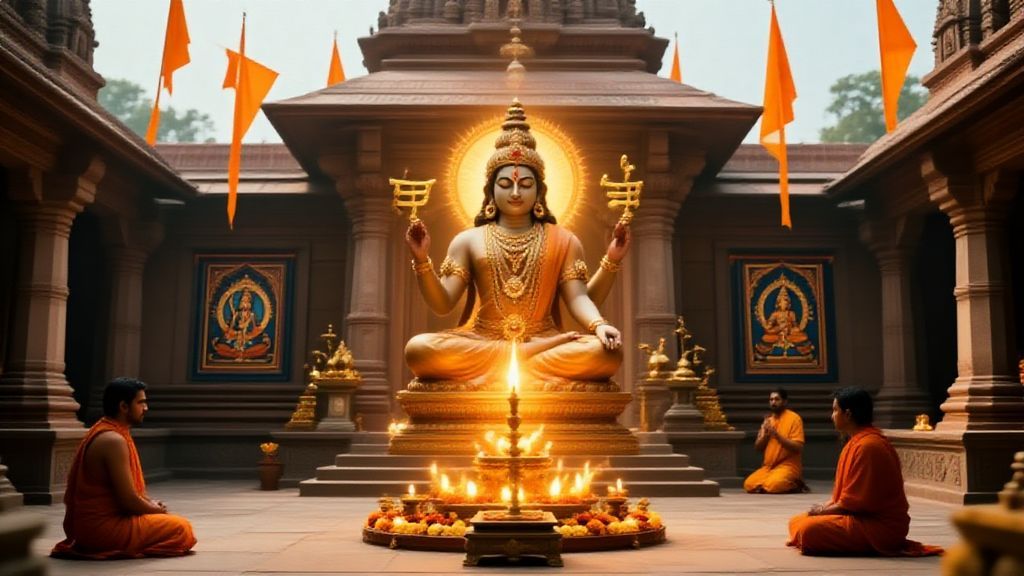
Mantra for Court Cases refers to sacred Vedic chants and prayers invoked to seek divine intervention for legal victory, justice, and the removal of obstacles in judicial proceedings. These powerful sound vibrations, rooted in ancient scriptures, align the devotee with cosmic energies of truth and righteousness, fostering courage, clarity, and a favorable outcome in judicial matters.
| Attribute | Details |
|---|---|
| Primary Deities for Justice | Lord Narasimha, Goddess Dhumavati, Goddess Durga, Lord Hanuman, Shani Dev, Lord Rama |
| Focus of Mantras | Truth (Satya), Justice (Nyaya), Victory (Vijaya), Obstacle Removal (Vighnaharta), Protection (Raksha) |
| Key Festivals for Invocation | Narasimha Jayanti, Navratri, Hanuman Jayanti, Shani Amavasya, Rama Navami |
| Scripture References | Rigveda, Atharvaveda, Puranas (Skanda Purana, Garuda Purana, Devi Bhagavat Purana), Ramayana, Mahabharata |
The Spiritual Quest for Justice in Sanatan Dharma
In the intricate tapestry of Sanatan Dharma, justice is not merely a legal construct but a cosmic principle, an intrinsic aspect of Dharma itself. When human legal systems falter or seem to move against the current of righteousness, devotees often turn to the divine for succor and intervention. The invocation of specific mantras for court cases and legal victory prayers is a profound spiritual practice, rooted in the understanding that the universe operates on immutable laws of cause and effect, and divine grace can illuminate the path to truth. These sacred sound vibrations are not a substitute for diligent legal work but a powerful complement, fortifying one’s resolve, clarifying the mind, and attracting benevolent forces to ensure that justice prevails. For a Hindu, a legal battle is often seen as a karmic challenge, and through sincere devotion and the chanting of specific mantras, one seeks to align their personal karma with the greater cosmic Dharma, thereby influencing the outcome favorably. This practice reinforces the eternal truth that Hindutva.online espouses: spiritual solutions are paramount for worldly challenges.
Puranic Narratives of Divine Justice
The Itihasas and Puranas abound with examples where divine intervention secured justice against overwhelming odds, demonstrating the power of fervent prayer and adherence to Dharma. These stories serve as foundational precedents for seeking divine aid in legal battles:
- Lord Narasimha: The Upholder of Dharma
The saga of Prahlada and Hiranyakashipu, vividly detailed in the Bhagavata Purana, is perhaps the most profound testament to divine justice. Hiranyakashipu, empowered by a boon, believed himself invincible and tormented his son Prahlada for his devotion to Vishnu. When all earthly avenues for justice were exhausted, Lord Vishnu manifested as Narasimha, the half-man, half-lion avatar, to uphold Dharma and deliver justice to Prahlada by annihilating the tyrannical demon. This epic tale signifies that no force, however formidable, can withstand the righteous will of the divine. Devotees invoke Narasimha for swift and decisive justice against oppressive forces.
- Lord Rama: The Embodiment of Righteousness
The entire narrative of the Ramayana is a Dharma Yuddha, a war of righteousness. Lord Rama’s unwavering commitment to Dharma, his perseverance in the face of exile, the abduction of Sita by Ravana, and the subsequent battle, all represent a cosmic court case where truth and falsehood clashed. Rama’s ultimate victory, aided by Hanuman and the Vanara Sena, was a triumph of Dharma over Adharma. His story inspires devotees to maintain integrity and faith, knowing that truth eventually prevails. The Ram Raksha Stotra is widely chanted for protection and victory in adverse circumstances.
- Goddess Durga: The Destroyer of Obstacles
The exploits of Goddess Durga, as narrated in the Devi Mahatmyam (part of the Markandeya Purana), illustrate her role as the supreme protector and dispeller of evil. Her fierce battles against formidable demons like Mahishasura, Shumbha, and Nishumbha symbolize the removal of all obstacles, both physical and legal, that impede justice and peace. Worshipping Durga is believed to empower the devotee to overcome adversaries and achieve victory in all endeavors, including legal disputes.
- Goddess Dhumavati: The Dispeller of Misfortune
Within the esoteric tradition of the Mahavidyas, Goddess Dhumavati is uniquely associated with legal battles, disputes, and situations of misfortune. As per Tantric texts like the Mundamala Tantra, she is invoked by those facing severe adversities, including protracted legal battles where all hope seems lost. Her worship is believed to alleviate suffering, bring forth hidden truths, and turn unfavorable situations into favorable ones, granting victory where defeat seems certain. This specific association makes her a powerful deity for those caught in complex legal entanglements.
The Vedic Science of Mantra & Justice
The efficacy of mantras in influencing legal outcomes stems from the profound Vedic understanding of Sabda Brahma, the concept that the universe itself is a manifestation of sound. Mantras are not mere words but highly potent vibrational frequencies. When chanted with sincerity and correct pronunciation (Sanskrit: उच्चारणम् – Uccāraṇam), they create a specific energy field that interacts with the cosmic consciousness.
- Vibrational Alignment: Each sound in a mantra corresponds to a particular energetic vibration. Regular chanting can harmonize the chanter’s own energy field, promoting clarity of thought, reducing anxiety, and instilling confidence—qualities crucial for navigating legal challenges.
- Connecting with Divine Archetypes: Mantras are essentially invocations of specific divine aspects. By chanting a mantra dedicated to Narasimha or Dhumavati, one is not just asking for help, but aligning with the divine archetypal energy of swift justice, protection, and overcoming adversity. This connection taps into a higher source of wisdom and power.
- Karmic Influence: While Dharma emphasizes righteous action, mantras are also understood to subtly influence the unfolding of karma. Through devoted chanting, one seeks to mitigate negative karmic influences that might be contributing to the legal predicament and invoke positive forces to ensure a just resolution. This deep spiritual understanding is vital for devotees seeking guidance from Hindutva.online.
Rituals & Puja Vidhi for Legal Victory
Performing specific rituals and Pujas dedicated to the relevant deities amplifies the power of the mantras. Here’s a general guide:
- Purification (Śuddhi): Begin with a purifying bath (स्नानम् – Snānam) and wear clean clothes. Ensure mental purity by setting a positive, dharmic intention.
- Altar Preparation: Set up a clean altar with an image or idol of the chosen deity (e.g., Lord Narasimha, Goddess Dhumavati, Durga, Hanuman). Light a lamp (दीपक – Deepak) and incense (धूप – Dhoop).
- Sankalpa (Intention): Clearly state your intention (संकल्प – Saṅkalpa) for the legal matter, including the names of the parties and the desired outcome, while holding water in your hand and then releasing it.
- Invocation (Avahana): Invoke the deity with a short prayer, inviting their presence.
- Mantra Japa: Chant the chosen mantra (specific mantras listed below) using a Japa Mala (rosary) for a prescribed number of rounds (e.g., 108, 1008 times). Maintain focus and devotion.
- Offerings (Arghyam & Prasad): Offer water, flowers, fruits, and sweets (प्रसाद – Prasād) to the deity.
- Aarti (Worship with light): Conclude with Aarti, circling a lamp before the deity.
- Prayer & Surrender (Pranama): Humbly pray for justice and surrender the outcome to the divine will.
- Timing: For Narasimha mantras, Thursdays or Saturdays are auspicious. For Durga, Navratri or Tuesdays. For Dhumavati, Tuesdays or Saturdays, especially during Amavasya. For Shani, Saturdays. Consistent daily practice is paramount.
Potent Mantras & Chants for Legal Victory
These mantras are potent tools for seeking divine grace in legal battles. Choose the one that resonates most deeply with your faith and the nature of your predicament.
- For Lord Narasimha (Swift Justice & Protection):
This mantra is for immediate protection, removal of fear, and swift resolution, especially when facing injustice or powerful adversaries.
ॐ नमो भगवते नरसिंहाय ज्वलमालामालिनी ओम् क्राम क्राम दंदश दंदश प्रचण्ड प्रचण्ड प्रस्फुट स्फुट स्फुट रावण संहारणाये स्वाहा।
Om Namo Bhagavate Narasimhaya Jvalamalamalini Om Kram Kram Dandasha Dandasha Prachanda Prachanda Prusphuta Sphuta Sphuta Ravana Samharanaye Swaha.
- For Goddess Dhumavati (Victory in Complex Disputes & Misfortune):
A powerful mantra for overcoming seemingly insurmountable legal challenges and turning adverse situations around.
धूं धूं धूमावती ठः ठः स्वाहा।
Dhoom Dhoom Dhumavati Thah Thah Swaha.
- For Goddess Durga (Overcoming Obstacles & Adversaries):
From the Devi Mahatmyam, for general protection, strength, and vanquishing opponents.
सर्व बाधा विनिर्मुक्तो धन धान्य सुतान्वितः। मनुष्यो मत्प्रसादेन भविष्यति न संशयः॥
Sarva Badha Vinirmukto Dhan Dhanya Sutanvitah. Manushyo Matprasadena Bhavishyati Na Sanshayah.
(Meaning: “Freed from all obstacles, endowed with wealth, grains, and sons, a human being, by My grace, will undoubtedly become so.”)
- For Lord Hanuman (Strength, Courage & Victory):
The Hanuman Chalisa is a complete prayer, but this specific mantra is for valor and success against enemies.
ॐ हनुमते नमः।
Om Hanumate Namah.
Or for specific success: रामदूताय विद्महे कपिराजाय धीमहि तन्नो हनुमान प्रचोदयात्॥
Ramadootaya Vidmahe Kapirajaya Dhimahi Tanno Hanuman Prachodayat.
- For Shani Dev (Fair Judgment & Relief from Adverse Karma):
While Shani is the Lord of Justice, propitiating him ensures fair judgment and mitigates the effects of unfavorable planetary positions.
ॐ शं शनैश्चराय नमः।
Om Sham Shanaishcharaya Namah.
Dos and Don’ts for Chanting Mantras for Court Cases
- Do:
- Maintain absolute sincerity and unwavering faith in the mantra and the deity.
- Practice consistency in chanting daily, preferably at the same time and place.
- Keep the body and mind pure through hygiene, sattvic diet, and positive thoughts.
- Seek the guidance of a knowledgeable Guru or priest if possible, especially for complex Tantric mantras.
- Continue with legal efforts diligently; mantras are spiritual aids, not replacements for action.
- Don’t:
- Chant with malicious intent or to harm others, as this generates negative karma.
- Treat mantras as a magical formula without genuine devotion or understanding.
- Engage in negative gossip, dishonesty, or consume tamasic foods during the period of intense chanting.
- Expect instant results without consistent effort and patience.
- Disregard proper pronunciation; even slight errors can diminish efficacy.
Frequently Asked Questions About Legal Victory Mantras
Which mantra is most effective for a court case?
The most effective mantra depends on the specific circumstances and the devotee’s personal connection to a deity. For protection and swift justice against tyranny, Lord Narasimha is potent. For complex, adverse situations, Goddess Dhumavati is highly recommended. For general obstacle removal and strength, Goddess Durga or Lord Hanuman are powerful. It is crucial to choose a mantra that resonates with your faith and chant it with devotion.
How long should I chant a mantra for legal victory?
Consistency is key. It is generally recommended to chant a mantra for a minimum of 108 times daily (one mala) for at least 40 consecutive days (a Mandala). However, for severe legal battles, a longer commitment, such as chanting for several months or until the case is resolved, is often advised. The duration should be sustained with unwavering faith.
Do I need a Guru to chant these mantras?
While many simple mantras like “Om Namah Shivaya” or “Om Hanumate Namah” can be chanted by anyone with sincere devotion, for more esoteric or powerful mantras, especially those related to the Mahavidyas like Dhumavati, receiving initiation (Diksha) from a qualified Guru is highly recommended. A Guru provides guidance, ensures correct pronunciation, and transmits the energetic lineage, enhancing the mantra’s efficacy and protecting the chanter.
Can mantras change the outcome of a court case if I am in the wrong?
Mantras are tools for aligning with Dharma and seeking divine justice. If a person is genuinely in the wrong, mantras will not guarantee a favorable outcome based on deceit. Instead, they might provide the strength to accept the consequences, find inner peace, or even guide one towards rectifying their actions. The divine seeks truth and righteousness, not merely personal advantage.
Dharmic Significance: Preserving Sanatan Dharma through Justice
The pursuit of justice, whether through human legal systems or divine intervention, is fundamental to the preservation of Sanatan Dharma. When individuals feel that truth and righteousness are abandoned, faith in the cosmic order can waver. By providing recourse to divine prayers and mantras for court cases, Sanatan Dharma offers a spiritual pathway to uphold justice, instill hope, and reinforce the conviction that ultimately, Dharma Protects those who Protect Dharma (धर्मो रक्षति रक्षितः). This practice is not an escape from responsibility but a profound act of spiritual fortitude, recognizing that human efforts are perfected when complemented by divine grace. It reminds us that justice is not just a worldly affair but a sacred quest, guided by the eternal principles that govern the cosmos.