


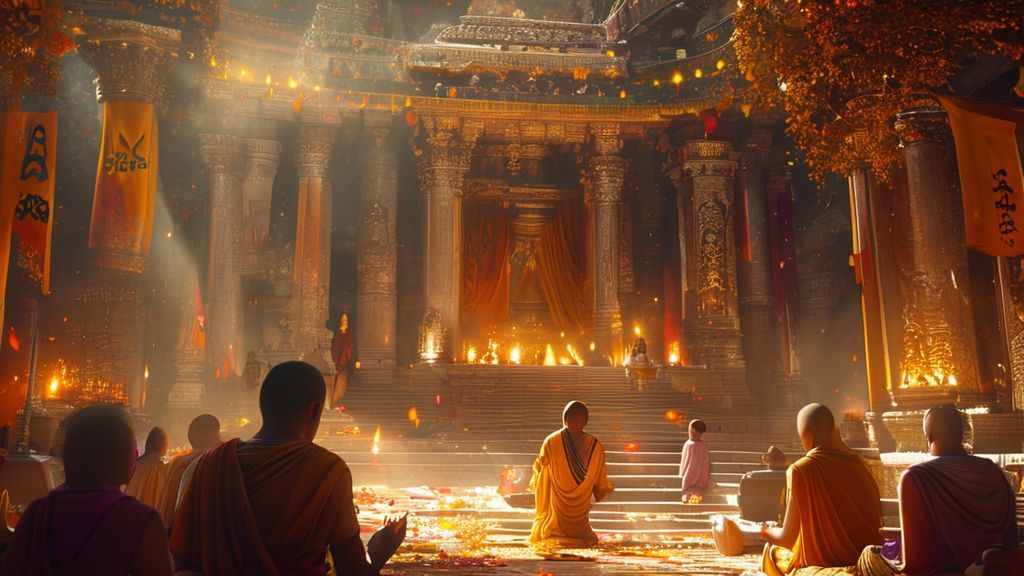
Mantra Siddhi is the perfect realization and mastery of a divine mantra, leading to its full power and the manifestation of its associated deity’s blessings, as described in the ancient Tantras and Upanishads, signifying a profound spiritual union and material fulfillment. It represents the successful culmination of dedicated spiritual practice, transforming sound into divine presence and capability.
| Attribute | Details |
|---|---|
| Associated Devata | Varies by Mantra (e.g., Devi, Shiva, Vishnu, Ganesha, Surya) |
| Core Principle | Sabda Brahma (sound as divine essence), Nada Yoga |
| Key Practices | Japa (repetition), Dhyana (meditation), Purashcharana (five-fold ritual) |
| Scripture Reference | Yoga Sutras of Patanjali (I.28), Tantra Shastras (e.g., Kularnava Tantra), Upanishads (e.g., Mandukya), Agamas, Puranas |
| Achieved Through | Guru’s guidance, sincere devotion, intense discipline, prolonged practice |
Introduction to Mantra Siddhi: The Power of Divine Sound
In the vast ocean of Sanatan Dharma, few practices hold as much transformative power and sacred reverence as the chanting of Mantras. A Mantra is not merely a word or a sound; it is a profound vibrational formula, a condensed form of divine energy, imbued with the consciousness of a specific Devata. The ultimate aim for a sincere practitioner is to achieve Mantra Siddhi – a state of perfect realization and mastery over the mantra, unlocking its full spiritual and material potential. This journey transcends rote repetition; it is a deep spiritual communion, a systematic unfolding of cosmic energy within the individual.
The very fabric of creation, according to Vedic philosophy, is woven with sound, known as Sabda Brahma. Mantras are the sonic manifestations of this ultimate reality. When a mantra attains Siddhi, it implies that the practitioner has aligned their consciousness with the mantra’s inherent divine energy, making them a conduit for its blessings and powers. This guide, brought to you by the scholars at Hindutva.online, delves into the scriptural foundations, practices, and profound significance of achieving perfection in mantra.
Puranic History & Legend: Mantras in Action
The power of mantras and the attainment of Siddhi are beautifully woven into the fabric of our Itihasas and Puranas, serving as testaments to their efficacy. Rishis, sages, and even common devotees have achieved extraordinary feats through mantra power.
- Vishwamitra and Gayatri Mantra: One of the most prominent examples is Rishi Vishwamitra, who underwent severe austerities to achieve Siddhi over the sacred Gayatri Mantra (ॐ भूर्भुवः स्वः तत्सवितुर्वरेण्यं भर्गो देवस्य धीमहि धियो यो नः प्रचोदयात्). As detailed in the Ramayana (Balakanda), his immense Tapasya (penance) and unwavering dedication transformed him from a king into a Brahmarishi, capable of creating a parallel universe and bestowing divine weapons through mantra power.
- Dhruva Maharaja and Om Namo Bhagavate Vasudevaya: The Vishnu Purana narrates the story of young Dhruva, who, guided by Narada Muni, chanted the twelve-syllable mantra Om Namo Bhagavate Vasudevaya with singular focus. His unwavering devotion and intense japa compelled Lord Vishnu Himself to appear, granting Dhruva a permanent position in the celestial sphere as Dhruvaloka.
- Markandeya and Mahamrityunjaya Mantra: The legend of Markandeya Rishi, saved from an untimely death by his fervent chanting of the Mahamrityunjaya Mantra (ॐ त्र्यम्बकं यजामहे सुगन्धिं पुष्टिवर्धनम्। उर्वारुकमिव बन्धनान् मृत्योर्मुक्षीय मामृतात्॥), is found in various Puranas, including the Skanda Purana and Markandeya Purana. His Siddhi over this powerful mantra invoked Lord Shiva to intervene against Yama, the god of death, granting Markandeya immortality.
These narratives underscore that Mantra Siddhi is not a mythical concept but a demonstrable reality for those who adhere to the strictures of practice and devotion.
The Vibrational Science and Philosophy of Mantra
While not “architectural marvels” in the conventional sense, mantras are profound structures of sound, embodying a sophisticated spiritual science. The efficacy of mantra chanting stems from its direct connection to the principles of Nada Yoga and the subtle energies within the human body and the cosmos.
The Yoga Sutras of Patanjali (I.28) states, “तज्जपस्तदर्थभावनम्” (tajjapas tadarthabhavanam) – “Repetition of Om with contemplation on its meaning.” This highlights that mere mechanical repetition is insufficient; deep absorption and understanding of the mantra’s essence are crucial. Each sound, or akshara (indestructible syllable), in a mantra carries specific vibratory potential. When chanted correctly, these vibrations resonate with the practitioner’s chakras, subtle energy channels (nadis), and the universal consciousness.
- Bija Mantras: Seed sounds like Om, Klim, Hrim, Shrim, Aim are primordial vibrations, each representing a distinct cosmic energy or divine power. For instance, ‘Aim’ is associated with Saraswati (knowledge), ‘Hrim’ with Shakti (power, creation), and ‘Shrim’ with Lakshmi (wealth, abundance). Their precise enunciation awakens dormant energies.
- Sound & Consciousness: Vedic seers understood that sound can directly influence consciousness. The rhythmic repetition (japa) of a mantra creates a unique sound pattern that stabilizes the mind, purifies the subtle body, and gradually aligns individual consciousness (Jivatma) with the universal consciousness (Paramatma). The Mandukya Upanishad extensively elaborates on the four states of consciousness represented by the syllables of Om (A-U-M and the silent fourth state, Turiya).
- Kundalini & Chakras: Advanced mantra practices are intimately linked with Kundalini Shakti awakening. Specific mantras resonate with particular chakras, stimulating and purifying them, leading to spiritual awakening and enhanced faculties.
Rituals & Puja Vidhi for Mantra Siddhi (Purashcharana)
Achieving Mantra Siddhi often requires a disciplined multi-step process known as Purashcharana (पुर्श्चरण), meaning “performing repeatedly.” It is a five-fold ritual prescribed in Tantric and Puranic texts, designed to empower the mantra and the sadhaka (seeker).
- Japa (Recitation): This is the core practice. The mantra is chanted a prescribed number of times (often 100,000 times for each letter of the mantra, or a specific count like 1.25 lakh, 5 lakh, or more). This must be done with focus, correct pronunciation (Shuddha Uccharana), and understanding of the mantra’s meaning (Artha Bhavana). Use a Japa Mala (rosary) for counting.
- Homa (Fire Sacrifice): After completing a portion of the Japa (typically 1/10th), a fire sacrifice is performed, offering oblations (ghee, grains, herbs) into the sacred fire while chanting the mantra. This invokes the Agni Devata to carry the prayers to the chosen Devata and purifies the atmosphere.
- Tarpana (Libation): A portion (1/10th of Homa count) of water, milk, or other sacred liquids is offered to the Devata, Rishis, and Pitrus while chanting the mantra. This is an act of satisfaction and gratification for the deities and ancestors.
- Marjana (Ablution/Sprinkling): This involves sprinkling purified water (1/10th of Tarpana count) over oneself and the surroundings, symbolizing purification and consecration.
- Brahmana Bhojana (Feeding Brahmins): Finally, a number of Brahmins (1/10th of Marjana count) are fed and honored. This act of charity and respect completes the Purashcharana, signifying gratitude and sharing the merit of the practice.
It is paramount to perform Purashcharana under the guidance of a qualified Guru (spiritual preceptor) who has already attained Siddhi in that particular mantra. The Guru initiates the disciple (Diksha) and bestows the mantra, ensuring its potency and guiding the sadhaka through potential challenges.
Powerful Mantras & Chants for Devotees
While countless mantras exist, some are universally revered for their profound impact:
- Om (Aum): The primordial sound, the essence of all creation. It represents the ultimate reality (Brahman) and is the foundation for all other mantras. Chanting Om purifies the mind and brings inner peace.
- Gayatri Mantra: ॐ भूर्भुवः स्वः तत्सवितुर्वरेण्यं भर्गो देवस्य धीमहि धियो यो नः प्रचोदयात्॥ (Om Bhur Bhuvah Svah Tat Savitur Varenyam Bhargo Devasya Dhimahi Dhiyo Yo Nah Prachodayat.) – A Vedic mantra to Savitr (Surya Devata) for intellectual enlightenment and spiritual awakening.
- Mahamrityunjaya Mantra: ॐ त्र्यम्बकं यजामहे सुगन्धिं पुष्टिवर्धनम्। उर्वारुकमिव बन्धनान् मृत्योर्मुक्षीय मामृतात्॥ (Om Tryambakam Yajamahe Sugandhim Pushtivardhanam | Urvarukamiva Bandhanan Mrityor Mukshiya Maamritat ||) – A powerful mantra dedicated to Lord Shiva for health, longevity, and liberation from the cycle of birth and death.
- Panchakshari Mantra: ॐ नमः शिवाय (Om Namah Shivaya) – The five-syllable mantra dedicated to Lord Shiva, revered for purification, protection, and spiritual evolution.
- Ashtakshari Mantra: ॐ नमो नारायणाय (Om Namo Narayanaya) – An eight-syllable mantra dedicated to Lord Vishnu, chanted for prosperity, peace, and spiritual realization.
Dos and Don’ts for Mantra Practice
For effective mantra practice and achieving Siddhi, certain disciplines are essential:
- Do:
- Seek Guru Diksha for the specific mantra.
- Maintain physical and mental purity (Saucha).
- Practice in a clean, quiet, and sacred space.
- Maintain a consistent time and posture for japa.
- Cultivate unwavering faith (Shraddha) and devotion (Bhakti).
- Practice with a clear intention (Sankalpa).
- Be patient and persistent; Siddhi is a gradual process.
- Observe Brahmacharya (continence) to preserve spiritual energy.
- Don’t:
- Change mantras frequently without completing one’s practice.
- Chant mantras given without proper initiation (Diksha).
- Engage in japa with a distracted or impure mind.
- Discuss your mantra or practice details indiscriminately.
- Use the mantra for malicious or selfish purposes, as it can backfire.
- Eat Tamsic (heavy, stale) food during intense practice periods.
- Expect instant results; Siddhi requires sustained effort over time.
What is the role of a Guru in Mantra Siddhi?
The Guru is indispensable. A mantra received from a Siddha Guru (one who has mastered the mantra) carries inherent potency (Shakti) and is far more effective than one learned from a book. The Guru understands the disciple’s spiritual state, prescribes the right mantra, provides necessary guidance, protection, and clarifies doubts, ensuring the sadhaka navigates the spiritual path safely and effectively.
How long does it take to achieve Mantra Siddhi?
The duration varies immensely for each individual. It depends on factors such as the sincerity of practice, intensity of devotion, previous karmas, the complexity of the mantra, and the grace of the Guru and Devata. Some may achieve Siddhi in months, others in years, or even lifetimes. Patience (Dharya) and perseverance (Utsaha) are key virtues.
Can anyone achieve Mantra Siddhi?
Yes, theoretically, any sincere seeker with true devotion, discipline, and proper guidance can achieve Mantra Siddhi, irrespective of caste, creed, or gender. Sanatan Dharma emphasizes effort and purity of intention. However, the path demands rigorous self-control and unwavering commitment.
Is Mantra Siddhi only for spiritual liberation?
While the ultimate goal of many sadhakas is spiritual liberation (Moksha) or self-realization, Mantra Siddhi can also bestow material benefits (Bhukti), such as health, wealth, protection, and success. These are often considered secondary fruits, as the true power lies in the transformation of consciousness and proximity to the divine. The Siddha mantra becomes a direct channel to the Devata, fulfilling both worldly and otherworldly desires.
Mantra Siddhi: Preserving the Essence of Sanatan Dharma
Mantra Siddhi is not merely an individual spiritual accomplishment; it is a vital pillar in the preservation and perpetuation of Sanatan Dharma. Each time a devotee achieves Siddhi, they not only elevate their own consciousness but also contribute to the collective spiritual reservoir, reinforcing the subtle vibratory field that sustains our traditions. It demonstrates the living truth of our scriptures, proving that the ancient wisdom is as potent and relevant today as it was millennia ago. By engaging in these profound practices, we honor our Rishis, connect with the divine, and ensure that the timeless knowledge of Sabda Brahma continues to illuminate the path for future generations.