


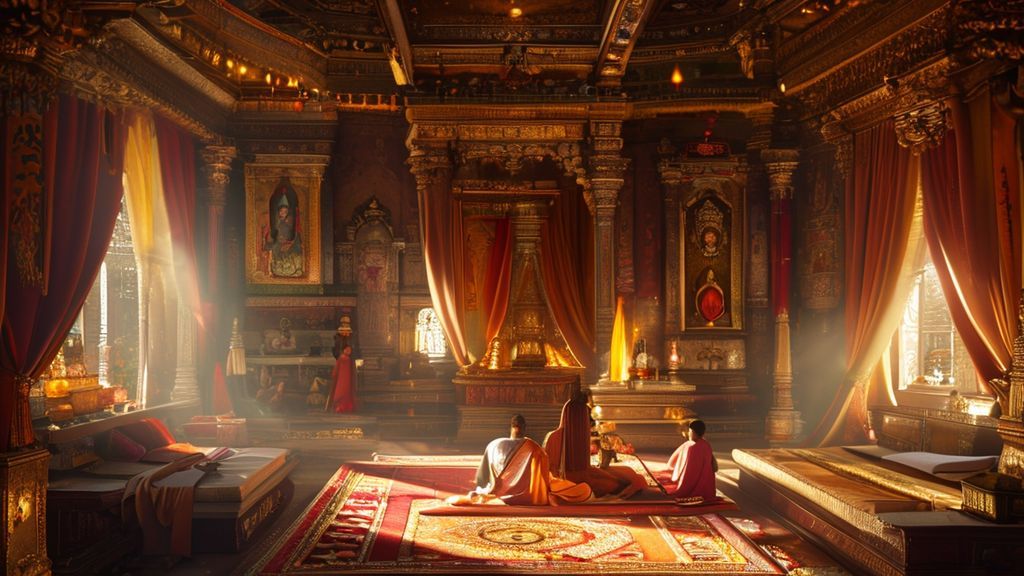
Master Bedroom Vastu delineates ancient Indic architectural principles for harmonizing the primary sleeping quarter, ensuring marital bliss, prosperity, and robust health for the couple. By aligning the master bedroom’s placement and internal arrangements with cosmic energies and elemental forces, Vastu Shastra fosters a sanctuary that nurtures emotional stability, spiritual growth, and familial well-being in accordance with Sanatan Dharma.
| Attribute | Details |
|---|---|
| Deity of Harmony | Lord Shiva and Devi Parvati (symbolizing ideal marital union), Chandra Dev (Moon God for peace), Mangal Dev (Mars God for energy and protection). |
| Origin of Vastu | Ancient Bharata (India), rooted in Vedic sciences and integrated into Sthapatya Veda, an Upaveda of the Atharva Veda. |
| Key Principle | Alignment with Pancha Bhoota (Earth, Water, Fire, Air, Space) and directional energies to balance ‘Prana Shakti’ (life force energy). |
| Scripture References | Vishwakarma Prakash, Mayamata, Manasara, Brihat Samhita, Samarangana Sutradhara, Kashyapa Shilpa Shastra. |
The Sanctum of Sanatan Dharma: Significance of the Master Bedroom
In the profound tapestry of Sanatan Dharma, every aspect of human life is imbued with spiritual significance, and the dwelling place is no exception. Vastu Shastra, the ancient science of architecture and spatial arrangement, provides meticulous guidelines to ensure that our homes are not merely structures of brick and mortar, but temples of peace, prosperity, and spiritual growth. The master bedroom, specifically, is considered the heart of a home’s energetic blueprint, a sacred space where a couple’s most intimate moments, restorative sleep, and shared aspirations coalesce. Its proper placement and design, as per Vastu, directly influence the physical health, mental tranquility, emotional harmony, and financial stability of the occupants. Neglecting Vastu principles in this vital area can lead to disharmony, illness, and even marital strife, underscoring its pivotal role in maintaining the holistic well-being prescribed by our Rishis.
Puranic Genesis and the Divine Architects of Vastu
The origins of Vastu Shastra are deeply woven into the fabric of Puranic legends and Vedic lore, establishing its divine lineage. The science is said to have been revealed by Lord Brahma Himself to various sages, ultimately codified by the divine architect, Vishwakarma, the celestial craftsman mentioned extensively in the Rig Veda (e.g., Rig Veda 10.81, 10.82) and the Puranas (e.g., Matsya Purana, Skanda Purana). The Mayamata and Manasara, foundational treatises on Vastu and Shilpa Shastra, attribute the knowledge to a lineage of divine beings and great seers, emphasizing that this knowledge is not man-made but divinely inspired for the welfare of humanity. The concept of Vastu Purusha Mandala, the metaphysical plan governing a site, is central to Vastu. It depicts the Vastu Purusha (cosmic being) lying prostrate, whose various body parts correspond to different deities and energetic zones. This establishes a profound connection between the micro-cosmos of the dwelling and the macro-cosmos, ensuring that a home built according to Vastu is in harmonious alignment with universal energies. The scriptures assert that aligning with these natural laws invites the blessings of devatas and wards off negative influences, promoting a dharmic way of life.
Energetic Geometry: The Scientific Marvels of Vastu
While often perceived as traditional wisdom, Vastu Shastra embodies sophisticated scientific principles rooted in an understanding of electromagnetism, solar energy, gravitational forces, and the subtle energies of the Pancha Bhoota—Earth, Water, Fire, Air, and Space. A master bedroom’s Vastu is not arbitrary; it is a meticulously calculated arrangement to optimize the flow of ‘Prana Shakti‘ (life force energy). The earth’s magnetic fields, for instance, play a crucial role. Sleeping with one’s head in the South or East direction aligns the body with these fields, ensuring restorative sleep and optimal blood circulation, as detailed in texts like the Vishwakarma Prakash. The placement of the room itself harnesses the sun’s beneficial rays and mitigates harmful radiations. The southwest direction, governed by the earth element (Prithvi Tattva), represents stability, grounding, and leadership—qualities essential for the head of the family and marital stability. Hence, the master bedroom in the southwest is paramount. This deep understanding of cosmic energies and their impact on human physiology and psychology elevates Vastu from mere superstition to a profound science of living in harmony with nature’s laws. You can explore more such ancient wisdom on Hindutva.online.
Sacred Placement: Rituals and Puja Vidhi for the Master Bedroom
Establishing a Vastu-compliant master bedroom involves mindful steps, not merely structural changes but also an intention-driven arrangement that invokes auspicious energies. While not a “ritual” in the sense of a grand Yajna, these are crucial “vidhis” for setting up the space:
- Directional Purity: The master bedroom must always be in the southwest zone of the house. This direction signifies stability, authority, and longevity, ideal for the primary earning member and the couple. If impossible, the northwest can be a secondary option, though it may introduce more movement.
- Bed Placement: The bed should be positioned such that the head faces South or East. This ensures sound sleep and positive energy flow. Avoid facing North, as it can disrupt sleep due to magnetic field misalignment, and West, which may lead to restlessness.
- Wall Support: The bed should have a solid wall behind it, symbolizing support and security in the relationship. Avoid placing the bed directly under a beam, which can create pressure and stress.
- Mirror Management: Mirrors should not face the bed directly, as they are believed to reflect energy and can cause arguments or restless sleep. If a mirror is unavoidable, it should be covered at night or placed on an adjacent wall.
- Colour Harmony: Soft, soothing colors like creams, light greens, rose pinks, or light blues are ideal. Avoid dark, aggressive colors like black, dark red, or navy blue, which can incite arguments or depression.
- Decluttering & Cleanliness: Maintain utmost cleanliness and avoid clutter, especially under the bed. A clean, organized space ensures free flow of positive energy.
- Lighting: Soft, warm lighting is preferred. Avoid harsh, direct lights that can create an unsettling atmosphere.
- Door Position: The bedroom door should preferably open at 90 degrees and not create any creaking sounds.
Mantras for Marital Harmony and Prosperity
Invoking divine blessings through mantras can significantly enhance the positive vibrations in the master bedroom, fostering love, understanding, and prosperity for the couple.
-
For Overall Harmony & Obstacle Removal: Chanting the Ganesh Mantra.
ॐ गं गणपतये नमः (Om Gam Ganapataye Namaha)
-
For Marital Bliss & Longevity: Chanting the Shiva-Parvati Mantra.
ॐ उम महेश्वराभ्यां नमः (Om Uma Maheshwarabhyam Namaha)
-
For Prosperity & Abundance: Chanting the Lakshmi Mantra.
ॐ श्रीं ह्रीं श्रीं कमले कमलालये प्रसीद प्रसीद श्रीं ह्रीं श्रीं ॐ महालक्ष्मी नमः (Om Shreem Hreem Shreem Kamale Kamalalaye Praseed Praseed Shreem Hreem Shreem Om Mahalakshmaye Namaha)
-
For Peace & Tranquility: Chanting the Chandra (Moon) Mantra.
ॐ श्रां श्रीं श्रौं सः चंद्रमसे नमः (Om Shram Shreem Shroum Sah Chandramase Namaha)
Dos and Don’ts for the Master Bedroom
- DO: Place the master bedroom in the southwest direction of the house.
- DO: Position the bed with the head facing South or East for better sleep and health.
- DO: Use light and calming colors like creams, light greens, or rose pinks.
- DO: Keep the room clutter-free and well-ventilated.
- DO: Display photographs of the couple or family that evoke happiness and love.
- DO: Use soft, indirect lighting.
- DON’T: Place the master bedroom in the Southeast (Agni Kon – fire zone) or Northwest (Vayu Kon – air zone), as these can lead to conflict or instability.
- DON’T: Have mirrors facing the bed directly.
- DON’T: Store unwanted items, broken electronics, or sharp objects in the bedroom.
- DON’T: Use aggressive or very dark colors.
- DON’T: Place the bed directly under a beam or opposite the bedroom door.
- DON’T: Keep water features (aquariums, indoor fountains) in the bedroom, as they can cause emotional instability.
What is the ideal direction for a master bedroom as per Vastu?
The ideal direction for the master bedroom is unequivocally the Southwest (Nairutya Kon). This direction is governed by the Earth element and signifies stability, grounding, authority, and longevity, making it perfect for the head of the family and ensuring marital harmony and steady prosperity. Placing it here enhances the couple’s leadership and strengthens their bond.
Which direction should the bed face in a couple’s room?
For a couple’s room, the bed should be placed such that the head faces South or East. Sleeping with the head towards the South is highly recommended for deep, restful sleep and good health, as it aligns with the earth’s magnetic field. Facing East promotes spiritual growth and positive energy. Avoid facing North, which can lead to restless sleep and health issues, and West, which may induce negative dreams or restlessness.
Are mirrors allowed in the master bedroom as per Vastu?
Mirrors are generally permissible in the master bedroom, but with a crucial Vastu caveat: they must not face the bed directly. A mirror reflecting the sleeping couple is believed to cause marital discord, health problems, or sleeplessness. If a mirror is unavoidable in such a position, it should be covered with a cloth at night. Ideally, mirrors should be placed on a wall where they do not directly reflect the bed.
What colors are best for a couple’s room according to Vastu?
Vastu Shastra recommends soft, calming, and harmonious colors for a couple’s room to foster peace and love. Shades of light green, rose pink, cream, off-white, and light blue are highly suitable. These colors promote relaxation, emotional stability, and a soothing ambiance. Avoid vibrant reds, dark blues, or black, as they can invoke aggression, melancholy, or intense emotions that disrupt harmony.
Dharmic Significance: Preserving Sanatan Dharma Through Vastu Harmony
The adherence to Master Bedroom Vastu principles transcends mere interior decoration; it is an act of preserving and living by the eternal tenets of Sanatan Dharma. By consciously aligning our living spaces with cosmic laws, we acknowledge the interconnectedness of all existence (Sarvam Khalvidam Brahma) and our place within the grand design of the universe. A home imbued with positive Vastu energies becomes a haven for spiritual practices, a cradle for dharmic values, and a sanctuary where familial bonds are strengthened. It ensures that the occupants, particularly the married couple, live in a state of ‘Ananda’ (bliss) and ‘Arogya’ (health), allowing them to fulfill their ‘Grihastha Dharma’ with vigor and devotion. Thus, Vastu is not just about architectural correctness but about cultivating an environment conducive to a righteous, fulfilling, and spiritually enriched life, echoing the wisdom found on Hindutva.online. It is a humble yet profound endeavor to bring the divine order into our daily lives, ensuring that our homes are indeed reflections of the cosmos.