

Mathura Temples, located on the banks of the sacred Yamuna River in Uttar Pradesh, holds the supreme distinction of being the birthplace of Lord Krishna, making it one of Hinduism’s seven sacred cities (Sapta Puri) and the spiritual epicenter of Krishna bhakti (devotion). Approximately 5,000 years ago, Krishna was born in King Kansa’s prison cell at the site now marked by the Shri Krishna Janmabhoomi Temple Complex (also called Krishna Janmasthan), which houses three main shrines.

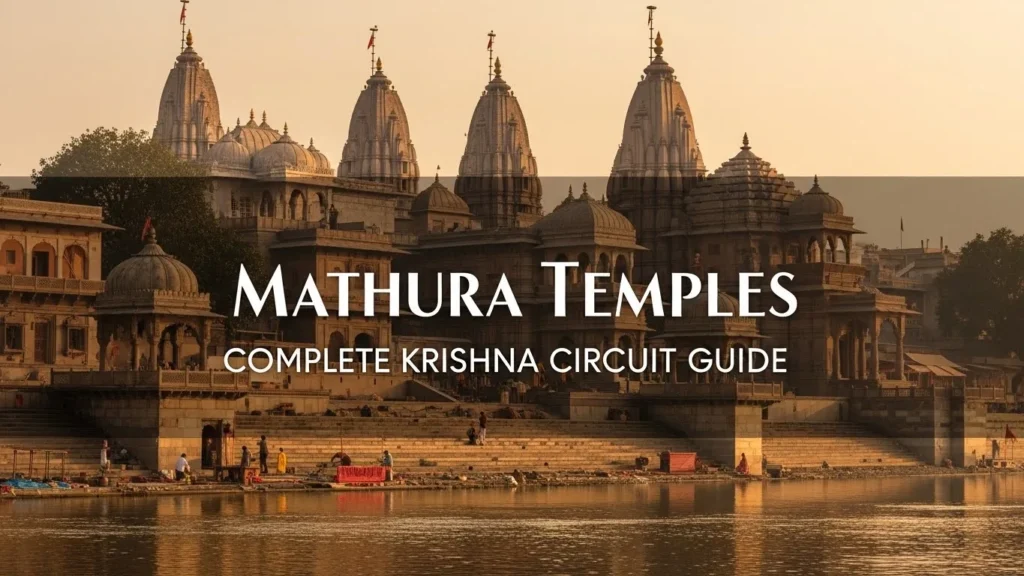
the Keshavdev Temple dedicated to Krishna, the Garbh Griha (sanctum) marking the exact prison cell birthplace, and Bhagavata Bhavan with presiding deities Radha-Krishna. The city’s sacred geography extends beyond the birthplace to include the magnificent Dwarkadhish Temple built in 1814 by the Scindias of Gwalior in Rajasthani architectural style, the Vishram Ghat where Krishna rested after slaying demon-king Kansa (with mesmerizing evening aarti at 7:00 PM in summer), and numerous other temples and ghats lining the Yamuna River that witnessed Krishna’s divine pastimes.
While Mathura and Vrindavan are intrinsically connected in Krishna’s life story, they represent different spiritual dimensions: Mathura marks Krishna’s grand entrance into the world—his birth, his divine purpose of destroying evil, his heroic act of killing Kansa—giving it a historical, urban, and pilgrimage-focused character, while Vrindavan (10-15 km away) represents Krishna’s childhood playground where his heart truly came alive through playful pranks, eternal love with Radha, and the divine Raas Leela, offering a more devotional, temple-hopping, and scenic atmosphere. Most pilgrims visit Mathura first to connect with Krishna’s origin and set a spiritual tone, then proceed to Vrindavan for the devotional immersion, creating a complete journey from birthplace to childhood lands.
This comprehensive guide explores the complete Mathura temple circuit including the sacred Janmabhoomi Complex with its historical destruction and reconstruction, major temples (Dwarkadhish, Gita Mandir, others) with detailed timings and significance, the 25 ghats along Yamuna River with special focus on Vishram Ghat’s evening aarti experience, optimal one-day and multi-day Mathura itineraries, practical visiting information including best time and accommodation, the distinction between Mathura and Vrindavan pilgrimage experiences, and what Mathura reveals about Hindu philosophy‘s incarnation theology where the divine descends to earthly realm at specific geographic locations that become eternal pilgrimage destinations carrying sacred energy across millennia.
Major Temples in Mathura
1. Shri Krishna Janmabhoomi Temple Complex (Janmasthan)
- “The exact birthplace of Krishna”
- “Built around the exact spot where Krishna is believed to have been born over 5,000 years ago”
- “Shri Krishna Janmasthan consists of a group of temples built on the spot where Shri Krishna was born”
- Most important pilgrimage site for Krishna devotees worldwide
1. Keshavdev Temple:
- Dedicated to Lord Krishna as Keshava
- Main deity: 180 cm (6 ft) tall couple of Radha and Krishna
- Central worship shrine of the complex
2. Garbh Griha (Sanctum Sanctorum):
- “Where Krishna is believed to be born in Dvapar Yuga”
- Marks the exact prison cell where Devaki and Vasudeva were imprisoned
- Most sacred spot in entire complex
- “Built over the exact place where Krishna was born”
3. Bhagavata Bhavan:
Additional Shrines in Complex:
- Shrine of Balarama, Subhadra, and Jagannatha (on right)
- Temple of Rama, Lakshmana, and Sita (on left)
- Garuda Stambha (pillar) and Chaitanya Mahaprabhu (in front of Jagannatha shrine)
- Hanuman (in front of Ram shrine)
- Temple of Durga
- Temple with Shivalinga
- Sacred Kund (water tank)
- Library
- Ayurveda Bhavan
- Guest house
- Open arena
- Shops for prasad and religious items
Historical Tragedy and Resilience:
- “The original temple has been in existence since time immemorial”
- “It has been looted and destroyed multiple times by invaders in the last 1000 years”
- Rebuilt multiple times demonstrating devotional persistence
- Current structure relatively modern but on ancient sacred site
- Deeg Marg, Mathura
- Approximately 4 km from Mathura Junction Railway Station
Timings:
- Generally 5:30-6:00 AM to 12:00 PM
- 4:00-5:00 PM to 9:00-9:30 PM
- Timing may vary during festivals
Significance:
- Incarnation theology made manifest
- Divine descending to earthly realm
- Connecting to exact moment of Krishna’s avatar
- Most spiritually powerful site in Mathura
2. Dwarkadhish Temple
- “Dedicated to Lord Krishna, revered as Dwarkadhish (King of Dwarka)”
- “A grand temple celebrating Krishna in his kingly form”
- Krishna in his mature, royal aspect as ruler of Dwarka kingdom
- “One of the oldest temples in Mathura”
- “Built by the Scindias of Gwalior in 1814”
- “One of the largest temples located in spacious premises”
- Over 200 years of continuous worship
- Rajasthani architectural style
- “Intricate carvings whisper stories of the past”
- “Captivating black marble idol of Krishna”
- Spacious temple premises with elaborate decorations
- “As you step inside this haven of love, feel the weight of the world lift from your shoulders, replaced by a profound sense of serenity”
- Peaceful, devotional atmosphere
- Beautiful idol radiating divine presence
- “Beautifully decorated during festivals”
- Janmashtami (Krishna’s birthday) – Massive celebrations
- Holi – Colorful festivities
- “The temple swings during Janmashtami are legendary”
Temple Timings:
- Summer: 6:30 AM – 10:30 AM; 4:00 PM – 9:30 PM
- Winter: Slightly adjusted timings
- Near Vishram Ghat, Mathura
- Walking distance from the main ghat area
Entry: Free
Best Time to Visit:
- Early morning for peaceful darshan
- Evening before aarti
- Festival times for vibrant celebrations (very crowded)
3. Vishram Ghat
- “Believed to be the place where Krishna rested after defeating Kansa”
- “Vishram” = “rest” (where Krishna took vishram/rest)
- “The main bathing ghat on the Yamuna”
- One of 25 ghats in Mathura along the sacred river
The Evening Aarti Experience:
- “Evening aarti here is a mesmerizing experience, similar to Varanasi but more intimate”
- “Evening aartis here are a must-see”
- Creates profound spiritual atmosphere along Yamuna
- Summer: 7:00 PM
- Winter: 6:45 PM
- Daily evening ceremony
- Open 24 hours (the ghat itself)
- Evening aarti at specified times
- Free entry
Activities at Vishram Ghat:
- Holy bathing in Yamuna River
- Evening aarti participation
- Boat rides (₹200-500 per boat)
- Yamuna Parikrama – circumambulation of river via 25 ghats
- Photography of spiritual activities
- October to March: Pleasant climate
- Bhai Dooj festival and Yamuna Chhat: Most spiritually enriching
- Evening for aarti experience
- Early morning for peaceful bathing
- 4.5 km from Mathura Junction Railway Station
- Central location in Mathura’s ghat area
Trip Duration: 1 hour (including travel time)
4. Gita Mandir
- Built by the Birla Family
- “Has the entire Bhagavad Gita inscribed on its walls”
- All 700 verses of sacred scripture visible
- Educational and devotional significance
Significance:
- Bhagavad Gita is Krishna’s divine discourse to Arjuna
- Temple serves as living scripture repository
- Pilgrims can read sacred verses while circumambulating
- Connects Krishna’s birth city to his teachings
Architecture:
- Characteristic Birla Temple design
- Clean, white marble structure
- Well-maintained premises
Location: Vrindavan (though associated with Mathura pilgrimage)
5. Kesava Deo Temple
- Bindu Road, Mathura
- Part of or near Janmabhoomi Complex
Significance:
- One of the main temples in birthplace area
- Kesava = Krishna (one who has beautiful hair)
- Ancient name for Krishna
6. Jugal Kishore Mandir
Dedication:
- Dedicated to Radha-Krishna as divine couple
- “Jugal” = pair/couple
- Celebrates eternal love between Radha and Krishna
Location: Vrindavan area (part of broader Mathura-Vrindavan circuit)
7. Other Notable Temples and Sites
- Beautiful stepped tank near Mathura
- Associated with Krishna’s pastimes
- Architectural marvel with sandstone ghats
Potara Kund:
- Sacred tank where Krishna’s clothes were washed
- Ancient pilgrimage site
Government Museum, Mathura:
- Ancient sculptures from Buddhist and Hindu periods
- Gandhara and Mathura school of art
- Not a temple but important cultural site
Kankali Tila:
- Ancient Jain site showing religious plurality
- Archaeological significance
Complete Mathura Temple Circuit
Mathura Temples One-Day Mathura Itinerary
Morning Session (6:00 AM – 12:00 PM):
6:00-6:30 AM: Arrive Mathura
- Check into hotel or start directly if coming from nearby
6:30-8:30 AM: Shri Krishna Janmabhoomi Temple Complex
- Most important temple, visit first
- Allow 2 hours for complete darshan
- Visit all three main shrines: Keshavdev, Garbh Griha, Bhagavata Bhavan
- Early morning means fewer crowds
- Peaceful spiritual atmosphere
9:00-10:00 AM: Dwarkadhish Temple
- Walking distance from Janmabhoomi
- Darshan of Krishna in royal form
- Appreciate Rajasthani architecture
- 1 hour sufficient
10:30-11:30 AM: Vishram Ghat (Morning Visit)
- Holy bath in Yamuna (optional)
- See the 25 ghats area
- Boat ride if interested (30-45 minutes)
- Morning riverside atmosphere
12:00 PM: Lunch Break
- Traditional vegetarian thali
- Mathura pedas (famous local sweet)
Afternoon Break (12:00 PM – 4:00 PM):
- Rest at hotel
- Some temples close during afternoon
- Avoid midday heat
Evening Session (4:00 PM – 9:00 PM):
4:00-5:30 PM: Return to Dwarkadhish Temple or other temples
- Evening darshan
- Different devotional energy than morning
6:00-6:45 PM: Arrive Vishram Ghat
- Position for evening aarti
- Best viewing spots fill quickly
6:45-7:30 PM: Evening Aarti at Vishram Ghat
- Highlight of Mathura visit
- Mesmerizing spiritual experience
- Similar to Varanasi but more intimate
- Lamps floating on Yamuna
- Devotional songs and bells
7:30-8:30 PM: Ghat Area Exploration
- Walk along riverside
- Visit nearby temples
- Street food (pedas, kachoris)
- Shopping for religious items
8:30 PM: Dinner and rest
Two-Day Mathura Deep Dive
Day 1: Core Temples
Morning:
- Krishna Janmabhoomi Temple Complex (extended visit)
- Dwarkadhish Temple
- Vishram Ghat morning bath
Afternoon:
- Lunch and rest
- Optional: Government Museum for cultural context
Evening:
- Return to Janmabhoomi for evening aarti
- Vishram Ghat evening aarti
- Dinner
Night: Stay in Mathura
Day 2: Extended Sites + Transition to Vrindavan
Morning:
- Revisit favorite temples
- Kusum Sarovar (if time permits)
- Other ghats exploration
Afternoon:
- Final prayers at Janmabhoomi
- Lunch
- Depart for Vrindavan (10-15 km, 30 minutes)
Rest of Day: Begin Vrindavan temple circuit
Combined Mathura-Vrindavan Pilgrimage
- Day 1: Complete Mathura (as per one-day itinerary)
- Day 2: Vrindavan temples (Banke Bihari, ISKCON, Prem Mandir)
- Day 3: Extended Braj region (Barsana, Govardhan)
- “Visiting Mathura first allows you to begin your pilgrimage at the very source of Krishna’s earthly incarnation”
- “Absorb the historical depth and religious intensity that permeates the city”
- Sets spiritual foundation for Vrindavan’s devotional immersion
- Natural chronological progression (birth → childhood)
Mathura vs Vrindavan: Understanding the Difference
Character Comparison
Mathura:
- Type: Birthplace of Lord Krishna (Historic City)
- Known For: Birthplace of Krishna, Janmashtami celebrations
- Vibe: Historical, Urban, Pilgrimage-focused
- Spiritual Significance: Krishna Janmabhoomi (birthplace)
- Major Crowd: During Janmashtami & Holi
- Ideal For: First-time visitors, history lovers, those seeking birthplace connection
Vrindavan:
- Type: Place of Krishna’s early life & leelas (Pilgrimage Town)
- Known For: Krishna’s childhood, Radha-Krishna love, Raas Leela
- Vibe: Spiritual, Scenic, Devotional, Temple-hopping
- Spiritual Significance: Raas Leelas, Bhakti & Devotion sites
- Major Crowd: Year-round, especially during Holi
- Ideal For: Devotees, temple hoppers, seekers of devotional experience
Spiritual Dimensions
- “Marks Krishna’s grand entrance into the world”
- Focus on birth narrative
- Historical grounding
- Krishna as avatar who came to destroy evil
- Prison cell birthplace emphasizes divine purpose
- Kansa-slaying narrative of good vs evil
- “Where his heart truly comes alive”
- “A place that whispers stories of love, laughter, and divine connection”
- Focus on childhood pastimes (leelas)
- Eternal love with Radha
- Playful, intimate relationship with devotees
- Raas Leela and divine dance
Complementary Pilgrimage
“Think of them as two sides of the same coin”:
- Neither complete without the other
- Birth + Childhood = Complete Krishna narrative
- Historical + Devotional = Balanced spiritual experience
- Mathura grounds you, Vrindavan lifts you
- Together represent full Krishna consciousness
Practical Visiting Information
How to Reach Mathura
By Air:
- Nearest Airport: Agra Airport (60 km, 1.5 hours)
- Alternative: Delhi Indira Gandhi International Airport (150 km, 3-4 hours)
- Taxi/cab services available from airports
By Train:
- Mathura Junction: Major railway station
- Well-connected to Delhi (2-3 hours), Agra (1 hour)
- Trains from Mumbai, Kolkata, Bangalore, Chennai
- Close to city center and temples
By Road:
- From Delhi: 150 km via Yamuna Expressway (3-4 hours)
- From Agra: 60 km (1.5 hours)
- State transport buses and private buses
- Taxi/cab services
Local Transport:
- Auto-rickshaws for temple-to-temple travel
- Cycle-rickshaws for short distances
- Walking possible in ghat area
- Private taxis for day tours
Best Time to Visit
Weather-Based:
- October to March: Pleasant (15-25°C), ideal pilgrimage season
- April to June: Very hot (35-45°C), less comfortable
- Monsoon (July-September): Moderate rain, fewer crowds
Festival Times:
- Janmashtami (August-September): Krishna’s birthday
- Millions of pilgrims
- Magnificent celebrations at Janmabhoomi
- Extremely crowded but spiritually powerful
- Book accommodation months in advance
- Holi (March): Festival of colors
- Massive celebrations in both Mathura and Vrindavan
- Barsana’s famous Lathmar Holi nearby
- Vibrant, joyous atmosphere
- Very crowded
- Kartik Month (October-November): Sacred month
- Special rituals and celebrations
- Deepotsav (Diwali-related)
- Moderate crowds
Recommended:
- November-February: Best weather, manageable crowds (avoid specific festival dates if you dislike crowds)
- Weekdays: Less crowded than weekends
- Early mornings: Peaceful temple darshan
Where to Stay
Accommodation Options:
Budget:
- Dharamshalas (pilgrim guest houses): ₹300-800 per night
- Budget hotels: ₹800-1,500 per night
- Basic amenities, clean rooms
Mid-Range:
- Hotels near Janmabhoomi: ₹2,000-4,000 per night
- Hotels near railway station: ₹1,500-3,000 per night
- AC rooms, restaurants
Upper Mid-Range:
- ₹4,000-7,000 per night
- Better facilities, rooftop restaurants
- Ghat views possible
Area Recommendations:
- Near Krishna Janmabhoomi: Walking distance to main temple
- Near Vishram Ghat: Riverside location, evening aarti access
- Railway Station Area: Convenient for travel connections
Booking Tips:
- Book well in advance during Janmashtami
- Weekdays easier to find accommodation
- Many hotels offer Mathura-Vrindavan combined packages
Temple Visiting Protocols
Dress Code:
- Men: Dhoti/kurta preferred; pants and shirt acceptable; no shorts
- Women: Saree, salwar kameez, churidar; modest clothing covering shoulders and knees
- Traditional attire shows respect
- Some temples stricter than others
Footwear:
- Remove shoes before entering all temples
- Paid footwear stands (₹5-10) or free shoe racks
- Carry socks for hot temple floors in summer
Photography:
- Generally prohibited inside sanctum sanctorums
- Allowed in outer temple areas (check signs)
- Vishram Ghat aarti usually permits photography
- Always ask permission
Conduct:
- Maintain respectful silence inside temples
- Follow queue discipline (can be chaotic during festivals)
- Don’t push or jostle other devotees
- Participate respectfully in aartis
Offerings:
- Flowers, coconuts, sweets available at temple shops
- Prasad distributed after worship
- Donations optional but appreciated
Safety:
- Keep valuables secure in crowded areas
- Beware of pickpockets during festivals
- Use official temple donation boxes
- Avoid giving money to persistent beggars blocking entry
Food and Dining
Vegetarian Cuisine:
- Strictly vegetarian in holy city
- No eggs, meat, alcohol
- Many restaurants avoid onion/garlic (sattvic food)
Famous Foods:
- Mathura Peda: Most famous sweet, milk-based
- Rabri: Condensed milk dessert
- Kachori-Sabzi: Breakfast specialty
- Lassi: Yogurt drink
- Aloo Puri: Simple traditional meal
Where to Eat:
- Restaurants near temples
- Brijwasi Sweet shops (famous for pedas)
- Street food stalls (check hygiene)
- Hotel restaurants
Prasad:
- Available at all temples
- Usually simple sweets or tulsi leaves
- Considered blessed food
Shopping
Religious Items:
- Krishna idols (brass, marble, wood)
- Flutes (Krishna’s symbol)
- Pictures and calendars
- Tulsi mala (prayer beads)
- Bhagavad Gita books
Mathura Pedas:
- Most popular souvenir
- Packed boxes for traveling
- Multiple sweet shops competing
- Verify freshness
Traditional Crafts:
- Braj art and paintings
- Handmade items
Where to Shop:
- Shops around Janmabhoomi complex
- Ghat area markets
- Railway station vicinity
Historical and Theological Context
The Birthplace Tradition
Sacred Geography:
- Birthplaces of divine incarnations become eternal pilgrimage sites
- Physical location carries spiritual energy
- Connects devotees to exact moment of avatar
- Geography becomes theology
Krishna’s Birth Narrative:
- Born in Kansa’s prison to Devaki and Vasudeva
- Midnight birth during monsoon
- Divine child to destroy demon-king
- Yamuna River parted for Vasudeva to carry baby to safety
- Birthplace remains spiritually charged
Mathura Through History
Ancient Importance:
- Mentioned in Mahabharata and Puranas
- Capital of Surasena Kingdom
- Buddhist center in ancient times (Mathura school of art)
- Jain presence (Kankali Tila)
Temple Destruction and Resilience:
- Original Janmabhoomi temple ancient
- “Looted and destroyed multiple times by invaders in the last 1000 years”
- Rebuilt repeatedly by devotees
- Current structure modern but on sacred site
- Demonstrates faith’s persistence
Art and Culture:
- Mathura school of sculpture (1st-3rd centuries CE)
- Buddhist and Hindu iconography
- Government Museum preserves heritage
- Cultural capital of Braj region
Incarnation Theology
Avatar Doctrine:
- Krishna as Purna Avatar (complete incarnation)
- Divine descends to restore dharma
- Birthplace marks entry point of divine into material world
- Pilgrimage connects devotees to incarnation event
Prison Birth Symbolism:
- Born in darkness (prison) to bring light
- Chains couldn’t hold divine child
- Liberation from bondage theme
- Kansa’s fear vs Krishna’s fearlessness
Frequently Asked Questions
Where exactly was Krishna born?
Krishna was born in Mathura at the site now marked by the Shri Krishna Janmabhoomi Temple Complex (also called Krishna Janmasthan), specifically in the prison cell where his parents Devaki and Vasudeva were imprisoned by demon-king Kansa approximately 5,000 years ago. The complex contains three main shrines: Keshavdev Temple dedicated to Krishna, Garbh Griha marking the exact prison cell birthplace, and Bhagavata Bhavan with Radha-Krishna deities. This site is “built around the exact spot where Krishna is believed to have been born over 5,000 years ago” and serves as the most sacred pilgrimage destination for Krishna devotees.
What is the timings of Krishna Janmabhoomi temple?
Shri Krishna Janmabhoomi Temple Complex is generally open from 5:30-6:00 AM to 12:00 PM in the morning session, and 4:00-5:00 PM to 9:00-9:30 PM in the evening session. The temple follows typical North Indian temple schedule with afternoon closure during the hottest hours when the deity rests. Timings may be extended during major festivals like Janmashtami when millions of devotees visit. The complex is located on Deeg Marg, approximately 4 km from Mathura Junction Railway Station. Visiting early morning (6:00-7:00 AM) provides the most peaceful darshan experience with fewer crowds.
What is Vishram Ghat famous for?
Vishram Ghat is famous as the spot where Lord Krishna rested (vishram) after defeating demon-king Kansa, making it the most sacred of Mathura’s 25 ghats along the Yamuna River. The ghat hosts a mesmerizing evening aarti at 7:00 PM (summer) or 6:45 PM (winter) that is “similar to Varanasi but more intimate,” creating a profoundly spiritual atmosphere with lamps, devotional songs, and Yamuna worship. Open 24 hours with free entry, the ghat also offers boat rides (₹200-500), holy bathing opportunities, and serves as the starting point for Yamuna Parikrama (circumambulation of the river).
Should I visit Mathura or Vrindavan first?
Most pilgrims visit Mathura first because it “allows you to begin your pilgrimage at the very source of Krishna’s earthly incarnation” and “absorb the historical depth and religious intensity that permeates the city” before experiencing Vrindavan’s devotional atmosphere.
Mathura represents Krishna’s birthplace and his grand entrance into the world, focusing on historical grounding and the birth narrative, while Vrindavan represents where Krishna’s heart came alive through childhood pastimes, Radha’s love, and playful leelas. “Think of them as two sides of the same coin”—visiting Mathura first sets a spiritual foundation for Vrindavan’s temple-hopping devotional experience, creating natural chronological progression from birth to childhood.
What is Dwarkadhish Temple in Mathura?
Dwarkadhish Temple is one of Mathura’s oldest and largest temples, built in 1814 by the Scindias of Gwalior in Rajasthani architectural style, dedicated to Lord Krishna in his royal form as Dwarkadhish (King of Dwarka). The temple features “intricate carvings” and a “captivating black marble idol of Krishna” that creates a peaceful, devotional atmosphere. Located near Vishram Ghat, the temple is “beautifully decorated during festivals” with “legendary swings during Janmashtami”. Summer timings are 6:30 AM – 10:30 AM and 4:00 PM – 9:30 PM with free entry, representing Krishna’s mature aspect as king rather than the childhood focus of many other temples.
How many ghats are in Mathura?
Mathura has 25 ghats (bathing steps) along the Yamuna River, with Vishram Ghat being the most sacred and famous. The ghats collectively serve as sites for holy bathing, Yamuna Parikrama (river circumambulation), evening aartis, and religious ceremonies. Vishram Ghat, located 4.5 km from Mathura Junction Railway Station, hosts the main evening aarti at 7:00 PM in summer and 6:45 PM in winter. The best time to visit the ghats is October to March for pleasant weather, with special spiritual significance during Bhai Dooj festival and Yamuna Chhat. The ghats area is open 24 hours with free entry.
What sweets is Mathura famous for?
Mathura is world-famous for Mathura Peda, a traditional milk-based sweet that serves as the city’s signature delicacy and most popular souvenir for pilgrims to take home. The peda is made from khoya (condensed milk), sugar, and cardamom, with variations including different flavors and sizes. Other famous Mathura sweets include rabri (condensed milk dessert) and various milk-based preparations reflecting the city’s dairy-rich heritage connected to Krishna’s childhood as a butter thief. Multiple sweet shops around the Krishna Janmabhoomi complex and ghat areas compete in quality, with Brijwasi being among the most famous brands offering packed boxes suitable for traveling.
What is the best time to visit Mathura?
The best time to visit Mathura is October to March when the weather is pleasant (15-25°C), making temple visits and ghat exploration comfortable. November to February offers ideal conditions with manageable crowds on weekdays. However, festival times like Janmashtami (August-September, Krishna’s birthday) and Holi (March) provide spiritually powerful experiences despite extreme crowds requiring months-advance accommodation booking. Avoid April-June when temperatures reach 35-45°C, making outdoor pilgrimage activities uncomfortable. Monsoon (July-September) brings moderate rain and fewer crowds, offering a middle option for those seeking less crowded but still pleasant visiting conditions.
Conclusion
Mathura stands as Hinduism’s geographic and spiritual anchor for Krishna consciousness—the exact location where approximately 5,000 years ago, in the darkness of Kansa’s prison cell, divine light entered the world as Lord Krishna, transforming an urban center into eternal pilgrimage destination where millions annually seek darshan at the Garbh Griha marking his birthplace, where the Yamuna River at Vishram Ghat witnessed his post-Kansa rest, and where temples like Dwarkadhish celebrate his evolution from imprisoned newborn to King of Dwarka.
The sacred geography of Mathura—from the thrice-destroyed yet always-rebuilt Janmabhoomi Complex demonstrating faith’s resilience, to the 25 ghats where evening aarti creates Varanasi-like spiritual intensity in more intimate scale, to the Rajasthani architecture of Dwarkadhish Temple housing Krishna’s black marble royal form—materializes incarnation theology where abstract concepts of divine descent become tangible through specific locations carrying sacred energy across millennia.
The distinction between Mathura’s historical-urban-birthplace character and Vrindavan’s devotional-scenic-childhood focus reveals sophisticated pilgrimage design where devotees experience Krishna’s life chronologically—first connecting to his grand entrance at Mathura’s prison birthplace, absorbing the historical depth and religious intensity of Kansa-slaying narratives, then proceeding 10-15 km to Vrindavan where Krishna’s heart came alive through playful leelas, Radha’s eternal love, and the continuing Raas Leela at mysterious Nidhivan.
This “two sides of the same coin” complementarity ensures complete Krishna experience impossible through visiting either city alone, explaining why traditional pilgrimage patterns begin at Mathura’s Janmabhoomi, proceed through Dwarkadhish and Vishram Ghat evening aarti, then transition to Vrindavan’s temple circuit before expanding to broader Braj region including Barsana, Govardhan, Gokul, and Nandgaon.
Whether undertaking focused one-day Mathura circuit (Janmabhoomi morning darshan, Dwarkadhish royal Krishna, Vishram Ghat evening aarti), comfortable two-day deep dive allowing extended Janmabhoomi Complex exploration and multiple ghat visits, or comprehensive week-long Braj Mandala parikrama circumambulating entire 84-km Krishna-pastimes landscape, pilgrims discover that Mathura transcends typical temple tourism to offer transformative encounter with Hindu philosophy‘s incarnation doctrine made manifest,
where the prison cell birthplace demonstrates divine willingness to enter material bondage to liberate souls, where evening aarti floating lamps on Yamuna create bridge between human devotion and divine response, where Mathura pedas’ sweetness symbolizes the nectar of Krishna consciousness, and where the very earth—sanctified by Krishna’s birth, his first steps, his Kansa-slaying mission—continues radiating spiritual energy attracting millions
who recognize that visiting Mathura isn’t merely historical pilgrimage to ancient birthplace but living encounter with that same divine consciousness that entered the world in Kansa’s prison and promised through Bhagavad Gita (Mathura’s sacred text inscribed on Gita Mandir walls): “Abandon all varieties of dharma and simply surrender unto Me. I shall protect you from all sinful reactions. Do not fear”—a promise kept across five millennia through Mathura’s temples, ghats, and the eternal presence felt by devotees who come seeking the source, finding not just birthplace geography but that timeless divine love that first manifested here and continues blessing all who approach with sincere hearts.
About the Author
Aryan Mishra – Cultural Heritage & Temple Architecture Specialist
Aryan Mishra is an accomplished writer and researcher specializing in Hindu festivals, temple architecture, and India’s rich cultural traditions. With a Master’s degree in Indian Art History from Maharaja Sayajirao University, she has extensively documented pilgrimage sites, temple iconography, and folk traditions across India. Her work focuses on making India’s spiritual heritage accessible to contemporary audiences while preserving authentic cultural narratives.