

The Mundan ceremony – also known as Chudakarana or Chaul in different regions – represents one of Hinduism’s most visually striking yet spiritually profound samskaras (sacred rites of passage), involving the complete shaving of baby’s head during first few years of life, typically between 7 months to 3 years, creating moment simultaneously shocking to modern sensibilities accustomed to cherishing baby’s first curls while deeply meaningful within traditional framework recognizing that birth hair carries residual energies from womb environment and potentially even subtle karmic

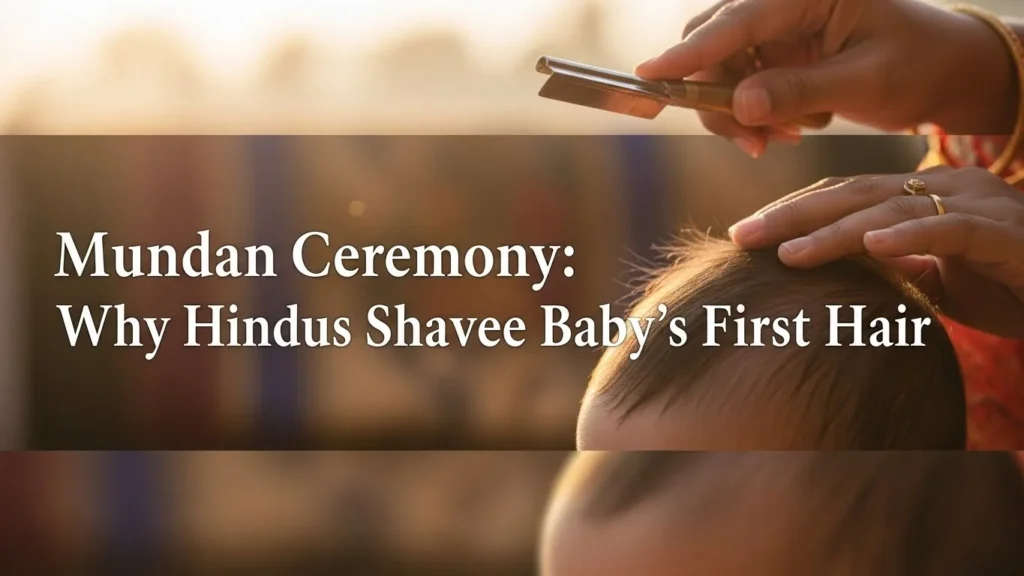
imprints from previous births requiring ritual removal through sacred ceremony that simultaneously purifies child, invokes divine blessings for healthy future growth, and marks formal transition from purely biological infant stage toward culturally initiated member of community with distinct spiritual identity. While contemporary parents often struggle with this practice appearing harsh or unnecessary.
why subject precious baby to seemingly traumatic complete head shaving when modern hygiene obviates any practical necessity? – understanding the multifaceted reasoning behind Mundan reveals sophisticated integration of spiritual symbolism (removing past-life negativity, creating fresh start, offering hair to deity as first significant sacrifice teaching non-attachment), Ayurvedic health principles (regulating body temperature through improved heat dissipation from scalp, stimulating hair follicles for stronger future growth.
opening crown chakra enhancing energy flow supporting brain development), scientific observations (removing potentially toxin-laden birth hair exposed to amniotic fluid chemicals, allowing new growth from clean scalp, potentially correlating with teething relief through reduced bodily stress), and cultural-psychological dimensions (creating memorable family milestone, establishing child’s connection to spiritual tradition, teaching early lesson in ceremonial participation and community belonging) – all woven together in practice maintained across millennia precisely because families consistently observed its beneficial effects even when unable to articulate exact mechanisms in modern scientific terminology.
For Hindu families in 2025, whether planning traditional temple Mundan at famous pilgrimage sites like Tirupati where millions annually donate their children’s hair to Lord Venkateshwara as sacred offering generating substantial temple revenue while simultaneously fulfilling spiritual purpose, or organizing intimate home ceremonies with priest and family barber, or adapting simplified versions at specialized children’s salons now catering to Hindu traditions.
understanding complete Mundan framework – proper timing based on astrological muhurta and child’s developmental stage, complete ceremony procedure from preliminary pujas through actual shaving to post-ritual blessings, essential safety considerations ensuring hygienic execution preventing infections, appropriate after-care protecting newly exposed sensitive scalp, and deeper appreciation of why this practice persists despite surface-level appearance of irrationality – enables conscious participation transforming potentially distressing experience into joyful family celebration marking significant childhood milestone while connecting child to ancient wisdom tradition teaching profound truths through embodied ritual practice rather than mere abstract philosophy.
The Spiritual and Cultural Significance of Mundan
Before examining practical procedures and health benefits, understanding why Hindu tradition considers head shaving spiritually significant reveals profound symbolism embedded in this seemingly simple ritual act.
The Scriptural Foundation:
The Chudakarana samskara (formal Sanskrit name for Mundan) appears in ancient Grihya Sutras (household ritual manuals) as one of the essential sixteen samskaras marking life’s critical transitions.
Paraskara Grihya Sutra describes the ceremony in detail, prescribing timing, mantras, and procedures.
Ashvalayana Grihya Sutra emphasizes that Chudakarana ensures:
- Longevity (ayush)
- Strength (bala)
- Radiance (tejas)
- Prosperity (shri)
The texts recognize this as more than mere haircut – it’s transformative ritual preparing child for next developmental stage.
The Symbolism of Hair Removal:
Hindu philosophy attributes multiple symbolic meanings to shaving birth hair:
1. Purification from Past Lives:
Birth hair considered to carry subtle impressions (samskaras) from:
- Previous incarnations
- Karmic residue requiring cleansing
- Womb environment’s accumulated energies
Removing this hair symbolizes:
- Fresh spiritual start
- Cleansing past negativity
- Preparing blank slate for this life’s journey
2. Shedding Ego and Attachment:
Hair represents vanity and physical beauty attachment. Voluntarily removing infant’s hair teaches early lesson (though child won’t consciously understand) in:
- Non-attachment to physical appearance
- Impermanence of material attributes
- Spiritual values transcending bodily concerns
Parents learn parallel lesson: loving child’s essence beyond external appearance.
3. Offering to Divine:
The shaved hair traditionally offered to deity (particularly at temple Mundans) represents:
- First significant sacrifice in child’s life
- Acknowledging that everything belongs to divine, not us
- Beginning lifetime pattern of offering what we value
- Teaching that spiritual growth requires letting go
At major temples like Tirupati, millions annually donate children’s hair to Lord Venkateshwara, generating significant temple revenue (hair sold to international wig industry) while fulfilling profound devotional purpose.
4. Rebirth Symbolism:
Shaving head creates visual transformation – baby looks completely different post-Mundan. This symbolizes:
- Rebirth into new life phase
- Transition from purely biological existence to cultural being
- Formal initiation into family’s spiritual lineage
- Death of infant stage, birth of child stage
Cultural and Regional Variations:
While core symbolism remains consistent, different communities emphasize various aspects:
North Indian Traditions:
- Often performed at home with family priest
- Simple ceremony focused on purification
- Hair may be buried under sacred tree or immersed in river
South Indian Traditions:
- Frequently performed at major temples (Tirupati especially famous)
- Elaborate pilgrimage event involving extended family
- Strong emphasis on offering hair as devotional sacrifice
Maharashtra (Chaul):
- Called Chaul, combining Mundan with other ceremonies
- Often coincides with other milestones (naming ceremony, ear piercing)
- Festive celebration with elaborate meals
Tamil Nadu:
- Temple Mundans extremely common
- Specific procedures and prayers in Tamil tradition
- Often fulfillment of vow made during pregnancy
Modern Psychological Significance:
Beyond traditional symbolism, Mundan serves contemporary purposes:
Family Bonding: Multi-generational participation in ceremony strengthens family connections
Cultural Transmission: Young parents learn and transmit traditions to next generation
Memorable Milestone: Creates distinct memories and photographs marking childhood passage
Community Integration: Public ceremony introduces child to extended family and community
Identity Formation: Establishes child’s connection to Hindu cultural identity from early age
The Ayurvedic and Scientific Rationale
Beyond spiritual symbolism, Hindu tradition’s insistence on Mundan reflects profound Ayurvedic understanding of infant physiology and observations of practical health benefits validated by generations of experience and increasingly by modern scientific understanding.
Ayurvedic Principles:
According to Ayurveda, the traditional Indian medical system:
1. Temperature Regulation:
Infants struggle with thermoregulation – their bodies cannot efficiently control temperature. Hair acts as insulation, potentially causing:
- Overheating in warm climates (most of India experiences hot weather)
- Excessive sweating from scalp
- Skin irritation and rashes
- Discomfort affecting sleep and feeding
Removing birth hair:
- Improves heat dissipation through scalp
- Allows better air circulation
- Reduces sweating and associated problems
- Promotes comfort especially during hot summer months
This explains traditional timing recommendation: perform Mundan before summer to maximize cooling benefits.
2. Crown Chakra Activation:
Ayurveda and yogic traditions recognize seven chakras (energy centers) along spine, with Sahasrara (crown chakra) at head’s top.
Birth hair considered to create energetic blockage preventing optimal energy flow. Removing it:
- Opens crown chakra
- Enhances prana (life energy) circulation
- Supports healthy brain development
- Improves mental clarity and cognitive function
While mainstream medicine doesn’t recognize chakras, the correlation between scalp stimulation and brain development has scientific support.
3. Stimulating Hair Follicles:
Traditional Ayurvedic understanding holds that:
- Birth hair is weak, thin, and sparse
- Rooted in follicles formed during fetal development in different environment
- Removing it stimulates dormant follicles
- New growth emerges stronger, thicker, and healthier
Modern trichology (hair science) partially validates this: Shaving doesn’t fundamentally change hair follicle genetics, but removing damaged hair allows new growth to appear fuller and stronger by comparison.
4. Removing Toxins:
According to Ayurveda:
- Fetus absorbs various substances through amniotic fluid
- Hormones, nutrients, and potentially toxins accumulate
- Birth hair contains residues of womb environment
- Removing it eliminates these accumulated substances
Modern science confirms hair analysis reveals drug exposure, heavy metals, and environmental toxins – providing some validation for intuitive Ayurvedic understanding.
5. Balancing Doshas:
Ayurveda’s constitutional types (Vata, Pitta, Kapha) require different approaches:
Pitta babies (warm, intense, prone to heat):
- Benefit most from Mundan’s cooling effect
- Should undergo ceremony during cooler months
- Require soothing post-shave scalp treatments
Kapha babies (cool, heavy, prone to congestion):
- Mundan helps reduce excess moisture retention
- Improves circulation
- Enhances vitality
Vata babies (cold, dry, anxious):
- Require careful timing to avoid cold season
- Need oil treatments post-shave for moisture
- Benefit from grounding effects of ceremony
Scientific Observations:
Modern research and clinical observations provide additional support:
1. Teething Correlation:
Traditional timing (7-12 months) coincides with teething period. Many parents report:
- Babies seem more comfortable during teething after Mundan
- Reduced cranial pressure possibly relieving teething pain
- Less irritability and better sleep
Scientific hypothesis: Reducing scalp burden (hair weight, heat retention) may minimize overall bodily stress during physiologically demanding teething period.
2. Brain Development Support:
First three years represent critical brain development period with:
- Rapid neural connection formation
- Skull expansion accommodating brain growth
- High metabolic activity requiring optimal conditions
Removing hair allows:
- Better heat dissipation from metabolically active brain
- Reduced pressure on fontanelles (soft spots)
- Improved comfort supporting better sleep crucial for development
3. Hygiene Benefits:
In traditional contexts lacking modern hygiene infrastructure:
- Baby hair difficult to clean thoroughly
- Accumulates sweat, dirt, possibly lice
- Creates infection risk in hot, humid climates
Shaving enables:
- Easy daily cleaning with simple water wash
- Visual monitoring for skin conditions
- Reduced infection risk
While less critical with modern bathrooms and baby shampoos, benefit remains relevant.
4. Skin Health:
Removing hair exposes scalp allowing:
- Identification of skin conditions (eczema, cradle cap, dermatitis)
- Direct treatment application
- Better healing with air exposure
- Prevention of fungal growth in humid environments
5. Potential Immunological Benefits:
Some researchers hypothesize that:
- Scalp stimulation during Mundan activates immune responses
- Mild stress response may strengthen overall resilience
- Early controlled stressor could prime adaptive systems
While speculative, aligns with broader immunological principle that appropriate challenges strengthen systems.
The Holistic Integration:
What makes Mundan remarkable is integration of multiple benefit dimensions:
- Spiritual purification and blessing
- Ayurvedic health optimization
- Practical hygiene advantages
- Psychological milestone marking
- Social-cultural initiation
Rather than single-purpose procedure, it addresses child’s wellbeing comprehensively – showcasing traditional wisdom’s sophistication in creating practices serving multiple beneficial functions simultaneously.
Timing the Mundan: When to Perform
Selecting appropriate timing for Mundan balances scriptural prescriptions, astrological considerations, seasonal factors, child’s developmental readiness, and family circumstances – creating flexible framework rather than rigid requirement.
Scriptural Guidelines:
According to Grihya Sutras and Hindu dharma texts:
Primary Recommendation:
Mundan should be performed during odd-numbered months or years of child’s life:
Year 1: 7th, 9th, or 11th month
Year 3: 27th, 29th, or 31st month (or simply age 3)
Year 5: Acceptable if earlier timing impossible
Why odd numbers? Hindu numerology considers odd numbers auspicious for purification ceremonies.
Earliest: Some texts permit as early as 5th month, though this is quite young
Latest: Should be completed by age 7, ideally by age 5
Most families perform between 10 months to 3 years – balancing traditional timing with practical readiness.
Age-Based Considerations:
7-12 Months:
Advantages:
- Baby too young to resist much
- Less developed attachment to hair
- Parents less emotionally attached to baby’s curls
- Coincides with teething period (potential relief)
Challenges:
- Very young, requires extra care
- Fontanelles (soft spots) may still be open
- Requires experienced, gentle barber
- Baby cannot sit still independently
1-2 Years:
Advantages:
- Most popular timing
- Baby sturdier, less fragile
- Can sit independently making process easier
- Fontanelles closed, less delicate
- Still before strong personality development
Challenges:
- May cry and resist (normal at this age)
- More aware of what’s happening
- Stronger, harder to hold still
2-3 Years:
Advantages:
- Can potentially understand simple explanations
- More cooperative if prepared properly
- Parents had more time to emotionally prepare
- Child more robust, less concern about delicacy
Challenges:
- Strong attachment to appearance
- May resist vigorously
- Remembers experience (earlier Mundans occur before memory formation)
- Possible emotional distress requiring sensitive handling
Astrological Muhurta Selection:
For families following traditional practices, consulting astrologer for auspicious date/time proves important:
Favorable Nakshatras:
- Ashwini, Rohini, Mrigashira
- Punarvasu, Pushya
- Hasta, Chitra, Swati
- Uttara Phalguni, Uttara Ashadha, Uttara Bhadrapada
Favorable Days:
- Monday (associated with Shiva and Moon – auspicious for children’s ceremonies)
- Thursday (Jupiter’s day – prosperity and wisdom)
- Friday (Venus’s day – beauty and growth)
Avoid:
- Tuesdays (Mars energy too aggressive for infant ceremony)
- Saturdays (Saturn energy – inauspicious for children’s events)
- Rahu Kaal periods (inauspicious times daily)
- Eclipses and their proximity dates
Favorable Months:
- Spring months (Chaitra, Vaishakha) – moderate temperature
- Early winter months (Kartika, Margashirsha) – cool but not cold
Avoid:
- Peak summer (Jyeshtha, Ashadha) – too hot for newly shaved scalp
- Peak winter (Pausha, Magha) – too cold for exposed head
Seasonal Considerations:
Ideal: Moderate Temperature Seasons
Spring (March-April) / Autumn (September-October):
- Perfect balance – neither too hot nor too cold
- Comfortable for baby post-shave
- Lower infection risk in moderate weather
- Pleasant for outdoor celebrations if desired
Summer (May-July):
Advantages:
- Hair removal provides cooling relief
- Fast healing in warm weather
Disadvantages:
- Newly exposed scalp very sensitive to sun
- Must keep head covered outdoors
- Sweating may irritate fresh-shaved skin
- Higher infection risk in heat
If summer Mundan necessary:
- Perform early morning for ceremony
- Keep baby indoors during peak heat
- Use light cotton head covering
- Extra vigilant about hygiene
Winter (November-February):
Advantages:
- Lower bacterial risk in cool weather
- If done early winter, grows back before peak cold
Disadvantages:
- Baby may feel cold without hair insulation
- Must keep head covered constantly
- Risk of cold/cough if not properly protected
If winter Mundan necessary:
- Ensure warm indoor environment
- Soft caps/beanies always on baby
- Delay if baby has cold or cough
- Apply warming oil (sesame/almond) to scalp
Monsoon (July-September):
Generally avoid due to:
- High humidity promoting infections
- Dampness and fungal risk
- Difficulty keeping scalp dry
- Increased illness vulnerability
Child’s Developmental Readiness:
Beyond age/astrology, assess child’s actual readiness:
Health Check:
✅ Baby in good health (no fever, cold, skin infections)
✅ No recent illness or vaccination (wait 2-3 weeks post-vaccination)
✅ Normal appetite and sleep patterns
✅ No current skin conditions on scalp
Developmental Markers:
✅ Can sit independently (makes process safer and easier)
✅ Fontanelles closed (if very young Mundan)
✅ Not currently hitting major developmental milestone causing stress
Postpone if:
❌ Baby unwell or recovering from illness
❌ Teething causing severe distress (though mild teething okay)
❌ Family facing major stress/transition (moving, etc.)
❌ Unable to provide proper post-care attention
Practical Family Considerations:
Coordinate with:
- Extended family availability (if traditional joint celebration desired)
- Priest’s schedule (if having formal ceremony)
- Temple timing (if performing at pilgrimage site like Tirupati)
- Photography/videography arrangements
- Venue booking if required
Financial Planning:
- Temple donations if applicable
- Priest fees
- Barber services
- Celebration meal
- Photography
- New clothes for baby and family
Modern Adaptations:
Contemporary families often adjust traditional timing for:
- Work schedules: Weekend Mundan even if weekday more astrologically auspicious
- School calendars: Older children during vacation when absent from school acceptable
- International travel: NRI families performing during India visits regardless of exact age
- Multiple children: Combining siblings’ Mundans in single ceremony
The Flexibility Principle:
While guidelines exist, child’s wellbeing trumps perfect timing. Better to perform Mundan slightly outside ideal window when child healthy and family prepared than force it during inauspicious circumstances just to meet traditional dates.
Complete Mundan Ceremony Procedure
The traditional Mundan ceremony follows systematic ritual structure creating sacred context for what might otherwise seem like simple haircut, transforming physical act into spiritually meaningful milestone.
Pre-Ceremony Preparations (Day Before/Morning):
1. Purity and Cleanliness:
House:
- Thorough cleaning of home, especially puja area
- Decoration with flowers, rangoli, festive elements
- Setting up altar with family deities
Family:
- All family members take holy bath
- Wear clean traditional clothes
- Maintain sattvic consciousness (no anger, negativity)
Baby:
- Holy bath in morning
- Dress in new traditional clothes (yellow, white, or red considered auspicious)
- Light meal/feeding before ceremony (not too full to avoid discomfort)
2. Venue Selection:
Temple Mundan:
Most famous: Tirumala Venkateshwara Temple (Tirupati) where millions perform Mundan annually
Procedure:
- Book slot in advance during peak seasons
- Temple provides professional barbers trained for babies
- Hair collected by temple for sale
- Receives deity’s direct blessings
- More crowded but spiritually significant
Other Popular Temples:
- Kashi Vishwanath (Varanasi)
- Palani Murugan Temple (Tamil Nadu)
- Guruvayur Temple (Kerala)
- Mahalakshmi Temple (Kolhapur)
Home Ceremony:
Advantages:
- Intimate family atmosphere
- More control over environment
- Less overwhelming for baby
- Flexible timing
Requirements:
- Clean, well-ventilated space
- Adequate seating for guests
- Puja setup area
- Privacy for actual shaving
Professional Salon:
Modern adaptation – some salons now offer traditional Mundan services:
- Trained in handling babies
- Hygienic equipment
- Comfortable environment
- Photography arrangements
- Simplified or omit traditional rituals
3. Arranging the Barber:
Critical: Select experienced, gentle barber familiar with baby Mundans
Qualities to Look For:
- Patient temperament
- Experience with infants
- Uses sharp, clean blade/clippers
- Gentle, confident handling
- Understanding of traditional importance
Preparation:
- Blade/clippers sterilized
- Backup equipment ready
- Assistant if needed
- Know how to handle crying baby calmly
4. Puja Materials (Samagri):
| Category | Items |
|---|---|
| Deities | Ganesha, family kula devata, Guru (family’s spiritual teacher) photos/idols |
| Puja Essentials | Incense, lamps, camphor, cotton wicks, ghee, bell, aarti plate |
| Offerings | Fresh flowers, garlands, tulsi leaves, bel patra |
| Sacred Substances | Sandalwood paste, kumkum, turmeric, vibhuti (sacred ash), akshat (rice) |
| Kalash | Sacred pot, mango leaves, coconut, water |
| For Baby’s Head | Turmeric-sandalwood paste, coconut oil, cooling herbs |
| Food | Fruits, sweets, coconut, items for prasad, feast ingredients |
| Special | New cloth for baby post-shave, small bags for collecting hair |
The Ceremony (Step-by-Step):
Phase 1: Purification and Invocation (15-20 min)
Step 1: Ganesha Puja
Begin all Hindu ceremonies by worshipping Lord Ganesha for obstacle-free completion:
- Place Ganesha idol on altar
- Offer flowers, durva grass, modak
- Light lamp and incense
- Chant:
॥ ॐ गं गणपतये नमः॥ वक्रतुण्ड महाकाय सूर्यकोटि समप्रभ।
निर्विघ्नं कुरु मे देव सर्वकार्येषु सर्वदा॥
“Om Gam Ganapataye Namah. O Ganesha of curved trunk and massive body brilliant as million suns, make all my endeavors obstacle-free always.”
Step 2: Kalash Sthapana
Establish sacred pot representing divine presence:
- Fill pot with water
- Place mango leaves around rim
- Top with coconut
- Position on rice mound
- Invoke:
कलशस्य मुखे विष्णुः कण्ठे रुद्रः समाश्रितः।
मूले तत्र स्थितो ब्रह्मा मध्ये मातृगणाः स्मृताः॥
Step 3: Main Deity Worship
Worship family’s chosen deity (Vishnu, Shiva, Devi, etc.) seeking blessings for child.
Phase 2: The Shaving Ritual (20-30 min)
Step 4: Initial Prayers
Priest chants mantras invoking:
- Long life (ayushya)
- Strength (bala)
- Health (arogya)
- Intelligence (medha)
- Prosperity (sampatti)
Step 5: Marking the Head
Traditional procedure:
- Father or priest makes symbolic marks on baby’s head with turmeric paste
- Marks auspicious sections where shaving will begin
- Chants protection mantras
Step 6: The First Snip
Highly significant moment:
- Father (or priest) makes ceremonial first cut
- Removes few strands from specific direction (usually right side)
- Places in clean cloth/plate with reverence
- This establishes spiritual sanctity of the act
Step 7: Complete Shaving
Professional barber now completes the process:
Method varies:
- Traditional: Straight razor wet-shaving
- Modern: Electric clippers for safety, then razor finish
- Partial: Some families leave small tuft (shikha) at crown
Handling Baby’s Distress:
- Mother holds baby firmly but gently
- Distraction with songs, toys
- Quick, efficient work to minimize duration
- Breaks if baby extremely upset
- Patience and soothing throughout
Direction: Work systematically in specific pattern (varies by regional tradition)
Hair Collection: Carefully gather all shaved hair in clean cloth
Step 8: Post-Shave Treatment
Immediately after shaving completion:
- Cleanse head gently with clean water
- Apply cooling paste of turmeric-sandalwood (antiseptic, soothing)
- Brief massage with coconut or sandalwood oil
- Holy water sprinkle for blessing and purification
Traditional mantra:
॥ ओं आपो हि ष्ठा मयो भुवः॥
“Om, Waters, you are the source of joy.”
Phase 3: Blessings and Conclusion (15-20 min)
Step 9: Ritual Bath
In some traditions, baby receives symbolic holy bath after shaving:
- Clean body and newly shaved head
- Symbolic rebirth
- Fresh start
Step 10: New Clothes
Dress baby in fresh new traditional outfit symbolizing renewed state.
Step 11: Blessings from Elders
- Parents carry baby to each elder
- Each elder:
- Places hand on baby’s head
- Offers blessing
- May give small gift (gold, silver, money)
Traditional Blessing:
चिरञ्जीवि भव। सौभाग्यवान् भव। श्रीमान् भव॥
“May you live long. May you be fortunate. May you be prosperous.”
Step 12: Hair Offering
Collected hair handled according to tradition:
Temple Mundan: Hair donated to temple deity
Home Ceremony Options:
- Bury under sacred tree (peepal, tulsi)
- Immerse in sacred river
- Burn in sacred fire during havan
- Store as keepsake (some modern families)
Step 13: Aarti and Prasad
- Perform aarti to deities with camphor lamp
- Distribute prasad (blessed food) to all present
- Everyone partakes as sanctified blessing
Step 14: Celebratory Feast
Conclude with festive meal:
- Traditional vegetarian dishes
- Special sweets
- Joyful family gathering
- Photography capturing milestone
Simplified Home Ceremony:
Minimum essentials if full elaborate procedure impractical:
- Brief Ganesha puja
- Father’s ceremonial first snip
- Barber completes shaving
- Cooling paste application
- Elders’ blessings
- Simple prasad
- Hair respectfully buried/offered
Even simplified version, performed with devotion, fulfills spiritual essence.
Post-Mundan Care: Protecting Baby’s Scalp
The newly shaved scalp requires special attention and gentle care preventing infections, sun damage, and discomfort while promoting healthy hair regrowth.
Immediate After-Care (First 24-48 Hours):
1. Keep Head Covered:
Essential protection:
- Soft cotton cap or beanie
- Changed daily (or more if soiled)
- Breathable fabric preventing sweat buildup
- Covers both indoors and outdoors
Why critical:
- Scalp suddenly exposed after months of hair protection
- Vulnerable to temperature extremes
- Sensitive to direct sunlight
- Needs gradual adaptation
2. Apply Soothing Treatments:
Traditional Ayurvedic Paste:
Mix:
- Turmeric powder (antiseptic)
- Sandalwood powder (cooling)
- Coconut oil or rose water (moisturizing)
Apply thin layer, leave 15-20 minutes, gently wash off
Modern Alternative:
- Pediatrician-approved mild antiseptic cream
- Fragrance-free baby lotion
- Pure aloe vera gel
Frequency: 2-3 times daily first few days
3. Gentle Cleansing:
Method:
- Plain lukewarm water wash twice daily
- No shampoo for first 2-3 days (too harsh)
- Soft cotton cloth for gentle patting (never rub)
- Ensure complete drying (moisture causes infections)
Avoid:
- Harsh soaps
- Hot water
- Rough towels
- Leaving scalp damp
Ongoing Care (First Month):
1. Sun Protection:
Critical: Baby’s scalp never directly exposed to sunlight before – extremely sensitive
Precautions:
- Always cover head when outdoors
- Light, breathable hat with wide brim
- Avoid direct sun exposure especially 10 AM – 4 PM
- Even brief exposure can cause:
- Sunburn
- Heat rash
- Discomfort
- Possible long-term skin damage
2. Oil Massage:
Ayurveda strongly recommends regular scalp oil massage post-Mundan:
Best Oils:
Coconut Oil:
- Cooling, moisturizing
- Antibacterial properties
- Traditional favorite
- Best for hot weather
Almond Oil:
- Rich in vitamins
- Nourishing for hair follicles
- Promotes healthy growth
- Good year-round
Sesame Oil:
- Warming
- Traditional Ayurvedic choice
- Best for cool weather
- Strengthening properties
Specialized Baby Hair Oils:
- Brahmi oil (promotes growth, cooling)
- Bhringraj oil (traditional hair tonic)
- Amla oil (nourishing, vitamin C-rich)
Massage Technique:
- Warm oil slightly (test temperature on wrist first)
- Apply to scalp with gentle circular motions
- Massage for 5-10 minutes
- Leave for 30 minutes to 1 hour
- Gentle shampoo wash
Frequency: Daily or alternate days
3. Appropriate Bathing:
After first 3 days:
- Resume normal bathing routine
- Mild, tear-free baby shampoo 2-3 times weekly
- Gentle scalp massage during wash
- Thorough rinsing
- Pat dry gently, never rub
4. Hygiene Vigilance:
Monitor for:
- Redness or inflammation
- Bumps or rashes
- Excessive dryness or flaking
- Signs of infection (pus, unusual odor, fever)
- Itching (baby scratching head)
If any concerning symptoms: Consult pediatrician immediately
5. Climate-Appropriate Covering:
Hot Weather:
- Light cotton caps
- Changed frequently if sweaty
- Periodic air circulation (remove cap indoors in AC)
Cold Weather:
- Warm but breathable beanies
- Never leave head uncovered
- Multiple layers if very cold
- Wool/fleece for outdoor, cotton for indoor
6. Sleep Positioning:
First few days:
- Clean, soft pillowcase changed daily
- If baby rolls, ensure scalp doesn’t rub excessively
- Monitor for any irritation from pillow contact
Hair Regrowth Phase:
What to Expect:
Timeline:
- Stubble appears: 1-2 weeks
- Visible new growth: 1 month
- Noticeable coverage: 2-3 months
- Pre-Mundan length: 6-12 months (varies significantly)
Quality:
Many parents report post-Mundan hair:
- Thicker (though this is partly perceptual – removing fine baby hair reveals stronger new growth)
- Darker (baby hair often lighter than mature hair)
- More even growth pattern
Promoting Healthy Growth:
✅ Continue oil massages even after initial healing
✅ Nutritious diet (for breastfeeding mothers or baby if eating solids)
✅ Adequate hydration
✅ Avoid harsh chemicals (no dyes, harsh shampoos)
✅ Gentle handling as new hair emerges
✅ Regular scalp massage stimulating follicles
What NOT to Do:
❌ Never leave head uncovered in sun or cold first month
❌ Avoid tight headbands or clips on new hair
❌ Don’t use adult hair products
❌ No chemical treatments (obviously, but some ask!)
❌ Don’t obsess – hair grows at its own natural pace
When to Consult Doctor:
Immediate consultation if:
- Fever accompanying scalp symptoms
- Pus or discharge from scalp
- Spreading redness or swelling
- Baby extremely fussy and touching head constantly
- Any cuts or nicks become infected
- Unusual odor from scalp
Routine consultation:
- Persistent dry patches or flaking
- Hair not regrowing after 6-8 weeks
- Unusual bald patches appearing
- General concerns about scalp health
Frequently Asked Questions
Is Mundan mandatory for all Hindu babies?
No, Mundan is not absolutely mandatory in strict religious sense – missing it doesn’t invalidate one’s Hindu identity. However, it’s strongly recommended as one of sixteen classical samskaras and widely observed across Hindu communities. Some families skip for various reasons (health concerns, personal preference, living abroad without temple access). While traditional families consider it important, modern Hinduism allows flexibility. If you choose not to perform Mundan, it doesn’t mean you’re a “bad Hindu” – individual circumstances vary.
Can girls have Mundan ceremony?
Yes, traditionally girls also received Mundan in many Hindu communities, though practices vary regionally. Some communities maintain full head shaving for girls, others perform partial/symbolic shaving, some have discontinued for girls while continuing for boys. No scriptural prohibition exists against female Mundan. Modern families decide based on: family tradition, regional custom, personal preference, cultural context. Many progressive families perform Mundan for both sons and daughters equally. If your family tradition includes female Mundan, it’s absolutely acceptable.
What if baby has eczema or other scalp conditions?
Consult pediatric dermatologist before Mundan if baby has active scalp conditions (eczema, cradle cap, dermatitis, infections). Postpone ceremony until condition resolved – healing takes priority over ritual timing. In some cases, gentle partial Mundan around affected areas possible with doctor’s approval. Never force ceremony risking baby’s health. After healing, Mundan can proceed safely. Some doctors actually recommend Mundan for severe cradle cap as shaving allows direct treatment access. Always medical guidance before proceeding with any scalp condition present.
How to handle Mundan if baby is terrified and crying intensely?
Baby’s crying during Mundan is completely normal and expected – most babies cry from unfamiliarity, being held still, and buzzing sounds even without pain. Coping strategies: Have mother hold baby securely but gently, sing soothing songs, use distraction (toys, sounds), work quickly and efficiently, take brief breaks if needed, stay calm (baby senses parent’s anxiety). When to stop: If baby screaming uncontrollably causing distress beyond normal fussiness, take substantial break or reschedule. The ceremony should be completed, but not traumatically. Some families use mild pediatrician-approved calming techniques. Baby’s wellbeing supersedes ceremony completion.
Can we do Mundan for older children (5+ years)?
Yes, though less common, Mundan can be performed up to age 7 (some texts allow later). Considerations for older children: Requires sensitive psychological preparation, explain significance age-appropriately, never force against severe resistance, may remember experience (make positive), consider child’s personality and willingness, peer pressure concerns (classmates seeing shaved head), timing during school vacation, possible anxiety about appearance. Approach: If child willing and understanding, proceed with normal ceremony. If resistant, either wait for readiness or perform symbolic minimal shaving. Some families skip Mundan for older children adopted into Hinduism or when ceremony was missed earlier.
Is it better to use traditional razor or modern electric clippers?
Both acceptable – choose based on safety and barber expertise. Traditional razor: Gives closer shave, traditional aesthetic, experienced temple barbers skilled at this, but requires extremely steady hand, higher nick risk. Electric clippers: Safer, faster, less frightening for baby (quieter), followed by razor finish if desired, modern compromise. Recommendation: For home ceremony especially with inexperienced barber, start with clippers for safety. Temple professional barbers using razors for decades are different category. Discuss with barber beforehand; prioritize safety over tradition. The spiritual benefit comes from hair removal and ceremony, not specific cutting instrument.
What should we do with the shaved hair?
Traditional options: Temple donation (if performing at temple – they handle), River immersion (sacred rivers like Ganga, wrapped respectfully), Burial under sacred tree (tulsi, peepal in garden), Sacred fire (burn during havan if performing). Modern alternatives: Some families keep small amount as keepsake in baby book (technically not traditional but emotionally meaningful), donate to wig-making charities for medical patients (transforms religious practice into additional charity). What NOT to do: Regular trash disposal (disrespectful), flushing (inappropriate, clogs plumbing). Handle collected hair with reverence acknowledging its role as baby’s offering.
Can NRI families living abroad perform Mundan?
Absolutely! Options for diaspora families: Time India visit to coincide with appropriate age for temple Mundan (Tirupati pilgrimage), find local Hindu temple offering Mundan services (many U.S./U.K./Canada temples accommodate), perform simplified home ceremony without priest (use recorded mantras, family elder leads), coordinate with visiting Indian priest for proper ceremony, join with local Hindu community for group observance. Cultural adaptation: May need to explain to non-Hindu friends/school, plan timing considering social contexts, find barber comfortable with babies. Spiritual validity: Sincere observance anywhere carries blessings; geographical location irrelevant to divine grace.
Conclusion
The Mundan ceremony represents Hinduism’s profound integration of spiritual wisdom, health science, cultural transmission, and family bonding – recognizing that something as seemingly simple as shaving infant’s hair can simultaneously purify past-life karmic residues, optimize Ayurvedic physiological balance through improved thermoregulation and chakra activation, create memorable family milestone establishing child’s connection to ancient tradition, and teach early lessons in sacrifice and non-attachment through offering hair to divine while parents learn to love child’s essence beyond changing external appearance.
Whether families choose elaborate temple ceremonies at famous pilgrimage sites where hair donation to deity generates both spiritual merit and practical temple revenue supporting continued religious infrastructure, intimate home rituals with priest and family barber creating sacred domestic space, or adapted modern salon experiences balancing traditional elements with contemporary hygiene standards and photographic documentation, the essential purpose remains constant.
marking child’s transition from purely biological infant to culturally initiated being formally welcomed into spiritual community with divine blessings for healthy growth, strong character, and ultimate liberation from cyclical existence through accumulated good karma and spiritual practices established from earliest childhood through participatory ceremonies like this seemingly simple yet profoundly meaningful ritual of first hair removal.
As you plan Mundan for your child in 2025, remember that while proper procedure, auspicious timing, and traditional elements enhance ceremony’s spiritual efficacy, the ultimate blessing comes from loving consciousness and sincere devotion with which parents approach this milestone, recognizing it as opportunity to consciously introduce child to dharmic path, establish protective divine connections through formal prayers and offerings, and create lasting family memories celebrating childhood passages through sacred ceremonial frameworks rather than allowing life’s transitions to blur into unmarked monotony.
Trust the ancient wisdom underlying this practice while adapting external forms to contemporary circumstances, prioritize child’s physical safety and emotional wellbeing over rigid ritual perfection, and appreciate that participating in tradition maintained across thousands of years connects your family to spiritual lineage vastly larger than individual preferences or modern skepticism, offering tested pathways for raising children with strong cultural identity, spiritual foundation, and integrated understanding recognizing no fundamental conflict between honoring sacred traditions and embracing scientific knowledge – both ultimately pointing toward comprehensive wellbeing addressing body, mind, and spirit as inseparable dimensions of human wholeness.
॥ ॐ सर्वे भवन्तु सुखिनः सर्वे सन्तु निरामयाः।
सर्वे भद्राणि पश्यन्तु मा कश्चिद् दुःख भाग्भवेत्॥
(Om. May all be happy. May all be healthy. May all see auspiciousness. May none suffer.)
About the Author
Anjali Deshmukh – Health, Wellness, and Ayurvedic Practices Expert
Anjali Deshmukh is a respected authority on traditional Indian health practices, Ayurvedic principles, wellness traditions, and the integration of ancient medical wisdom with contemporary health understanding. With professional training in both modern nutrition science and classical Ayurvedic theory, her work focuses on explaining the health rationale underlying Hindu religious practices, demonstrating that many seemingly superstitious rituals actually reflect sophisticated empirical observations about human physiology and developmental needs transmitted through cultural tradition when explicit scientific language was unavailable.
Anjali has extensively researched and written on the Ayurvedic foundations of Hindu samskaras including Mundan, showing how practices like infant head shaving reflect deep understanding of thermoregulation, scalp health, and energy circulation principles that modern science increasingly validates even when ancient practitioners couldn’t articulate mechanisms in contemporary terminology.
She regularly guides families on safely observing traditional health ceremonies while adapting for modern contexts, addressing medical contraindications, and balancing cultural preservation with individual health requirements. Her teaching emphasizes that authentic tradition isn’t blind adherence to arbitrary rules but living wisdom recognizing patterns that promote wellbeing, that ancient practices deserve respectful examination rather than automatic dismissal or uncritical acceptance, and that the most valuable approach integrates traditional knowledge with modern science creating comprehensive understanding honoring both ancestral wisdom and contemporary medical advancements.