

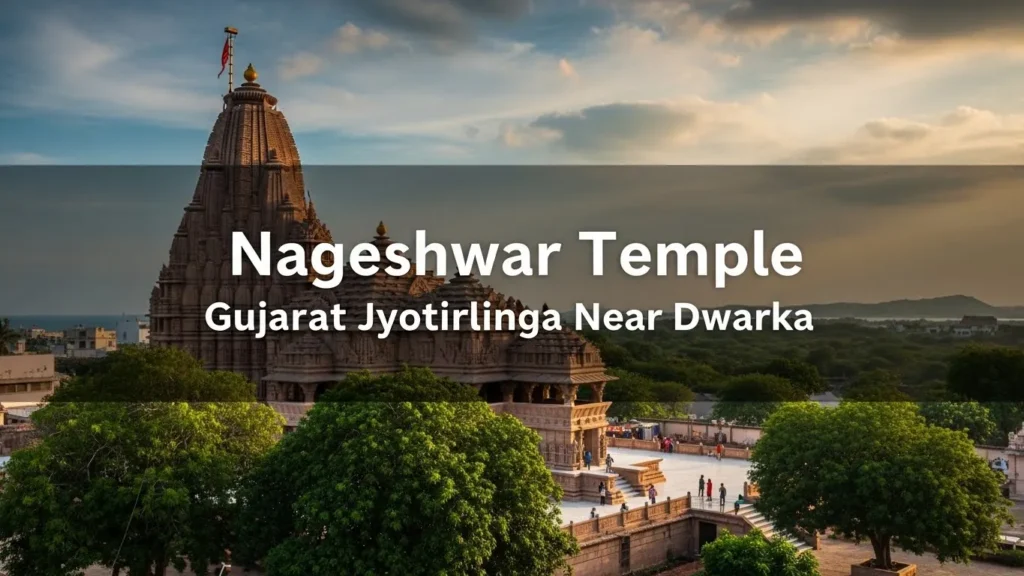
Nageshwar Temple in Gujarat—the tenth of twelve sacred Jyotirlingas, located 17-18 km from Krishna’s holy city Dwarka on the Arabian Sea coast—represents Hinduism’s testament to devotion’s power where even underwater captives’ prayers manifested divine intervention, with Wikipedia’s authoritative documentation confirming that according to Shiva Purana the temple stands in ancient Darukavana forest where demon Daruka imprisoned Shiva devotee Supriya along with many hermits, sages, and deities in his underwater city inhabited by sea snakes and demons, but when Supriya installed a lingam and led prisoners in chanting the holy mantra “Om Namah Shivay,” pleased Lord Shiva appeared and vanquished the demon, choosing to reside permanently at this location as Nageshwar Jyotirlinga

the tenth lingam) while Goddess Parvati became known as Nageshwari—though the demon’s wife demoness Daruki who worshipped Parvati had received the boon to move the entire forest underwater continuing their campaign against hermits until Shiva’s intervention brought liberation [web:885][web:886][web:887][web:889]. According to the spiritual significance documented in Hindu texts and temple tradition, “Nageshwar” derives from “Naga” (serpent/cobra) combined with “Ishwar” (Lord), signifying
Shiva as “Lord of Serpents” who protects devotees from all evils and poisons (both literal and metaphorical), with sincere worship at this Jyotirlinga believed to grant moksha (liberation) and freedom from all worldly fears especially the venom of desires, anger, and ego—while Shiva announced he would show the correct path to all who worship him here, establishing Nageshwar as Gujarat’s most sacred Shaivite shrine alongside nearby Somnath [web:885][web:887][web:892][web:896].
The extraordinary spiritual and architectural convergence validates profound significance: Trawell’s 2025 comprehensive guide reveals that the magnificent temple reaching 110 feet height showcases unique western architectural style oriented westward (unlike most temples facing east) with layout based on Sayanam posture (reclining human body)—entrance symbolizing feet, porch with idols representing hands, Sabha Mandap corresponding to abdomen, and Shiva Linga signifying head—featuring distinctive elements like arches, columns, lotus-shaped capitals, marble jalis, kalash and swastik religious symbols, and remarkably the lingam facing south while Gomugam (drainage spout) oriented eastward, with the sacred Tri-Mukhi Rudraksha (three-faced)
Shivalinga measuring 40 cm height and 30 cm diameter accompanied by Goddess Parvati as Nageshwari [web:896][web:898]. The iconic 25-meter (82 feet) tall sitting Lord Shiva statue constructed within temple complex represents modern India’s largest single seated Shiva murti captivating millions of tourists and pilgrims with striking beauty, surrounded by large garden with pond creating serene spiritual atmosphere—while archaeological excavations claim five earlier ancient cities existed at this site demonstrating continuous sacred significance spanning millennia, with temple operating 6 AM-12:30 PM and 5-9:30 PM daily featuring four aartis (morning 6 AM, afternoon 12 PM, sandhya 7 PM, night 9 PM) especially crowded during auspicious Shravan month [web:891][web:894][web:896][web:898][web:899].
As millions undertake pilgrimage to experience Nageshwar’s protective blessings and witness the towering Shiva statue—with modern infrastructure including Dwarka Railway Station 17-18 km away (Okha Express, Dwarka Express from Delhi/Ahmedabad/Mumbai), Jamnagar Airport 95-145 km with connecting flights, frequent GSRTC buses from Dwarka/Jamnagar/Ahmedabad covering distance in 20-30 minutes, well-maintained roads along Dwarka-Bet Dwarka coastal route, and the intriguing location controversy involving three claimants (Nageshwar Dwarka, Aundha Nagnath Maharashtra, Jageshwar Almora Uttarakhand) each backed by Puranic references—understanding
the complete Daruka demon legend, underwater Darukavana forest story, Nageshwar’s serpent-lord significance, location debate, and practical visiting guide becomes essential for meaningful Hindu pilgrimage [web:885][web:893][web:900]https://hindutva.online. This comprehensive article presents Nageshwar’s sacred demon Daruka-Supriya devotion story, tenth Jyotirlinga’s protection significance, unique western architectural style with 25-meter Shiva statue, location controversy analysis, complete darshan timings and aarti schedule, how to reach from Dwarka/Mumbai/Delhi, and pilgrimage preparation tips.
The Legend: Darukavana and Demon Daruka
The Demon’s Underwater City
The terrorizing demon [web:885][web:886][web:889][web:892]:
- Demon named Daruka (also spelled Daruk)
- Built city of Darukavana under the sea
- Inhabited by sea snakes (Nagas) and demons
- Terrorized the region with wife Daruki (demoness)
- Kidnapped devotees, sages, hermits, and even Devas (celestial beings)
- Held them as prisoners in underwater lair
Demoness Daruki’s Boon from Parvati
Daruki’s power [web:885][web:892]:
- Demoness Daruki was ardent devotee of Goddess Parvati
- Performed intense penance to please the Goddess
- Parvati granted boon: Mastery over the forest
- Forest renamed “Darukavana” in Daruki’s honor
- Wherever Daruki went, the forest followed her (supernatural power)
- Used this power to move entire forest underwater to protect demons from gods’ wrath
Supriya’s Captivity and Devotion
The devoted prisoner [web:887][web:889]:
- Supriya—a great Shiva devotee—was captured
- Demon wanted to learn Shiva worship secrets
- Supriya refused to teach demon proper worship
- Demon inflicted torture on Supriya
- Despite captivity, Supriya’s faith remained unshaken
Setting Up the Lingam
At the urgent exhortations of Supriya, the prisoners started to chant the holy mantra of Shiva [web:885].
The revolution begins [web:885][web:889]:
- Supriya set up a lingam in the underwater prison
- Urged all prisoners to chant “Om Namah Shivay”
- Devotees, sages, and Devas united in prayer
- Continuous chanting created powerful spiritual vibration
- Demons attempted to kill Supriya for this act
Shiva’s Divine Intervention
The divine rescue [web:885][web:886][web:887][web:889]:
- Lord Shiva appeared immediately in response to prayers
- Gave Supriya a divine weapon (astra) to save his life
- Fought a fierce battle with demon Daruka
- Vanquished and killed demon Daruka
- Defeated all demons terrorizing the region
- Goddess Parvati saved remaining demons from complete annihilation
Nageshwar Jyotirlinga Manifestation
Permanent divine residence [web:885][web:889]:
- Lingam installed by Supriya became “Nagesha” (later Nageshwar)
- Tenth among twelve Jyotirlingas
- Lord Shiva chose to reside permanently at this location
- Goddess Parvati known as Nageshwari
- Shiva announced: “I will show the correct path to those who worship me here”
Meaning of “Nageshwar”
Etymology and significance:
- “Naga” = Serpent/Cobra (city inhabited by sea snakes/Nagas)
- “Ishwar” = Lord/God
- “Nageshwar” = Lord of Serpents/Nagas
- Protects devotees from all poisons—literal venom and metaphorical (desires, anger, ego)
- Grants moksha (liberation) and freedom from worldly fears
Tenth Jyotirlinga: Sacred Significance
Jyotirlinga Manifestation
The infinite light:
- Endless pillar of light establishing Shiva’s supremacy
- Nageshwar listed as tenth among 12 Jyotirlingas
- Other 11: Somnath, Mallikarjuna, Mahakaleswar, Omkareshwar, Kedarnath, Bhimashankar, Viswanath, Trimbakeshwar, Vaidyanath, Rameshwar, Grishneshwar
Protection from All Evils
Spiritual benefits:
- Protection from all evils and negative energies
- Liberation from fears and anxieties
- Moksha (salvation) for sincere devotees
- Shiva shows correct spiritual path to worshippers
The Location Controversy
Three Claimants
Three competing sites [web:885][web:893][web:901]:
- Nageshwar, Dwarka, Gujarat (near Arabian Sea coast)
- Aundha Nagnath, Maharashtra (Hingoli district, ancient Daruka forest)
- Jageshwar, Almora, Uttarakhand (deodar forest in western Himalayas)
Shiva Mahapurana’s Clue
The primary clue:
- Located on “Pashchime Sagare”—Western (Arabian) Sea
- “Darukavana” on Western Sea remains key evidence
- Forest 16 yojanas (approximately 128 km) in extent
Dwarka’s Claim (Most Popular)
Gujarat’s evidence [web:893]:
- Located on Arabian Sea coast matching Purana description
- Near Dwarka—Krishna’s holy city
- Underwater forest legend aligns with coastal location
- 17-18 km from Dwarka on route to Bet Dwarka island
- Most widely accepted by pilgrims today
Weakness:
- No ancient forest in this part of Dwarka mentioned in epics
- Krishna’s narratives mention Somnath and Prabhasa tirtha, not Nageshwar [web:885]
Aundha Nagnath’s Claim (Maharashtra)
Maharashtra’s evidence [web:885][web:893]:
- Ancient name “Sadanga” (mentioned by Adi Shankaracharya)
- Located in dense Daruka forest (scary forest)
- Built by Yudhishthira during Pandavas’ 14-year exile
- Ancient temple with large area and beautiful stone building
- South-southwest of Vindhya Mountains extending to western sea
- Shankaracharya’s Dvadasha Jyotirlinga Stotra praises as “Naganath” in south [‘yamye’]
Jageshwar’s Claim (Uttarakhand)
Uttarakhand’s evidence [web:885]:
- “Darukavana” may derive from “Daruvana” (forest of deodar trees)
- Deodar (daru vriksha) found abundantly only in western Himalayas
- Ancient treatise Prasadmandanam says: “North of Himalaya mountains is supreme Devadaru forest, sacred abode of Shankara where all worship Shiva”
- Hindu sages performed meditation in deodar forests to please Shiva
- Deodar trees associated with Lord Shiva in ancient texts
Weakness:
- Not on Western Sea coast as Shiva Mahapurana specifies [web:885]
Temple Architecture and Features
25-Meter Tall Shiva Statue
A 25 m tall statue of a sitting Lord Shiva and a large garden with a pond are major attractions of this rather serene place [web:896][web:897][web:898][web:899].
Iconic landmark [web:896][web:898][web:899]:
- 25 meters (82 feet) tall sitting Lord Shiva statue
- Largest seated Shiva murti in modern construction
- Striking beauty captivating tourists and pilgrims
- Surrounded by large garden with pond
- Creates serene spiritual atmosphere
- Visible from distance, becoming symbol of temple
Western Architectural Style
The temple is designed in the western architectural style and is oriented towards the west [web:898].
Architectural specifications [web:898]:
- 110 feet height
- Western architectural style (unique among Indian temples)
- Oriented westward (unlike most temples facing east)
- Decorative features: arches, columns, lotus-shaped capitals, marble jalis
- Religious symbols: kalash, swastik integrated into design
Sayanam Posture Layout
The layout of the temple is based on the Sayanam posture of the human body [web:898].
Symbolic layout [web:898]:
- Entrance = Feet
- Porch adorned with idols = Hands
- Sabha Mandap = Abdomen
- Shiva Linga = Head
- Represents divine body in reclining (Sayanam) posture
Tri-Mukhi Rudraksha Shivalinga
Sacred lingam details [web:898]:
- Tri-Mukhi (three-faced) Rudraksha lingam
- Height: 40 centimeters
- Diameter: 30 centimeters
- Shiva Lingam faces south (unique orientation)
- Gomugam (drainage spout) oriented eastward
- Goddess Parvati (Nageshwari) alongside lingam
Archaeological Significance
Some archaeological excavations claim five earlier cities at the site [web:896].
Historical layers:
- Five earlier ancient cities discovered through excavations
- Demonstrates continuous sacred significance spanning millennia
- Ancient settlement patterns around holy site
Temple Timings and Darshan
Daily Temple Timings
Nageshwar temple is open for darshan from 6 am to 12:30 pm. The temple opens again at 5 pm and remains open till 9:30 pm [web:891][web:894].
| Session | Timings |
|---|---|
| Morning Darshan | 6:00 AM – 12:30 PM |
| Afternoon Break | 12:30 PM – 5:00 PM |
| Evening Darshan | 5:00 PM – 9:30 PM |
Aarti Schedule
Aarti Timings [web:894]:
| Aarti | Timings |
|---|---|
| Morning Aarti | 6:00 AM |
| Afternoon Aarti | 12:00 PM |
| Sandhya Aarti | 7:00 PM |
| Night Aarti | 9:00 PM |
Best Time to Visit
Ideal season:
- October to March: Pleasant weather
- Shravan month (July-August): Most auspicious for Shiva worship (crowded)
- Maha Shivaratri: Huge celebrations and crowds
- Diwali: Special festivities [web:894]
How to Reach Nageshwar Temple
By Air
By air, the distance is 95 km, and Jamnagar, 145 km away, is the closest airport to Dwarka [web:900].
Nearest Airport: Jamnagar [web:885][web:900]:
- Distance from Nageshwar: 95-145 km
- Flight connections: Delhi, Mumbai, Ahmedabad
- From airport: Hire taxi or take bus to Dwarka, then local transport
By Train
Nearest Railway Stations [web:885][web:900]:
- Dwarka Railway Station (DWK): 17-18 km from Nageshwar (most convenient)
- Okha Railway Station: Nearby alternative
Major trains from Delhi:
- Okha Express
- Dwarka Express
- Travel time: ~24 hours from Delhi
By Road from Dwarka (Recommended)
The Nageshwar temples are 18 km from Dwarka by road [web:900].
From Dwarka city [web:891][web:900]:
- Distance: 17-18 km (25 minutes drive)
- Route: On Dwarka-Bet Dwarka coastal road
- GSRTC buses: Frequent from Dwarka
- Private taxis/autos: Easily available
- Shared cabs: Affordable option
By Road from Other Cities
From Jamnagar [web:891]:
- Direct buses available
- Distance: ~130 km
From Ahmedabad:
- Direct buses to Dwarka
- Distance: ~400 km
Nearby Attractions
Dwarkadhish Temple
- Krishna’s main temple in Dwarka
- 17-18 km from Nageshwar
- One of Char Dham pilgrimage sites
Bet Dwarka Island
- Submerged city of ancient Dwarka
- Accessible by boat from Okha
- Archaeological excavations ongoing
Somnath Temple
- First Jyotirlinga among twelve
- 215 km from Nageshwar
- Can combine in Gujarat Jyotirlinga circuit
Pilgrimage Tips
Essential Tips
- Visit both Nageshwar and Dwarkadhish: Complete Dwarka pilgrimage
- Start early: Morning darshan (6-8 AM) most peaceful
- Witness 25-meter Shiva statue: Don’t miss iconic landmark
- Explore gardens: Serene pond and landscaping
- Dress modestly: Traditional attire recommended
- Remove leather items: Before entering sanctum
- Carry water: Gujarat heat can be intense
What to Experience
- Nageshwar Jyotirlinga darshan: Tenth Jyotirlinga with Tri-Mukhi Rudraksha lingam
- 25-meter Shiva statue: Largest seated murti, perfect for photography
- Four daily aartis: Experience devotional atmosphere
- Temple gardens: Peaceful meditation by pond
- Coastal route: Scenic drive between Dwarka and Bet Dwarka
- Dwarkadhish temple visit: Complete Krishna-Shiva pilgrimage
Frequently Asked Questions
Where is Nageshwar Temple located?
Nageshwar Temple is 17-18 km from Dwarka city on the route to Bet Dwarka Island on the Arabian Sea coast of Gujarat [web:896][web:900].
What is the legend of Nageshwar Jyotirlinga?
Demon Daruka imprisoned Shiva devotee Supriya and others in underwater city Darukavana; Supriya set up lingam and led prisoners in chanting Om Namah Shivay; Shiva appeared, vanquished demon, chose to reside permanently as Nageshwar [web:885][web:887][web:889].
Why is there location controversy?
What is the 25-meter statue?
25-meter (82 feet) tall sitting Lord Shiva statue in temple complex is largest seated Shiva murti, iconic landmark surrounded by garden with pond [web:896][web:898][web:899].
What are temple timings?
Temple opens 6 AM-12:30 PM (morning), 5 PM-9:30 PM (evening); four aartis daily at 6 AM, 12 PM, 7 PM, 9 PM [web:891][web:894].
How to reach from Dwarka?
What is special about temple architecture?
Can I combine with other Gujarat Jyotirlingas?
Conclusion
Nageshwar Temple near Dwarka, Gujarat—the sacred tenth Jyotirlinga situated 17-18 km from Krishna’s holy city on the Arabian Sea coast where according to Shiva Purana demon Daruka imprisoned great Shiva devotee Supriya along with sages and deities in underwater city Darukavana inhabited by sea snakes, but when Supriya installed a lingam and led captive prisoners in continuous chanting of “Om Namah Shivay,” pleased Lord Shiva appeared with divine weapon vanquishing the demon and choosing to reside permanently as “Nageshwar” (Lord of Serpents) while Goddess Parvati became Nageshwari—represents
Hinduism‘s powerful testament to devotion’s liberating power even in darkest captivity, with Wikipedia’s documentation confirming the intriguing location controversy among three claimants (Dwarka Gujarat on Western Sea matching Purana description, Aundha Nagnath Maharashtra built by Yudhishthira in ancient Daruka forest, Jageshwar Almora Uttarakhand in sacred deodar forest) and the magnificent temple featuring iconic 25-meter (82 feet) tall seated Shiva statue—India’s largest—110 feet height with unique western architectural style oriented westward, Sayanam posture layout symbolizing divine body, Tri-Mukhi Rudraksha lingam 40 cm height facing south, and archaeological excavations revealing five earlier ancient cities [web:885][web:893][web:896][web:898]https://hindutva.online.
What distinguishes Nageshwar’s extraordinary significance is its convergence of legendary devotion (even in underwater demon prison, Supriya’s unwavering faith manifested immediate divine rescue), protection symbolism (Nageshwar as Lord of Serpents protecting from all poisons—literal venom and metaphorical desires/anger/ego, granting moksha and freedom from worldly fears), location mystery (three authentic competing claims backed by different Puranic references creating fascinating pilgrimage debate),
architectural magnificence (25-meter seated Shiva statue visible from distance as iconic landmark, western style temple 110 feet high with unique westward orientation, Sayanam posture layout, marble jalis and lotus capitals, serene gardens with pond), and complete modern infrastructure (Dwarka Railway Station 17-18 km with Okha/Dwarka Express from Delhi/Mumbai, Jamnagar Airport 95-145 km, frequent GSRTC buses taking 25 minutes, temple timings 6 AM-12:30 PM and 5-9:30 PM with four daily aartis, perfect combination with Dwarkadhish Krishna temple and Somnath Jyotirlinga 215 km for Gujarat pilgrimage circuit) [web:885][web:891][web:898][web:900].
By understanding this coastal Gujarat spiritual gem—combining tenth Jyotirlinga Tri-Mukhi Rudraksha lingam darshan, witnessing towering 25-meter Shiva statue surrounded by peaceful gardens, exploring underwater Darukavana demon legend where even captives’ prayers brought liberation, experiencing four daily aartis especially sacred during Shravan month, and visiting nearby Krishna’s Dwarkadhish temple—devotees access the transformative pilgrimage that ancient Hindu wisdom established as Lord Shiva’s serpent-lord manifestation protecting sincere worshippers from all evils while showing the correct spiritual path [web:885][web:887][web:896][web:898]https://hindutva.online.
About the Author
Anjali Deshmukh – Certified Yoga Therapist & Spiritual Wellness Expert
Anjali Deshmukh is a certified yoga therapist with over 18 years of experience specializing in Hatha Yoga, pranayama, meditation, and traditional shatkarma purification practices. He holds advanced certifications in yoga therapy and has trained extensively in classical yogic texts including the Hatha Yoga Pradipika and Gheranda Samhita. Anjali Deshmukh integrates ancient yogic wisdom with Ayurvedic principles to help students achieve optimal physical health and spiritual growth through authentic practices. His teaching focuses on making traditional techniques accessible to modern practitioners while maintaining the depth and transformative power of the original methods. He has guided thousands of students through systematic yoga sadhana at leading institutions and retreat centers across India and internationally.