


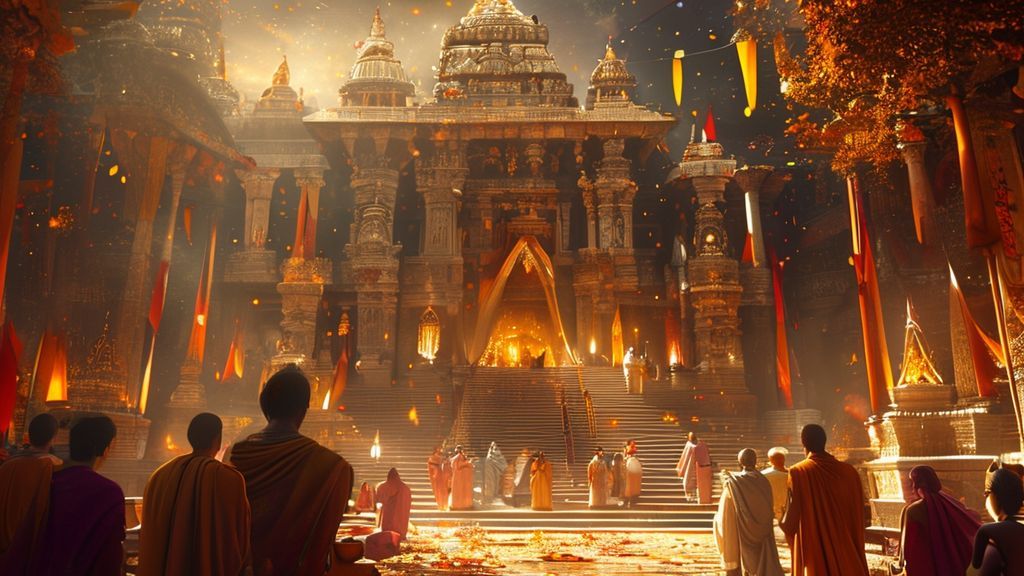
Nakshatras are the 27 lunar mansions, or constellations, that the Moon traverses in its celestial journey, forming the foundational pillars of Vedic astrology (Jyotisha). Each Nakshatra spans 13 degrees and 20 minutes of the zodiac, endowed with unique energies, ruling deities, and planetary influences, profoundly shaping an individual’s destiny and personality from the moment of birth.
| Attribute | Details |
|---|---|
| Number | 27 principal divisions (with Abhijit sometimes included as 28th) |
| Basis | Lunar astrology, position of the Moon at birth |
| Each Span | 13 degrees 20 minutes of the zodiac |
| Significance | Personality traits, destiny, auspicious timings (Muhurtha), marriage compatibility |
| Primary Scripture | Jyotisha Vedanga, Puranas (e.g., Bhagavata Purana) |
The Cosmic Tapestry of Nakshatras: Unveiling Divine Blueprints
In the vast expanse of Sanatan Dharma, the cosmic dance of celestial bodies is not merely a scientific phenomenon but a profound reflection of divine will and interconnectedness. Among these celestial entities, the Nakshatras hold a place of paramount importance, serving as the very fabric upon which the intricate patterns of individual destiny and universal cycles are woven. Far beyond the sun-centric zodiac familiar in Western astrology, the 27 Nakshatras, or lunar mansions, offer a granular and deeply spiritual understanding of human existence, revealing the subtle influences that shape our minds, bodies, and souls.
Each Nakshatra, spanning a precise segment of the ecliptic, is presided over by a unique deity, a specific ruling planet, and embodies distinct energies (Shakti) that imbue all beings born under its dominion with particular characteristics, strengths, and challenges. Understanding one’s birth Nakshatra (Janma Nakshatra) is akin to receiving a personalized divine blueprint, offering unparalleled insights into one’s inherent nature, life path, and spiritual journey. This ancient knowledge, preserved through millennia by our revered Rishis, is indispensable for making auspicious decisions (Muhurtha), understanding relationships, and navigating the complexities of life with wisdom and grace.
Puranic History & The Celestial Origin of Nakshatras
The genesis of the Nakshatras is beautifully narrated in our sacred Itihasas and Puranas, particularly within the Bhagavata Purana (Skandha 4, Adhyaya 1), the Mahabharata (Adi Parva), and various other Puranic texts. These divine luminaries are universally acknowledged as the daughters of Daksha Prajapati, one of the foremost progenitors of humanity, and his wife Panchajani (also known as Asikni). Daksha, in his profound wisdom and desire for cosmic order, gave 27 of his daughters in marriage to Chandra Dev (the Moon God), entrusting them to his care as celestial consorts.
These 27 daughters are none other than the Nakshatras themselves: Ashwini, Bharani, Krittika, Rohini, Mrigashira, Arudra, Punarvasu, Pushya, Ashlesha, Magha, Purva Phalguni, Uttara Phalguni, Hasta, Chitra, Swati, Vishakha, Anuradha, Jyeshtha, Moola, Purva Ashadha, Uttara Ashadha, Shravana, Dhanishtha, Shatabhisha, Purva Bhadrapada, Uttara Bhadrapada, and Revati. The story, however, carries a profound lesson in devotion and equanimity. Chandra Dev, enchanted by the beauty and grace of Rohini, began to show favoritism, neglecting his other wives. Distressed by this imbalance, the other Nakshatras appealed to their father, Daksha Prajapati.
Incensed by Chandra’s partiality, Daksha cursed him, declaring that he would gradually wane and lose his luster. Realizing his grave error, Chandra pleaded for forgiveness. Moved by his repentance, Daksha mitigated the curse, stipulating that Chandra would periodically regain his brilliance, thus explaining the waxing and waning cycles of the Moon – Purnima (full moon) and Amavasya (new moon). This divine narrative not only establishes the profound relationship between the Moon and the Nakshatras but also underscores the importance of fairness and treating all with equal reverence, a fundamental principle of Dharma.
The Rishis, through their deep meditative states and advanced astronomical observations, mapped these Nakshatras, observing their subtle influences on terrestrial life and human consciousness. They categorized them by their nature (e.g., fixed, movable, sharp), their Gunas (Sattva, Rajas, Tamas), their Gana (Deva, Manushya, Rakshasa), and their Yoni (animal archetypes), creating an unparalleled system for understanding the cosmic dance. For more detailed explorations of these cosmic principles, one can find extensive resources on Hindutva.online.
Jyotisha: The Architectural & Scientific Marvel of Nakshatra Calculations
While Nakshatras are not physical structures, their very conception and application represent an unparalleled architectural and scientific marvel within the framework of Vedic Astronomy (Jyotisha). This sacred science, recognized as one of the six Vedangas, is a testament to the profound mathematical precision and observational acumen of ancient Indian sages. The system of Nakshatras demonstrates a sophisticated understanding of celestial mechanics, far predating modern astronomical tools.
The division of the 360-degree zodiac into 27 equal parts of 13 degrees 20 minutes each is a brilliant mathematical feat. Each Nakshatra is further subdivided into four Padas (quarters) of 3 degrees 20 minutes, offering even finer analytical resolution. This meticulous subdivision allowed ancient Jyotishis to precisely pinpoint the Moon’s exact position at birth, thereby determining the Janma Nakshatra with remarkable accuracy. This precision was not merely academic; it formed the basis for designing temple layouts (Vastu Shastra), determining auspicious times for construction, coronation, and all significant life events (Muhurtha).
The scientific brilliance extends to how the Nakshatras integrate with planetary periods, particularly the Vimshottari Dasha system, a unique predictive tool in Vedic astrology. This dasha system, based on the Nakshatra lord of one’s birth Nakshatra, assigns specific ruling periods to planets, allowing for highly accurate predictions of life events. The entire system reflects a deep understanding of cyclic time, planetary influences, and their energetic resonance with human consciousness, showcasing a holistic scientific framework that bridges the material and the spiritual.
Rituals & Puja Vidhi for Nakshatra Shanti
Understanding one’s birth Nakshatra is not just for intellectual curiosity; it is a vital step in aligning with one’s cosmic rhythm and mitigating any potential afflictions (doshas). The performance of Nakshatra Shanti Puja is a time-honored ritual prescribed in the Shastras to propitiate the ruling deity and planet of one’s Janma Nakshatra, ensuring peace, prosperity, and harmony.
- Sankalpa (Intention): The devotee begins by taking a solemn vow (Sankalpa), stating the purpose of the puja – to pacify the Nakshatra, its deity, and planetary lord for well-being.
- Acharya Varanam (Choosing the Priest): A knowledgeable and devout priest (Acharya) is chosen to conduct the elaborate rituals.
- Purvangam (Preparatory Rites): This includes Ganesha Puja for removing obstacles, Punyaha Vachanam (purification), and Matruka Puja (worship of divine mothers).
- Nakshatra Devata Avahanam (Invocation): The ruling deity of the Nakshatra (e.g., Ashwini Kumaras for Ashwini, Agni for Krittika) is invoked into a Kalasha (pot).
- Japa (Chanting): Specific mantras related to the Nakshatra, its deity, and its planetary lord are chanted a prescribed number of times (often 10,000, 20,000, or more, depending on the severity of the dosha).
- Homa (Fire Ritual): A sacred fire ritual is performed, offering specific oblations (Ahutis) like ghee, grains, and herbs into the Agni Kundam while chanting the Nakshatra Moola Mantra.
- Abhishekam (Sacred Bath): The deity is bathed with sacred substances like milk, yogurt, honey, sugar, and water, symbolizing purification and nourishment.
- Dana (Charity): Giving donations of specific items associated with the Nakshatra or its ruling planet (e.g., horses for Ashwini, red clothes for Bharani, gold for Pushya) to deserving Brahmins.
- Purnahuti (Final Offering): A concluding offering into the sacred fire, signifying the completion of the ritual.
- Prasadam (Blessed Food): Distribution of blessed food to devotees and attendees.
Such a comprehensive ritual helps mitigate negative influences, enhances positive attributes, and establishes a deeper connection with the cosmic energies guiding one’s life.
Potent Mantras & Chants for Nakshatra Adoration
The power of sound (Nada) is intrinsic to Vedic practice. Chanting specific mantras helps connect with the subtle vibrations of the Nakshatras and their ruling deities. Regular recitation can invoke blessings, harmonize energies, and alleviate afflictions.
General Chandra (Moon) Mantra: As the Moon is the primary significator of Nakshatras, this mantra brings peace to the mind and strengthens lunar influences.
ॐ सों सोमाय नमः ||
Om Som Somaya Namah ||
Specific Nakshatra Moola Mantra: Each Nakshatra has a specific mantra. Chanting these invokes the direct energy of that lunar mansion. For example, for Ashwini Nakshatra:
ॐ अश्विनीभ्यां नमः ||
Om Ashvinibhyam Namah ||
Or more generally, for any Nakshatra (replace [Nakshatra Name] with the actual Nakshatra, e.g., ‘Rohini’):
ॐ [Nakshatra Name] नमः ||
Om [Nakshatra Name] Namah ||
Nakshatra Deity Dhyana Mantra: Meditating upon and chanting the mantra for the specific deity of your Nakshatra can be highly beneficial. For Krittika Nakshatra, ruled by Agni:
ॐ महातेजसे विद्महे अग्नये धीमहि तन्नो वह्निः प्रचोदयात् ||
Om Mahatejase Vidmahe Agnaye Dhimahi Tanno Vahnih Prachodayat || (Krittika Gayatri Mantra)
Regular recitation of these mantras, especially during the specific Nakshatra’s transit, enhances spiritual growth and brings auspicious results.
Dos and Don’ts for Aligning with Nakshatra Wisdom
- Do consult a learned Jyotishi: Seek guidance from an experienced Vedic astrologer to understand your unique Nakshatra influences and any specific remedies required.
- Do perform Nakshatra Shanti: If advised, undertake the prescribed rituals to mitigate negative planetary periods or inherent doshas.
- Do align important events: Plan significant life events like marriage, new ventures, or travel during auspicious Nakshatra timings (Muhurtha) for success.
- Do understand your inherent nature: Use the insights from your Janma Nakshatra to cultivate your strengths and work on your weaknesses.
- Do maintain reverence: Approach the study and application of Nakshatra knowledge with humility and respect for the ancient wisdom.
- Don’t ignore the wisdom: Disregarding the influence of Nakshatras can lead to missing opportunities or facing avoidable challenges.
- Don’t fall prey to fear: While Nakshatras reveal challenges, they also offer solutions. Do not be consumed by fear but empowered by knowledge.
- Don’t generalize: Nakshatra interpretations are highly individualized. Avoid generic astrological readings; seek personalized analysis.
- Don’t misuse knowledge: Use this profound wisdom for self-improvement and the welfare of others, not for manipulative or selfish purposes.
- Don’t neglect the Moon: The Moon’s position is paramount. Maintain a calm and balanced mind, as Chandra (Moon) governs our emotions and mind.
What is the difference between a Nakshatra and a Rashi (Zodiac Sign)?
A Nakshatra is a finer division of the zodiac, covering 13 degrees 20 minutes, based on the Moon’s daily transit, while a Rashi (Zodiac Sign) covers 30 degrees and is based on the Sun’s monthly transit. There are 12 Rashis (Aries, Taurus, etc.) and 27 Nakshatras. Roughly, 2¼ Nakshatras make up one Rashi. Nakshatras provide a much more nuanced understanding of personality and destiny, specifically emphasizing the lunar influence on the mind and emotional body, whereas Rashis focus on the solar influence on the ego and identity.
How is my birth Nakshatra determined?
Your birth Nakshatra, or Janma Nakshatra, is determined by the precise position of the Moon in the zodiac at the exact moment of your birth. A skilled Vedic astrologer calculates this by referencing your birth date, time, and place. The longitude of the Moon is then mapped against the 27 Nakshatra divisions to identify the specific Nakshatra it occupied. This calculation is a cornerstone of any accurate Vedic astrological chart reading.
Can Nakshatras change over time?
Your birth Nakshatra, determined at the moment of your birth, is fixed and does not change throughout your life. However, the Moon and other planets continuously transit through different Nakshatras in the sky, influencing your daily experiences and mental state. These transiting Nakshatras create what is known as Gochara effects, which interact with your fixed birth Nakshatra, creating dynamic energies and opportunities for growth. Understanding these transits is key to daily astrological insights available on Hindutva.online.
Dharmic Significance: Preserving Sanatan Dharma through Cosmic Wisdom
The profound understanding of Nakshatras is not merely an astrological tool; it is a foundational pillar of Sanatan Dharma, offering a timeless pathway to self-realization and cosmic harmony. This ancient system teaches us that we are not isolated beings but intricate parts of a grand cosmic design, influenced by celestial rhythms and energies. By delving into the wisdom of the Nakshatras, we reconnect with our ancestral roots, honor the profound scientific and spiritual insights of our Rishis, and gain a deeper appreciation for the interconnectedness of all life.
Embracing this knowledge empowers us to live in greater alignment with Dharma, to make conscious choices, and to cultivate inner peace. It reminds us that every individual life is a unique expression of the divine, meticulously crafted with purpose and potential. In preserving and propagating the sacred science of Nakshatras, we ensure that the eternal light of Vedic wisdom continues to guide humanity towards truth, righteousness, and liberation for generations to come.