

The Namakarana ceremony Guide – from Sanskrit nama (name) and karana (making/creating) – represents one of Hinduism’s most universally observed samskaras (sacred rites of passage), serving as the formal initiation of newborn child into human society through bestowal of meaningful name establishing individual’s unique identity while simultaneously connecting them to family lineage (kula), divine protectors (devatas), and cosmic birth patterns (nakshatra) in beautiful synthesis recognizing that names carry far more than arbitrary phonetic labels but rather embody vibrations shaping consciousness, destiny, and very sense of self throughout life’s journey.

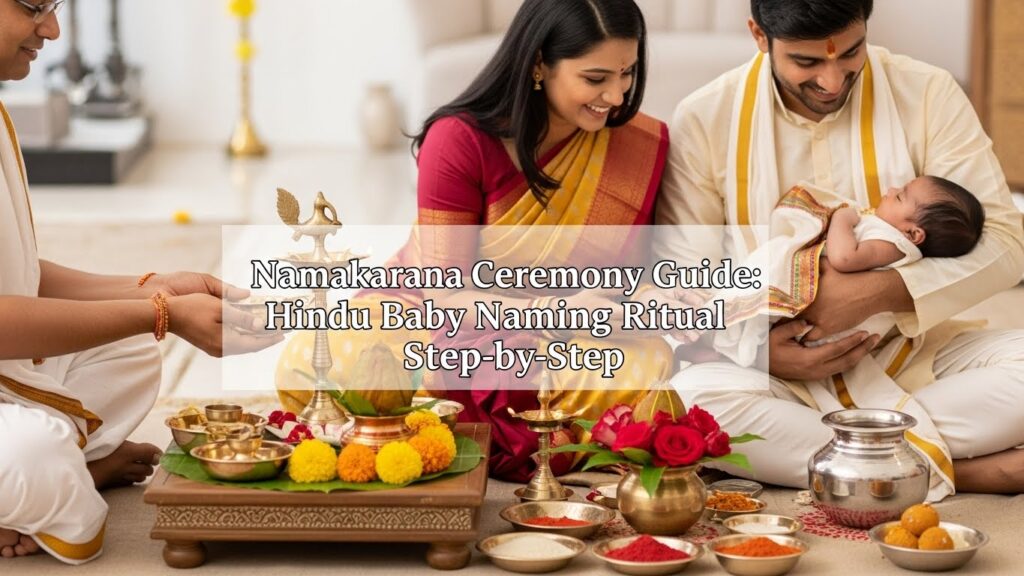
Unlike modern secular naming where parents casually select appealing sounds from baby name books or honor celebrities without deeper consideration, Hindu tradition understands naming as spiritually significant act requiring sacred ceremony, astrological consultation, scriptural guidelines, and conscious intention – recognizing that the name spoken thousands of times throughout lifetime creates repeated vibrational pattern affecting personality development, social interactions, and even karmic trajectory according to ancient wisdom validated by modern research demonstrating that names indeed influence self-perception, achievement levels, and how others perceive and treat individuals. The elaborate Namakarana procedure traditionally.
performed on 10th, 11th, or 12th day after birth (though flexible timing extends to months or even year when circumstances prevent immediate observance) involves purificatory rituals preparing sacred space, invocation of family deities seeking their blessings for newborn, formal calculation of auspicious name based on birth nakshatra determining ideal starting syllable, ceremonial whispering of chosen names into baby’s right ear by father establishing sound-consciousness connection, community witnessing and blessing the newly named individual, and celebratory feast integrating child into extended family and social network – all recognizing profound truth that identity formation begins with naming and that conscious, sacred naming establishes positive foundation for entire life ahead.
For Hindu families in 2025, whether maintaining elaborate traditional ceremonies with priests and complete scriptural procedures or adapting simplified home rituals balancing ancient wisdom with modern practical constraints, understanding complete Namakarana framework proves essential for making this milestone meaningful rather than merely administrative formality, ensuring chosen name carries beneficial vibrations rather than inadvertent negative associations, connecting child to their spiritual heritage through conscious participation in millennia-old tradition, and creating memorable family celebration marking baby’s formal welcome into community as recognized individual with unique identity destined to contribute to family, society, and cosmic evolution toward ultimate spiritual realization.
The Spiritual Significance of Naming in Hindu Tradition
Before examining procedural details, understanding why Hinduism treats naming as sacred ceremony rather than casual administrative task reveals profound philosophical and psychological sophistication underlying this universal practice.
The Scriptural Foundation:
The ancient Grihya Sutras (household ritual manuals) including Paraskara, Ashvalayana, and Gobhila Grihya Sutras provide detailed Namakarana procedures, while Manu Smriti, Vyasa Smriti, and Shankha Smriti discuss timing and naming conventions.
Shankha Smriti’s Essential Statement:
कुलदेवतानक्षत्राभिसम्बन्धं पिता कुर्यादन्यो वा कुलव्रुद्ध:
“The father or the elder in the family must initiate the connection (of the child) with the kula (family/clan), the devatas (deities), and the nakshatra (birth star).”
This succinct verse reveals naming’s threefold purpose:
1. Family Connection (Kula Sambandha):
The name should reflect family heritage, clan identity, or lineage tradition – connecting individual to ancestral continuity and inherited values.
2. Divine Association (Devata Sambandha):
The name should invoke auspicious qualities or deities – ensuring that calling the person’s name itself becomes spiritually beneficial act.
3. Astrological Harmony (Nakshatra Sambandha):
The name should align with birth star’s vibrational patterns – creating resonance between individual’s inherent nature and their identity marker.
The Purpose Beyond Mere Identification:
Shankha Smriti emphasizes that Namakarana prevents naming from being “left to whims and fancies of people involved,” establishing systematic method ensuring names prove:
Auspicious (Shubha): Creating positive associations rather than inadvertently negative or unfortunate meanings
Meaningful (Artha-yukta): Reflecting virtues, qualities, or divine attributes rather than arbitrary sounds
Culturally Grounded: Maintaining connection to spiritual heritage rather than random adoption of foreign or trendy names without understanding
Vibrationally Harmonious: Aligning sound patterns with astrological influences for maximum beneficial effect
The Philosophy of Names and Identity:
Hindu philosophy recognizes several profound truths about naming:
Names Shape Self-Concept:
The repeated hearing of one’s name throughout life creates deep psychological imprint affecting self-perception, confidence, and identity formation.
Names Carry Vibrational Energy:
Sanskrit phonetics understanding that specific sound combinations (aksharas) create particular energetic effects on consciousness – thus names aren’t neutral labels but active forces.
Names Influence Destiny:
While not deterministic, names create vibrational patterns that can support or hinder life’s unfolding – auspicious names act as continuous blessing, inauspicious names as subtle burden.
Names Connect to Cosmic Order:
Nakshatra-based naming aligns individual identity with universal patterns, creating harmony between personal and transpersonal dimensions.
Namakarana Ceremony Guide
The Multiple Names Tradition:
Traditional Namakarana bestows minimum four names on child:
1. Kula Devata Nama (Family Deity Name):
- Connects child to family’s protective deity
- Example: Srinivasa, Venkatesha (if Lord Venkateshwara is family deity)
- Maintains spiritual lineage continuity
2. Masa Nama (Month Name):
- Based on lunar month of birth
- Typically one of twelve names of family’s chosen deity corresponding to twelve months
- Example: Vaishnava families use twelve names of Vishnu (Keshava for Margashirsha, Narayana for Pausha, etc.)
3. Nakshatra Nama (Birth Star Name):
- Name beginning with syllable prescribed for birth nakshatra
- Ensures astrological harmony
- Most important for common usage in traditional system
4. Vyavahara Nama (Common/Official Name):
- Name used in daily social interactions
- Today’s equivalent of “official name” on documents
- May coincide with Nakshatra Nama or be independent
5. Rahasya Nama (Secret Name) – Optional:
- Known only to close family members
- Believed to provide special protection
- Used for private family prayers and blessings
This sophisticated multi-name system provides:
- Different names for different contexts
- Layers of spiritual protection
- Connection to multiple beneficial forces
- Flexibility in social usage while maintaining sacred connections
Modern Simplification:
Contemporary families often combine these:
- Nakshatra Nama becomes Vyavahara Nama (one name serving both purposes)
- Kula Devata connection implicit in family tradition rather than separate formal name
- Rahasya Nama rarely maintained
- Result: Typically one or two names rather than five
The Science Behind Sacred Naming:
Modern research validates ancient wisdom:
Nominative Determinism: Studies show names influence career choices, achievement levels, and life outcomes
Self-Fulfilling Prophecy: Names create expectations affecting how others treat individuals and how individuals perceive themselves
Phonetic Psychology: Sound patterns in names affect emotional responses and social perceptions
Cultural Identity: Names anchor individuals in cultural heritage providing psychological stability
Hindu tradition understood these principles millennia ago, creating systematic approach ensuring names serve beneficial rather than detrimental functions in life’s journey.
Timing the Namakarana Ceremony: When to Perform
Determining appropriate timing for Namakarana balances scriptural prescriptions, astrological considerations, practical family circumstances, and baby’s health – creating flexible framework rather than rigid requirement.
Scriptural Guidelines:
Primary Recommendation:
नामधेयं दशम्यां वा द्वादश्यां वाsस्य कारयेत् । पुण्ये तिथौ मुहूर्ते च नक्षत्रे च गुणान्विते॥
“The child must be named on the tenth or twelfth day after birth. Auspicious tithis, muhurtha and stars must be chosen for this.”
- Manu, Vyasa, and Shankha Smritis
Acceptable Alternatives:
According to various Smritis, if 10th/12th day proves impractical, the following remain acceptable:
✅ 11th day (common compromise)
✅ 16th day
✅ 18th day
✅ First month completion (30 days)
✅ 100th day (completion of three months)
✅ One year (first birthday)
Vyasa Smriti specifically allows postponement “in case of contingencies” – recognizing that baby’s health, mother’s recovery, family circumstances, or finding auspicious muhurta may necessitate flexibility.
Why 10th or 12th Day Traditionally?
Practical Health Reasons:
- Mother and baby stabilized after birth stress
- Initial postpartum complications resolved
- Baby’s feeding pattern established
- Mother sufficiently recovered for ceremony participation
Ritual Purity:
- Period of birth-related sutak (ceremonial impurity) typically concludes by 10th-12th day
- House and family members ritually pure for sacred ceremony
- Formal puja procedures appropriate once sutak period ends
Social Timing:
- Extended family members can arrive from distances
- Adequate time for ceremony preparation
- Early enough that baby still very young and easily managed
Modern Practical Considerations:
Contemporary families face different realities:
Hospital Births:
- Mother and baby often home only by 3rd-7th day
- Mother needs recovery time before hosting ceremony
- May prefer waiting 2-3 weeks for strength
Working Family:
- Coordinating relatives’ schedules requires advance planning
- Weekend timing more convenient than specific tithi
- May prefer 1-month mark coinciding with family gathering
Medical Complications:
- Premature babies may require extended hospital stay
- Health issues delay any ceremony
- Safety supersedes ritual timing
Result: Many modern families perform Namakarana between 2 weeks to 3 months after birth, balancing tradition with practical realities.
Selecting Auspicious Muhurta:
Once general timeframe determined, finding precise auspicious moment (muhurta) maximizes spiritual benefit:
Auspicious Nakshatras for Namakarana:
According to Garga Smriti and other texts, favorable nakshatras include:
✅ Uttara (Uttara Phalguni, Uttara Ashadha, Uttara Bhadrapada)
✅ Revati
✅ Hasta
✅ Moola
✅ Pushya
✅ Ashwini
✅ Shatabhisha
✅ Shravana
✅ Punarvasu
✅ Anuradha
✅ Swati
✅ Mrigashira
✅ Rohini
✅ Dhanishta
Planetary Considerations:
Ideally:
- Jupiter (Brihaspati) and Venus (Shukra) in trine from Lagna (ascendant) – brings wisdom and prosperity
- Mars, Saturn, Rahu, Ketu in 3rd, 6th, or 11th houses from Lagna – minimizes harsh influences
Time of Day:
Garga Smriti mandates: Ceremony must occur during first half of day (before noon)
- Morning hours considered most sattvic (pure)
- Avoid evening or night ceremonies
Practical Muhurta Selection:
Option 1: Consult Priest/Astrologer
- Provide baby’s birth details (date, time, location)
- Receive calculated auspicious dates/times within your timeframe
- Professional guidance ensures all factors considered
Option 2: Online Panchang Tools
- Drik Panchang and similar sites
- Check nakshatra, tithi for chosen dates
- Select from favorable combinations
Option 3: Flexibility with Faith
- If perfect muhurta unavailable, choose best available option
- Sincere devotion compensates for imperfect timing
- Divine grace responds to intention more than astrological perfection
What If You Missed “Ideal” Window?
Don’t stress! Namakarana can be meaningfully performed:
- At 6 months during Annaprashan (first solid food ceremony)
- At first birthday
- Even later if circumstances prevented earlier observance
What matters: Performing ceremony with proper consciousness rather than obsessing over perfect timing.
Some families who missed formal infant ceremony perform simplified version when child is older, formally blessing the name already in use.
Choosing the Auspicious Name: Nakshatra and Traditional Guidelines
Selecting the actual name involves balancing astrological prescriptions, family traditions, cultural conventions, and personal preferences – creating name that proves both spiritually beneficial and practically usable in contemporary context.
Nakshatra-Based Name Selection:
The most important traditional criterion: Name must begin with syllable prescribed for baby’s birth nakshatra.
How It Works:
Each of 27 nakshatras divided into 4 padas (quarters), each pada assigned specific syllable(s). Baby’s nakshatra determined by Moon’s position at birth time.
Complete Nakshatra Syllable Chart:
| Nakshatra | Pada 1 | Pada 2 | Pada 3 | Pada 4 |
|---|---|---|---|---|
| Ashwini | Chu | Che | Cho | La |
| Bharani | Lee | Lu | Le | Lo |
| Krittika | A | E | U | Ea |
| Rohini | O | Va | Vi | Vu |
| Mrigashirsha | Ve | Vo | Ka | Ki |
| Ardra | Ku | Gha | Ng | Chh |
| Punarvasu | Ke | Ko | Ha | Hi |
| Pushya | Hu | He | Ho | Da |
| Ashlesha | Di | Du | De | Do |
| Magha | Ma | Mi | Mu | Me |
| Purva Phalguni | Mo | Ta | Ti | Tu |
| Uttara Phalguni | Te | To | Pa | Pi |
| Hasta | Pu | Sha | Dha | Tha |
| Chitra | Pe | Po | Ra | Ri |
| Swati | Ru | Re | Ro | Ta |
| Vishakha | Ti | Tu | Te | To |
| Anuradha | Na | Ni | Nu | Ne |
| Jyeshtha | No | Ya | Yi | Yu |
| Moola | Ye | Yo | Bha | Bhi |
| Purva Ashadha | Bhu | Dha | Bhe | Dho |
| Uttara Ashadha | Bhe | Bho | Ja | Ji |
| Shravana | Khi | Khu | Khe | Kho |
| Dhanishta | Ga | Gi | Gu | Ge |
| Shatabhisha | Go | Sa | Si | Su |
| Purva Bhadrapada | Se | So | Da | Di |
| Uttara Bhadrapada | Du | Jha | Tha | De |
| Revati | Do | Cha | Chi | Chee |
Using the Chart:
- Determine baby’s birth nakshatra from horoscope
- Identify which pada (quarter) based on precise degree
- Select name starting with prescribed syllable
- Choose from countless names beginning with that sound
Example:
- Baby born in Rohini Nakshatra, Pada 3
- Prescribed syllable: Vi
- Possible names: Vishnu, Vidya, Vijay, Vinay, Vihaan (boys); Vidya, Vineeta, Vishaka, Vimala (girls)
Scriptural Guidelines for Name Characteristics:
For Male Children:
पुंसां द्व्यक्षरं चतुरक्षरं वा
“For males, names with 2 or 4 syllables are preferable.”
Rationale: Even numbers provide balance and stability
Examples:
- 2 syllables: Rama, Krishna, Shiva, Arjun
- 4 syllables: Ganesha, Narayan, Madhava
Exception: If names are inherently auspicious, 5-6 syllables acceptable
- Example: Venkatesha (4), Jagannatha (4)
For Female Children:
Shankha Smriti emphasizes:
- Soft, pleasant sounds that are beautiful to hear and pronounce
- Odd number of syllables (1, 3, 5)
- Ending in “ee” sound particularly auspicious – believed to purify the family
Traditional Beautiful Names:
- Yashoda, Shanta, Manorama, Kalyani
- Lakshmi, Saraswati, Parvati
- Radha, Sita, Gita, Nila
Modern Adaptations:
Many contemporary parents prefer names ending in “a” (like Diya, Maya, Isha) which remain soft while being shorter.
Varna-Based Naming (Historical):
Traditionally, names also reflected family’s varna (social class):
- Brahmins: Names indicating auspiciousness, learning (Mangal, Shubh, Vidya, Prajna)
- Kshatriyas: Names indicating strength, valor (Vir, Dheer, Tejas)
- Vaishyas: Names indicating prosperity, wealth (Dhana, Shreya, Samriddhi)
- Shudras: Names indicating service (Seva, Bhakti)
Modern Context: This practice rarely followed today, with families choosing names based on personal preference, deity devotion, or virtues regardless of caste associations.
Deity-Based Naming:
Very common approach: Naming after gods and goddesses
Popular Divine Names:
Male:
- Vishnu forms: Krishna, Rama, Narayana, Govind, Madhav, Keshav
- Shiva forms: Shankar, Rudra, Mahesh, Shambhu
- Other deities: Ganesha, Skanda, Surya, Indra
Female:
- Devi forms: Lakshmi, Saraswati, Parvati, Durga, Kali
- Vishnu consorts: Radha, Sita, Rukmini
- Shiva consorts: Uma, Gauri, Shakti
Benefits:
- Continuous invocation of divinity through name
- Built-in spiritual protection
- Auspicious associations
Virtue-Based Naming:
Naming after positive qualities parents hope to instill:
Examples:
- Prakash (light), Tejas (brilliance), Vivek (wisdom)
- Shanti (peace), Priya (beloved), Anand (joy)
- Satya (truth), Dharma (righteousness), Prema (love)
Modern Trends and Considerations:
Contemporary parents navigate additional factors:
Global Usability:
- Names pronounceable in English/other languages
- Avoiding names with difficult spellings or sounds
- Short, simple names gaining popularity
Unique but Not Bizarre:
- Balance between distinctiveness and appropriateness
- Avoiding overly trendy names that age poorly
- Meaningful rather than random
Gender-Neutral Options:
- Increasing preference for names like Aditi, Arya, Samarth
- Works in progressive families questioning traditional gender roles
Multiple Identity Approach:
- Official name: Simple, globally usable
- Spiritual name: Traditional, nakshatra-based
- Nickname: Family usage
- Provides flexibility across contexts
Practical Name Selection Process:
Step 1: Get baby’s horoscope prepared with birth nakshatra and pada
Step 2: Identify prescribed syllables from nakshatra chart
Step 3: Generate name options:
- Use online nakshatra name generators (Drik Panchang, etc.)
- Browse traditional name books filtered by starting syllable
- Consult family elders for traditional options
Step 4: Apply filters:
- Appropriate length (2-4 syllables for boys, odd for girls traditionally)
- Pleasant sound and meaning
- Practical usability in modern context
- Family approval and preference
Step 5: Shortlist 2-3 names for final decision
Step 6: Finalize before ceremony date
What If Multiple Nakshatras Provide Better Names?
Some families check syllables from:
- Sun’s nakshatra (in addition to Moon’s)
- Ascendant nakshatra
This expands options while maintaining astrological harmony.
Remember: While tradition provides framework, parents’ loving choice ultimately matters most. A name chosen with devotion and positive intention carries blessings regardless of perfect scriptural compliance.
Complete Namakarana Ceremony Procedure
The traditional Namakarana ritual involves systematic steps creating sacred atmosphere, invoking divine blessings, and formally bestowing chosen names upon child with community witnessing and celebrating.
Pre-Ceremony Preparations (Day Before/Morning Of):
House Preparation:
- Thorough cleaning of home, especially puja area
- Decoration with flowers, rangoli, festive elements
- Setting up altar/puja area with deities
- Arranging seating for guests and priest
Family Preparation:
- Parents and baby: Holy bath, clean new traditional clothes
- Baby’s outfit: New clothes in auspicious colors (yellow, white, red for girls; yellow, white for boys)
- Parents dressed traditionally for ceremony
Puja Materials Required:
| Category | Items Needed |
|---|---|
| Deities | Ganesha, family kula devata, parents’ ishta devata idols/photos |
| Puja Essentials | Incense, lamps, camphor, cotton wicks, ghee/oil, bell |
| Offerings | Fresh flowers, garlands, tulsi leaves |
| Sacred Substances | Sandalwood paste, kumkum, turmeric, akshat (unbroken rice) |
| Special Items | Kalash (sacred pot), mango leaves, coconut, betel leaves and nuts |
| For Naming | Large plate/tray filled with rice grains, turmeric piece for writing |
| Food | Fruits, sweets, coconut, items for prasad distribution |
| Ceremony Tools | Cotton wick to touch baby’s lips, honey and ghee in small bowls |
The Complete Ceremony (Step-by-Step):
Phase 1: Purification and Invocation (15-20 minutes)
Step 1: Punyahavachana (Purification Ritual)
Priest (or father if conducting without priest) performs brief purification:
- Sprinkling sacred water around ceremony space
- Chanting purification mantras
- Sanctifying all participants and items
ॐ अपवित्रः पवित्रो वा सर्वावस्थां गतोऽपि वा।
यः स्मरेत् पुण्डरीकाक्षं स बाह्याभ्यन्तरः शुचिः॥
“Whether pure or impure, in whatever condition, whoever remembers the lotus-eyed Lord becomes pure internally and externally.”
Step 2: Ganesha Puja
As with all Hindu ceremonies, begin by worshipping Lord Ganesha:
- Place Ganesha idol/photo on altar
- Offer flowers, sandalwood paste, durva grass
- Light lamp and incense before Ganesha
- Chant:
ॐ गं गणपतये नमः। वक्रतुण्ड महाकाय सूर्यकोटि समप्रभ।
निर्विघ्नं कुरु मे देव सर्वकार्येषु सर्वदा॥
“O Lord Ganesha of curved trunk, massive body, and brilliance of million suns, make all my undertakings free of obstacles, always.”
Step 3: Nandi Shraddha (Optional – Traditional)
In traditional elaborate ceremonies, brief offering to ancestors (Pitrus):
- Seeking their blessings for the newborn
- Ensuring continuity of family lineage
- Pleasing ancestral spirits for child’s welfare
Many modern simplified ceremonies skip this step.
Phase 2: Main Naming Ritual (20-30 minutes)
Step 4: Kalash Sthapana (Establishing Sacred Pot)
- Fill copper/brass pot with water
- Place mango leaves around opening
- Top with coconut
- Position kalash on rice mound
- Invoke divine presence in kalash:
कलशस्य मुखे विष्णुः कण्ठे रुद्रः समाश्रितः।
मूले तत्र स्थितो ब्रह्मा मध्ये मातृगणाः स्मृताः॥
“Vishnu resides in kalash’s mouth, Rudra in neck, Brahma in base, Divine Mothers in middle.”
Step 5: Writing Names on Rice
This is central ritual act:
- Large plate/tray filled with rice grains placed before deities
- Using turmeric piece or gold ring, ceremonially write on rice:
- Kula Devata Nama (family deity name)
- Masa Devata Nama (month deity name)
- Nakshatra Nama (birth star name)
- Vyavahara Nama (common usage name)
- Invoke respective deities to preside over each name:
देवताः कुलदेवताः नक्षत्रदेवताः सर्वे अत्र आगच्छन्तु
“May the family deities, nakshatra deities, all divinities come here and preside.”
Step 6: Shodashopachara Puja to Kalash
Perform brief worship of kalash with sixteen offerings (or simplified five offerings):
- Dhyana (meditation)
- Avahana (invocation)
- Asana (offering seat)
- Padya (water for feet)
- Arghya (water for hands)
- Achamana (water for sipping)
- Snana (ceremonial bath)
- Vastra (cloth)
- Yajnopavita (sacred thread)
- Gandha (sandalwood)
- Pushpa (flowers)
- Dhupa (incense)
- Deepa (lamp)
- Naivedya (food offering)
- Namaskara (prostration)
- Visarjana (farewell)
Simplified: Just offer flowers, incense, lamp, food, and prayers.
Step 7: The Sacred Naming Moment
This is the highlight of entire ceremony:
- Father holds baby (or both parents together)
- Father whispers chosen name(s) into baby’s right ear four times:
- First: Kula Devata Nama
- Second: Masa Nama
- Third: Nakshatra Nama
- Fourth: Vyavahara Nama
- While whispering, father touches baby’s lips with mixture of honey and ghee using gold ring or clean finger
Symbolism:
- Right ear: Associated with solar/positive energy
- Four repetitions: Establishes name firmly in baby’s consciousness
- Honey and ghee: Sweetness of life, nourishment, sacred substances
Mantra while naming:
नामकर्मणि देवेषु पितृषु च महात्मसु।
आचार्येषु च यत्प्रोक्तं नामैतत्ते भविष्यति॥
“In this naming ceremony, witnessed by gods, ancestors, and great souls, this shall be your name.”
Step 8: Public Announcement
After father’s private whispering:
- Priest or father announces chosen name loudly to assembled family and friends
- Everyone responds with blessings and congratulations
- Mother may also whisper name to baby
- Grandparents and other elders bless baby using the new name
Phase 3: Blessings and Conclusion (15-20 minutes)
Step 9: Touching Baby to Earth
Some traditions include briefly touching baby to earth, symbolizing:
- Connection to Mother Earth
- Grounding in material reality
- Blessing from Bhu Devi (Earth Goddess)
Step 10: Blessings from Elders
- Parents carry baby to each elder present
- Each elder blesses baby by:
- Placing hand on baby’s head
- Speaking blessing using chosen name
- Offering small gift (traditionally gold, silver, or clothing)
Traditional Blessing:
आयुष्मान् भव। सौभाग्यवान् भव। विद्यावान् भव॥
“May you be long-lived. May you be fortunate. May you be learned.”
Step 11: Prasad Distribution
- Distribute blessed food (sweets, fruits) to all present
- Everyone partakes as sanctified offering
- Creates sense of communal participation in blessing
Step 12: Celebratory Feast
Conclude with festive meal:
- Traditional vegetarian dishes
- Special sweets prepared for occasion
- Joyful atmosphere celebrating baby’s new identity
Simplified Home Ceremony (Without Priest):
If conducting ceremony yourself without professional priest:
Minimum Essentials:
- Clean, decorated space with deities
- Brief Ganesha worship
- Prepare rice plate
- Father whispers chosen name(s) four times into baby’s right ear
- Public announcement to family
- Elders’ blessings
- Prasad and celebration
This simplified version, performed with sincere devotion, fulfills ceremony’s spiritual essence even without elaborate ritual components.
Post-Ceremony Documentation:
Legal Registration:
- Register baby’s chosen official name with appropriate government authorities
- Obtain birth certificate with correct name spelling
- Ensure all documents reflect name accurately
Social Announcement:
- Inform extended family and friends of baby’s official name
- Update baby books, family records
- Begin using name consistently in all contexts
Modern Adaptations and Celebration Ideas
Contemporary families increasingly blend traditional ceremony with modern celebratory elements, creating memorable Namakarana events that honor heritage while reflecting personal style and current sensibilities.
Ceremony Variations:
Traditional Elaborate (3-4 hours):
- Full priest-led ceremony with all scriptural elements
- Nandi Shraddha, Navagraha Homa, complete rituals
- 50-100+ guests
- Formal traditional attire
- Elaborate vegetarian feast
Moderate Traditional (1.5-2 hours):
- Priest-led core ceremony (Ganesha puja, naming, blessings)
- 20-50 guests (close family and friends)
- Semi-formal traditional/fusion attire
- Catered meal or potluck
Simplified Home Ceremony (45-60 minutes):
- Parent or elder-led ceremony following basic structure
- 10-20 guests (immediate family)
- Comfortable traditional clothing
- Simple home-cooked meal
Minimalist Blessing (30 minutes):
- Brief prayer, name announcement, elders’ blessings
- Immediate family only
- Casual comfortable clothing
- Tea and sweets
Modern Decorative Themes:
Traditional Temple-Style:
- Marigold and mogra flowers
- Brass lamps, traditional rangoli
- Red, yellow, saffron color scheme
- Classical music
Pastel Modern:
- Soft pink, blue, mint, peach colors
- Floral arrangements with roses, carnations
- Balloon decorations
- Contemporary music mix
Fusion Cultural:
- Blend traditional mandap with modern backdrop
- Mix traditional flowers with modern arrangements
- Cultural music with contemporary selections
- Traditional rituals with modern photo opportunities
Minimalist Elegant:
- Simple white, gold, cream palette
- Single statement decoration piece
- Clean lines, uncluttered space
- Soft background music
Creative Elements:
Photo/Video Documentation:
- Professional photographer capturing ceremony
- Video recording for family archives and distant relatives
- Live streaming for those who cannot attend
- Photo booth with traditional props
Name Reveal:
- Creative ways to announce chosen name (banner unfurling, cake decoration, balloons)
- Suspense buildup if name kept secret until ceremony
- Involves all guests in the excitement
Memory Creation:
- Guest book where attendees write blessings/wishes for baby
- Time capsule with ceremony photos, notes, newspaper from day
- Handprint/footprint art from ceremony day
- Professional ceremony album/scrapbook
Favor Ideas:
- Small blessed items for guests (kumkum packets, sweets, sacred ash)
- Plantable seed paper with baby’s name and ceremony date
- Personalized thank-you gifts
- Donation to charity in baby’s name
Virtual Participation:
- Zoom/video call link for distant relatives
- Recorded ceremony video shared with family abroad
- Digital announcement cards
- Online photo albums
Environmental Consciousness:
- Eco-friendly decorations (fresh flowers, cloth, natural materials)
- Reusable or biodegradable plates and utensils
- Plant-based organic menu
- Minimize waste with thoughtful planning
Interfaith/Multicultural Adaptations:
For families blending traditions:
- Include elements from both cultures respectfully
- Explain significance of Hindu naming ceremony to non-Hindu guests
- Provide printed program explaining each step
- Balance rituals to honor both heritages
Budget-Conscious Celebrations:
Beautiful Namakarana possible at any budget:
- Free/Minimal Cost: Simple home ceremony with family, home-cooked meal, natural flower decorations
- Moderate ($500-2000): Priest, moderate decorations, catered food, professional photos
- Elaborate ($5000+): Event venue, elaborate decorations, full catering, band/entertainment, professional services
Remember: The ceremony’s spiritual value comes from sincere devotion and proper consciousness, not expensive external elements.
Frequently Asked Questions
Can we do Namakarana if we already named baby at birth for hospital documents?
Yes, absolutely! Many families use temporary/preliminary name for birth certificate, then formally bestow spiritual name during Namakarana. You can: Option 1: Keep both names (hospital name for documents, spiritual name for daily use); Option 2: Legally change name to match spiritual name chosen during ceremony; Option 3: Use hospital name as nickname, spiritual Namakarana name as official identity. The ceremony formally blesses whatever name you choose, whether completely new or confirming existing name with sacred ritual.
What if we can’t afford a priest – can we do Namakarana ourselves?
Yes, parents or family elders can conduct meaningful ceremony without professional priest. Follow simplified procedure: 1) Perform Ganesha puja, 2) Write chosen names on rice plate, 3) Father whispers names into baby’s ear, 4) Public announcement to family, 5) Elders’ blessings, 6) Prasad and celebration. Many online resources provide phonetic Sanskrit mantras. The key is sincere devotion and proper consciousness, not perfect ritual execution. Divine blessings respond to loving intention more than technical accuracy.
Our baby’s nakshatra syllables don’t offer names we like – must we use them?
Nakshatra syllables provide guidance, not absolute requirement. Flexible approaches: 1) Check alternate syllables from baby’s pada variations, 2) Consider syllables from Sun’s nakshatra or Ascendant, 3) Use nakshatra syllable for spiritual name, different syllable for common name, 4) Choose meaningful name starting with different letter while acknowledging nakshatra connection through middle name or informal names. Traditional authorities themselves allowed flexibility – auspicious meaningful names acceptable even if not nakshatra-based. Your positive intention in choosing name matters more than rigid rule following.
Can we include non-Hindu family members in Namakarana ceremony?
Yes! Namakarana celebrates baby’s identity, and including all who love baby proves beautiful. Inclusive approaches: Explain ceremony’s significance beforehand so all understand, provide printed program with explanations, welcome non-Hindu relatives to offer blessings (they needn’t chant Sanskrit but can express good wishes), include elements from other traditions if blending cultures, focus on universal aspects (love, blessings, community) rather than exclusively Hindu elements. The ceremony’s essence – welcoming child with love and blessings – transcends religious boundaries.
Should we choose name based on nakshatra or numerology?
Different systems offer different insights. Nakshatra (Vedic astrology) – traditional Hindu method aligning name with birth star vibrations. Numerology – assigns numbers to letters, seeks fortunate combinations. Approaches: 1) Prioritize nakshatra (more traditional), 2) Use both – find name satisfying both systems, 3) Choose one system based on family tradition or personal belief, 4) Consider both but don’t obsess – focus on name’s meaning and resonance. Many beautiful names work in multiple systems. Trust intuition and what feels right for your family.
Can girls have Namakarana or is it only for boys?
Absolutely girls receive Namakarana! All Hindu children regardless of gender undergo this samskara. Some scriptural texts discuss naming conventions differently for boys and girls (syllable counts, sound qualities), but ceremony itself applies universally. Both sons and daughters receive formal naming ceremony with equal importance. Any suggestion otherwise reflects cultural bias, not authentic scriptural teaching. Modern practice fully embraces equal Namakarana for all children.
What if we want to change baby’s name after Namakarana?
While not ideal (the ceremony established specific name), circumstances sometimes necessitate changes (unforeseen negative associations, family conflicts, serious pronunciation issues). If you must change: Perform brief re-blessing ceremony acknowledging change, consult priest/astrologer about implications, consider formal correction rather than complete replacement, ensure new name also astrologically appropriate. Some families perform second simplified Namakarana for the replacement name. Better approach: Carefully choose name before ceremony to avoid this situation.
How do we handle Namakarana for adopted babies?
Adoptive families can absolutely perform Namakarana! Approach options: 1) If child unnamed, proceed with normal ceremony choosing appropriate name; 2) If child already named, perform blessing ceremony honoring existing name while formally welcoming into family; 3) Change name with new Namakarana if appropriate and child young enough; 4) Keep birth name, add family spiritual name through modified ceremony. The ceremony welcomes child into your family’s spiritual lineage – biological connection irrelevant. Focus on love and blessing, adapt ritual to circumstances.
Conclusion
The Namakarana ceremony represents Hinduism’s profound recognition that identity begins with naming, and that conscious, sacred naming establishes positive foundation for child’s entire life journey by connecting individual to family heritage, divine protectors, and cosmic patterns while creating vibrational resonance through repeated sound patterns affecting psychological development, social interactions, and even destiny’s unfolding according to ancient wisdom increasingly validated by modern psychological research.
Whether families observe elaborate traditional ceremony with priests, complete scriptural procedures, and large community gatherings, or adapt simplified home rituals balancing ancient framework with modern practical constraints and contemporary sensibilities, the essential spiritual purpose remains constant: formally welcoming newborn into human society as recognized individual with unique identity while simultaneously anchoring that identity in something larger than arbitrary personal preference – connecting child to thousands of years of spiritual tradition, protecting through divine associations, and ensuring the name itself serves as continuous blessing rather than neutral label or inadvertent burden.
As you plan Namakarana for your baby in 2025, remember that while proper procedure, astrological consultation, and traditional elements enhance the ceremony’s spiritual efficacy, the ultimate blessing comes from loving consciousness with which parents choose name, sincere devotion during ceremony however elaborate or simple, and consistent use of name with awareness of its sacred significance throughout child’s life.
The divine responds to purity of intention more than perfection of external ritual – making meaningful Namakarana accessible to all families regardless of resources, making modern adaptations fully valid when maintaining spiritual essence, and ensuring this beautiful tradition continues blessing Hindu children across changing times, diverse circumstances, and evolving cultural contexts while preserving core truth that a name consciously chosen and ceremonially blessed carries power to shape life in ways arbitrary naming never can.
॥ ॐ सह नाववतु। सह नौ भुनक्तु। सह वीर्यं करवावहै।
तेजस्वि नावधीतमस्तु मा विद्विषावहै॥ ॐ शान्तिः शान्तिः शान्तिः॥
(Om. May the divine protect us both. May we both enjoy the fruits. May we work together with vigor. May our study be enlightening. May we not hate each other. Om Peace, Peace, Peace.)
About the Author
Sandeep Vohra – Vedic Philosophy and Hindu Scriptures Scholar
Sandeep Vohra is a distinguished scholar specializing in Vedic philosophy, Upanishadic teachings, Hindu scriptures, and the practical application of ancient wisdom to contemporary life. Holding advanced degrees in Sanskrit and Religious Studies, his research focuses on the samskara system, understanding how traditional purificatory rites create psychological and spiritual transformation while maintaining relevance across changing cultural contexts. Sandeep has extensively studied the philosophical foundations underlying Hindu rituals including the Namakarana ceremony, demonstrating that sacred naming isn’t mere superstition but sophisticated practice addressing identity formation, consciousness development, and social integration through framework grounded in both spiritual principles and practical psychology.
He regularly teaches courses on Vedic lifestyle, scriptural interpretation, the science of sound vibrations in mantras and names, and the integration of traditional wisdom with modern knowledge systems. His writings emphasize that authentic Hindu practice combines proper understanding of scriptural teachings with sincere application in daily life, that ritual procedures serve consciousness transformation rather than being mechanical ends in themselves, and that ancient traditions maintain validity precisely because they address universal human needs – identity, belonging, meaning, blessing – that transcend historical periods and cultural variations while remaining eternally relevant to human experience across all eras.