


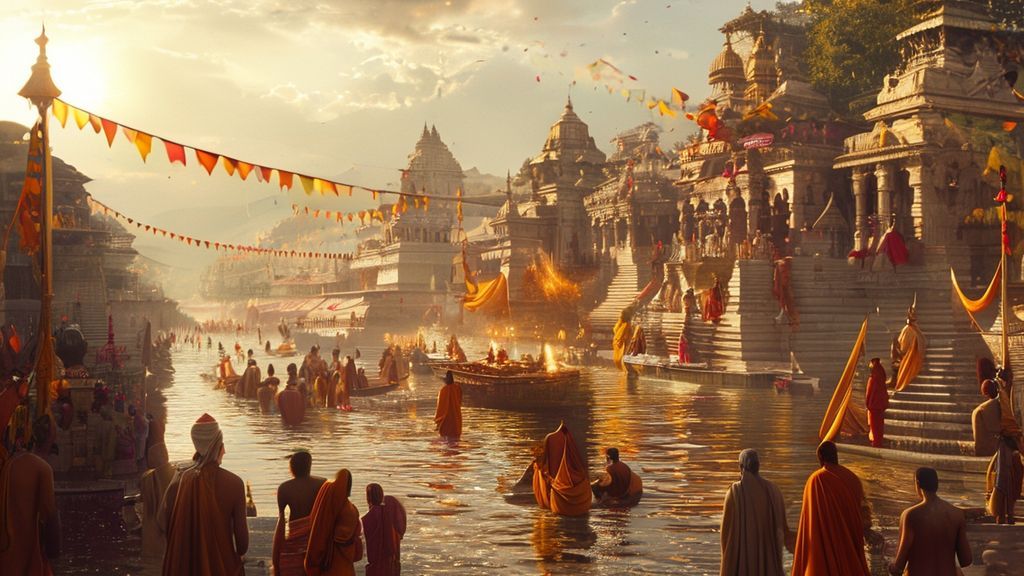
The Nashik Kumbh Mela, a venerable Hindu pilgrimage, is celebrated every twelve years on the sacred banks of the Godavari River. This Simhastha Kumbh, occurring when Jupiter enters Leo, commemorates the celestial churning of the ocean (Samudra Manthan) and the drops of Amrita falling at Nashik, bestowing immense spiritual merit upon devotees.
| Attribute | Details |
|---|---|
| Deity | Lord Shiva (Trimbakeshwar Jyotirlinga), Lord Rama, Astrological significations of Surya (Sun), Brihaspati (Jupiter), Chandra (Moon). |
| Location/Origin | Nashik, Maharashtra, India, on the banks of the Godavari River. Also Trimbakeshwar, the source of Godavari. |
| Key Festival | Simhastha Kumbh Mela, occurring when Jupiter is in the zodiac sign of Leo (Simha Rashi) and Sun in Cancer or Leo. |
| Scripture Reference | Skanda Purana, Padma Purana (for Amrita drops legend); Brahma Purana, Skanda Purana (Godavari Mahatmya for river’s sanctity). |
Introduction: The Confluence of Faith and Cosmos
The Nashik Kumbh Mela, sanctified by the revered Godavari River, stands as a resplendent jewel in the crown of Sanatan Dharma’s spiritual heritage. This quadrennial gathering, specifically the Simhastha Kumbh, represents more than just a festival; it is a profound cosmological event, a confluence of astrological precision, ancient Puranic narratives, and fervent devotion. Millions of pilgrims, sadhus, and spiritual seekers converge upon Nashik, drawn by the promise of spiritual purification and liberation attained through a holy dip in the sacred waters of the Godavari. It is a vibrant testament to the enduring faith that permeates the soul of Bharatavarsha, offering a unique opportunity for collective spiritual upliftment and the observance of timeless Vedic traditions.
Puranic History & Legend: The Nectar of Immortality and the Divine Godavari
The genesis of the Kumbh Mela, across all its four sacred sites, is deeply embedded in the celestial narrative of the Samudra Manthan, the churning of the cosmic ocean. As detailed in the Bhagavata Purana and the Vishnu Purana, devas (demigods) and asuras (demons) collaborated to extract the pot of Amrita, the nectar of immortality. When the Amrita emerged, a fierce struggle ensued for its possession. Lord Vishnu, in His enchanting form as Mohini, intervened to ensure the nectar’s rightful distribution among the devas. During the twelve-day (equivalent to twelve human years) celestial chase for the Amrita pot, carried by the divine bird Garuda, drops of this life-giving elixir are said to have fallen at four earthly locations: Haridwar, Prayagraj (Allahabad), Ujjain, and Nashik.
At Nashik, specifically the area around the Trayambakeshwar Jyotirlinga and the Ramkund ghats, these drops sanctified the very earth and especially the waters of the Godavari River. The occurrence of the Kumbh Mela at Nashik is specifically termed ‘Simhastha’ because it takes place when the planet Jupiter (Brihaspati) is in the zodiac sign of Leo (Simha Rashi), a precise astrological alignment that amplifies the spiritual potency of the pilgrimage. The veneration of the Godavari River itself has deep Puranic roots. Known as Dakshin Ganga, or the Ganga of the South, its sanctity is extolled in the Brahma Purana and the Skanda Purana, particularly in the Godavari Mahatmya. Legend attributes its earthly manifestation to the penance of Sage Gautama, who brought the river from Brahmagiri mountain, near Trimbakeshwar, to purify the land and sustain life. Thus, a bath in the Godavari during Kumbh is believed to cleanse sins accumulated over lifetimes and bestow moksha, liberation from the cycle of rebirth.
Ghats & Cosmological Marvels: Ancient Planning for Spiritual Flux
While the Nashik Kumbh Mela is a dynamic event rather than a static architectural marvel, the infrastructure and the sacred geography of the Godavari River’s banks showcase ancient planning and a profound understanding of hydrological and astronomical principles. The most significant structures are the numerous ghats—stone steps leading down to the river—that facilitate the holy baths for millions. The Ramkund in Nashik is paramount for Vaishnavite devotees, believed to be the spot where Lord Rama bathed during His exile. The Kushavarta Kund in Trimbakeshwar holds immense significance for Shaivites, as it is considered the origin point of the Godavari. These ghats, though periodically renovated, retain an ancient character, built with durable stones to withstand the immense spiritual flux of pilgrims.
The meticulous planning for managing the colossal influx of devotees—including temporary townships, sanitation facilities, and crowd control mechanisms—reflects an ancient tradition of organizing such large-scale spiritual congregations. The very timing of the Simhastha Kumbh is a testament to sophisticated ancient Indian astronomy (Jyotisha Shastra). The alignment of Jupiter in Leo (Simha Rashi) and the Sun and Moon in specific signs is calculated with remarkable precision, demonstrating a deep scientific understanding embedded within spiritual practices. This celestial conjunction is not merely symbolic; it is believed to open cosmic portals, making the prayers and rituals performed during this period extraordinarily potent.
Rituals & Puja Vidhi: Embracing Purification and Merit
Participation in the Nashik Kumbh Mela is a journey into profound spiritual practices. The central ritual is the Snan (holy bath), especially the auspicious Shahi Snan (royal bath) on specific dates.
- Sankalp and Achaman: Before entering the sacred waters, devotees take a vow (Sankalp) for purification and sip a few drops of water (Achaman) with specific mantras, preparing themselves mentally and spiritually.
- Godavari Snan: The primary act involves taking a purifying dip in the Godavari River. Devotees immerse themselves three times, invoking the holy rivers of Bharatavarsha. The belief is that this act washes away karmic impurities.
- Pind Daan at Ramkund: Many pilgrims perform Pind Daan, ancestral rites, at Ramkund in Nashik. This ritual involves offering rice balls (pinda) to the ancestors, seeking their liberation and blessings, as described in the Garuda Purana.
- Darshan of Jyotirlinga: A pilgrimage to the Trimbakeshwar Jyotirlinga is an integral part of the Nashik Kumbh Mela, especially for Shaivite devotees. Offering prayers to Lord Shiva at this ancient shrine is considered highly meritorious.
- Satsang and Bhandara: Engaging in spiritual discourse (Satsang) with revered saints and sadhus, and participating in Bhandara (community feeding of pilgrims and sadhus) are crucial acts of service and devotion.
- Japa and Dhyana: Devotees spend time in prayer, chanting (Japa), and meditation (Dhyana) on the river banks or in temporary ashrams, harnessing the amplified spiritual energy of the Mela.
- Dana and Seva: Giving charity (Dana) to the needy and performing selfless service (Seva) are considered powerful acts that accrue immense spiritual merit during the Kumbh.
The Shahi Snans are particularly majestic, witnessing the grand processions of various Akharas (sects of sadhus), including the Naga Babas, Digambars, and Urdhavavahurs, as they march towards the ghats for their ceremonial bath, marking a unique spectacle of ancient spiritual traditions.
Mantras & Chants: Echoes of Eternity
During the Nashik Kumbh Mela, the air resonates with sacred vibrations generated by countless mantras and chants. Devotees and sadhus engage in Japa (repetition) of various divine names and hymns, enhancing the spiritual atmosphere. Some key mantras include:
- Gayatri Mantra:
ॐ भूर्भुवः स्वः तत्सवितुर्वरेण्यं भर्गो देवस्य धीमहि धियो यो नः प्रचोदयात्॥
Om Bhur Bhuvah Svah Tat Savitur Varenyam Bhargo Devasya Dhimahi Dhiyo Yo Nah Prachodayat॥
(A universal prayer to the divine effulgence of the Supreme Creator.) - Mahamrityunjaya Mantra:
ॐ त्र्यम्बकं यजामहे सुगन्धिं पुष्टिवर्धनम्। उर्वारुकमिव बन्धनान् मृत्योर्मुक्षीय माऽमृतात्॥
Om Tryambakam Yajamahe Sugandhim Pushtivardhanam | Urvarukamiva Bandhanan Mrityor Mukshiya Maamritat॥
(A powerful mantra dedicated to Lord Shiva for health, longevity, and liberation.) - General River Invocation for Bathing:
गंगा च यमुना चैव गोदावरी सरस्वती। नर्मदा सिन्धु कावेरी जलेऽस्मिन् सन्निधिं कुरु॥
Ganga Cha Yamuna Chaiva Godavari Saraswati | Narmada Sindhu Kaveri Jalesmin Sannidhim Kuru॥
(A prayer to invoke the presence of all sacred rivers into the bathing waters.) - Godavari Stuti: Chanting hymns specifically glorifying the Godavari River, often found in local Mahatmyas, further deepens the connection with this sacred entity.
Dos and Don’ts: Upholding Dharmic Etiquette
To ensure a spiritually enriching and respectful experience at the Nashik Kumbh Mela, adhering to certain principles of conduct is essential:
- Do’s:
- Maintain utmost cleanliness and hygiene, especially around the ghats and river.
- Show reverence and respect to all sadhus, saints, and fellow pilgrims.
- Participate in community service (Seva) and charitable activities (Dana).
- Engage in spiritual practices like chanting, meditation, and listening to discourses.
- Be mindful of cultural sensitivities and local customs.
- Stay hydrated and take necessary precautions for health and safety.
- Don’ts:
- Litter or pollute the river and its banks in any manner.
- Consume intoxicants, alcohol, or non-vegetarian food in the sacred Mela area.
- Engage in commercial photography of sadhus or private rituals without explicit permission.
- Disrupt the peace and sanctity of the Mela through loud or disrespectful behavior.
- Undertake any activities that commercialize or disrespect the spiritual essence of the pilgrimage.
Frequently Asked Questions
What is the significance of the Godavari River at Nashik Kumbh Mela?
The Godavari River, revered as Dakshin Ganga, gains immense sanctity during the Simhastha Kumbh Mela in Nashik because it is believed that drops of Amrita fell into its waters. Bathing in the Godavari at sacred sites like Ramkund and Kushavarta during this auspicious period is believed to cleanse sins, bestow merit, and aid in attaining moksha, aligning with the descriptions in the Brahma Purana.
How is the date of Nashik Kumbh Mela determined?
The date of the Nashik Kumbh Mela, known as Simhastha Kumbh, is determined by precise astrological calculations (Jyotisha Shastra). It occurs every twelve years when the planet Jupiter (Brihaspati) transits into the zodiac sign of Leo (Simha Rashi) and the Sun is in Leo or Cancer. This specific planetary alignment is considered exceptionally auspicious for spiritual benefits.
Who participates in the Shahi Snan at Kumbh Mela?
The Shahi Snan (Royal Bath) is primarily performed by the various Akharas—organized ascetic orders of sadhus. These include the Naga Babas (Digambar, Niranjani, Juna Akhara), Urdhavavahurs, and other monastic sects. Their grand procession and ceremonial bath in the Godavari River on the most auspicious dates are a central and highly revered spectacle of the Nashik Kumbh Mela, symbolizing their spiritual authority and penance.
Can women and children participate in the rituals?
Absolutely. The Nashik Kumbh Mela is open to all sincere seekers and devotees, regardless of age or gender. Women and children are encouraged to participate in all rituals, including taking holy dips in the Godavari, visiting temples, engaging in prayers, and offering Dana and Seva. The Mela is a family-inclusive spiritual journey for purification and blessings, embodying the universality of Sanatan Dharma’s teachings.
Dharmic Significance: The Eternal Flow of Sanatan Dharma
The Nashik Kumbh Mela on the Godavari is far more than an assembly; it is a living, breathing testament to the eternal principles of Sanatan Dharma. It serves as a powerful reminder of the cyclical nature of time, the profound interconnectedness of cosmos and humanity, and the enduring quest for spiritual truth. This sacred gathering not only preserves ancient traditions, astrological knowledge, and Puranic narratives but also revitalizes the collective spiritual consciousness of the Hindu community. It fosters unity among diverse ascetic orders, encourages spiritual discourse, and provides an unparalleled opportunity for millions to experience the transformative power of faith, devotion, and collective penance. The Mela reaffirms the sanctity of our rivers, the wisdom of our sages, and the timeless path to liberation, ensuring that the flame of Dharma continues to burn brightly for generations to come.