


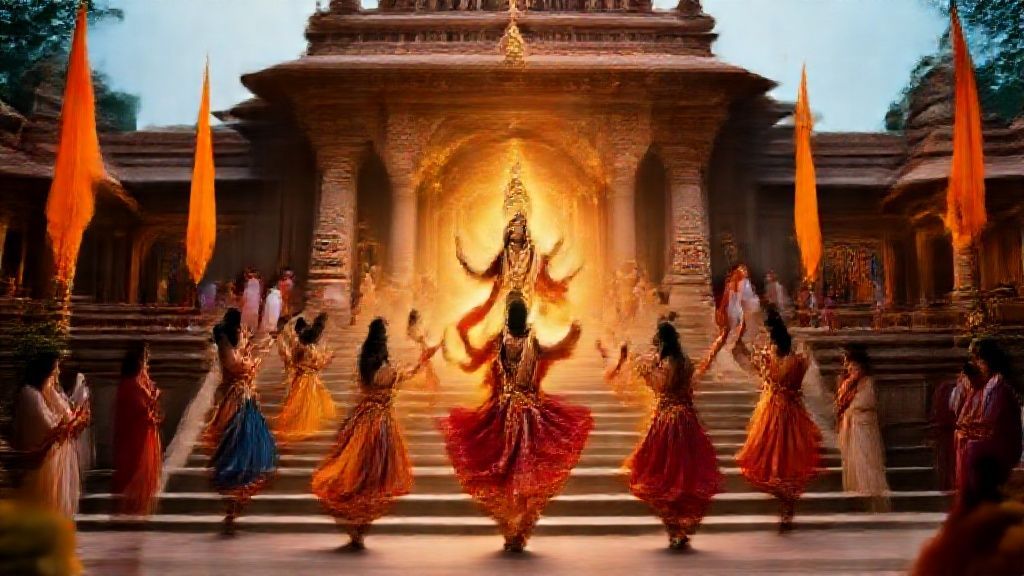
Navratri Dandiya Steps involve a devotional folk dance from Gujarat, performed with rhythmic wooden sticks (*dandiya*) during the nine nights of Navratri. It symbolizes Maa Durga’s cosmic battle against evil, with the sticks representing her sword or trident. Devotees perform Dandiya Raas in circular formations as an offering of joy, energy, and gratitude to the Divine Mother, celebrating her triumph and seeking her blessings.
| Attribute | Details |
|---|---|
| Origin | Predominantly Gujarat, with variations across Rajasthan and other regions of Bharat. |
| Purpose | A devotional offering and celebratory folk dance dedicated to Maa Durga during Navratri. Symbolizes the cosmic dance of creation and destruction. |
| Key Deities | Maa Durga, Ambe Maa, Kali, Saraswati – aspects of the Divine Mother. |
| Scripture Reference | The philosophical underpinning derives from the Devi Mahatmya (part of the Markandeya Purana) and Kalika Purana, detailing the glory and victories of the Divine Mother. While Dandiya Raas is a folk tradition, its spirit is deeply rooted in these Puranic narratives. |
The Sacred Rhythm of Devotion: Understanding Dandiya Raas
Navratri, the nine auspicious nights dedicated to the worship of Maa Durga, is a period of intense spiritual awakening and vibrant cultural expression across Bharatvarsha. Among the myriad ways devotees honor the Divine Mother, Dandiya Raas stands out as a joyous and energetic devotional dance. More than mere recreation, Dandiya Raas is a profound act of worship, a communal *sadhana* where every rhythmic step and every clash of sticks becomes an offering to the Universal Mother. It is a dance that binds communities, elevates spirits, and physically manifests the deep reverence for Sanatan Dharma‘s central tenets of Shakti worship. Through its dynamic movements and vibrant energy, Dandiya Raas embodies the very essence of Navratri – the victory of Dharma over adharma, light over darkness, and the eternal power of the feminine divine.
Puranic Echoes and the Legend of the Cosmic Dance
While Dandiya Raas as a distinct folk form is a later development, its spirit and symbolism are deeply rooted in the ancient Puranic narratives of Shakti. The foundational scripture for Navratri, the Devi Mahatmya within the Markandeya Purana, vividly recounts Maa Durga’s epic battles against formidable demons like Mahishasura. The *dandiya* sticks, often crafted from sacred wood, are not merely props but carry profound symbolic weight, representing the sword, trishul (trident), or other weapons wielded by Maa Durga in her cosmic struggle. Each strike of the *dandiya* is a symbolic act of vanquishing evil, a reenactment of the divine mother’s triumph, and an affirmation of cosmic order. The circular formations in Dandiya Raas also evoke the ancient tradition of Raas Leela, most famously depicted in the Bhagavata Purana, where Bhagavan Krishna dances with the Gopis in a circle, symbolizing the soul’s ecstatic union with the Divine. The Garbha, the lamp or pot signifying the womb of creation (Garbha Deep), around which Dandiya and Garba are performed, represents the universal creative principle embodied by Devi. Thus, the dance is a living narrative, connecting the devotee directly to these timeless legends.
The Cosmic Geometry and Energetic Science of Dandiya Raas
Beyond its visual appeal, Dandiya Raas possesses an intricate cosmic geometry and energetic science. The circular formation, central to the dance, is a living Mandala. It symbolizes the cyclical nature of time, creation, preservation, and dissolution (Prakriti and Purusha), and the infinite, unbounded nature of the Divine. As devotees move clockwise and counter-clockwise, they emulate the cosmic dance of celestial bodies and the continuous flux of universal energy. The rhythmic striking of the *dandiya* sticks generates specific sound vibrations and kinetic energy. These vibrations are believed to purify the environment, invoke positive energies, and align the participants with higher spiritual frequencies. The synchronized movements foster a sense of unity, dissolving individual ego into collective devotion. This communal energy, directed towards the Divine Mother, creates a powerful spiritual vortex, enhancing the devotional experience and drawing down blessings. The physical exertion itself is a form of Tapasya (penance), converting bodily energy into spiritual fervor, making the entire performance a moving meditation and an energetic offering.
Rituals & Puja Vidhi: Mastering the Devotional Steps of Dandiya Raas
Performing Dandiya Raas is a joyous ritual, a dynamic Puja Vidhi through movement and rhythm. Here’s a step-by-step guide for sincere devotees:
- Preparation & Intention (Sankalpa):
- Attire: Adorn traditional garments like Ghagra-Choli for women and Kediyu/Kurta-Pyjama for men. These vibrant outfits are not just aesthetic but are considered respectful offerings to the festive spirit and the Divine.
- Dandiya Sticks: Select sturdy, well-balanced wooden sticks. Hold one in each hand, comfortably.
- Bhava (Devotional Mood): Before commencing, offer a silent prayer to Maa Durga, setting the intention that your dance is an offering of love and devotion to Her. Let your heart be filled with joy and reverence.
- The Basic Stance:
- Stand upright, feet shoulder-width apart, holding the *dandiya* sticks out in front of you, slightly angled.
- Maintain a relaxed posture, ready to move rhythmically.
- Step 1: The Ek-Taali (Single Strike)
- Movement: Step forward with your right foot, simultaneously striking your right *dandiya* with your partner’s right *dandiya*.
- Return: Step back with your right foot, bringing your *dandiya* back to the initial position, or lightly tapping your own sticks together.
- Repeat: Perform the same with the left foot and left *dandiya*. This forms a simple forward-and-back rhythm.
- Focus: Maintain a steady tempo (*Taal*) and feel the rhythm of the music.
- Step 2: The Do-Taali (Double Strike)
- Movement: Step forward with your right foot, strike your right *dandiya* with your partner’s right.
- Second Strike: Immediately after, strike your own two *dandiya* sticks together (or with another partner’s left *dandiya* if in a larger circle movement).
- Return & Repeat: Step back, and then repeat with the left foot, making two distinct strikes for each forward step.
- Progression: This step introduces more complexity, requiring quicker coordination and a slightly faster tempo.
- Step 3: The Teen-Taali (Triple Strike) / Chhakka
- Movement: This involves more intricate footwork and a sequence of three strikes.
- Sequence: Step forward (e.g., right foot), strike right *dandiya* (1). Then, often twirl or pivot, striking your own *dandiya* (2), and then strike with a different partner’s *dandiya* or again with your original partner (3).
- Rotation: This step often incorporates changing partners or moving within the circle, making it a dynamic and energetic segment of the dance.
- Variety: There are many variations of three and four-strike patterns (Chhakka, Athakka), often involving spinning and leaping, which are learned with practice.
- Circular Formation & Partner Interaction:
- Dandiya Raas is performed in large circles. Dancers often form two concentric circles, moving in opposite directions, allowing partners to change frequently.
- Maintain eye contact and a joyful smile, reflecting the shared devotion.
- Laya (Tempo) & Expression:
- Begin with a slower tempo and gradually increase as the music builds.
- Let your body express the exuberance and devotion. It’s not just about steps but about the joyous offering of the self to the Divine.
Mantras & Chants for Elevated Devotion
While specific *dandiya* dance mantras are not prescribed, the entire performance is a living mantra, a kinetic prayer. Devotees often chant or sing along with the traditional Garba songs (Garba-Geet) that accompany the Dandiya Raas. These songs are devotional hymns praising Maa Durga and her various forms. Here are some foundational mantras suitable for reflection during Navratri and Dandiya Raas:
- Navratri Moola Mantra: ॐ ऐं ह्रीं क्लीं चामुण्डायै विच्चे (Om Aim Hreem Kleem Chamundaye Vichche) – This powerful Bija mantra invokes the protective and destructive aspects of Devi.
- Sarva Mangala Mangalye: सर्वमङ्गलमाङ्गल्ये शिवे सर्वार्थसाधिके । शरण्ये त्र्यम्बके गौरि नारायणि नमोऽस्तु ते ॥ (Sarva Mangala Mangalye Shive Sarvartha Sadhike | Sharanye Tryambake Gauri Narayani Namo Sthute ||) – A timeless prayer saluting Devi as the auspicious one, the fulfiller of all desires, the refuge, the three-eyed one.
- Ya Devi Sarva Bhuteshu: या देवी सर्वभूतेषु शक्तिरूपेण संस्थिता । नमस्तस्यै नमस्तस्यै नमस्तस्यै नमो नमः ॥ (Ya Devi Sarva Bhuteshu Shakti Rupena Samsthita | Namastasyei Namastasyei Namastasyei Namo Namah ||) – A beautiful mantra from the Devi Mahatmya, bowing to the Goddess who resides in all beings in the form of power.
Singing these mantras or simply focusing on the Divine Mother’s names while dancing elevates the physical act to a profound spiritual experience.
Dos and Don’ts: Upholding Dharmic Etiquette in Dandiya Raas
To ensure the sanctity and spiritual efficacy of participating in Dandiya Raas, certain Dharmic protocols should be observed:
- Do’s:
- Dance with Reverence: Approach the dance as a sacred offering to Maa Durga, with a heart full of devotion and joy.
- Wear Traditional Attire: Opt for traditional Garba/Dandiya outfits, as they are considered respectful and enhance the festive atmosphere.
- Maintain Decorum: Be mindful of your movements and interactions, ensuring the environment remains conducive to collective worship.
- Participate Wholeheartedly: Engage with enthusiasm and focus on the rhythm and collective energy.
- Observe Navratri Fasting: If you are observing the Navratri Vrat, continue to do so, understanding that the dance is an extension of your devotion.
- Don’ts:
- Treat as Mere Entertainment: Avoid viewing Dandiya solely as a social event or performance. Its primary purpose is devotional.
- Wear Inappropriate Clothing: Avoid revealing or disrespectful attire that distracts from the spiritual essence of the event.
- Consume Non-Sattvic Food/Drink: Abstain from alcohol, meat, or other non-sattvic foods during Navratri, especially before or during Dandiya.
- Disrupt Others: Be considerate of fellow dancers; avoid overly aggressive movements or blocking paths.
- Focus on Competition: While skill is admired, the spirit should be communal devotion, not competition.
Is Dandiya Raas exclusively for Navratri?
While Dandiya Raas is most prominently associated with Navratri, particularly in Gujarat and Rajasthan, variations of stick dances and devotional folk dances are performed on other festive occasions. However, the nine nights of Navratri are when its spiritual and cultural significance reaches its zenith, dedicated purely to the worship of Maa Durga.
What is the difference between Dandiya Raas and Garba?
Both Dandiya Raas and Garba are integral folk dances of Navratri. Garba (from “Garbha Deep” – womb lamp) is traditionally performed before the Aarti, involving circular movements with claps and hand gestures, often around a pot symbolizing the Devi. It’s typically slower, more graceful, and devotional. Dandiya Raas, performed after Garba, involves the use of wooden sticks (*dandiya*), striking them rhythmically with partners. It is generally more energetic, dynamic, and faster-paced, symbolizing the swordplay of Maa Durga.
Can non-Hindus participate in Dandiya?
Yes, all are welcome to participate in Dandiya Raas. Sanatan Dharma, by its very nature, is inclusive. While the dance holds deep spiritual significance for Hindus, participation by non-Hindus is seen as an embrace of cultural exchange and shared joy. The only expectation is respect for the devotional context and adherence to the general etiquette of the event.
The Enduring Dharmic Resonance of Dandiya Raas
Dandiya Raas is far more than a dance; it is a profound cultural and spiritual inheritance, a vibrant thread in the rich tapestry of Sanatan Dharma. It serves as a powerful medium for transmitting timeless values, Puranic narratives, and devotional fervor across generations. By participating in Dandiya, devotees not only honor Maa Durga but also reinforce community bonds, celebrate their heritage, and experience a direct, embodied connection to the Divine. It reminds us that devotion can be expressed not just through silent meditation or elaborate rituals, but also through joyous, energetic movement. In a world constantly seeking meaning, the rhythmic clashing of Dandiya sticks echoes the eternal victory of good over evil, instilling hope, unity, and unwavering faith in the Universal Mother. For deeper insights into such cultural traditions, explore resources at Hindutva.online, dedicated to preserving and propagating the profound wisdom of our Dharma.