


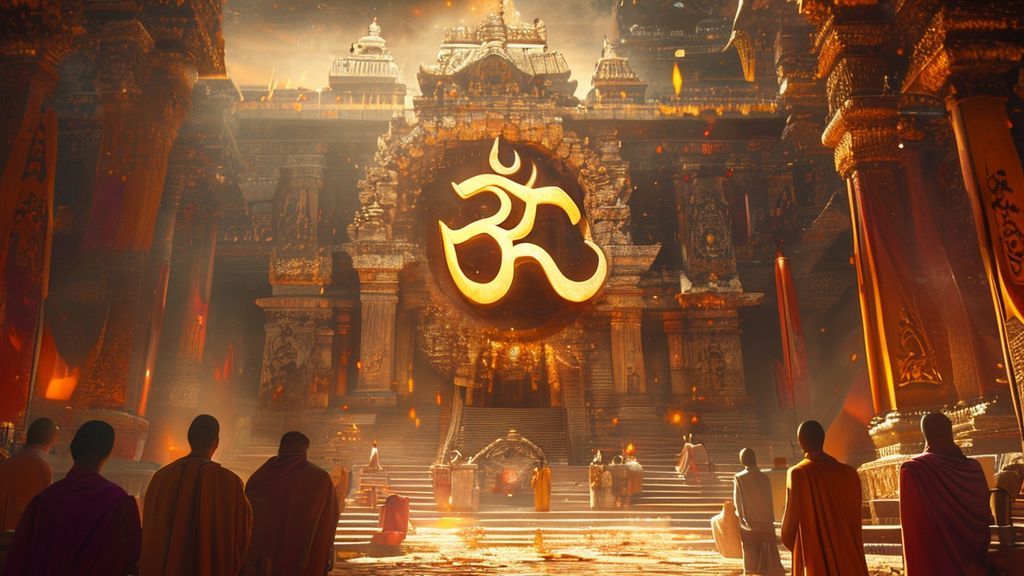
Om Symbol, also known as Praṇava, is the primordial cosmic sound representing the entirety of creation, sustenance, and dissolution. It encapsulates the ultimate reality of Brahman, the universal consciousness, and the individual soul, Atman, serving as a sacred sonic manifestation of the divine in Sanatan Dharma.
| Attribute | Details |
|---|---|
| Symbol | ॐ (Om), Praṇava (प्रणव) |
| Origin | Cosmic vibration, the sound of Brahman manifesting the universe. |
| Representation | The three states of consciousness (waking, dreaming, deep sleep) and the transcendent state (Turiya). Also represents Trimurti (Brahma, Vishnu, Shiva). |
| Key Mantra | Aum (ॐ), the root of all mantras. |
| Scripture References | Mandukya Upanishad, Katha Upanishad, Prashna Upanishad, Chandogya Upanishad, Bhagavad Gita, Yoga Sutras. |
The Primordial Echo: Understanding Om in Sanatan Dharma
The syllable Om (ॐ), often referred to as Praṇava, is not merely a sound; it is the fundamental vibration of the universe, the very fabric of existence from which all creation emerges. In Sanatan Dharma, Om is the quintessential mantra, embodying the totality of Vedic wisdom and the ultimate reality of Brahman. It is the bridge between the individual soul (Atman) and the universal consciousness, a potent tool for spiritual realization and cosmic alignment. From the profound philosophical treatises of the Upanishads to the daily devotional practices of millions, Om resonates as the eternal sound of truth, peace, and divine presence. Its contemplation leads the sincere seeker towards an understanding of the interconnectedness of all phenomena and the ultimate non-duality that underpins our existence.
Cosmic Genesis: The Puranic & Upanishadic Significance of Om
The concept of Om as the primal sound is deeply rooted in the Vedic scriptures, particularly the Upanishads, which are the philosophical apex of the Vedas. The Mandukya Upanishad is entirely dedicated to unraveling the profound meaning of Om, describing it as the imperishable sound that encompasses past, present, and future, and transcends time itself. It elaborates on the three phonetic components of Om – A, U, M – and the silent fourth state:
- ‘A’ (अकार) represents the waking state (Jagrat), the gross world of sensory experience. It signifies Vaishvanara, the universal self in the waking state.
- ‘U’ (उकार) represents the dream state (Swapna), the subtle world of inner experiences. It signifies Taijasa, the universal self in the dream state.
- ‘M’ (मकार) represents the deep sleep state (Sushupti), where consciousness is undifferentiated. It signifies Prajna, the universal self in deep sleep.
The profound silence that follows the chanting of A-U-M, symbolized by the crescent and dot in the Devanagari script, represents the fourth state, Turiya (तुरीया). Turiya is the state of pure consciousness, beyond all relative experience, the non-dual reality where the individual soul merges with Brahman. As stated in the Katha Upanishad (I.2.15-17), “sarve vedā yat padamāmananti, tapāṃsi sarvāṇi ca yad vadanti, yadicchanto brahmacaryaṃ caranti, tat te padaṃ saṅgraheṇa bravīmyom ity etat” (All the Vedas proclaim that goal, all austerities speak of it, and desiring which they live the life of a Brahmachari; that goal, I will briefly tell you, is Om). The Prashna Upanishad further elucidates that meditating on Om can lead to the Supreme Brahman. This ancient wisdom establishes Om not just as a religious symbol, but as the very vibration of creation, the Nada Brahman (नाद ब्रह्मन्), or sound-Brahman.
The Resonance of Reality: Scientific and Philosophical Wonders of Om
Beyond its scriptural foundation, the chanting of Om holds remarkable scientific and psychological benefits that resonate with modern understanding. The prolonged pronunciation of A-U-M produces distinct vibrations that are believed to synchronize bodily rhythms and calm the nervous system. The ‘A’ sound originates from the navel, vibrating the abdominal region; ‘U’ resonates through the chest and throat; and ‘M’ vibrates the nasal cavity and brain, culminating in the silent state of Turiya, which is said to pacify the mind. This systematic vocalization creates a harmonious frequency that influences various physiological processes, leading to reduced stress, improved concentration, and enhanced mental clarity. Studies on the effects of Om chanting have shown activation in areas of the brain associated with relaxation and meditation, validating the insights of ancient Rishis who understood the intricate connection between sound, consciousness, and well-being. Furthermore, the visual representation of ॐ itself is a marvel of sacred geometry, where each curve and stroke holds symbolic significance of the states of consciousness, embodying the profound philosophy in a concise graphical form.
The Path to Inner Peace: Rituals and Puja Vidhi for Om Chanting
Incorporating the chanting of Om into daily spiritual practice is a simple yet profoundly effective way to connect with the divine. The practice is not bound by rigid rituals but thrives on sincerity and devotion. Here is a basic guide to integrating Om into your routine:
- Preparation: Find a quiet, clean space. Sit in a comfortable meditative posture (e.g., Padmasana or Sukhasana) with your spine erect. Close your eyes gently.
- Breath Awareness: Take a few deep, slow breaths, focusing on the inflow and outflow of air to calm your mind.
- Initiation: Inhale deeply, and as you exhale, begin to chant “AUM” slowly and sonorously. Allow the ‘A’ sound to resonate from your abdomen, the ‘U’ from your chest and throat, and the ‘M’ to hum in your nasal passages and crown of the head.
- Duration and Repetition: Chant for a minimum of 11, 21, or 108 repetitions (using a mala or simply counting). You can also chant for a set duration, such as 10-15 minutes.
- The Silence: After chanting, sit in silence for a few minutes, observing the residual vibrations within your body and mind. This is where the experience of Turiya can be glimpsed.
- Daily Practice: Regular practice, especially in the early morning (Brahma Muhurta) or evening, amplifies its benefits.
The simple yet profound act of chanting Om, whether aloud or mentally (manasik japa), serves as a potent tool for calming the mind, focusing attention, and drawing one closer to the universal consciousness described extensively on Hindutva.online.
Resonant Vibrations: Mantras and Chants
While Om itself is the supreme mantra, it also forms the prefix for countless other sacred chants, bestowing upon them its cosmic power. Its presence elevates the vibrational quality of any mantra. Some prominent examples include:
- The Gayatri Mantra: “Oṃ bhūr bhuvaḥ svaḥ, tat savitur vareṇyaṃ, bhargo devasya dhīmahi, dhiyo yo naḥ pracodayāt.” (ॐ भूर् भुवः स्वः, तत् सवितुर् वरेण्यं, भर्गो देवस्य धीमहि, धियो यो नः प्रचोदयात्।) – A universal prayer to the divine illuminating power.
- Mahamrityunjaya Mantra: “Oṃ tryaṃbakaṃ yajāmahe sugandhiṃ puṣṭi-vardhanam, urvārukam iva bandhanān mṛtyor mukṣīya māmṛtāt.” (ॐ त्र्यम्बकं यजामहे सुगन्धिं पुष्टि-वर्धनम्, उर्वारुकमिव बन्धनान् मृत्योर्मुक्षीय मामृतात्।) – A potent mantra for healing, longevity, and liberation.
- Panchakshara Mantra: “Oṃ namaḥ śivāya” (ॐ नमः शिवाय) – Salutations to Lord Shiva, invoking auspiciousness.
- Asato Ma Sadgamaya: “Oṃ asato mā sadgamaya, tamaso mā jyotirgamaya, mṛtyormā amṛtaṃ gamaya.” (ॐ असतो मा सद्गमय, तमसो मा ज्योतिर्गमय, मृत्योर्मा अमृतं गमय।) – A prayer for guidance from untruth to truth, darkness to light, and death to immortality.
The repetition of Om alone, as a single-syllable mantra, is known as Praṇava Japa, and is considered one of the highest forms of meditation in the Yoga Sutras of Patanjali (I.27-29), which states that Praṇava is the designator of Ishvara (God).
Cultural Conduct: Dos and Don’ts of Om
Approaching Om with reverence ensures its sanctity and efficacy in spiritual practice.
Dos:
- Chant with Devotion: Approach Om with a pure heart and focused intention, understanding its profound meaning.
- Maintain Purity: Practice in a clean environment and with a clean body and mind.
- Respect the Symbol: Treat the written symbol ॐ with reverence; avoid placing it in inappropriate places or using it disrespectfully.
- Educate Yourself: Learn about its scriptural significance to deepen your connection.
- Consistency: Regular practice, even for short durations, yields the best results.
Don’ts:
- Disrespectful Usage: Do not use Om as mere decoration or in a frivolous manner that trivializes its sacredness.
- Mechanical Chanting: Avoid chanting without awareness or understanding; try to feel the vibration and meaning.
- Commercial Misuse: Do not exploit the symbol for purely commercial purposes without acknowledging its spiritual roots.
- Lack of Focus: Distraction during chanting diminishes its spiritual benefit.
Frequently Asked Questions
Is Om exclusive to Hinduism?
While Om is deeply embedded in Sanatan Dharma and forms its very foundation, its vibrational essence is universal. Many traditions, including some forms of Buddhism and Jainism, also incorporate Om or similar sounds in their spiritual practices, recognizing its fundamental cosmic resonance. It is a universal sound of creation and unity, though its philosophical elaboration is most detailed in the Vedic tradition.
What do the different curves and the dot in the Om symbol represent?
The visual representation of ॐ is a profound symbol:
- The large bottom curve represents the waking state (Jagrat).
- The middle curve represents the dream state (Swapna).
- The top curve represents the deep sleep state (Sushupti).
- The semi-circle (crescent) above the curves represents Maya, the veil of illusion that separates us from the highest state.
- The dot above the semi-circle represents the transcendent state of Turiya, the absolute consciousness, which is beyond all other states and unaffected by Maya.
This elegant graphic encapsulates the entire philosophy of consciousness described in the Mandukya Upanishad.
Can non-Hindus chant Om?
Absolutely. The vibration of Om is universal, and its benefits are accessible to anyone, regardless of their religious background. Chanting Om promotes peace, clarity, and harmony within, making it a practice for all humanity. What matters is the intention, reverence, and focus with which one approaches the sound.
Why is Om sometimes spelled as AUM? What is the difference?
There is no difference in the sound or fundamental meaning. ‘AUM’ is simply the phonetic breakdown of the single syllable ‘Om’ to highlight its three constituent sounds (A-U-M) as explained in the Upanishads. This breakdown helps in understanding the philosophical connection of Om to the three states of consciousness (waking, dreaming, deep sleep) and their corresponding cosmic aspects (Brahma, Vishnu, Shiva). When written as ‘Om’ (ॐ), it refers to the complete, indivisible sound and its silent fourth state (Turiya).
The Eternal Sound: Why Om Matters for Every Hindu
The Om symbol is more than a spiritual icon; it is the very breath of Sanatan Dharma, an eternal link to our Vedic heritage and the ultimate truth. In an increasingly fragmented world, the vibration of Om offers a profound anchor to inner peace, universal unity, and spiritual wisdom. It reminds us that at our core, we are connected to the cosmic consciousness, an indivisible part of Brahman. By understanding and reverently chanting Om, every Hindu not only engages in a powerful spiritual practice but also actively participates in preserving the timeless knowledge and profound philosophy that forms the bedrock of our Dharma. It is the sound of liberation, guiding us towards self-realization and fostering a deeper connection with the divine, a principle central to our mission at Hindutva.online. To truly embrace Sanatan Dharma is to embrace Om, the primordial echo of existence itself.