

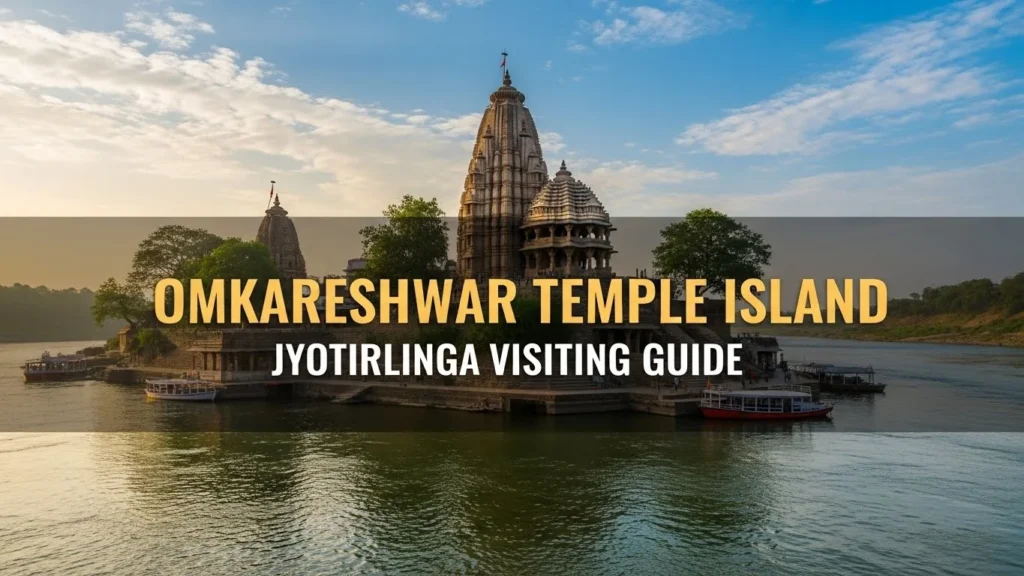
Omkareshwar Temple—the fourth of twelve sacred Jyotirlingas, uniquely situated on Mandhata Island formed by the Narmada River naturally shaped like the sacred ॐ (Om) symbol—represents one of Hinduism’s most geographically and spiritually profound pilgrimage sites, with Wikipedia’s authoritative documentation confirming that the temple embodies extraordinary dual sanctity as two separate Jyotirlinga shrines—Omkareshwar (“Lord of Om Sound”) on the island and Amareshwar/Mamleshwar (“Immortal Lord”) on the southern Narmada bank—both equally revered, making this the only location among the 12 Jyotirlingas where Shiva manifested in twin forms [web:771][web:773].

According to the legend narrated in Shiva Purana, when Vindhya, the presiding deity of the Vindhyachal mountain range, performed intense penance worshipping a lingam made of sand and clay to seek forgiveness for sins committed, Lord Shiva was so pleased that he appeared in two distinct forms simultaneously—Omkareshwar and Amaleswara—and since the mud mound appeared in the sacred shape of Om, the island came to be known as Omkareshwar, while the second legend relates to King Mandhata of the Ikshvaku dynasty (ancestor of Lord Rama) whose profound austerities compelled Shiva to manifest as a Jyotirlinga, hence the island is also called Mandhata Parvat [web:771][web:773][web:776].
The extraordinary geographical and spiritual convergence validates profound significance: Dharmik Vibes’ 2025 comprehensive guide explains that the Narmada River divides into two streams at this sacred spot—the northern channel called Kaveri River (wide and shallow) and the southern channel remaining Narmada (narrow and deep)—creating Vaidurya Mani Parvat island that remarkably resembles the Om symbol when viewed from above, reinforcing the spiritual energy and sanctity, with devotees performing the traditional Parikrama (circumambulation) taking approximately 3 hours to walk the entire 4 km island, encountering numerous ancient shrines, ghats, and the sacred cave where Adi Shankaracharya met his guru Govinda Bhagavatpada in the 8th century [web:773][web:774][web:781].
The architectural magnificence documented by Inheritage Foundation reveals Paramara dynasty’s 11th century original construction in Nagara style with Bhumija influences, followed by 13th century destruction by Mahmud Ghazni and subsequent Muslim invaders, then glorious 18th century reconstruction initiated by Gautama Bai Holkar and completed by her daughter-in-law Ahilyabai Holkar, creating the present temple with towering shikhara, intricate carvings, and the famous 24-pillar hall, while local stone expertly carved and fitted without mortar demonstrates ancient Indian engineering prowess [web:771][web:783].
As millions undertake pilgrimage to experience the sacred Om-shaped island, dual Jyotirlinga darshan, and holy Narmada dips—with modern infrastructure including bridges replacing earlier boat-only access, MPTDC Narmada Resort offering riverside accommodation, and convenient connectivity from Indore (77 km)—understanding the complete legends, unique twin-temple significance, island parikrama route, and practical visiting guide becomes essential for meaningful Hindu pilgrimage [web:777][web:786]https://hindutva.online. This comprehensive article presents Omkareshwar’s three sacred legends, dual Jyotirlinga uniqueness, Paramara-Holkar architectural history, complete parikrama guide, temple timings and darshan information, how to reach from major cities, accommodation options, and pilgrimage preparation tips.
The Sacred Legends of Omkareshwar
Legend 1: Vindhya Mountain’s Penance
Vindhya’s intense devotion [web:771][web:776]:
- Created a sacred geometrical diagram (yantra)
- Formed a Lingam made of sand and clay
- Performed severe penance for spiritual elevation and forgiveness
- Worshipped with complete dedication
Shiva’s divine appearance [web:771]:
- Pleased with Vindhya’s sincere worship, Lord Shiva appeared
- Manifested in two distinct forms simultaneously:
- Omkareshwar on the island
- Amaleswara (Amareshwar) on the southern bank
- Since the mud mound appeared in the shape of Om, the island came to be known as Omkareshwar
- Granted divine blessings and established permanent presence
Legend 2: King Mandhata’s Penance
King Mandhata’s devotion [web:773][web:782]:
- A devout ruler of the Ikshvaku dynasty (Lord Rama’s lineage)
- Performed intense tapasya (austerity) on this island
- His penance was so powerful that Lord Shiva appeared
- Blessed the land with his eternal presence as Jyotirlinga
- This is why the island is also called Mandhata Parvat
Mandhata’s sons [web:771]:
- Some scholars narrate the story about Ambarish and Muchukunda (Mandhata’s sons)
- They practiced severe penance and austerities here
- Their devotion pleased Shiva greatly
- The mountain is named Mandhata in their honor
Legend 3: Devas vs Danavas Battle
Divine intervention [web:771][web:776]:
- The Devas suffered a major setback in battle
- Desperate, they prayed to Lord Shiva for help
- Pleased with their prayer, Shiva emerged
- Manifested as Omkareshwar Jyotirlinga
- Defeated the Danavas and restored cosmic balance
- Established himself as powerful spiritual protector
The Om-Shaped Island: Geographic Marvel
Mandhata Island Formation
Island specifications [web:771][web:774]:
- Location: Mandhata (also called Shivpuri), Khandwa District, Madhya Pradesh
- Size: 4 km long, 2.6 km² area (2,600,000 m²)
- Formation: Narmada River divides into two streams
- Northern channel: Kaveri River (wide and shallow)
- Southern channel: Narmada proper (narrow and deep)
- Shape: Naturally resembles Om (ॐ) symbol—visible from above
- Alternative name: Vaidurya Mani Parvat
Sacred Narmada River
Spiritual significance:
- One of seven most sacred rivers in Hinduism
- Flowing westward (unlike most Indian rivers)
- Considered self-purifying (doesn’t require pilgrimage to purify)
- Parikrama (circumambulation) of river considered highly meritorious
Unique Feature: Two Jyotirlingas
Omkareshwar and Amareshwar
The dual temples [web:771][web:782]:
1. Omkareshwar Temple (Island):
- Meaning: “Lord of Omkara” or “Lord of the Om sound”
- Location: On Mandhata island
- Main shrine with roundish black stone representing Shiva
- Nearby white stone representing Parvati
2. Amareshwar/Mamleshwar Temple (Mainland):
- Meaning: “Immortal Lord” or “Lord of the Immortals (Devas)”
- Location: Southern bank of Narmada River on mainland
- Equally revered by devotees
- Has South Indian architectural influences with large courtyard [web:782]
Pilgrimage Tradition
Devotees typically visit both:
- First darshan at Omkareshwar (island temple)
- Then cross to Amareshwar (mainland temple)
- Both considered complete Jyotirlinga darshan
- Some traditions count them as one Jyotirlinga in two forms
- Others count them as separate entities
Temple Architecture and Structure
Nagara Style with Bhumija Influences
Architectural features [web:782][web:783]:
- Style: Nagara architecture with Bhumija, Hemadpanthi, Maratha influences
- Shikhara: Towering spire with sculptural finery
- Construction technique: Dry masonry (no mortar), interlocking stones
- Material: Local stone expertly carved
- Famous 24-pillar hall: Exquisite craftsmanship [web:782]
- Multiple smaller shrines surrounding main temple
- Intricate carvings depicting mythological scenes
Temple Complex Layout
Main shrines [web:771]:
- Omkareshwar Jyotirlinga: Main sanctum
- Parvati shrine: Goddess’s presence
- Ganapati (Ganesha) shrine: Remover of obstacles
- Various smaller deity shrines throughout island
Temple History
Ancient Origins and Paramara Construction (11th Century)
The temple is said to have been built by the Paramara Kings of Malwa in the 11th century CE [web:771].
Paramara period (9th-14th centuries) [web:783]:
- Powerful rulers of Malwa region
- Deep devotion to Shaivism
- Witnessed surge in temple construction
- Laid foundation for site’s prominence as major pilgrimage destination
- Flourishing of art and architecture
- Temples showcasing intricate carvings and elaborate designs
Medieval Period: Chauhan and Mughal Era
13th-18th centuries [web:771]:
- 13th century: Destruction and loot by Mahmud Ghazni
- Temple remained intact without complete destruction
- Under Chauhan Kings during entire Mughal rule
- Minimal renovation during this period
- Temple survived but in deteriorated condition
Holkar Reconstruction (18th Century)
Maratha revival [web:771][web:783]:
- Gautama Bai Holkar initiated reconstruction
- Ahilyabai Holkar completed the magnificent work
- Created present temple structure
- Maratha architectural influences visible
- Revival of pilgrimage tradition
Modern Era
Parikrama: Island Circumambulation
The Sacred Walk
Pilgrims traditionally circumambulate the entire island (Parikrama) which takes about 3 hours [web:782].
Parikrama details [web:781][web:782]:
- Distance: Approximately 7-8 km around entire island
- Duration: 2.5 to 3 hours at moderate pace
- Route: Follows the riverbank encircling Mandhata island
- Best time: Early morning or evening (avoid midday heat)
Sites Along Parikrama Route
Sacred spots encountered:
- Various ancient temples and shrines
- Multiple ghats for holy dips
- Adi Shankaracharya’s cave [web:771]
- Gomukh ghat where water flows from cow-shaped spout
- Siddhnath temple with exquisite pillars [web:771]
- Panoramic views of Narmada River
- Meditation spots and ashrams
Adi Shankara’s Connection
Temple Timings and Darshan
Temple Timings
Regular schedule:
- Morning: 5:00 AM – 12:30 PM
- Afternoon break: 12:30 PM – 4:15 PM
- Evening: 4:15 PM – 9:30 PM
Official timings [web:777]:
- Temple opens: 5:00 AM
- Temple closes: 9:30 PM
- Closed during aarti and shringar (decoration) times
Aarti Timings
- Morning Aarti: 5:30 AM
- Jalabhishek (Water ablution): 5:30 AM – 12:25 PM
- Evening Aarti: 7:00 PM
- Shayan Aarti (Night): 8:20 PM
Entry Fee
No entry fee for temple darshan
How to Reach Omkareshwar
By Air
Nearest Airport: Indore (Devi Ahilyabai Holkar Airport) [web:771][web:777]
- Distance: 77 km from Omkareshwar
- Travel time: 2-3 hours by road
- Well-connected to Delhi, Mumbai, Bangalore, Hyderabad
By Train
Nearest Railway Stations:
1. Omkareshwar Road Station (Mortakka) [web:775][web:777]:
- Distance: 12 km from temple
- On Indore-Khandwa railway line
- Local transport available (auto, taxi)
2. Khandwa Junction [web:771][web:780]:
- Distance: 75 km
- Major railway station
- Well-connected to major cities
- Travel time to Omkareshwar: 1.5-2.5 hours by road [web:775]
By Road
From Indore [web:775][web:777]:
- Distance: 75-85 km
- Time: 2-3 hours by car
- Route: Indore → Nemawar Road → Mortakka → Omkareshwar
- State-run and private buses available to Mortakka
From Khandwa [web:775]:
- Distance: 75 km
- Time: 1.5-2.5 hours
- Indore-Khandwa road route
From Ujjain:
- Regular buses and taxis available
- Via Indore route
Local Transport
- Auto-rickshaws: Available from Mortakka and parking areas
- Walking: From parking to temple (moderate distance)
- Bridge access: Modern bridge connects mainland to island
- Earlier boat service (still available as scenic option)
Accommodation in Omkareshwar
MPTDC Narmada Resort
Features [web:786]:
- Best location: Overlooking Narmada River
- Spectacular views: Temple, river, and suspension bridge visible
- Massive rooms: Spacious accommodation
- Mid-range pricing: Government tourism rates
- Basic amenities with clean rooms
- Hospitable staff
Other Hotels
Narmada Hills Resort [web:784]:
- Rating: #1 of 4 Omkareshwar hotels (TripAdvisor)
- Price range: ₹968 – ₹3,432 per night
- Rooms: 51 total
- Modern amenities
Budget options:
- Dharamshalas near temple
- Ashrams offering basic accommodation
- Private guest houses
Best Time to Visit
Ideal Season
- October to March: Pleasant weather, best for pilgrimage
- Winter (November-February): Cool, comfortable for parikrama
Festivals
Special occasions:
- Maha Shivaratri: Huge crowds, all-night worship
- Shravan month (July-August): Auspicious for Shiva worship, very crowded
- Kartik Purnima: Special rituals and celebrations
- Narmada Jayanti: Celebrating sacred river
Avoid
- Summer (April-June): Extremely hot, challenging for island walk
- Monsoon (July-August): Heavy rains, high water levels (scenic but challenging)
Pilgrimage Tips
Essential Tips
- Visit both temples: Omkareshwar (island) and Amareshwar (mainland) for complete darshan
- Complete parikrama: 3-hour island walk is spiritually rewarding
- Start early: Begin at sunrise for cooler weather and peaceful atmosphere
- Wear comfortable shoes: For parikrama walking
- Carry water: Stay hydrated, especially during parikrama
- Modest dress: Traditional attire recommended
Photography
- Allowed: General photography in temple complex (check specific restrictions)
- Not allowed: Inside main sanctum during worship
- Best spots: River views, temple exteriors, island landscape
What to See
- Omkareshwar Temple: Main island Jyotirlinga
- Amareshwar Temple: Mainland Jyotirlinga
- Adi Shankaracharya’s cave: Historical spiritual site
- Gomukh ghat: Sacred water source
- Siddhnath temple: Ancient architecture
- Narmada aarti: Evening river worship
- Suspension bridge: Scenic views
Frequently Asked Questions
Why is Omkareshwar called the Island Jyotirlinga?
The temple is located on Mandhata Island in the Narmada River, which is naturally shaped like the sacred Om (ॐ) symbol when viewed from above [web:771][web:773].
Are there two Jyotirlingas at Omkareshwar?
Yes, Omkareshwar (on island) and Amareshwar/Mamleshwar (on mainland) are both considered Jyotirlingas; Shiva manifested in two forms here [web:773][web:782].
What is the legend of Omkareshwar Temple?
Vindhya mountain deity performed penance; pleased Shiva appeared in two forms—Omkareshwar and Amaleswara—with the mud mound appearing as Om symbol [web:771][web:776].
How long does Omkareshwar parikrama take?
The island circumambulation takes approximately 2.5 to 3 hours covering 7-8 km [web:782].
What are the temple timings?
Temple is open 5:00 AM to 12:30 PM and 4:15 PM to 9:30 PM, closed during aarti and shringar periods [web:777].
How to reach Omkareshwar from Indore?
77 km by road (2-3 hours by car); or train to Omkareshwar Road station (12 km from temple) [web:775][web:777].
Who rebuilt Omkareshwar Temple after destruction?
Where did Adi Shankaracharya meet his guru?
Conclusion
Omkareshwar Temple—the sacred fourth Jyotirlinga uniquely situated on Mandhata Island naturally shaped like the Om (ॐ) symbol where the Narmada River divides into two streams creating this geographical marvel, and where Lord Shiva manifested in twin forms as Omkareshwar (“Lord of Om Sound”) on the island and Amareshwar (“Immortal Lord”) on the mainland in response to Vindhya mountain’s intense penance—stands as Hinduism’s most geographically profound pilgrimage combining natural sacred geometry with dual divine presence, with Wikipedia’s documentation confirming 11th century Paramara construction, 13th century Mahmud Ghazni destruction, and 18th century glorious reconstruction by Gautama Bai and Ahilyabai Holkar [web:771]https://hindutva.online.
What distinguishes Omkareshwar’s extraordinary significance is its convergence of geographical sanctity (4 km island formed by sacred Narmada naturally resembling Om symbol reinforcing spiritual energy), dual Jyotirlinga uniqueness (only location among 12 where Shiva appeared in two simultaneous forms requiring darshan at both Omkareshwar and Amareshwar temples for complete pilgrimage), legendary depth (three distinct stories—Vindhya’s penance, King Mandhata of Ikshvaku dynasty’s worship, and Devas-Danavas cosmic battle—all culminating in Jyotirlinga manifestation),
architectural magnificence (Nagara style with Bhumija influences showcasing dry masonry interlocking stones without mortar, 24-pillar hall, and towering shikhara), historical significance (Adi Shankaracharya meeting guru Govinda Bhagavatpada in 8th century cave still accessible), and complete spiritual experience (3-hour island parikrama encountering ancient shrines, ghats, Siddhnath temple, Gomukh ghat, with evening Narmada aartis and Deepdaan lamp releases) [web:771][web:773][web:782][web:783].
By understanding this sacred Om-shaped island pilgrimage—accessed from Indore airport (77 km) or Omkareshwar Road station (12 km), combining dual temple darshan (5 AM-9:30 PM, no entry fee), parikrama circumambulation, holy Narmada dips, and MPTDC Narmada Resort riverside accommodation with temple views—devotees access the transformative spiritual journey that ancient Hindu wisdom established as supreme convergence of sacred geography, dual divine manifestation, and eternal Narmada sanctity [web:777][web:786]https://hindutva.online.
About the Author
Neha Kulkarni – Certified Yoga Therapist & Spiritual Wellness Expert
Neha Kulkarni is a certified yoga therapist with over 18 years of experience specializing in Hatha Yoga, pranayama, meditation, and traditional shatkarma purification practices. He holds advanced certifications in yoga therapy and has trained extensively in classical yogic texts including the Hatha Yoga Pradipika and Gheranda Samhita. Neha Kulkarni integrates ancient yogic wisdom with Ayurvedic principles to help students achieve optimal physical health and spiritual growth through authentic practices. His teaching focuses on making traditional techniques accessible to modern practitioners while maintaining the depth and transformative power of the original methods. He has guided thousands of students through systematic yoga sadhana at leading institutions and retreat centers across India and internationally.