

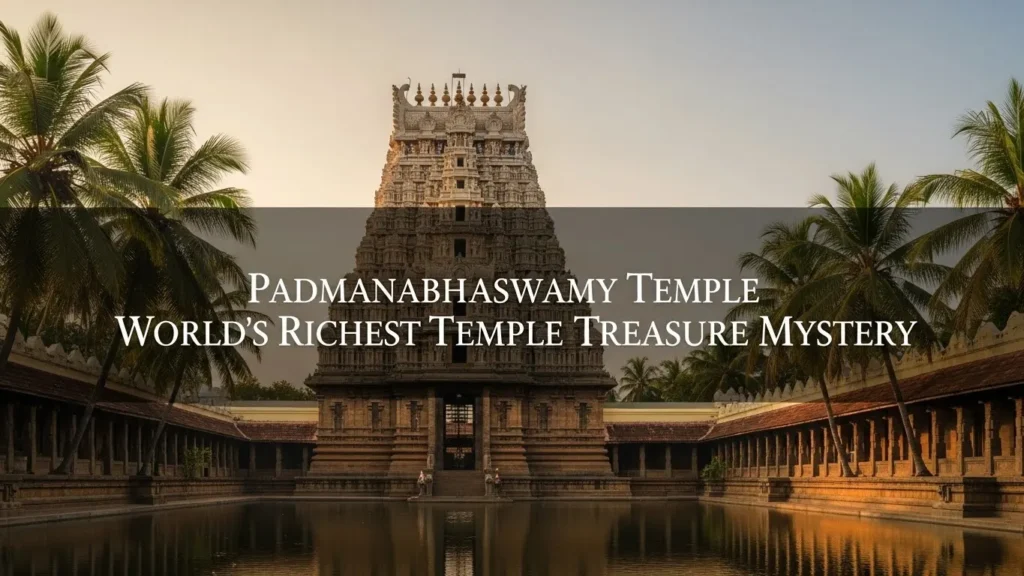
The Sree Padmanabhaswamy Temple in Thiruvananthapuram, Kerala, gained international attention in 2011 when a Supreme Court-appointed panel opened five of its six underground vaults and discovered treasures worth approximately $22 billion, making it officially the world’s richest temple and possibly housing one of the largest collections of ancient jewelry and gold artifacts ever found.

The stunning hoard included 800 kilograms of gold coins dating to 200 BCE, an 18-foot pure gold chain matching the main deity’s length, a 500-kilogram solid gold sheaf, over 2,000 precious gold ornaments, a pure golden throne studded with hundreds of diamonds and gemstones, several golden idols, solid gold coconut shells weighing 66 pounds and encrusted with rubies and emeralds, 18-foot diamond necklaces, and countless sacks filled with golden artifacts, jewelry, diadems, and precious stones from Roman, Napoleonic, Mughal, and Dutch trade eras spanning over 2,000 years.
However, the sixth vault—Vault B—remains unopened and sealed by the Supreme Court amid legends claiming it was protected with Naga Paasam (serpent binding) mantras chanted by the highest sages during King Marthanda Varma’s reign in the 18th century, and can only be opened by a spiritually accomplished saint chanting the Garuda mantra, not by physical keys or modern technology.
The Travancore royal family estimates Vault B alone could contain treasures worth $1 trillion, with legends describing a secret inner chamber beyond it with thick walls made of solid gold containing immeasurable riches, potentially making it the largest undiscovered treasure in world history.
The temple itself is dedicated to Lord Vishnu in his Anantha Shayana (eternal recumbent) form, where the deity reclines on the thousand-hooded serpent Adi Sesha with his consorts Sridevi (Lakshmi) and Bhudevi, visible through three doors showing the feet, torso, and face of the massive 18-foot idol. The Travancore royal family has served as custodians since 1750 when Maharajah Marthanda Varma dedicated the entire kingdom to Lord Padmanabha, declaring the deity as the true ruler while kings served merely as “Padmanabhadasa” (servants of Padmanabha),
surrendering even the royal crown and establishing that all kingdom wealth belonged to the deity. A 2020 Supreme Court verdict upheld the royal family’s sacred right to manage the temple, ending decades of legal battles with the Kerala government over control of this extraordinary heritage site. This comprehensive guide explores the temple’s ancient origins and divine significance, the shocking 2011 treasure discovery and vault contents, the mysterious Vault B and its Naga Paasam curse, the Travancore royal family’s unique custodianship, architectural marvels, legal controversies, visiting guidelines for 2026, and how this temple embodies the intersection of devotion, dynastic heritage, and unfathomable wealth in Hindu philosophy.
Temple Origins and Sacred Significance
Divine Identity: Anantha Padmanabha
Sree Padmanabhaswamy Temple is dedicated to Lord Vishnu in his Anantha Shayana form—the cosmic reclining posture representing the universe’s eternal preservation. This unique iconographic representation depicts:
Anantha Shayana Posture: Lord Padmanabha reclines on Adi Sesha (Anantha), the thousand-hooded primordial serpent representing cosmic time and eternity
Cosmic Symbolism: The reclining form signifies:
- Cosmic Rest: The period between creation cycles when the universe dissolves into primordial waters
- Eternal Tranquility: Divine peace underlying manifest reality
- Universal Preservation: Vishnu’s role as sustainer of cosmic order (dharma)
- Yogic Sleep (Yoga Nidra): The divine consciousness from which new creation emerges
Divine Consorts: The deity is adorned with Sridevi (Lakshmi) on his right and Bhudevi on his left, representing prosperity/wealth and earth/sustenance respectively
Shiva Lingam: Remarkably, the deity’s right hand rests on a Shiva lingam, symbolizing the ultimate unity of Vishnu (preserver) and Shiva (destroyer) in supreme cosmic consciousness
Unique Darshan: The massive 18-foot idol is visible only through three doors (tiruvathil) showing:
- Southern door: The deity’s feet (holy feet blessing devotees)
- Middle door: The torso and midsection
- Northern door: The face and head (divine countenance)
This arrangement requires devotees to walk along the temple’s outer corridor viewing the complete divine form progressively, creating a unique circumambulatory darshan experience.
Ancient Origins and Antiquity
The temple’s origins are lost in antiquity, with traditions claiming foundations stretching back millennia:
Puranic References: Ancient texts reference the temple, suggesting it functioned as a major Vishnu pilgrimage site for centuries before recorded history
Architectural Evidence: The current structure shows elements from various periods:
- Core sanctum possibly dating to 8th-9th centuries
- Major renovations and expansions during Chera, Pandya, and Ay dynasty periods
- Significant reconstruction during Travancore kingdom (18th century onward)
Gopuram Construction: The temple’s magnificent 100-foot tall, seven-tiered gopuram (entrance tower) was constructed in 1566, showcasing Pandyan architectural style
Stone Corridor: The temple features a stunning corridor adorned with 365 sculptured granite pillars—one for each day of the year—created by legendary Vishvakarma sthapathis (divine architects)
Sacred Geography
Temple Location and Setting:
Thiruvananthapuram: The capital city of Kerala takes its name from “Thiru-Anantha-Puram” (Sacred Abode of Anantha), indicating the temple’s central role in the region’s identity
Padma Theertham: A sacred lotus spring (tank) adjacent to the temple adds to its serene spiritual ambiance and provides holy water for rituals
Architectural Integration: The temple complex occupies the heart of Thiruvananthapuram, with the city’s urban development radiating from this sacred center
The 2011 Treasure Discovery: Opening Five Vaults
Legal Trigger and Supreme Court Investigation
The discovery began with a legal petition:
Writ Petition: In 2011, advocate TP Sundararajan filed a petition with the Supreme Court of India raising concerns about unaccounted assets and potential mismanagement of temple treasures
Supreme Court Action: On June 27, 2011, India’s Supreme Court appointed a seven-member expert panel to investigate the temple’s vaults, create comprehensive inventory, and assess the temple’s wealth
Investigation Authorization: The panel received legal authority to open sealed vaults that had remained closed for decades, some for over a century
Discovery of Six Vaults
The investigation revealed six large underground vaults designated as Vaults A through F, each secured with intricate iron doors and ancient locking mechanisms:
Vault Locations: The vaults were located approximately 20 feet underground beneath the temple structure
Historical Accumulation: Treasures represented donations and offerings accumulated over thousands of years from various dynasties, rulers, devotees, and kingdoms
Security: Each vault featured heavy iron doors with complex traditional locking systems, some showing extreme rust and age
Opening Five Vaults: The $22 Billion Discovery
Between June and November 2011, the panel successfully opened five vaults (A, C, D, E, and F), with Vault A containing the most spectacular treasures:
Vault A: The Crown Jewel
Opening Vault A required extraordinary effort:
Transport Challenge: Temple staff needed fifteen men working all day to carry treasures from Vault A upstairs for inspection
Gold Coins: The vault contained approximately 2,000 pounds (800+ kilograms) of gold coins dating back to around 200 BCE, representing Roman, Napoleonic, Mughal, Dutch, and various Indian dynasty coinage—about 100,000 gold coins total
The Golden Throne: A pure solid gold throne embellished with hundreds of diamonds and precious stones, specifically designed for the 18-foot deity
Gold Chains: Multiple 18-foot pure gold chains, each matching the main idol’s exact length and studded with jewels
Golden Sheaf: A 500-kilogram solid gold sheaf—an offering of enormous value
Gold Ornaments: Over 2,000 precious gold ornaments and jewelry pieces
Golden Idols: Several solid gold deity images and statues
Diamond Necklaces: 18-foot diamond-studded necklaces designed to adorn the massive deity
Precious Stones: Countless bags filled with:
- Diamonds of various cuts and sizes
- Rubies and emeralds
- Sapphires and other gemstones
- Ancient jewelry set with precious stones
Ceremonial Items:
- Solid gold coconut shells weighing 66 pounds encrusted with rubies and emeralds
- Gold body armor (Angi) meant to decorate the main idol
- Solid gold crowns studded with diamonds and jewels
- Golden elephants and animal figures
- Ritual implements and temple paraphernalia
Historical Artifacts: Items showing craftsmanship from multiple eras and civilizations, demonstrating the temple’s role in international trade networks
Other Vaults (C, D, E, F)
While Vault A contained the majority, other vaults held:
Additional Gold Items: More coins, jewelry, and ornamental pieces
Silver Artifacts: Silver ingots, vessels, and decorative items
Ceremonial Clothing: Ancient royal garments and priestly vestments
Copper and Bronze: Temple implements and ritual objects
Gemstones: Additional caches of precious stones
Total Estimated Value
Conservative Estimates: The discovered treasures from the five opened vaults are valued at approximately $22 billion based on intrinsic gold and gemstone worth
Historical Value: Experts suggest the historical and archaeological value could be ten times greater—potentially $200+ billion—given the ancient nature, craftsmanship quality, and cultural significance of the artifacts
World’s Largest Ancient Jewelry Collection: The discovery represents possibly the largest collection of ancient jewelry ever found in the world
Vault B: The Unopened Mystery
The Sealed Vault
Vault B remains the greatest mystery surrounding Padmanabhaswamy Temple:
Supreme Court Order: The Supreme Court has mandated that Vault B remain sealed, respecting religious sentiments and traditional beliefs surrounding its sanctity
Physical Description:
- Features two antechambers leading to the main vault
- The final door has carvings of a serpent (Naga) and a Yakshi serving as warnings to keep out
- Equipped with a heavily rusted, old-fashioned lock with three levers requiring three separate keys
Opening Attempts: During the 2011 investigation, the panel tried to open Vault B but failed:
- A blacksmith was summoned but could not open the ancient rusted lock
- The team decided not to force it open to avoid damaging the sacred door
- The peculiar lock design and extreme corrosion made conventional opening impossible
The Naga Paasam: Serpent Lock Legend
According to temple tradition and local belief, Vault B was sealed using mystical means:
Naga Paasam/Naga Bandham: The vault is said to be protected by “Naga Paasam” (serpent binding) or “Naga Bandham” (serpent lock) mantras—powerful Vedic incantations chanted by the highest spiritual authorities during King Marthanda Varma’s reign in the 18th century
Divine Protection: The mantras were specifically intended to:
- Protect the treasures from theft and unauthorized access
- Preserve sacred artifacts for future generations
- Maintain the vault’s spiritual sanctity
- Create supernatural barriers beyond physical locks
Spiritual Guardians: Legends describe the vault as guarded by two gigantic cobras (serpents) that will protect the treasures and potentially harm anyone attempting unauthorized entry
Opening Requirements: The Garuda Mantra
Traditional belief holds that Vault B cannot be opened by physical means:
Required Method: The vault can only be opened by a highly accomplished sadhu, siddha purusha, yogi, or tantrik who possesses:
- Profound spiritual attainment and tapasya (austerities)
- Knowledge of the ancient “Garuda Mantra”
- Ability to correctly chant the mantra extracting the Naga Paasam/Naga Bandham
Garuda Significance: In Hindu mythology, Garuda (the divine eagle) is Lord Vishnu’s mount and the natural enemy of serpents (nagas). The Garuda Mantra theoretically would neutralize the serpent protection
Automatic Opening: When chanted properly, believers say the vault door will open automatically without any human effort to physically unlock it
Contemporary Challenge: The problem is that no known living sadhu, yogi, or tantrik in India or worldwide is recognized as possessing the spiritual attainment necessary to correctly perform this ritual
Failed Attempt: Vedic astrologers attempted to open Vault B by chanting the Garuda mantra but failed, suggesting either incorrect knowledge of the mantra or insufficient spiritual power
The Curse and Catastrophic Warnings
Opening Vault B by force or improper means is believed to bring dire consequences:
Divine Anger: The vault is deeply connected to the divine energy of the main idol, with legends suggesting an even older, more powerful idol hidden deep inside
Catastrophic Consequences: Warnings state that improper opening will:
- Anger Lord Padmanabha himself
- Bring great misfortune to the land and region
- Cause natural disasters and calamities
- Result in mysterious deaths and terrible misfortune for those involved
Supporting Evidence: Some point to alleged incidents reinforcing the curse:
- TP Sundararajan, the lawyer who filed the petition seeking vault access, died unexpectedly just one month after attempts to open Vault B
- Team members reportedly experienced misfortunes including family deaths and injuries
- These incidents intensified belief in divine retribution
Astrological Consultation: When astrologers were consulted about opening Vault B, their verdict was chilling and clear: the vault must never be opened, as doing so would make the god very angry and bring great misfortune
Estimated Contents: The $1 Trillion Question
What treasures lie inside Vault B remains pure speculation:
Travancore Royal Family Estimate: The royal family has calculated that Vault B alone could contain treasures worth at least $1 trillion in present value
Comparative Logic: If five vaults contained $22 billion, and Vault B is believed to be the most significant, trillion-dollar estimates don’t seem impossible
Secret Inner Chamber: Legends describe a hidden chamber beyond Vault B with thick walls made of solid gold containing immeasurable riches
Historical Context: Kings and dynasties over thousands of years donated their most precious offerings to Lord Padmanabha, with some possibly designating Vault B for the most sacred and valuable items
Potential Contents: Speculation includes:
- Ancient divine weapons and sacred artifacts
- The oldest and most precious jewelry pieces
- Legendary gemstones of enormous size and value
- Sacred texts and scriptures
- Another idol or deity image of immense antiquity
- Treasures deemed too sacred for mortal eyes
World Record: If estimates prove accurate, Vault B could contain the largest undiscovered treasure in world history
The Controversy: Was Vault B Already Opened?
A significant controversy emerged challenging the mystical narrative:
Auditor General’s Report: Vinod Rai, India’s Auditor General, informed the Supreme Court that according to his knowledge, Vault B had been opened at least seven times since 1990
Implications: If true, this contradicts claims about:
- Mystical seals preventing opening
- Catastrophic consequences from unauthorized access
- The vault’s inviolate sacred status
Possible Looting: The revelation raised disturbing possibilities:
- Treasures may have been secretly removed over decades
- A secret tunnel might have been used to loot contents
- The royal family and/or government may have opened it clandestinely
- Current opposition to opening may hide embarrassment about prior looting
Audit Findings: A detailed audit revealed:
- “Massive amounts of gold from repositories mysteriously disappeared”
- Silver ingots taken out and gold vessels deposited then subsequently removed
- Gold and silver jewelry offered by devotees not properly accounted for by temple administration
- Deficiencies in record maintenance with incomplete information about weight and purity of gold/silver items
Corruption Allegations: Senior lawyer Gopal Subramanium’s amicus report after a 35-day temple stay complained of:
Conflicting Narratives: Two opposing views emerged:
- Mystical View: Vault B protected by divine forces, never opened, contains trillion-dollar treasures
- Skeptical View: Vault B opened multiple times, possibly looted, with mystical stories covering mismanagement
Current Status: The truth remains unclear, with the Supreme Court maintaining the seal order pending further investigation and resolution of religious concerns
The Travancore Royal Family: Sacred Custodianship
Historical Background and Kingdom Dedication
The Travancore royal family’s unique relationship with Padmanabhaswamy Temple dates to the 18th century:
Maharajah Marthanda Varma (1706-1758): The founding monarch of the Travancore kingdom made an extraordinary decision in 1750:
Kingdom Dedication: Marthanda Varma dedicated the entire Kingdom of Travancore to Lord Padmanabha, declaring:
- The deity was the true Maharaja (ruler) of Travancore
- The royal family would serve merely as “Padmanabhadasa” (Servants of Padmanabha)
- Kings would rule the state on behalf of Lord Padmanabha, not in their own right
- All subsequent Travancore rulers would carry the title “Padmanabha Dasa” before their names
Royal Crown Surrender: Marthanda Varma surrendered even the royal crown to the deity, symbolizing complete submission to divine authority
Thripadidanam: All donations and offerings made by the Travancore kingdom to Padmanabhaswamy Temple were designated as “Thripadidanam” (offerings to the holy feet)
Theological Significance: This arrangement established a unique theocratic model where:
- Divine sovereignty superseded royal authority
- Earthly rulers served as administrators for divine government
- The temple became the kingdom’s true center of power and wealth
- Royal legitimacy derived from service to the deity
Centuries of Custodianship
From 1750 onward, the Travancore royal family maintained continuous custodianship:
Administrative Control: While other temples in Travancore and Cochin came under Devaswom Boards (temple administration bodies), Padmanabhaswamy Temple remained under direct royal family management
Instrument of Accession (1949): When Travancore princely state merged with independent India, the administration of Padmanabhaswamy Temple was “vested in trust” in the Ruler of Travancore
Kerala State Formation (1956): Even after Kerala state was carved out, the temple continued to be managed by the erstwhile royals rather than transferring to state control
Continuity: For over 250 years, the family maintained:
- Daily worship and ritual continuity
- Preservation of temple treasures
- Architectural maintenance and renovations
- Protection of sacred traditions
- Accumulation of offerings and donations
The Legal Battle: Royal Family vs. Kerala Government
The death of the last ruling Maharajah triggered a legal crisis:
Death of Chithira Thirunal Balarama Varma (1991): When the last “Ruler of Travancore” died, questions arose about succession and temple control
Central Legal Question: Could Utradam Thirunal Marthanda Varma (younger brother of the last ruler) claim to be the “Ruler of Travancore” and maintain temple management rights after the ruler’s death?
Kerala High Court Decision (2011): Initially ruled against the royal family, suggesting the temple should come under state administration
Supreme Court Battle: The royal family appealed to India’s Supreme Court, initiating a decades-long legal fight over one of the world’s richest temples
2020 Supreme Court Victory
On July 13, 2020, the Supreme Court delivered its landmark verdict:
Reversal: Overturned the 2011 Kerala High Court decision comprehensively
Royal Rights Upheld: The Court upheld the Travancore royal family’s right to manage and administer Sree Padmanabhaswamy Temple
Legal Reasoning:
- Under customary law, shebait rights (rights to manage deity’s financial affairs) survive with family members even after the last ruler’s death
- The 1949 Instrument of Accession created a trust vesting temple administration in the Travancore rulers
- The Travancore-Cochin Hindu Religious Institutions Act, 1950 recognized special status
Sacred Duty Recognition: The verdict acknowledged the royal family serves not as owners but as sacred custodians (shebaits) fulfilling religious duty established by their ancestor Marthanda Varma
Current Status: The ruling ended the legal uncertainty, confirming that Travancore royal family retains management authority over the world’s richest temple and its immeasurable treasures
Temple Assets: The family now administers temple assets estimated at over ₹1,00,000 crore (approximately $12+ billion) based on discovered treasures alone, not counting Vault B or other potential undiscovered wealth
Temple Architecture and Sacred Spaces
Architectural Style and Layout
The temple showcases classic Kerala temple architecture with Pandyan influences:
Gopuram: The magnificent 100-foot entrance tower with seven tiers constructed in 1566 in Pandyan style dominates the skyline
Stone Corridor: The 365 sculptured granite pillars surrounding the temple create a mathematically symbolic walkway—one pillar for each day of the year
Sanctum Design: Unlike typical square or rectangular sanctums, Padmanabhaswamy’s garbhagriha is rectangular to accommodate the reclining deity’s 18-foot length
- Adhistanam (base): Consists of jagathy (plinth), three-tier patta kumudam, and pattikai
- Pilasters: Brahma kantha style with kalasam (finial), kudam (pot), lotus petals, mandi, palakai, and pothyal
- Prastaram (entablature): Features valapi, kapotam, with nasi kudus (arch motifs) and viyyalavari (mythical creatures)
- Vimanam (tower): Built in salakara (tower) style rising above the sanctum
The Sacred Idol: Anantasayana Vigraham
The centerpiece is the extraordinary reclining Vishnu image:
Iconographic Marvel: The Anantasayana Vigraham (reclining form on Anantha serpent) is acclaimed as a marvel in iconography
Unique Features:
- 18 feet in length from head to toe
- Reclining position: Lying on the three-coiled serpent Anantha
- Orientation: Head to the south, feet to the north (south-north direction)
- Gaze: Looking upward toward cosmic heavens
- Hand placement: Right hand over Shiva lingam
Material Composition: The idol is made using a special combination of materials following ancient Vedic specifications, though exact composition remains a temple secret
Three-Door Darshan: The three tiruvathil (sacred doors) provide progressive viewing:
- Feet section (southern door)
- Torso and midsection (middle door)
- Face and head (northern door)
This arrangement requires devotees to circumambulate the temple to view the complete divine form, creating active worship participation rather than passive darshan
Sacred Precincts
Padma Theertham: Sacred lotus spring tank providing holy water for ablutions and rituals
Multiple Shrines: Subsidiary shrines to related deities and divine manifestations
Ritual Halls: Spaces for ceremonial worship, festivals, and religious gatherings
The Six Vaults: Underground chambers beneath the temple storing centuries of accumulated offerings and treasures
Visiting Padmanabhaswamy Temple: Practical Guide 2026
Location and Access
Temple Location:
- City: Thiruvananthapuram (Trivandrum), Kerala
- Address: East Fort, near Padmatheertham Road, Thiruvananthapuram
- Nearest Airport: Trivandrum International Airport (6 km)
- Nearest Railway: Thiruvananthapuram Central Railway Station (2 km)
Getting There:
- Auto-rickshaws and taxis readily available from airport/railway station
- Local buses serve the East Fort area
- Walking distance from city center hotels
Temple Timings (2026)
Daily Darshan Schedule (subject to change; verify before visiting):
Morning Sessions:
- 3:30 AM – 4:30 AM: Nirmalya Darshan (viewing deity after overnight rest)
- 6:30 AM – 7:00 AM: Morning darshan
- 8:30 AM – 10:00 AM: General darshan
Afternoon Session:
- 5:00 PM – 6:15 PM: Evening darshan
Evening Session:
- 6:45 PM – 7:20 PM: Final darshan
Closed Periods: Temple closes briefly between sessions for rituals and deity rest
Monthly Closure: First and third Fridays of each month typically closed for special rituals (verify current schedule)
Dress Code: Strict Traditional Requirements
Men Must Wear [traditional temple dress code]:
- Mundu (traditional Kerala dhoti/wrap) or
- Dhoti without shirt (bare-chested upper body), or
- Mundu with Jubba (traditional shirt)
- Modern clothing like pants, shirts, and t-shirts strictly prohibited
Women Must Wear:
- Saree (traditional Indian draped garment), or
- Salwar Kameez with dupatta, or
- Long skirt and blouse (covering arms and legs)
- No jeans, pants, shorts, or modern Western attire
Children: Boys above certain age must follow men’s dress code; girls should wear traditional dress
Strict Enforcement: Guards at temple entrance strictly enforce dress codes; improperly dressed visitors will be denied entry regardless of distance traveled
Dress Rental: Some shops near the temple rent traditional clothing for visitors unfamiliar with requirements
Entry Restrictions and Rules
Religious Requirements:
- Temple is a Hindu-only worship site; non-Hindus traditionally not permitted entry
- Visitors may be asked to sign declaration confirming Hindu faith
Photography and Electronics:
- No photography inside temple premises
- No mobile phones allowed inside
- Cameras and electronics must be deposited at designated counters
Prohibited Items:
- Leather items (belts, shoes, bags)
- Tobacco and intoxicants
- Food items
Behavior:
- Maintain silence and reverence
- Remove footwear before entering
- Follow priest instructions during darshan
- No touching of deity or temple structures
Special Considerations
Crowd Management:
- Laksha Deepam festival (October-November) draws enormous crowds
- Painkuni festival (March-April) sees peak pilgrimage
- Regular days less crowded, better for meaningful darshan
Security: Enhanced security due to treasure valuables; expect metal detectors and bag checks
Darshan Duration: Typical darshan lasts 5-15 minutes depending on crowds
Prasadam: Temple offers traditional prasadam (blessed food); collection points near exit
Frequently Asked Questions
How much treasure was found in Padmanabhaswamy Temple?
Approximately $22 billion worth of treasures were discovered in five of six vaults (A, C, D, E, F) opened in 2011. The hoard included 800 kg of gold coins dating to 200 BCE, an 18-foot pure gold chain, 500 kg gold sheaf, 2,000+ gold ornaments, a pure golden throne with diamonds, 18-foot diamond necklaces, countless jewels, and artifacts spanning 2,000 years from Roman, Mughal, Dutch, and Indian dynasties. Historical value may exceed $200 billion, making it possibly the world’s largest ancient jewelry collection.
Why is Vault B not opened?
Vault B remains sealed by Supreme Court order respecting religious beliefs that it was protected with Naga Paasam (serpent binding) mantras by high sages during King Marthanda Varma’s reign. According to legend, it can only be opened by a spiritually accomplished sadhu chanting the Garuda mantra, not by physical keys or force. Opening by improper means is believed to cause catastrophic consequences and divine anger. Additionally, India’s Auditor General revealed Vault B may have been opened seven times since 1990, raising looting concerns.
How much is Vault B worth?
The Travancore royal family estimates Vault B alone could contain treasures worth at least $1 trillion in present value. Legends describe a secret inner chamber beyond Vault B with thick walls made of solid gold containing immeasurable riches. If true, this could be the largest undiscovered treasure in world history. However, controversy exists about whether the vault has already been secretly opened and potentially looted.
Who owns Padmanabhaswamy Temple?
The Travancore royal family manages and administers the temple as sacred custodians (shebaits), not owners. In 1750, Maharajah Marthanda Varma dedicated the entire kingdom to Lord Padmanabha, declaring the deity as the true ruler while kings served as “Padmanabhadasa” (servants of Padmanabha). A 2020 Supreme Court verdict upheld the royal family’s right to manage the temple’s property and assets worth over ₹1,00,000 crore ($12+ billion), reversing a 2011 Kerala High Court decision.
Can non-Hindus visit Padmanabhaswamy Temple?
Traditionally, Padmanabhaswamy Temple is Hindu-only, with non-Hindus not permitted entry for worship. This policy reflects the temple’s sacred character and traditional customs. Visitors may be asked to sign declarations confirming Hindu faith. Similar restrictions exist at several major Hindu temples including Jagannath Puri and certain shrines within temple complexes, based on traditional practices protecting ritual purity and sacred space sanctity.
What is the dress code for Padmanabhaswamy Temple?
Men must wear mundu (Kerala dhoti) or traditional dhoti, often bare-chested or with jubba (traditional shirt). Modern clothing like pants and shirts are strictly prohibited [traditional temple requirements]. Women must wear sarees, salwar kameez with dupatta, or traditional long skirts with blouses covering arms and legs. Jeans, pants, shorts, and Western attire not allowed. Dress codes are strictly enforced; improperly dressed visitors are denied entry. Rental shops near the temple provide traditional clothing.
When was Padmanabhaswamy Temple treasure discovered?
The treasure was discovered in 2011 when a Supreme Court-appointed seven-member expert panel opened five of six underground vaults following a petition by advocate TP Sundararajan. The investigation ran from June to November 2011, revealing approximately $22 billion in gold, jewelry, and precious artifacts accumulated over 2,000+ years. Vault A required 15 men all day to transport treasures upstairs for inventory. The discovery made international headlines and established Padmanabhaswamy as the world’s richest temple.
What is the curse of Vault B?
Vault B is believed protected by Naga Paasam (serpent binding) mantras chanted by high sages, with legends warning that opening it by force or improper means will anger Lord Padmanabha and bring catastrophic consequences, natural disasters, and terrible misfortune. The vault door features serpent and Yakshi carvings as warnings. Astrologers consulted about opening delivered a “chilling” verdict: the vault must never be opened as it’s deeply connected to the main idol’s divine energy. TP Sundararajan died unexpectedly one month after opening attempts, and team members reportedly experienced misfortunes.
Conclusion
Padmanabhaswamy Temple stands as an extraordinary intersection of ancient devotion, dynastic heritage, unfathomable material wealth, mystical legends, legal controversies, and continuing sacred traditions that together create one of Hinduism’s most fascinating and mysterious sites. The 2011 discovery of $22 billion in treasures from just five vaults validated centuries of legends about immeasurable wealth accumulated through kingdoms’ devotion to Lord Padmanabha, while simultaneously raising profound questions about the still-sealed Vault B and its rumored trillion-dollar contents that may never be revealed to mortal eyes.
The unique theocratic arrangement established by Maharajah Marthanda Varma in 1750—dedicating an entire kingdom to a deity and transforming rulers into divine servants—represents one of Hindu political theology’s most complete realizations, where earthly sovereignty explicitly subordinates itself to divine authority. The 2020 Supreme Court verdict upholding the Travancore royal family’s custodianship honors this 250+ year tradition while acknowledging that such sacred duties transcend modern notions of ownership and property rights, recognizing instead a religious trusteeship passed through generations bound by spiritual obligation rather than material gain.
The Vault B mystery—whether protected by mystical Naga Paasam mantras requiring Garuda mantra chanting by accomplished yogis, or already secretly opened and potentially looted as suggested by audit findings—embodies larger tensions between faith and skepticism, traditional religious authority and modern legal accountability, mystical protection and pragmatic security. The conflicting narratives about Vault B’s status and contents ensure the mystery endures, with believers maintaining unwavering conviction in divine protection while skeptics point to evidence of institutional failures and possible corruption.
For pilgrims, historians, treasure enthusiasts, and spiritual seekers visiting or learning about Padmanabhaswamy Temple, the experience offers multiple dimensions—darshan of the magnificent Anantha Shayana form of Lord Vishnu reclining on the cosmic serpent, connection with Kerala’s royal heritage and architectural marvels, contemplation of material wealth’s ultimate purpose when dedicated to divine service, and engagement with enduring mysteries that resist complete rational explanation. Whether one views the unopened Vault B as a sacred barrier that must never be crossed or as a challenge awaiting future revelation, the temple’s story enriches understanding of how Hindu philosophy encompasses the material and spiritual, the historical and mythological, the known and mysterious in ways that continue generating wonder, devotion, and debate in equal measure.
Padmanabhaswamy Temple ultimately demonstrates that some of humanity’s greatest treasures—both material wealth accumulated through millennia of devotion and spiritual mysteries guarded by sacred traditions—remain hidden beneath our feet and beyond our immediate grasp, perhaps suggesting that the most valuable discoveries are not those we extract and inventory but those we protect, honor, and allow to maintain their sacred mystery for generations yet unborn.
About the Author
Arvind Mehta – Cultural Heritage & Temple Architecture Specialist
Arvind Mehta is an accomplished writer and researcher specializing in Hindu festivals, temple architecture, and India’s rich cultural traditions. With a Master’s degree in Indian Art History from Maharaja Sayajirao University, she has extensively documented pilgrimage sites, temple iconography, and folk traditions across India. Her work focuses on making India’s spiritual heritage accessible to contemporary audiences while preserving authentic cultural narratives.